 |
REMAINS OF YOUNG MOSASAURS FROM THE SMOKY HILL CHALK (UPPER CONIACIAN-LOWER
CAMPANIAN) OF WESTERN KANSAS
Update
of a Presentation at the Second Mosasaur Meeting
Sternberg
Museum of Natural History,
Hays, Kansas
May
3-6, 2007
Page created 10/25/2008; Last updated 08/28/2012
Copyright © 2008-2012 by Mike Everhart
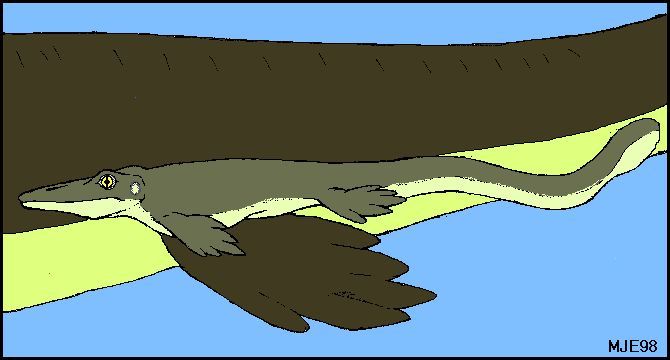
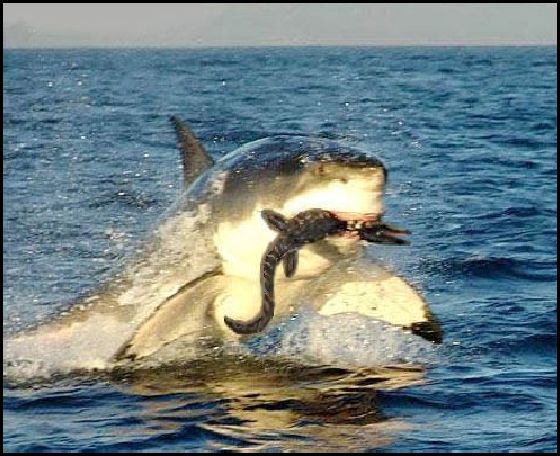
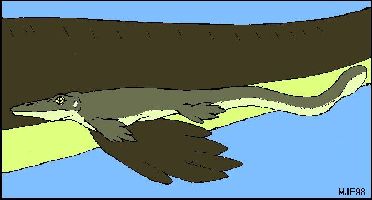
LEFT: A recently born Tylosaurus is
attacked and killed by a giant Ginsu shark (Cretoxyrhina mantelli) |
|
From
Williston, 1904: "If the
mosasaurs were exclusively marine animals, it would seem almost certain
that they were not viviparous, as were the ichthyosaurs, and probably also
the plesiosaurs, and as are some modern lizards. As Fraas has remarked
concerning the European ichthyosaurs, if one searches carefully, he will
find in many Kansas specimens the remains of the skin and stomach
contents, but never has
there been found anything which has the faintest suggestion of mosasaur
embryos. No aquatic reptiles of the present time lay their eggs in the
water. The sea snakes are viviparous, or at least all available
information concerning them gives viviparous habits. The sea turtles and
the crocodiles lay their eggs upon the beaches, the latter guarding their
nests and young. Doubtless the crocodiles of the past had the same
beach-laying habits, suggesting that they were never inhabitants of the
open oceans. The mosasaurs must have been practically helpless upon land;
still it is not impossible that they may have frequented
the beaches for the deposition of their eggs, though it is highly
improbable that they gave any attention or care to either their eggs or
their young. That the eggs of the mosasaurs were more numerous than are
those of the terrestrial lizards of the present time is not to be
supposed. The waters in which the mosasaurs flourished swarmed with highly
predaceous fishes, sharks, and plesiosaurs, to say nothing of the hordes
of their own kind; and, unless the eggs were very numerous, or unless the
young were jealously guarded by the parent. the young reptiles must have
stood very little chance in the fierce struggle for existence.
It
is, of course, possible that the shallow waters of the bays and estuaries
may have afforded sufficient protection for the young mosasaurs, but this
is doubtful, in the entire absence of all remains of such animals in
marine deposits. It seems more probable that the mosasaurs were brought
forth, perhaps alive, in fresh
water, that the females ascended the rivers to breed, and that the young
remained in such protected places until fairly able to care for
themselves. That the mosasaurs, as also the aigialosaurs, were in part
denizens of fresh water may be, perhaps, one reason for the great relative
abundance of their remains in the deposits of inland or protected seas.
Their occurrence in Kansas associated with great numbers of small turtles.
pterodactyls. and birds would seem to be fairly good evidence that they
were more littoral than pelagic in their habits." |
ABSTRACT: REMAINS OF
YOUNG MOSASAURS FROM THE SMOKY HILL CHALK (UPPER CONIACIAN-LOWER CAMPANIAN) OF WESTERN
KANSAS
EVERHART, Michael J., Sternberg Museum of Natural History, Fort Hays State
University, Hays, Kansas, 67601, USA.
The remains of young mosasaurs, especially those that could be considered to be newly
born, are poorly represented in the fossil record. This lack of specimens led some earlier
workers to suggest that mosasaur babies were born or hatched in other localities such as
distant shores, or along the banks of rivers or estuaries. However, no such birthing area
or concentration of the remains of young mosasaurs has ever been located. On the other
hand, specimens of immature mosasaurs have been found within the Smoky Hill Chalk of
western Kansas. The chalk was deposited on the eastern shelf of the Western Interior Sea
during late Coniacian through Early Campanian time, hundreds of kilometers from the
nearest land. Most of the specimens recovered to date are the isolated premaxillae of
small tylosaurines, arguably the most resistant part of the skull of a mosasaur at any
age. Most also appear to be the remains of a larger predator’s meal because of the
digested appearance of the bone and the fact that the teeth have been dissolved into their
alveoli. Measurement of the specimens and comparisons to complete skulls of tylosaurines
for scaling purposes indicates that the total skull length of these individuals was 18-25
cm. Assuming that the skull to body length proportions (14%) remained approximately equal
through life in mosasaurs, the remains represent young tylosaurines that were 1.3 to 1.8 m
in length at the time of death. Some specimens (KUVP 5012 and FHSM VP-14845) include
additional skull fragments and one specimen (VP-14846 and VP-14847) includes the partially
digested and commingled skull fragments of two small plioplatecarpines. Another
tylosaurine specimen (FHSM VP-14848) represents a 2 m long individual that apparently
reached the sea bottom relatively intact.
 |
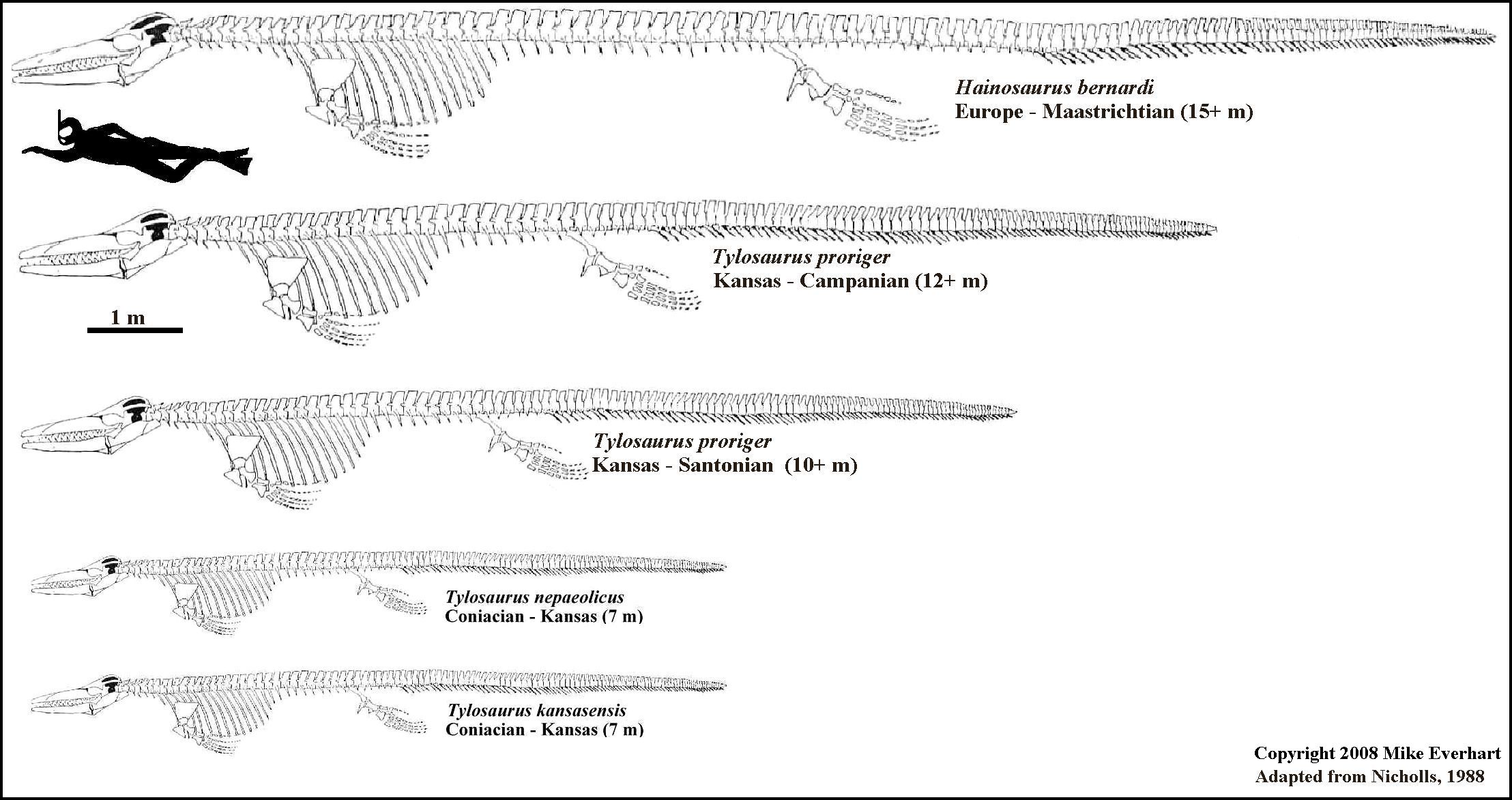
LEFT: We
know that mosasaurs became the apex predators of the Earth’s oceans during the Late
Cretaceous. Tylosaurines were among the largest of all mosasaurs, with Hainosaurus
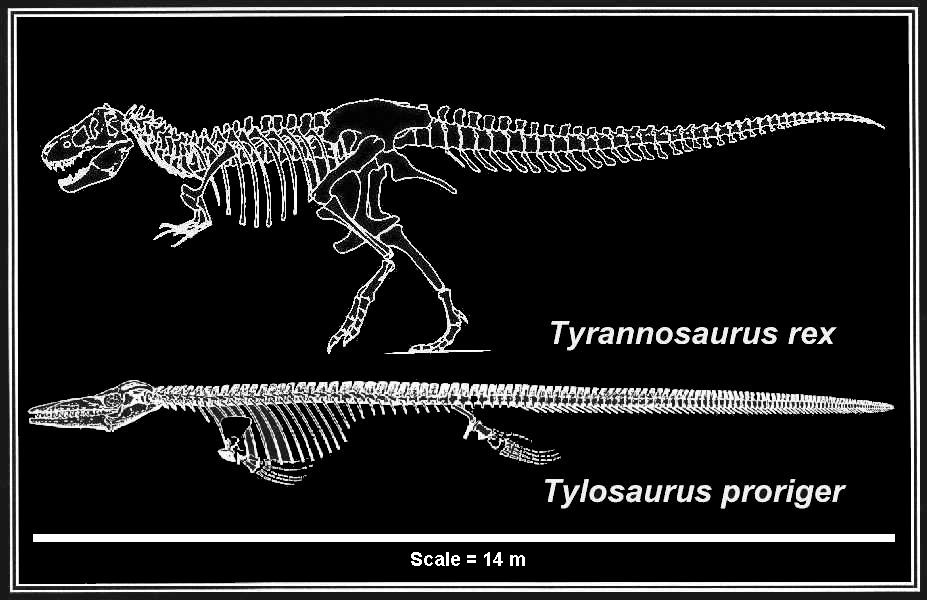
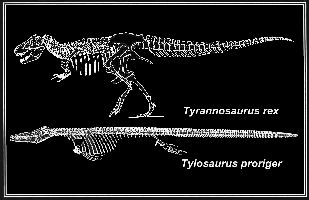
reaching lengths of 15+ meters by the Maastrichtian. RIGHT: A comparison of the skeletons of a Tyrannosaurus rex
and a Tylosaurus proriger ... both are 15 m (46 ft long).... That was about the
maximum size of a T. rex, but mosasaurs (e.g. Hainosaurus and Mosasaurus)
grew even larger.... If you think that encountering a fully grown T. rex would
have been scary, you certainly would not want to go swimming in the oceans of the
Cretaceous. |
 |
 |
Even though mosasaurs grew to great lengths, their bodies were
long and slender, so they were not nearly as heavy as an elasmosaur (barrel-shaped body)
of the same length, and even less so compared to a modern whale (lots of blubber to stay
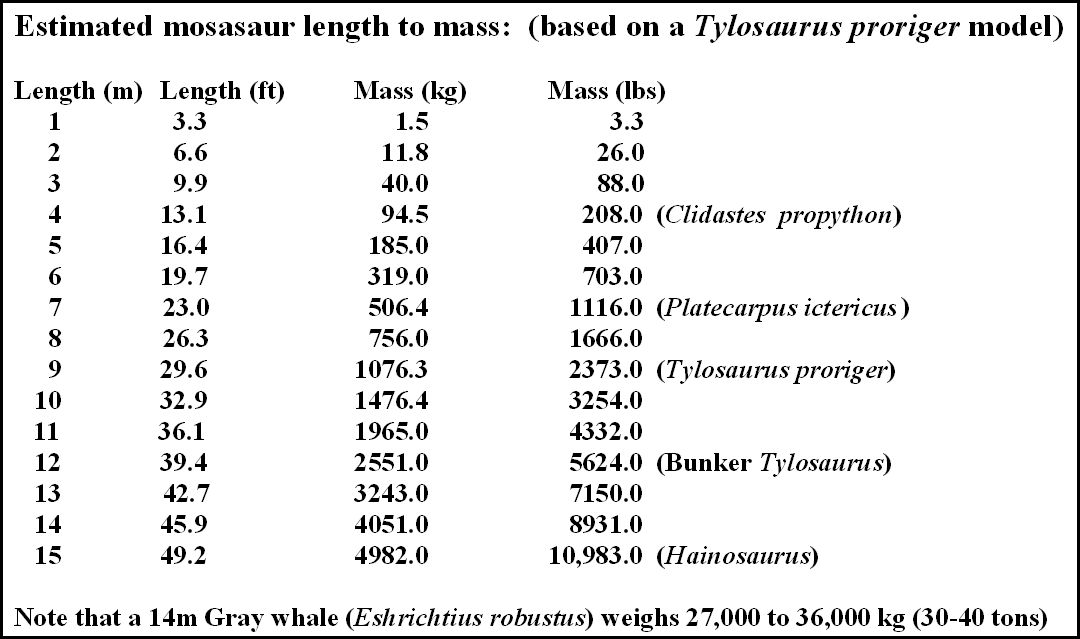
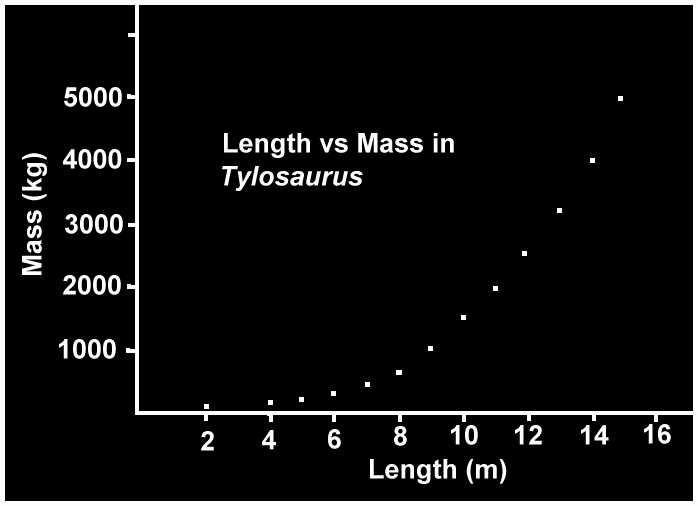
warm): A 14 m Gray Whale (Eshrichtius robustus) weighs about
32,000 kg (35 tons);
A 14 m Elasmosaurus platyurus would have weighed about 10,000 kg (11 tons);
A 14 m Tylosaurus proriger would have weighed about 4000 kg (4.5 tons)
LEFT: Perhaps
the real question should be not how large mosasaurs grew, but how small they were at birth
and how this affected their survival far from shore near the middle of the Western
Interior Sea where the Smoky Hill Chalk was deposited over Kansas! |
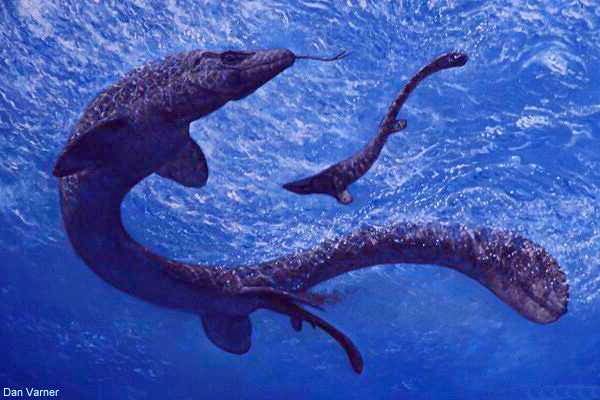 |
LEFT:
A Plioplatecarpus specimen discovered in South Dakota showed conclusively that
mosasaurs gave live birth, but we do not know how many babies or how large the babies were
when born. REFERENCES:
Bell, G. L. Jr. and A. M. Sheldon.
2004. A gravid mosasaur (Plioplatecarpus) from South Dakota. Abstract book and
field guide of the First Mosasaur Meeting, Schulp, A. S. and John W. M. Jagt (eds.),
Natuurhistorisch Museum Maastricht, the Netherlands pp. 16 (Abstract).
Bell, G. L. Jr., M. A. Sheldon, J. P.
Lamb and J. E. Martin, 1996. The first direct evidence of live birth in Mosasauridae
(Squamata): Exceptional preservation in Cretaceous Pierre Shale of South Dakota. Journal
of Vertebrate Paleontology 16(suppl. to 3):21A.
In
modern reptiles, the young are typically about 15% of the mother’s length.
Go
here for a chart of mosasaur length to mass measurements
Go
here for a graphic showing how much heavier mosasaurs became as they grew longer. |

|
| Most
of the evidence we have regarding young mosasaurs comes from the remains of meals by other
predators. In Kansas, that meant large sharks,
like Cretoxyrhina mantelli. During the Late
Cretaceous (Coniacian-early Campanian) a Great
white sized shark (7-8 m), Cretoxyrhina mantelli, was a formidable predator on many
kinds of marine creatures, including mosasaurs. It had razor-sharp teeth and strong jaws
capable of literally biting through bone…Most of what we know about young mosasaurs
in the Smoky Hill Chalk of Kansas is the results of predation /
scavenging by sharks. Note that a modern 4.5 m (16 ft) Great white shark would weigh
about 1500 kg (3200 lb) compared to about 185 kg (400 lb) for a mosasaur of the same
length! |
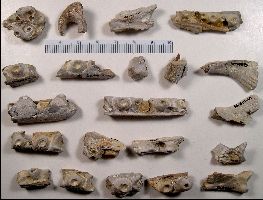 |
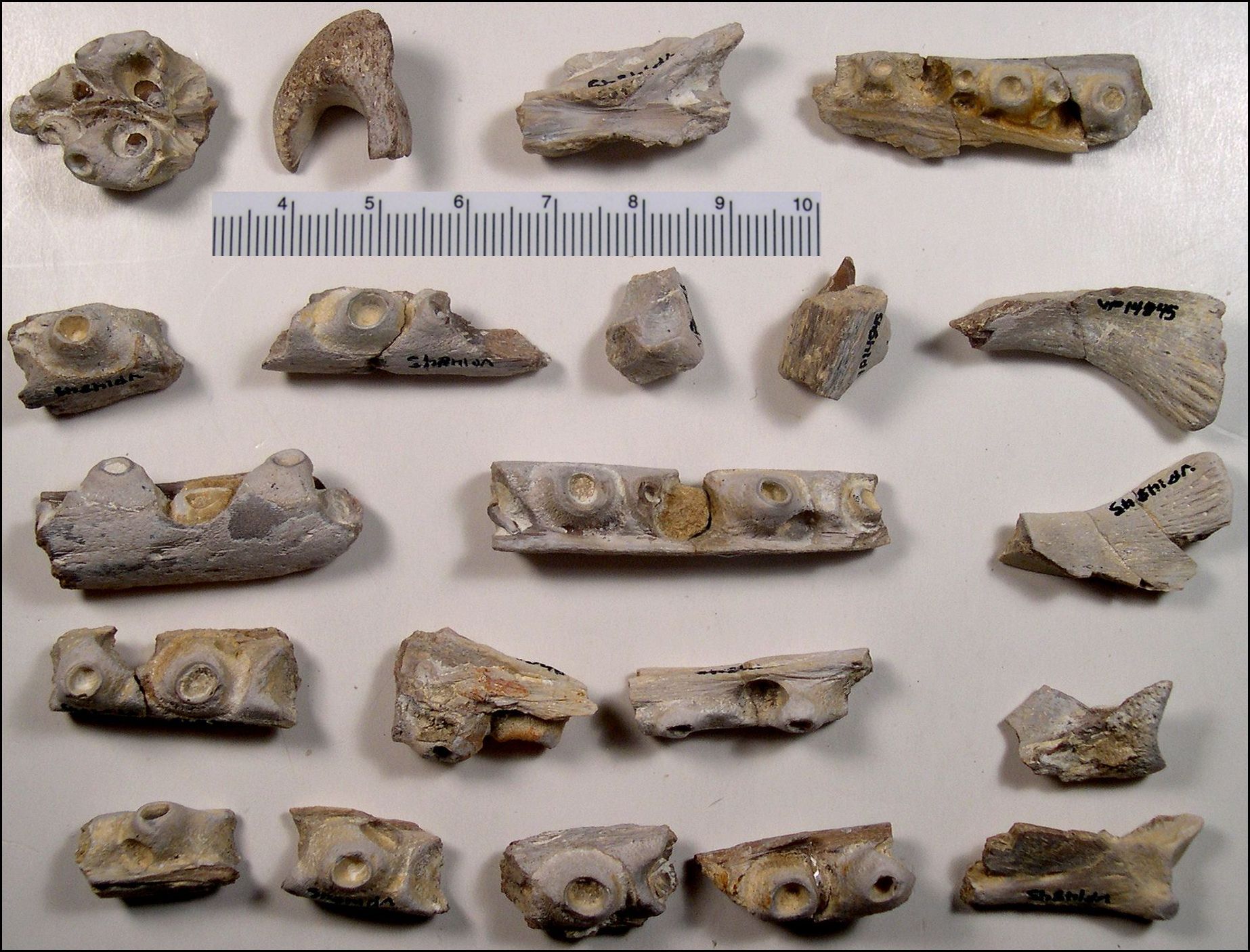
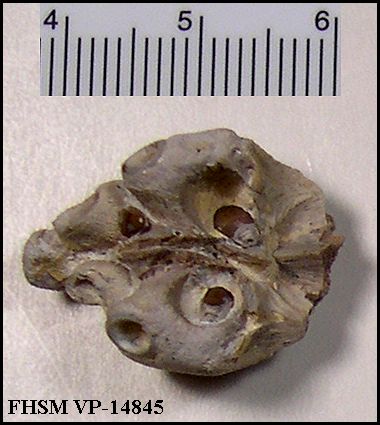
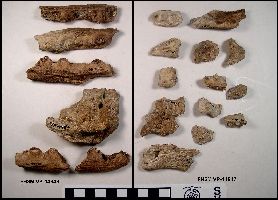
LEFT: FHSM
VP-14845: Partially digested remains (skull only) of a very young (neonate?) mosasaur from
Gove County (early Santonian); Note the
incomplete development of the premaxilla (upper left, ventral view). Based on the nearly
terminal tooth positions on the premaxilla and the tip of the left dentary (far left,
third row down; medial view), it is likely that these remains are those of a baby Platecarpus.
It is also possible that these remains are the result of scavenging on the unborn fetus of
a pregnant mosasaur... Click
here for a closer view of the ventral side of the premaxilla |
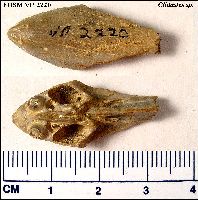 |
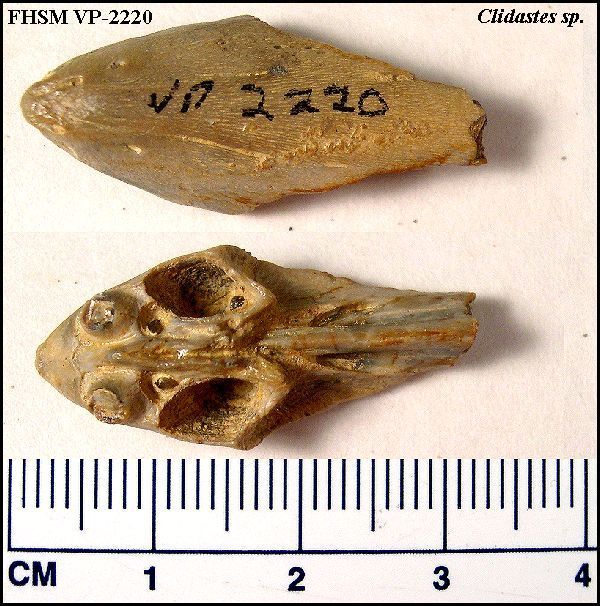
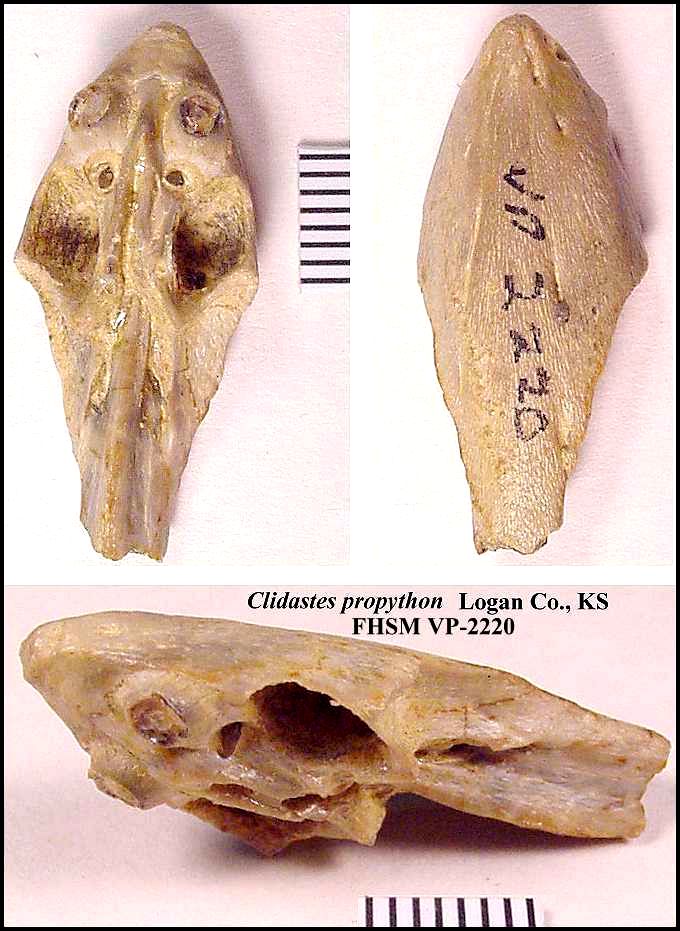
LEFT: FHSM VP-2220
– Partially digested Clidastes cf. propython premaxilla from Logan
County (lower Campanian). Click here for
another view |
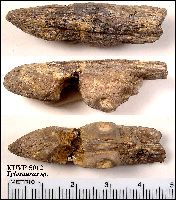 |
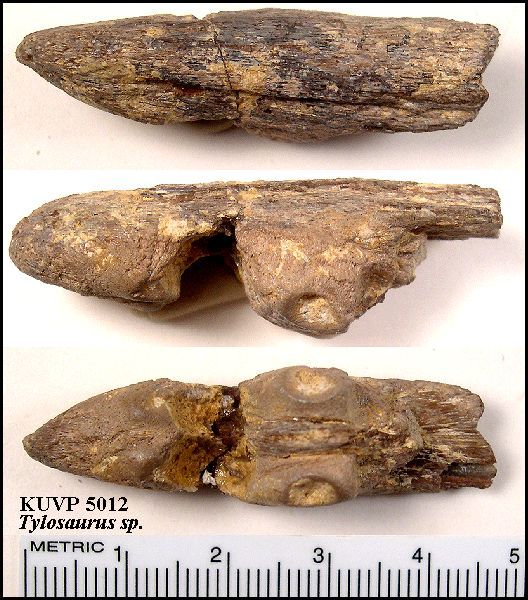
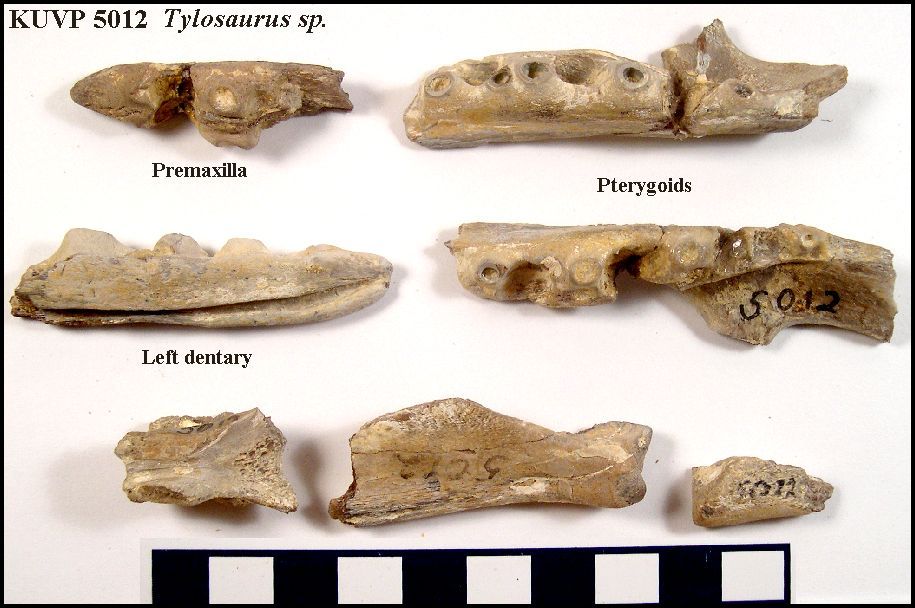
LEFT: KUVP 5012 -
Partially digested premaxilla from the skull of a small tylosaurine. The rest of the specimen is HERE. Based on the
differences in the appearance of some of the bones, these remains may be part of a
“mixed” specimen, two or more young mosasaurs eaten by the same predator. |
 |
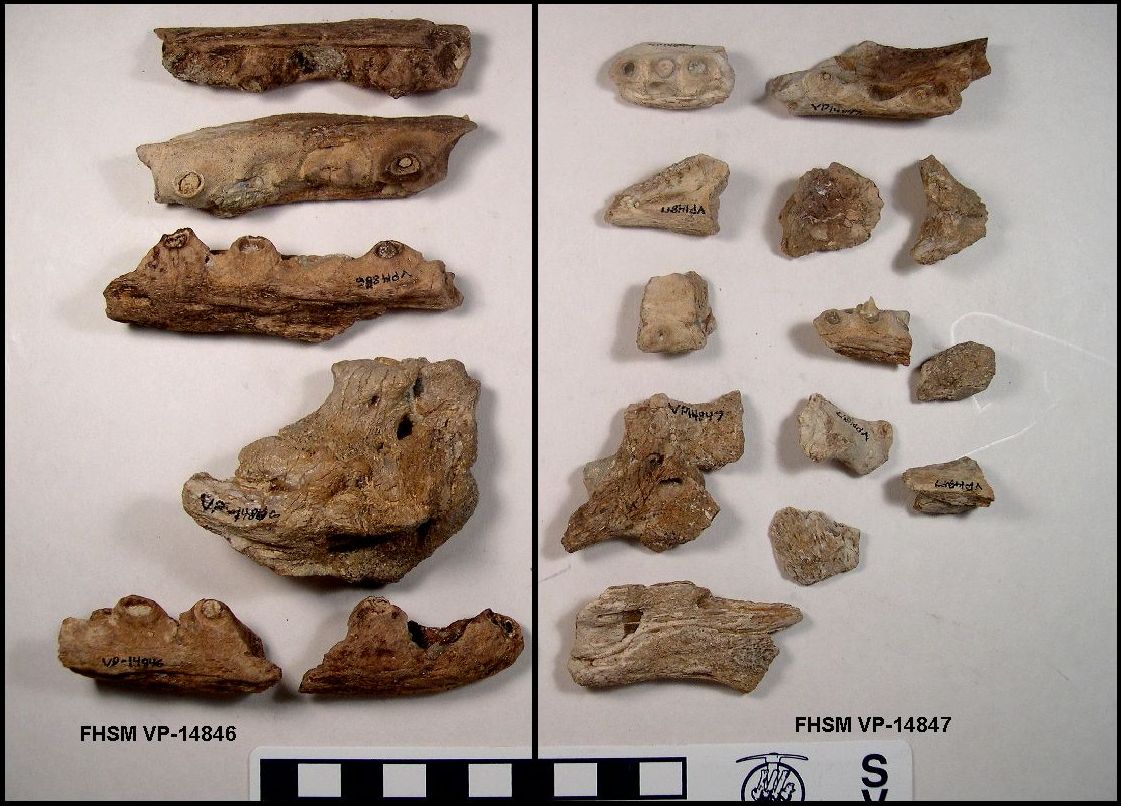
LEFT: FHSM
VP-14846 and VP-14847. This specimen consists of a mixture of cranial material and
represents the partially digested remains of two co-mingled cf. Platecarpus
juveniles. |
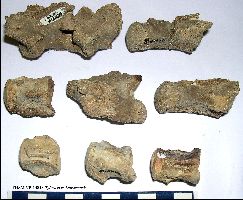 |
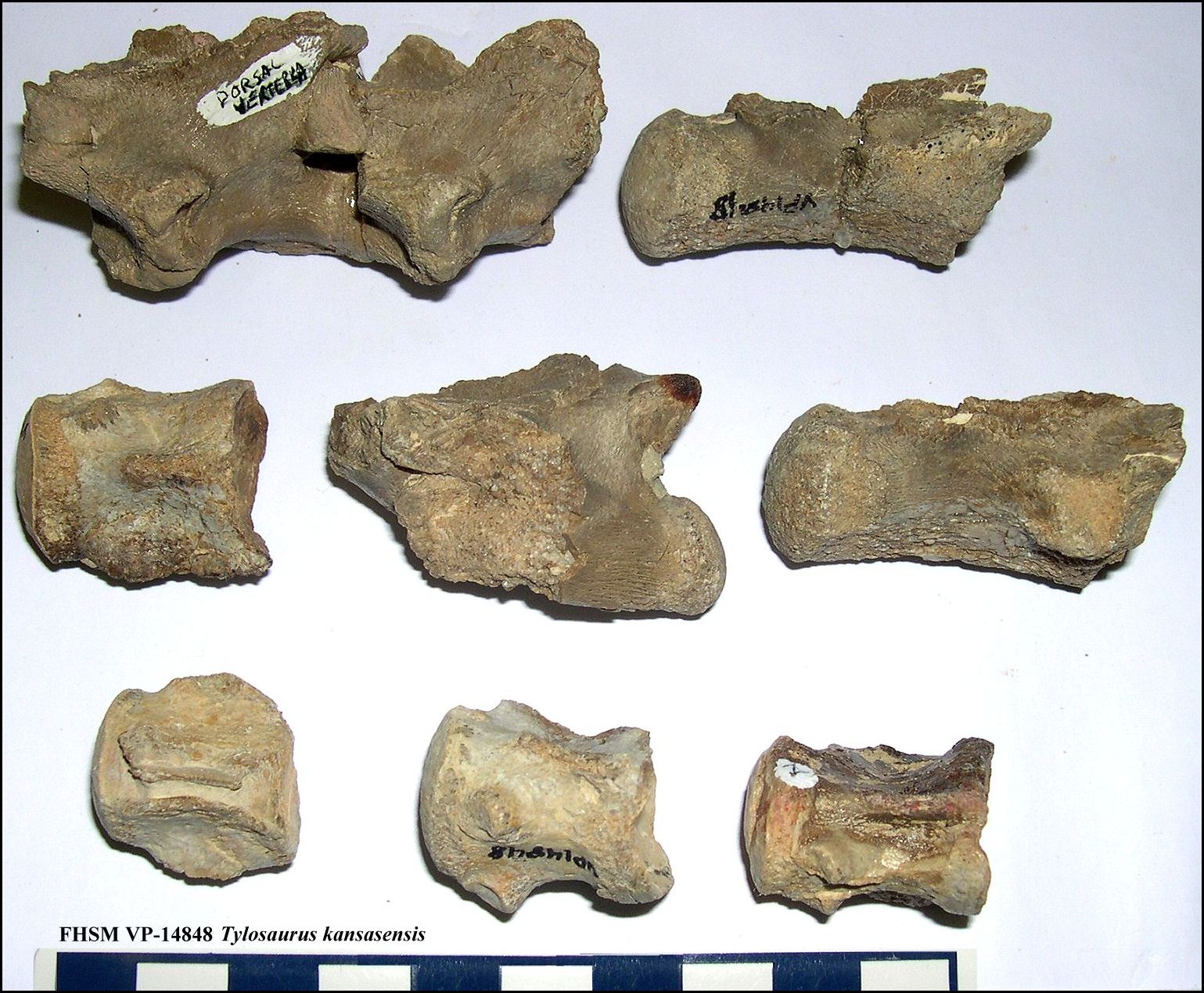
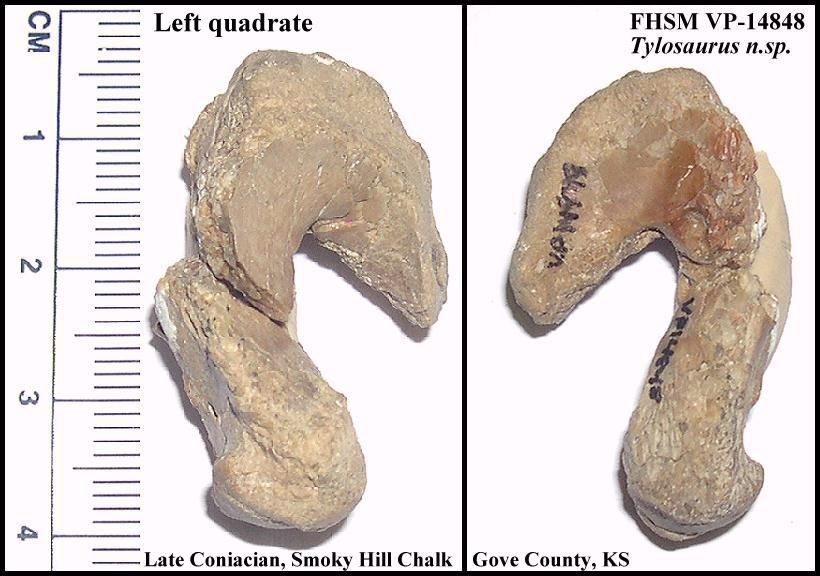
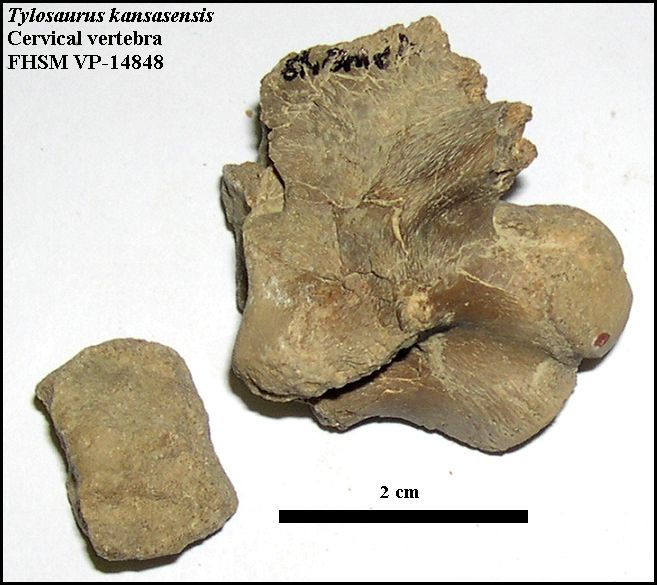
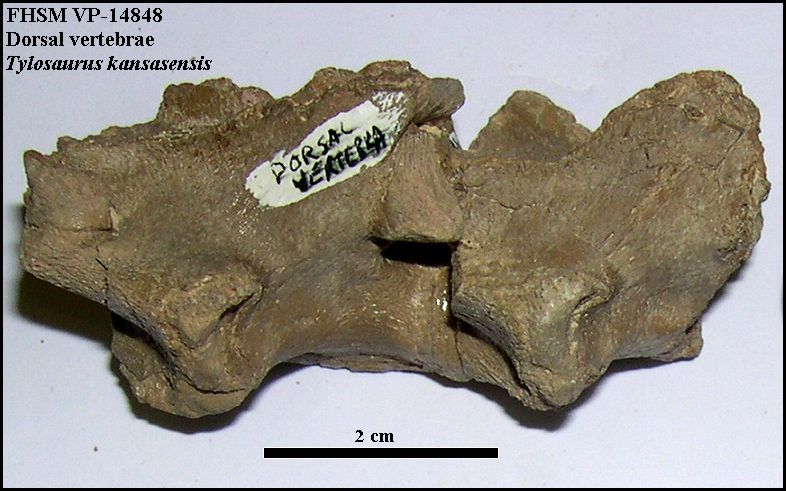
LEFT: FHSM VP-14848:
Some of the vertebrae from the remains of a small (< 2m) Tylosaurus kansasensis (upper
Coniacian). Although the mosasaur was possibly scavenged (no limb material presents), the
bones that were found had not been consumed (partially digested). Here are photos of the very small quadrate.;
A cervical vertebra, and; Two dorsal vertebrae |
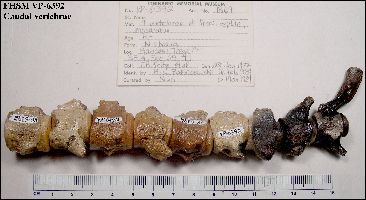 |
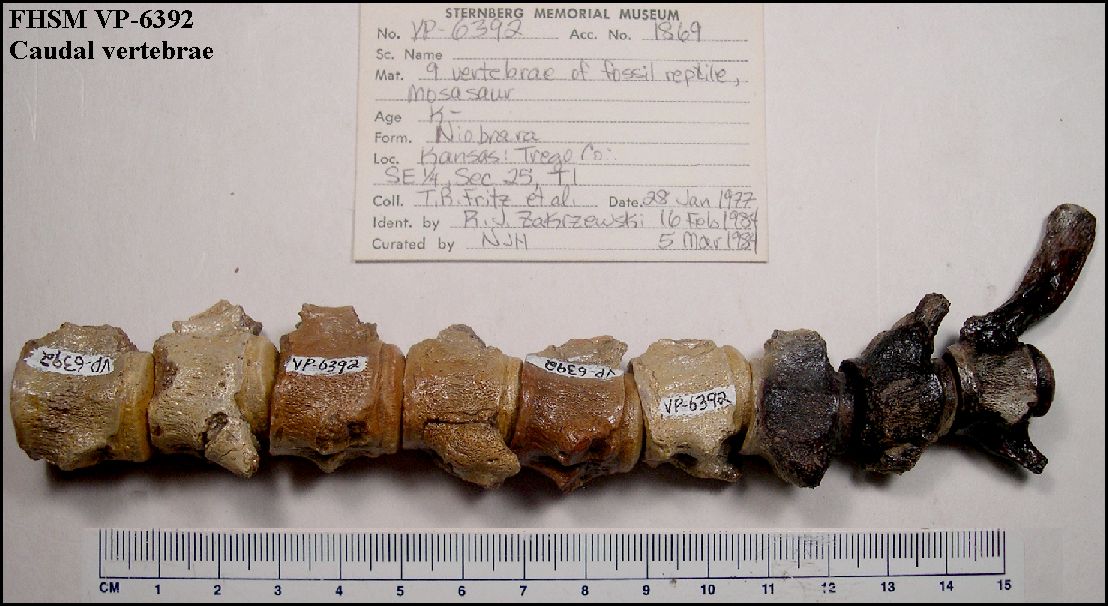
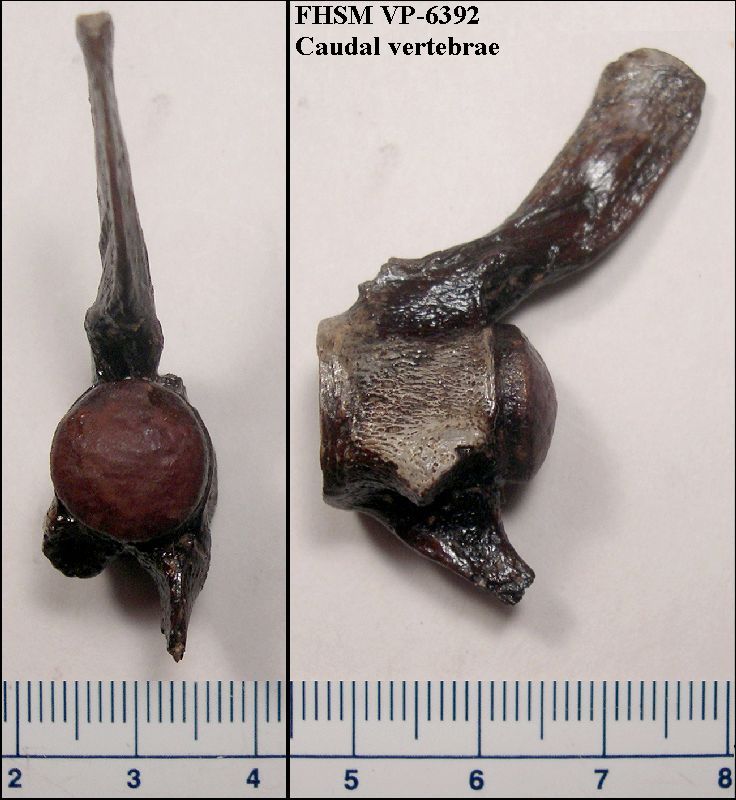
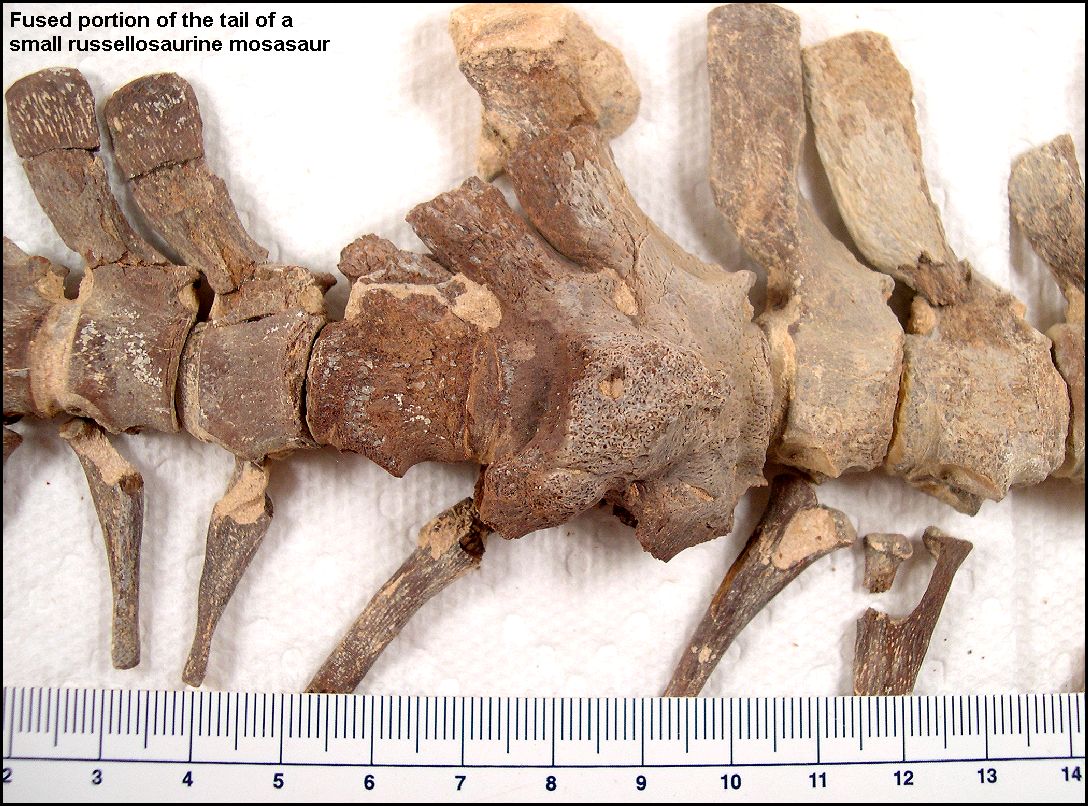
LEFT: FHSM VP-6392 - Nine small caudal
vertebrae measuring just over 15 cm... or less than 2 cm (3/4 inch) each.... Lower Smoky
Hill Chalk, Trego County, KS. Note the fused chevron bones on the ventral side of
vertebrae. This is probably a portion of the tail of a small Clidastes, cf. C.
liodontus. Click here for closer views of the last
vertebra in this series... |
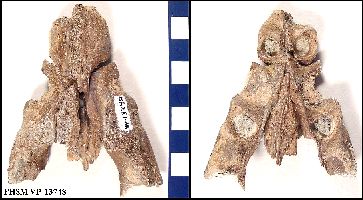 |
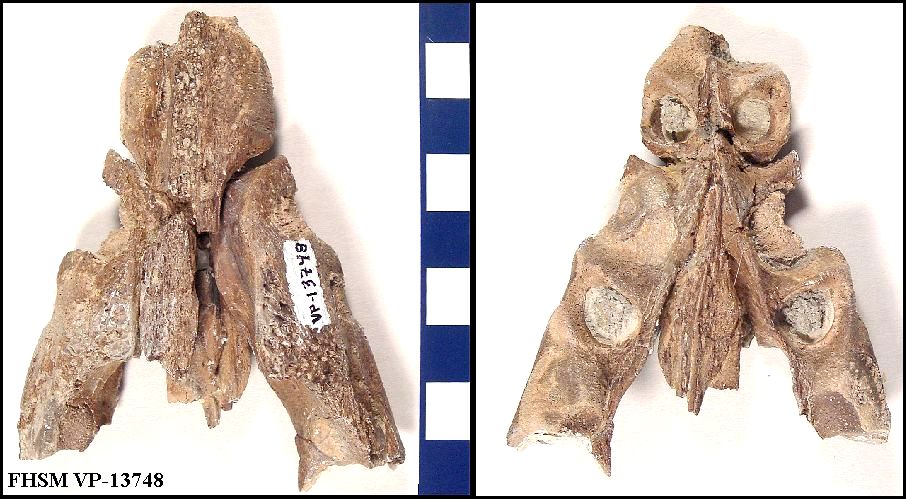
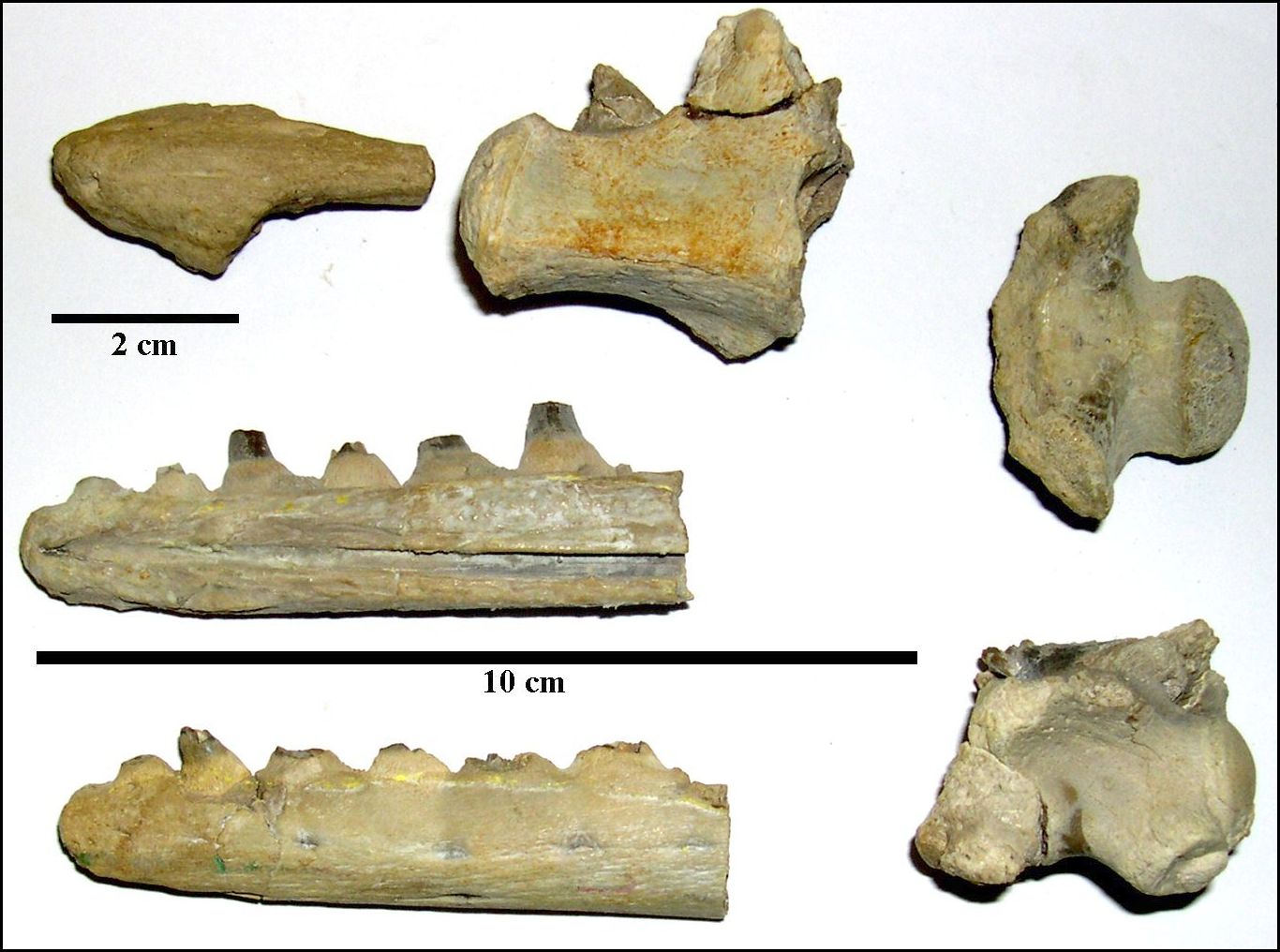
LEFT: FHSM VP-13748 -
Severed, partially digested anterior premaxilla and maxillae in dorsal (left) and ventral
view from a juvenile cf. Platecarpus (lower Santonian) – Gove County, Kansas. |
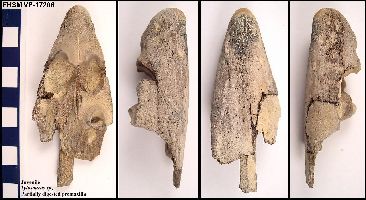 |
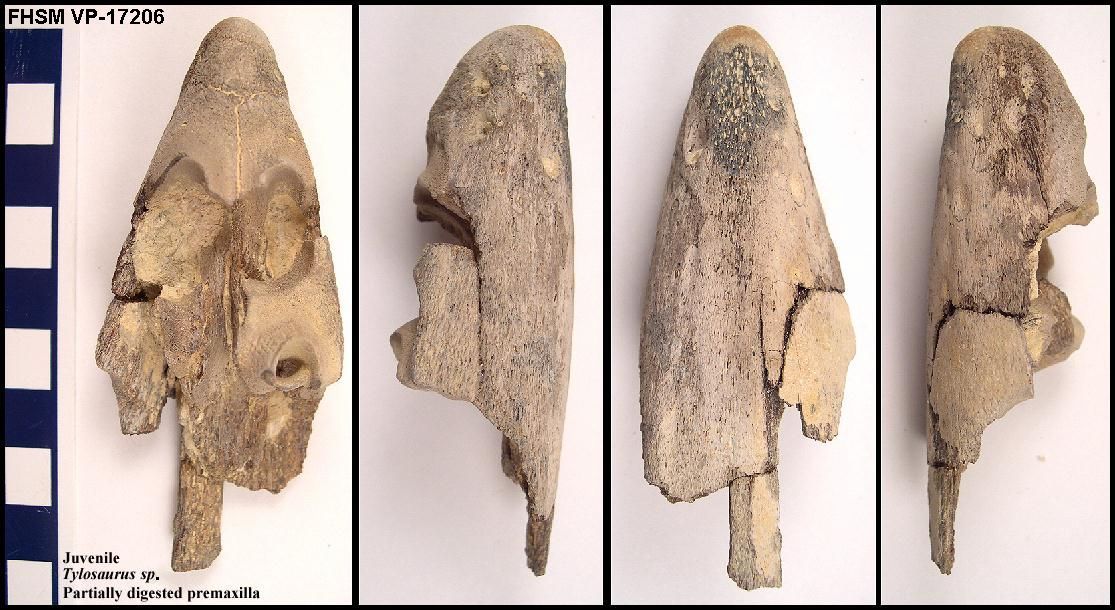
FHSM VP-17206 - Partially digested
juvenile Tylosaurus cf. kansasensis premaxilla; Collected between MU 1 and
2, (upper Coniacian), south-western Trego County, Kansas. |
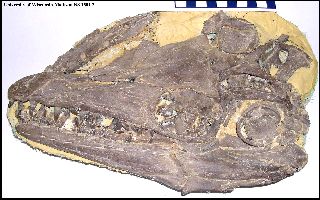 |
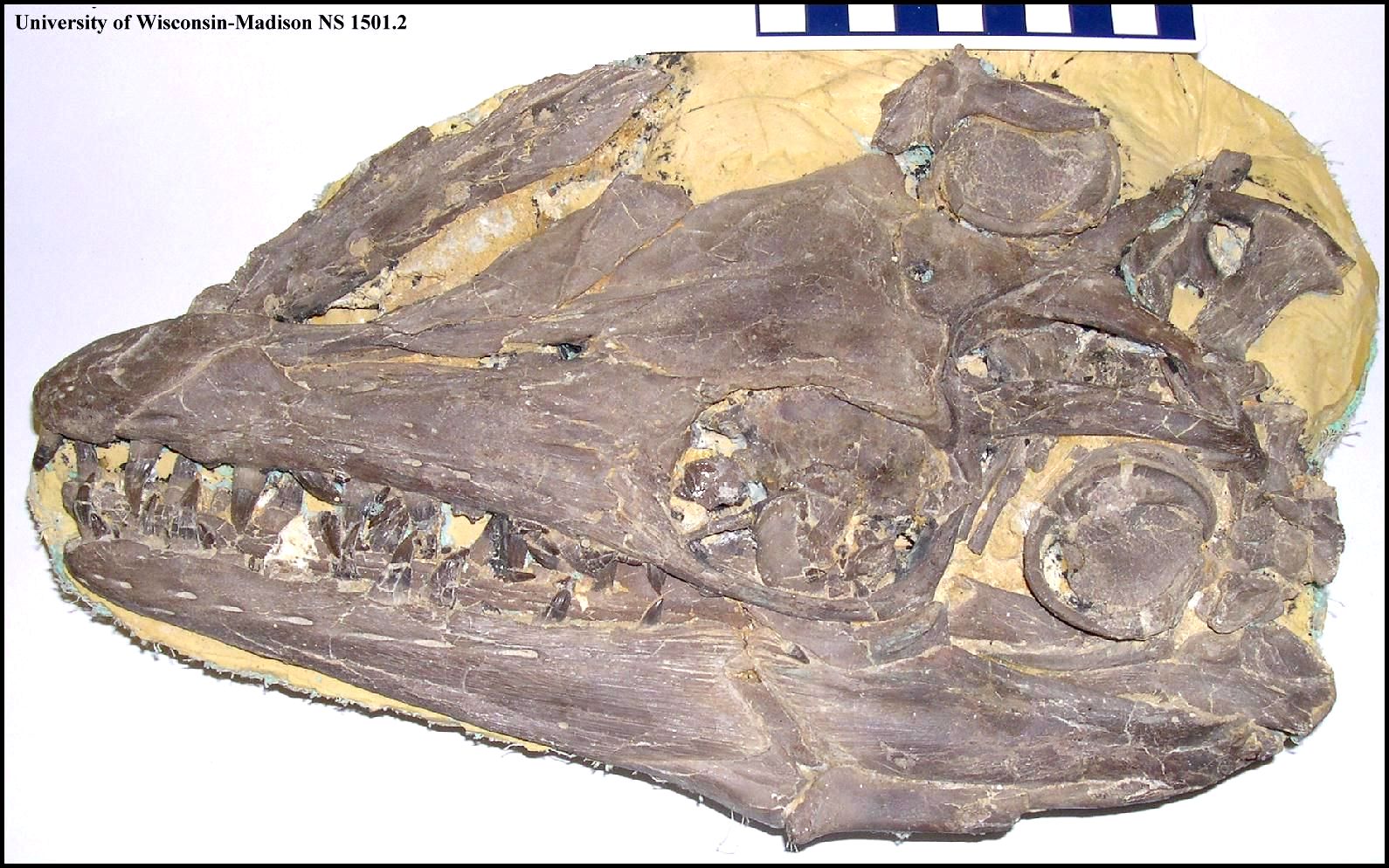
LEFT: UW-M 1501-2 - Nearly complete,
articulated skull of a juvenile Platecarpus ictericus in left lateral view…
upper chalk, Logan County, KS. Lower jaw length 28 cm. (Estimated body length = < 3 m) |
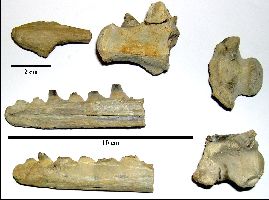 |
LEFT: UW-M 1501-24 – Remains of a
juvenile Clidastes cf. propython, Logan County, Kansas |
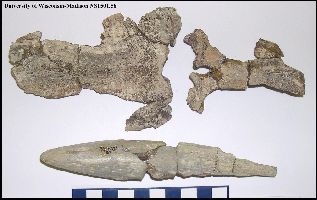 |
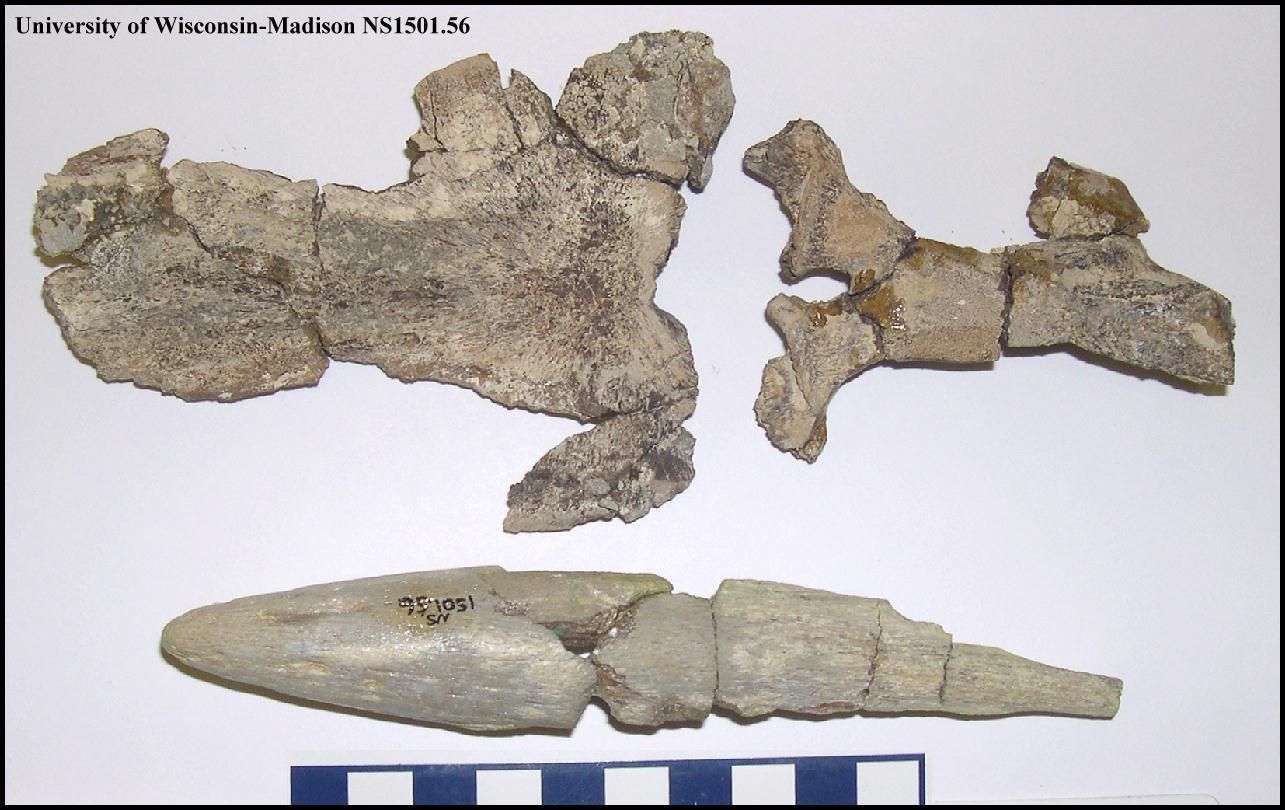
LEFT: UW-M 1501-56 - Skull remains of a
juvenile Tylosaurus proriger - Upper
chalk, Logan County, Kansas |
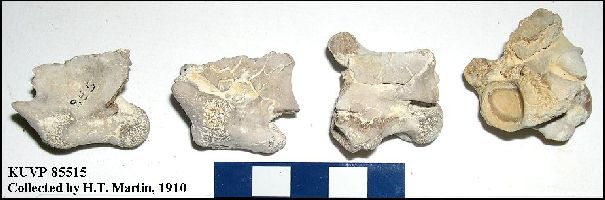 |
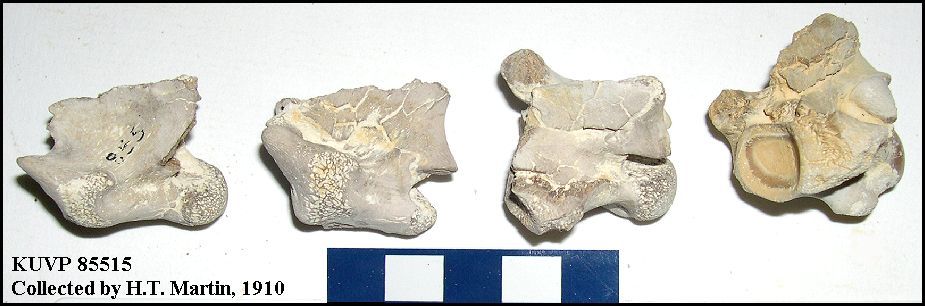
LEFT: KUVP
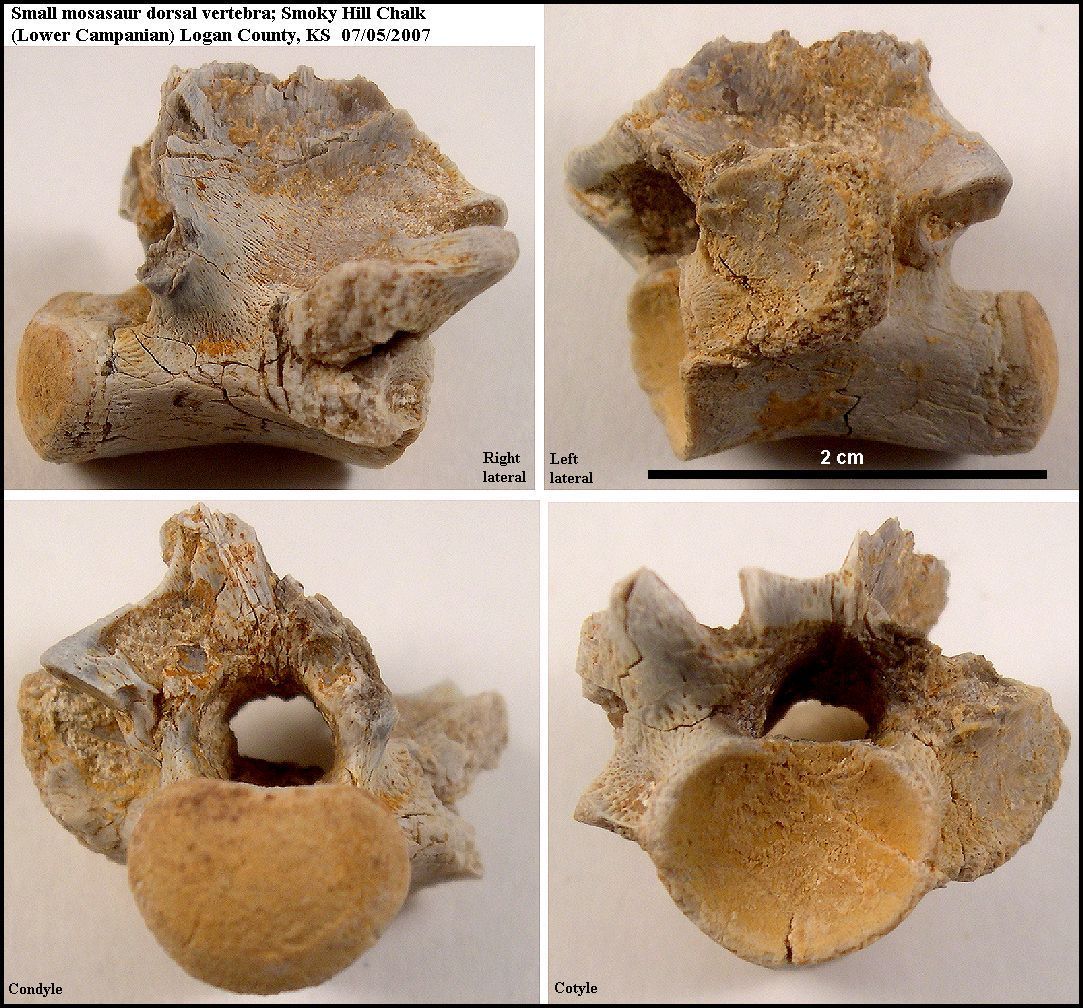
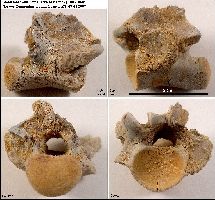
88515: Partially digested vertebrae from a small mosasaur RIGHT: A dorsal vertebra from a small mosasaur in the upper Smoky
Hill Chalk, Logan County (Early Campanian age). This vertebra is about 2 cm (about 3/4
inch) in length. |
 |
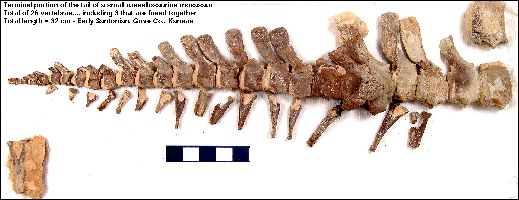 |
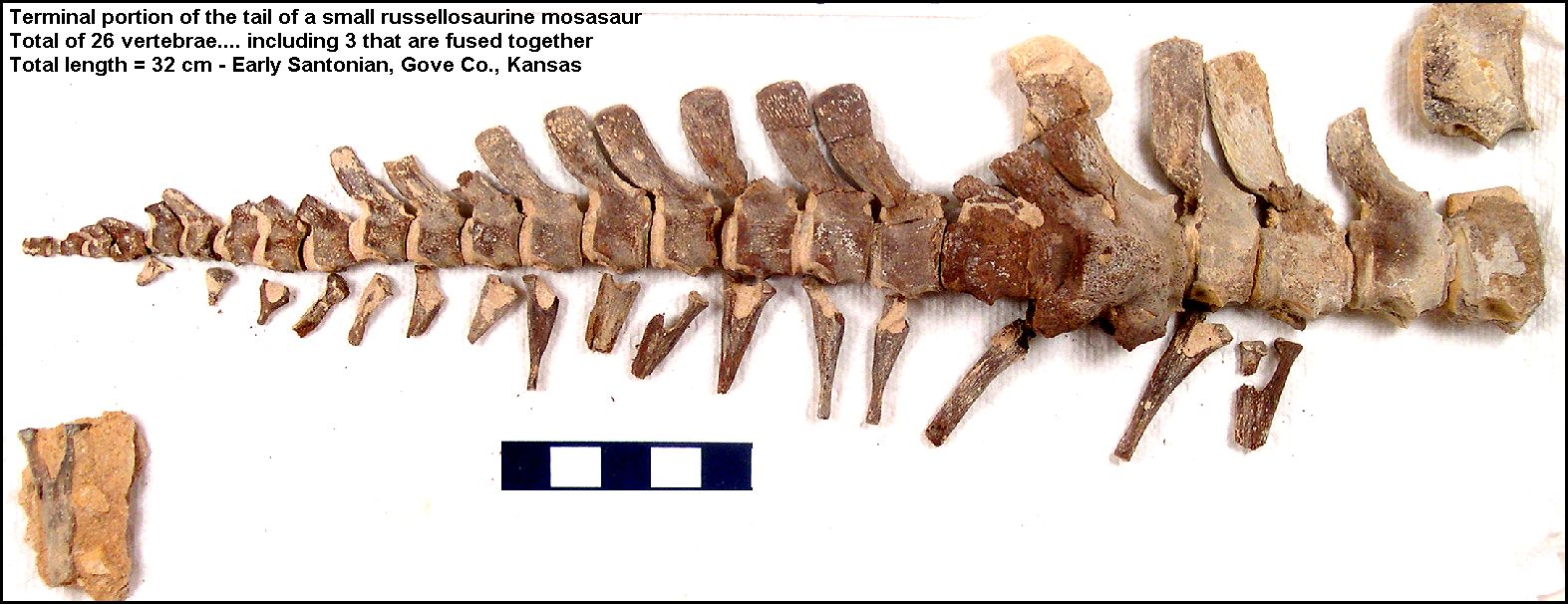
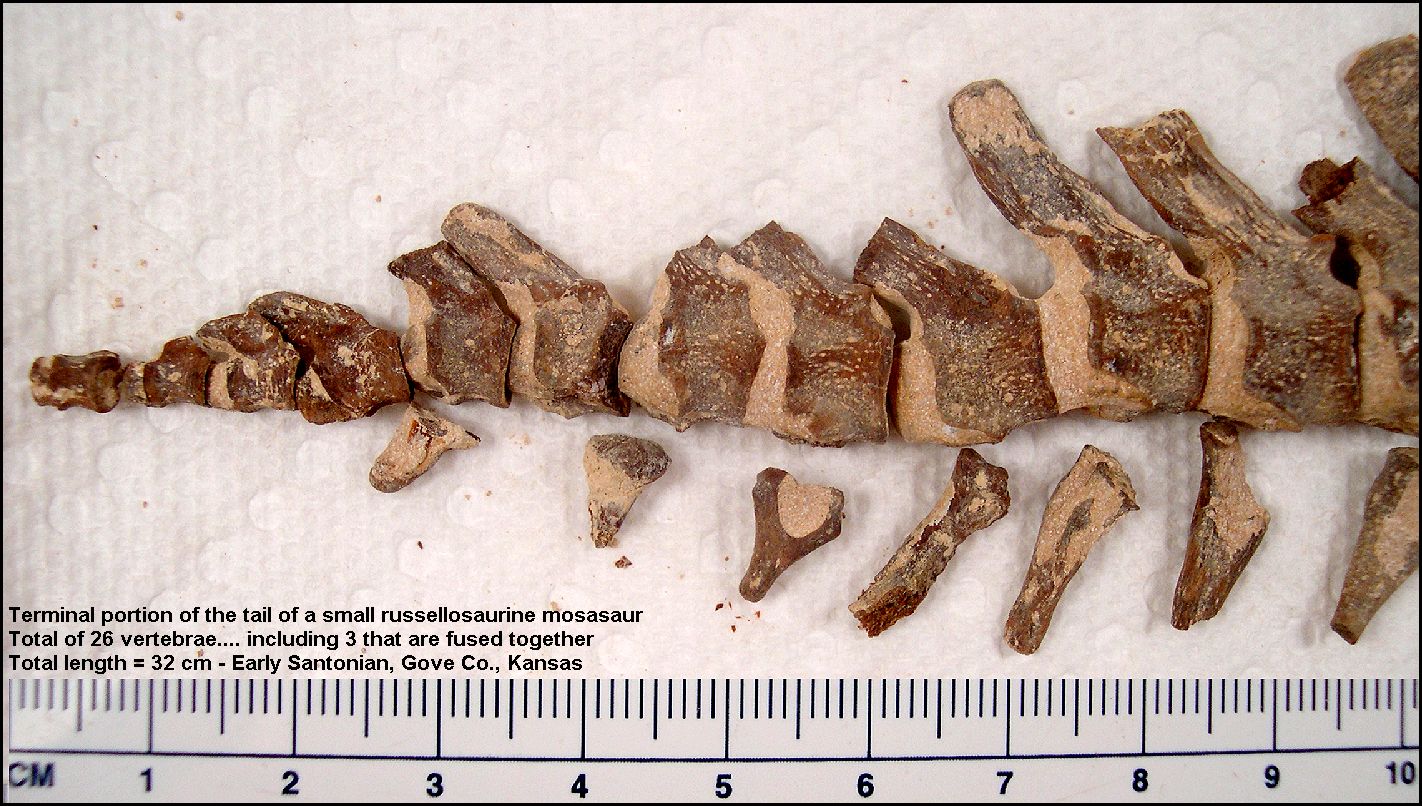
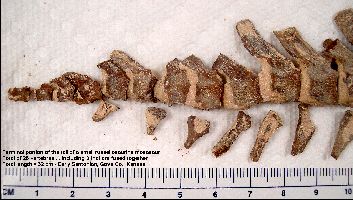
LEFT: The terminal end of the tail of a juvenile mosasaur (cf. Platecarpus).
This 32 cm section (26 vertebrae) represents about 7% of the total length of the mosasaur
(TL = 4.2 m). Note the fusion of three of the
caudal vertebrae resulting from a bone infection, probably caused by a bite. RIGHT:
Close up of the last dozen vertebrae (about 4 inches). |
 |
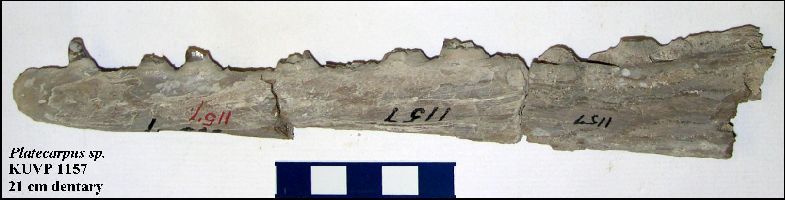 |
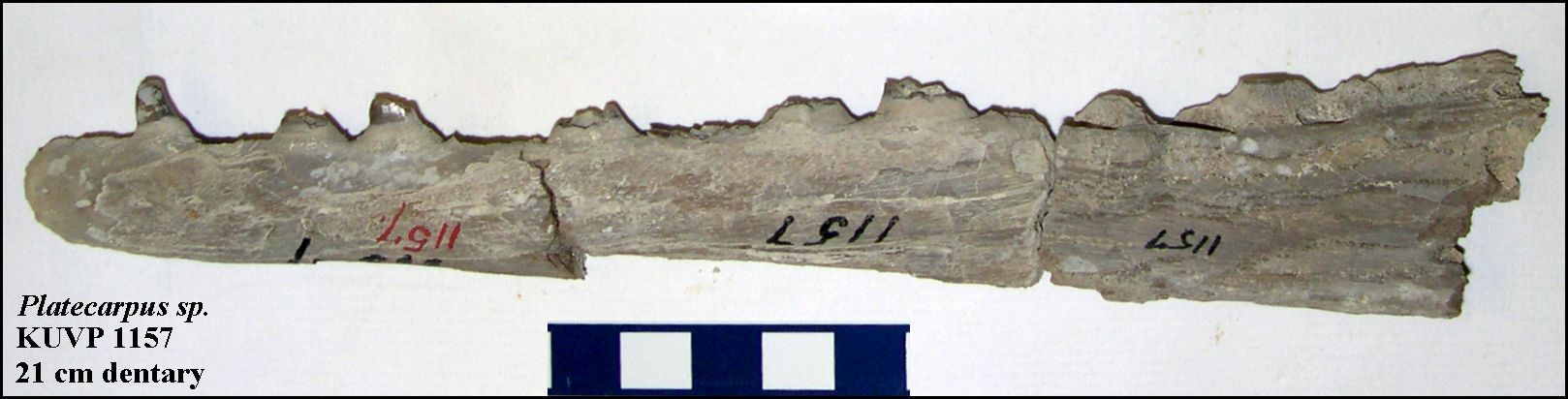
LEFT: KUVP 1157 –
Left dentary from a small Platecarpus. |
REFERENCES:
Bell G.L., Jr. and Barnes, K.R.
2007. First record of stomach contents in Tylosaurus nepaeolicus and comments on
predation among Mosasauridae. Second Mosasaur Meeting Abstract Booklet and Field Guide,
Sternberg Museum of Natural History, Hays Kansas, pp. 9-10.
Bell, G.L. Jr., and
Sheldon, M.A.
1986. Description of a very young mosasaur from Greene County, Alabama, Journal of the
Alabama Academy of Science, Vol. 57, No. 2, pages 76-82.
Bell, G.L. Jr., Sheldon,
M.A., Lamb, J.P. and Martin, J.E. 1996. The first direct evidence of live birth in Mosasauridae
(Squamata): Exceptional preservation in Cretaceous Pierre Shale of South Dakota. Journal
of Vertebrate Paleontology 16(suppl. to 3):21A.
Bell, G.L. Jr. and Sheldon, M.A. 2004. A gravid mosasaur (Plioplatecarpus)
from South Dakota. Abstract book and field guide of the First Mosasaur Meeting, Schulp, A.
S. and John W. M. Jagt (eds.), Natuurhistorisch Museum Maastricht, the Netherlands, pp. 16
(Abstract).
Everhart, M.J. 1999. Evidence of
feeding on mosasaurs by the late Cretaceous lamniform shark, Cretoxyrhina mantelli.
Journal of Vertebrate Paleontology 17(suppl. to 3):43A-44A.
Everhart, M.J. 2002. Remains of
immature mosasaurs (Squamata; Mosasauridae) from the Niobrara Chalk (Late Cretaceous)
argue against nearshore nurseries. Journal of Vertebrate Paleontology 22(Supplement to 3):
52A.
Houssaye, A. and
Tafforeau, P. 2012.What vertebral microanatomy reveals about the ecology of
juvenile mosasaurs (Reptilia, Squamata). Journal of Vertebrate Paleontology
32(5):1042-1048.
Russell, D.A. 1967. Systematics
and morphology of American mosasaurs. Peabody Museum of Natural History, Yale University,
Bulletin 23.
Sheldon, M.A. 1990. Immature
mosasaurs from the Niobrara: a sampling problem? Journal of Vertebrate Paleontology
Abstract 10(Supplement to 3): 42A.
Williston, S.W. 1904. The
relationships and habits of the mosasaurs. Journal of Geology 12(4):43-51.