Tylosaurus kansasensis
A new species of mosasaur from the Smoky Hill Chalk
Written and Illustrated by Mike Everhart; Copyright © 2000-2010
|
Tylosaurus kansasensis A new species of mosasaur from the Smoky Hill Chalk Written and Illustrated by Mike Everhart; Copyright © 2000-2010 Page created 01/30/1999 - Updated 07/12/2012 |
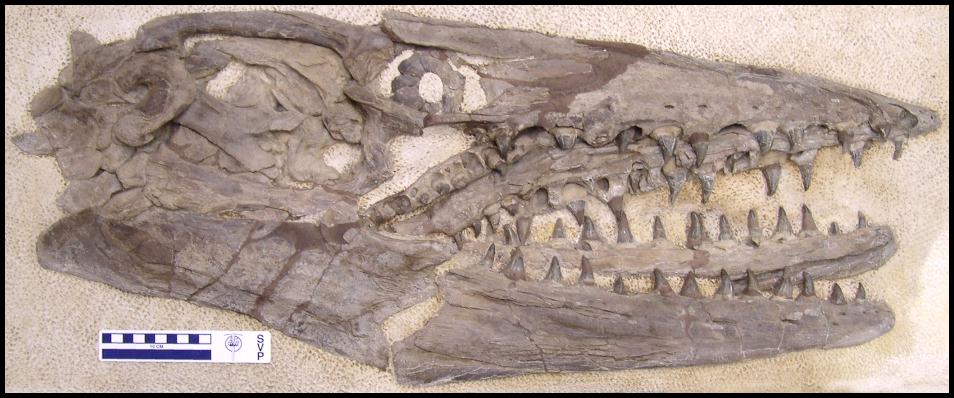
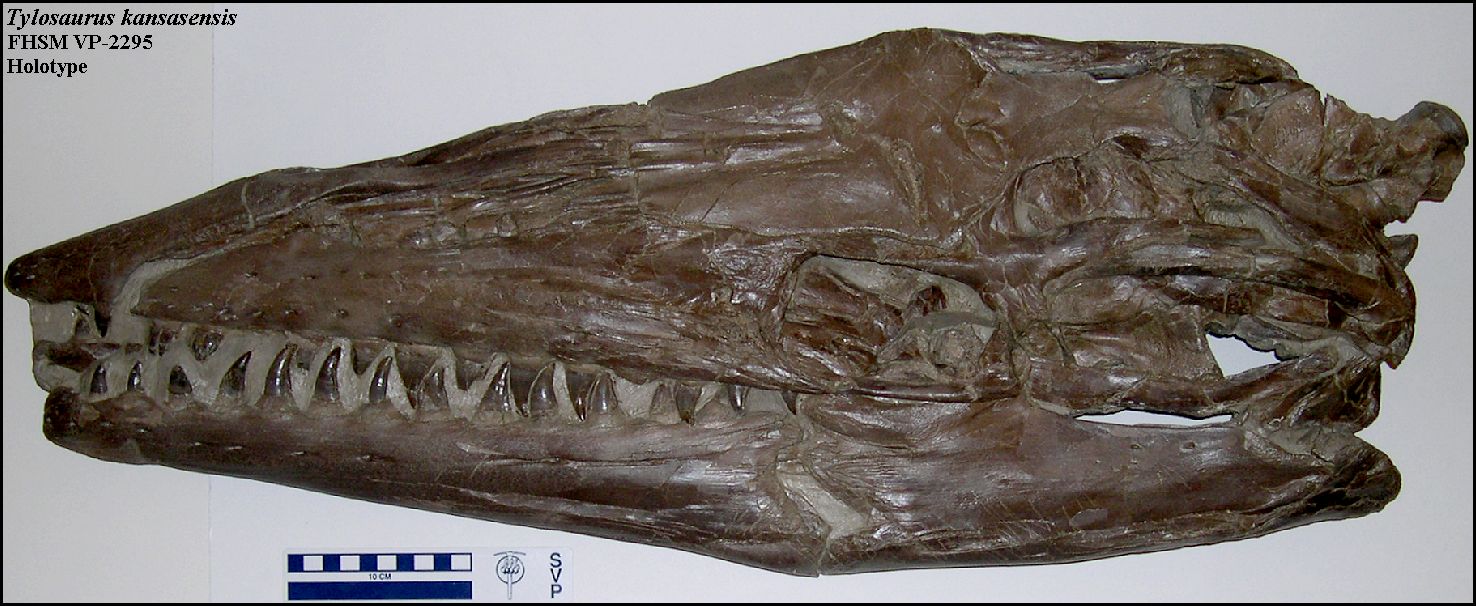
My paper naming a new (third) species of Tylosaurus from the Smoky Hill Chalk was published in October, 2005. The specimen shown above and below (FHSM VP-2295) is designated as the holotype specimen and is currently on exhibit at the Sternberg Museum of Natural History. Free PDF is available online:
Everhart, M.J. 2005. Tylosaurus kansasensis, a new species of tylosaurine (Squamata: Mosasauridae) from the Niobrara Chalk of western Kansas, U.S.A. Netherlands Journal of Geosciences / Geologie en Mijnbouw, 84(3), p. 231-240.
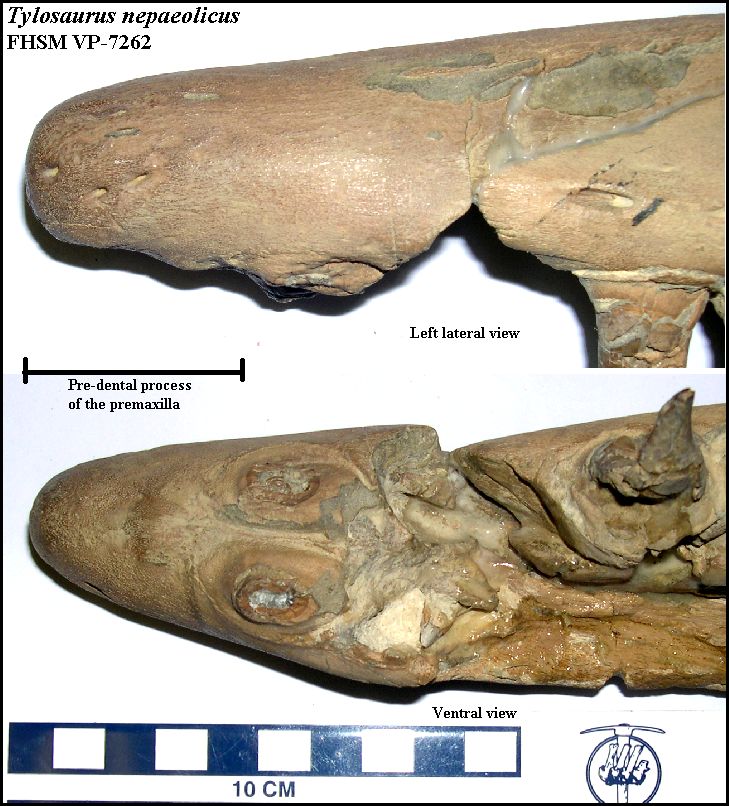
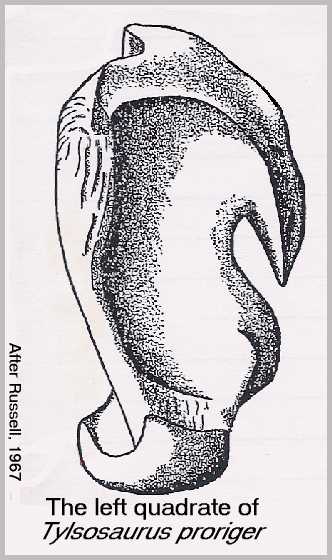
| ABSTRACT: Tylosaurus kansasensis sp. nov. is described herein on the basis of thirteen specimens collected from the Smoky Hill Chalk (upper Coniacian) of western Kansas, USA. The new species, originally designated Tylosaurus n. sp., co-occurred with T. nepaeolicus and exhibits a number of primitive characters that place it in a basal position in the mosasaur phylogeny. Among the key differences separating this species from other tylosaurines are a shortened, more rounded pre-dental process of the premaxilla, a distinctive quadrate lacking an infrastapedial process, and a parietal foramen located adjacent to the frontal-parietal suture. |
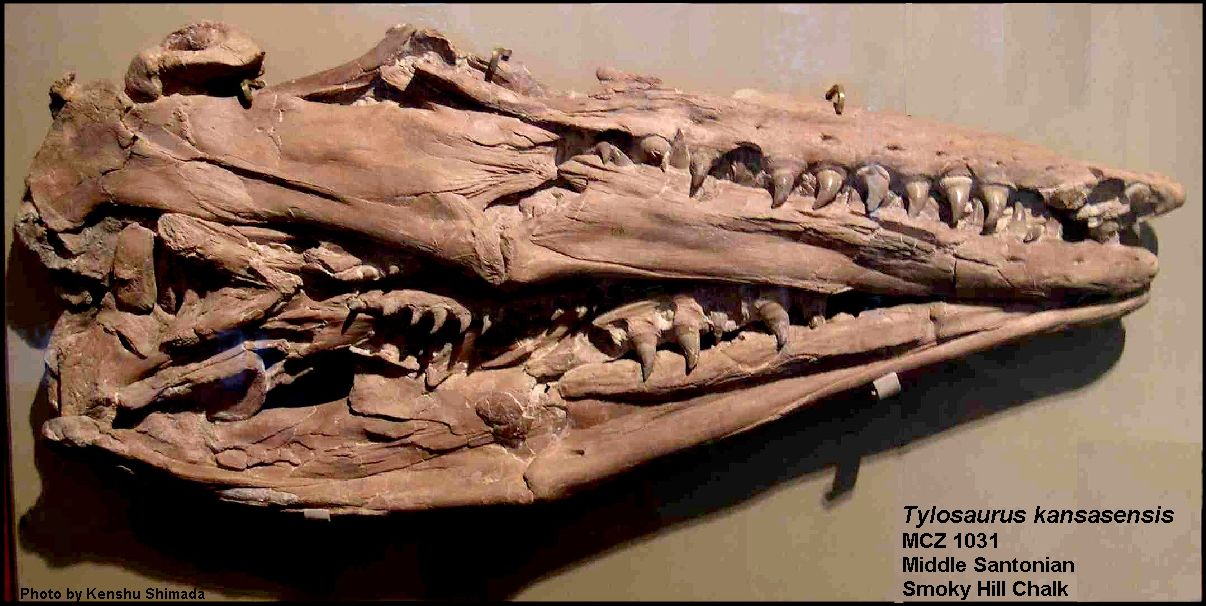
The naming of this new species is sort of a long and tangled story. The fact that there was a third species of Tylosaurus in the Smoky Hill Chalk was certainly recognized as early as 1924 by G.F. Sternberg when he advertised a specimen for sale to the Harvard Museum of Comparative Zoology and sent photographs with the notation "Sp. 2-24, Tylosaurus, species not determined." This specimen includes a large, complete and articulated skull, many vertebrae, limb bones, most of the pelvis, and preserved costal cartilage.. It was collected from southwest Trego County in the lower Smoky Hill Chalk. Sternberg had been collecting Kansas mosasaurs for more than 20 years at the time... and certainly would have recognized that it was the skull of Tylosaurus proriger or T. nepaeolicus. The specimen was purchased by Harvard and curated as MCZ 1031. The 36 inch (92 cm) skull is currently on display as a plaque mount (Photo by Kenshu Shimada, used with permission).
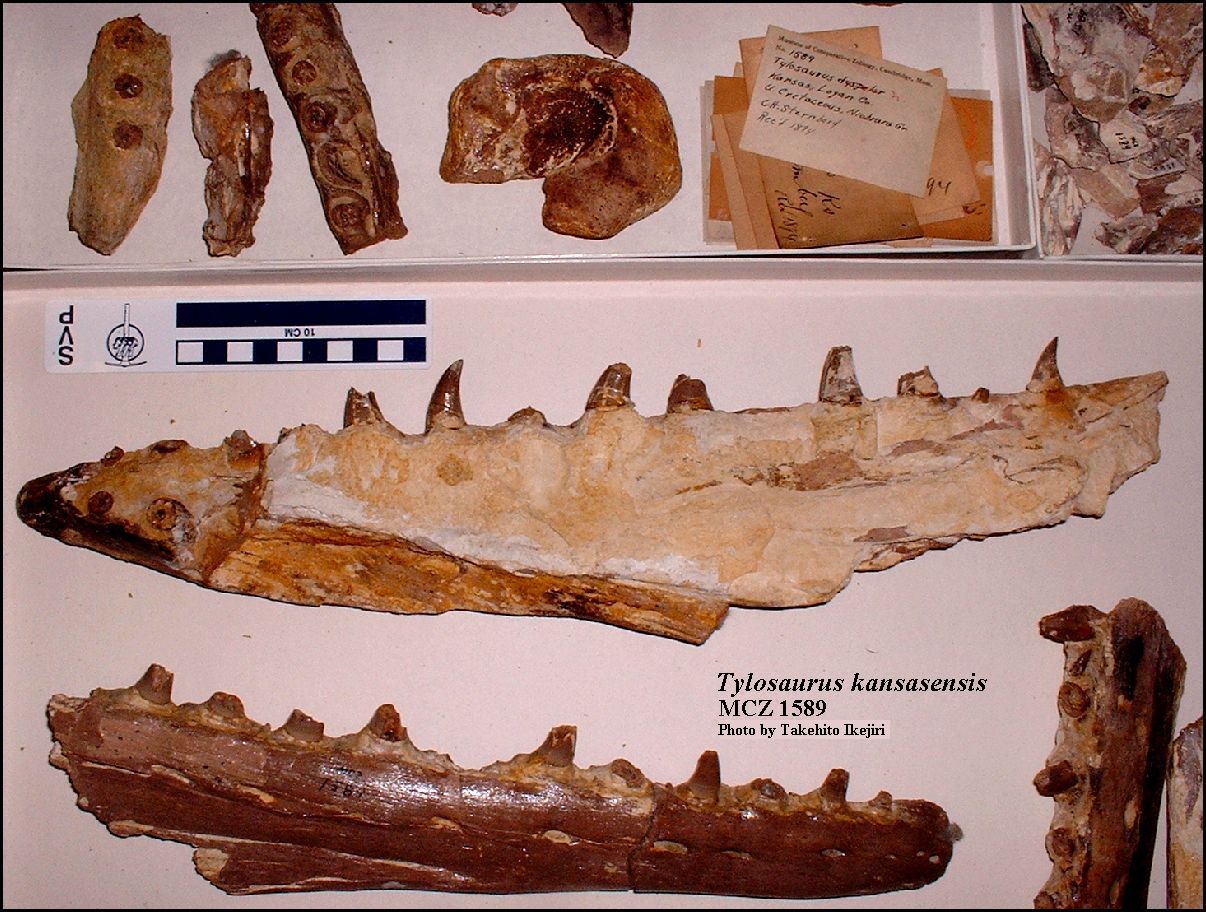
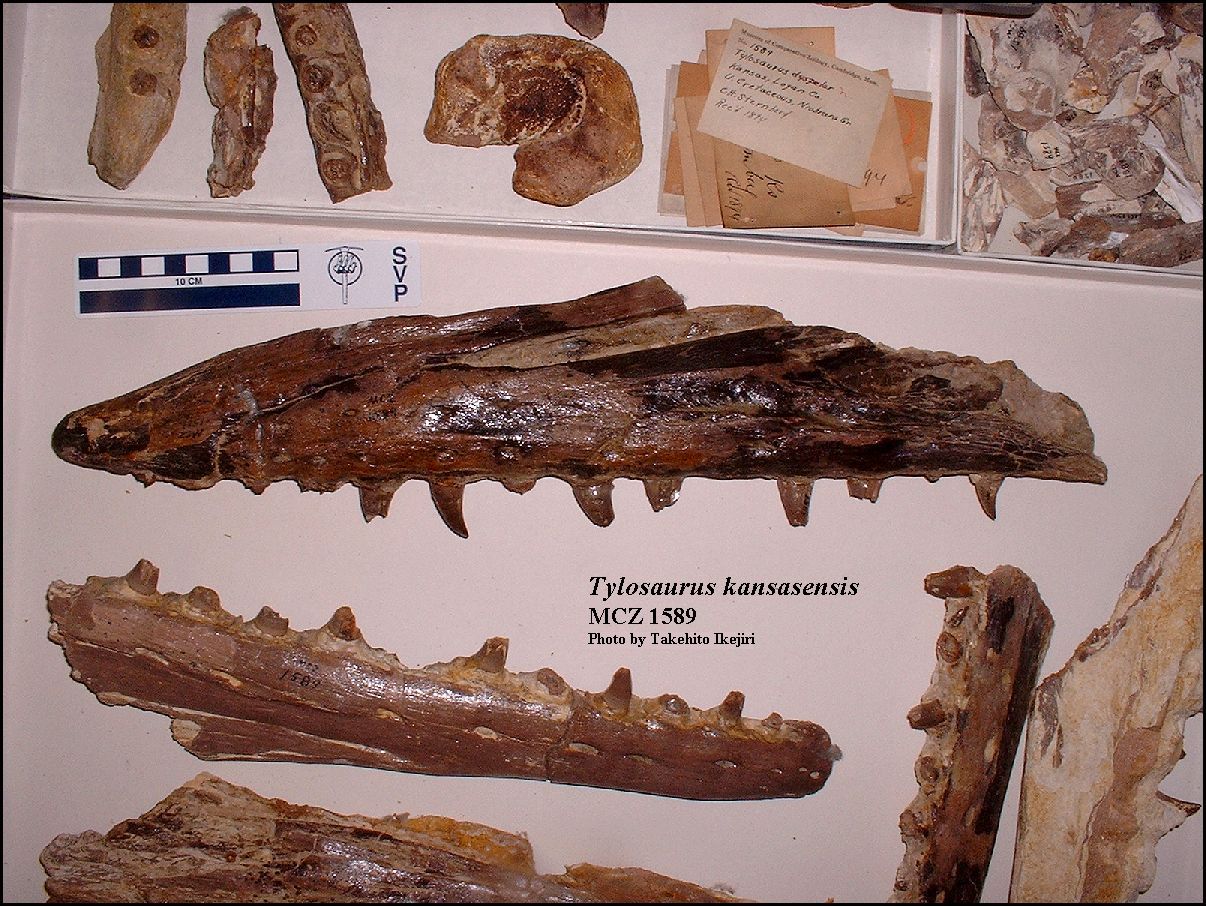
Unfortunately, I was not aware of this specimen when the paper was written but did describe a second specimen (MCZ 1589 - Photo 1 and Photo 2; photos by Takehito Ikejiri; used with permission) that was collected by C.H. Sternberg and acquired by the MCZ in 1894. The specimen had previously been identified as Tylosaurus dyspelor and the card with the specimen indicates that it came from Logan County. Gorden Bell (1993) re-identified the specimen as Tylosaurus sp. novum. In addition, Bell (1993) had identified another fragmentary Tylosaurus sp. novum (YPM 40796) in the collection of the Yale Peabody Museum that had been collected by B.F. Mudge in 1876.
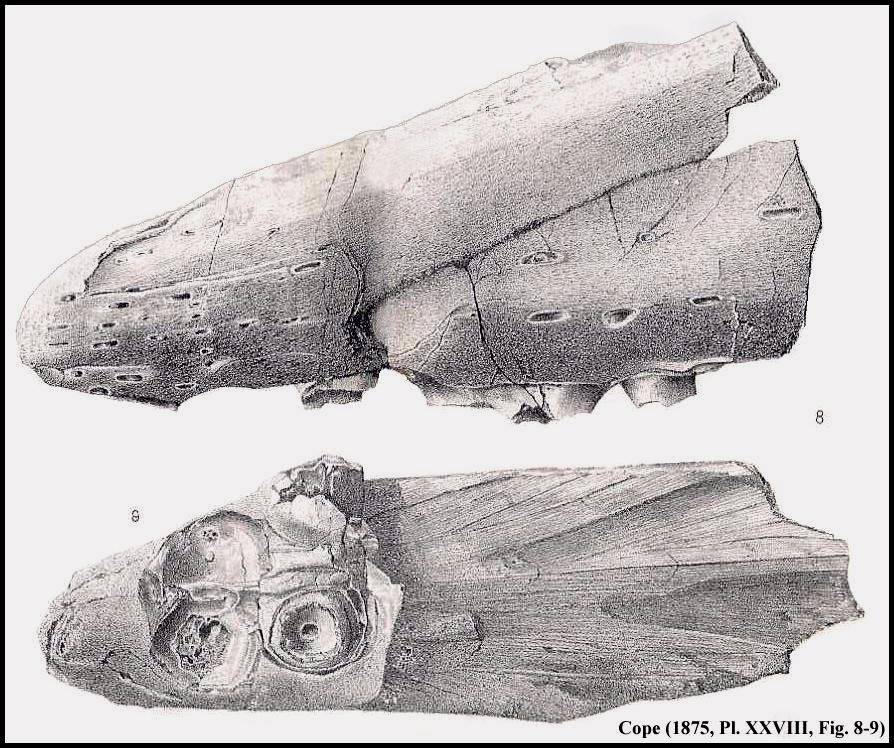
It is also quite possible that E.D. Cope (1875) described and figured another specimen (whereabouts currently unknown) in his "The Vertebrata of the Cretaceous Formations of the West." Plate XXVIII (figures 8 and 9) shows two views of a Tylosaurus rostrum with the distinctive shortened extension of the premaxilla.
Another complete skull was collected in 1939 by G.F. Sternberg from the lower chalk of northwest Ellis County and identified as Tylosaurus proriger. However, it's occurrence in the lower chalk is much earlier than the earliest known example of that species. It was later acquired by Prof. Fryxell at Augustana College in Rock Island, IL. and is currently curated as V-43 the collections of the Fryxell Geology Museum. FGM V-43 displays the right quadrate, premaxilla, right sclerotic ring and both lower jaws) and two cervical vertebrae, mounted in ventral right-lateral view. The frontal-parietal suture is obscured by the plaster mounting. The right lower jaw measures 82.5 cm.
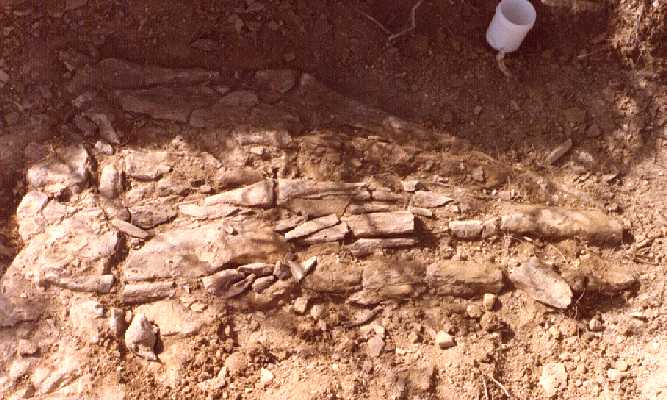
Fast forward to 1968... While on a summer school geology field trip in northwest Ellis County, one of Myrl V. Walker's students found 4 mosasaur cervical vertebrae eroding from the chalk. Walker returned to the site with two students in November and recovered another articulated skull... (FHSM VP-2295 - above). According to the museum records, it was initially identified as "Platecarpus" by Walker. It was subsequently re-identified as Tylosaurus nepaeolicus by Bell in 1990 but then included in his list of Tylosaurus sp. novum specimens in his 1993 dissertation. The lower jaw length is 72 cm.
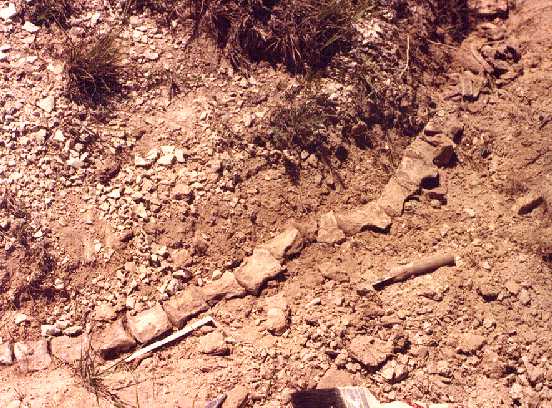
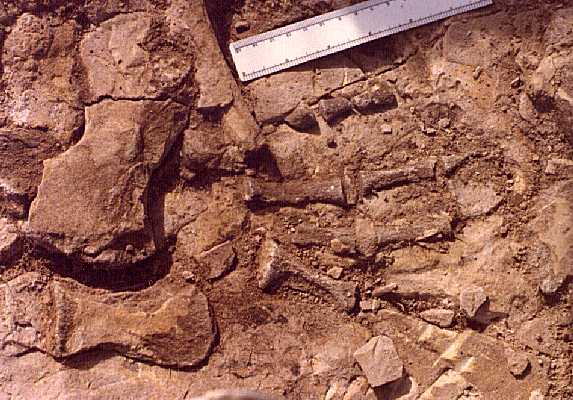
In 1979, I discovered my first mosasaur from the Smoky Hill Chalk, an articulated skull, 42 articulated vertebrae over a distance of 10 feet and some elements of the shoulder girdle and front paddles... The locality was within a mile of the FHSM VP-2295 specimen, and within 3-4 miles of probable locality of the V-43 skull collected by G.F. Sternberg in 1939. Of course, I didn't realize that at the time... or in fact, until almost 30 years later. It came the lower Smoky Hill Chalk of northwest Ellis County, just south of the Saline River. I was very new to mosasaurs at the time, and was unable to positively identify specimen beyond the genus Tylosaurus. It took me several years to decide for certain that was not one of the described species of Tylosaurus. I donated it to the Sternberg Museum in 2007 (FHSM VP-15631).
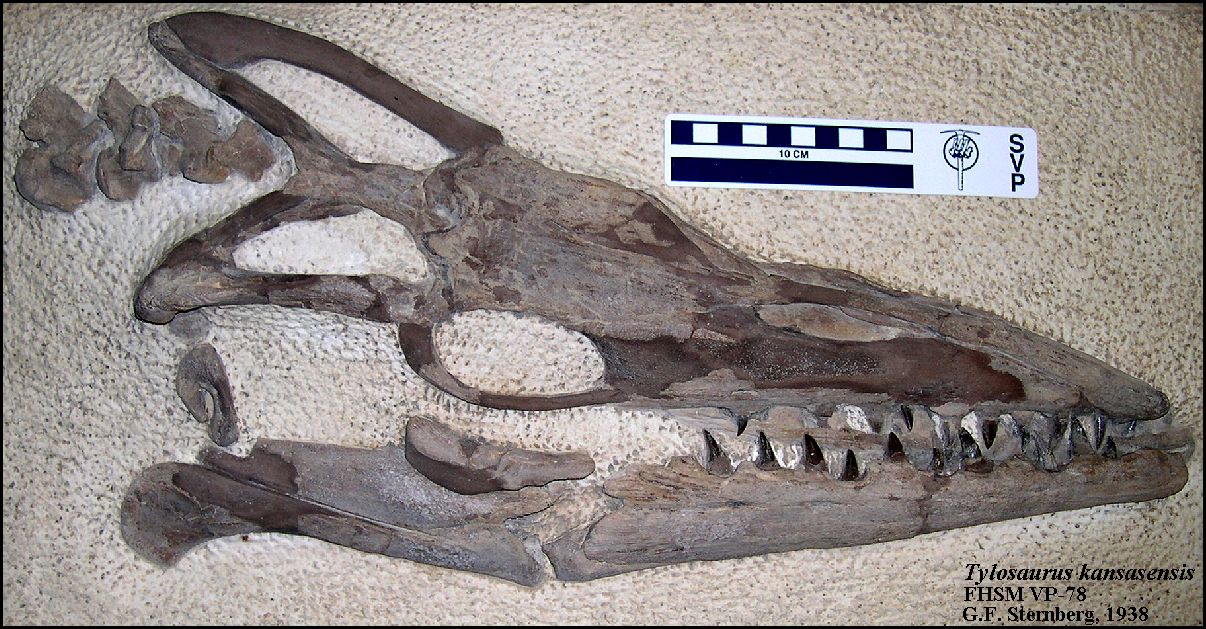
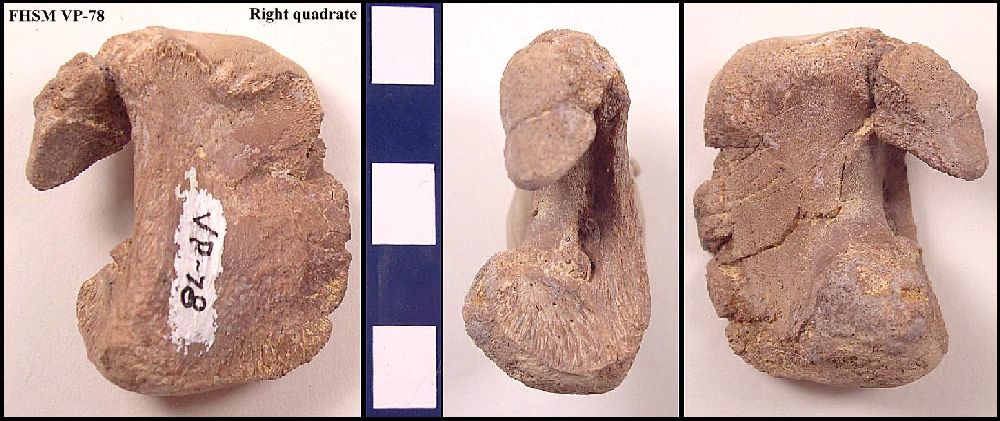
In 1990, the annual meeting of the Society of Vertebrate Paleontology annual meeting was held at the University of Kansas. In his "Niobrara Formation vertebrate stratigraphy" paper in the field trip guide, J.D. Stewart listed a third species of Tylosaurus that occurred in the lower Smoky Hill Chalk. During the field trip visit to the Sternberg Museum, J.D., Gorden Bell and I agreed that one of the specimens in the exhibit (FHSM VP-78) was mis-labeled as Platecarpus and instead was definitely a juvenile of the undescribed species. Previously identified by Dale Russell as T. nepaeolicus in 1967, it had been collected and prepared by G.F. Sternberg in 1938. For some unknown reason, during the mounting of the skull in plaster, Sternberg inserted the left quadrate on the right side of the skull. The right quadrate is undamaged and stored in the collections.
I was able to identify several other specimens of Tylosaurus kansasensis in the Sternberg Museum collection. Most of them are fairly fragmentary ... and most were discovered by my wife and I. They are:
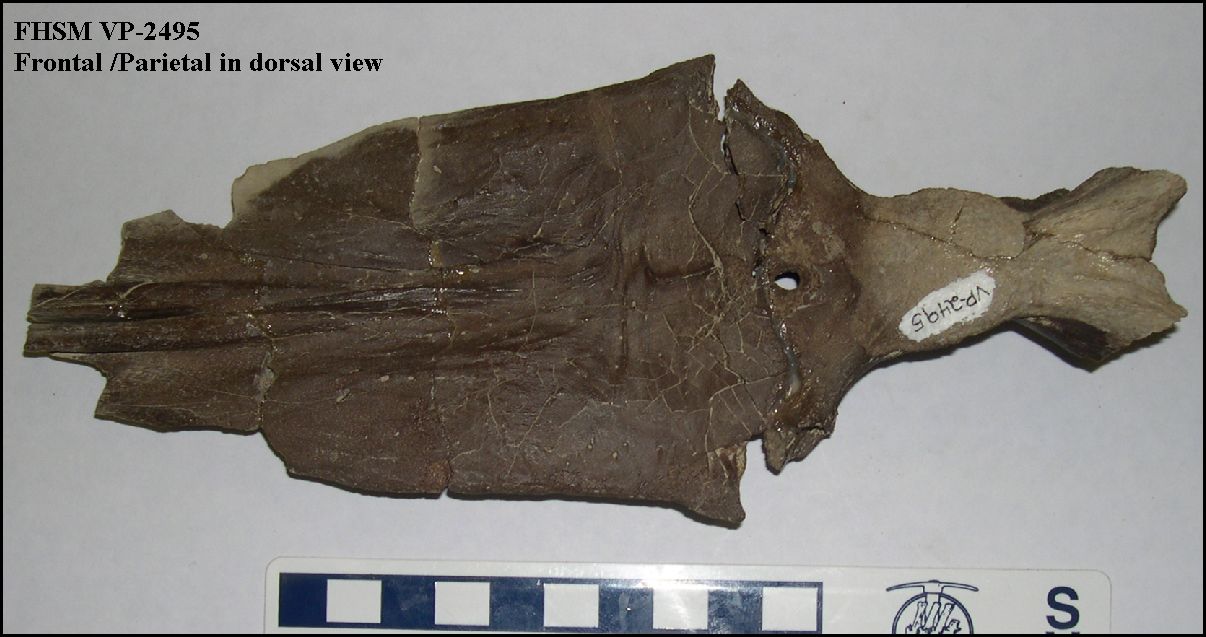 |
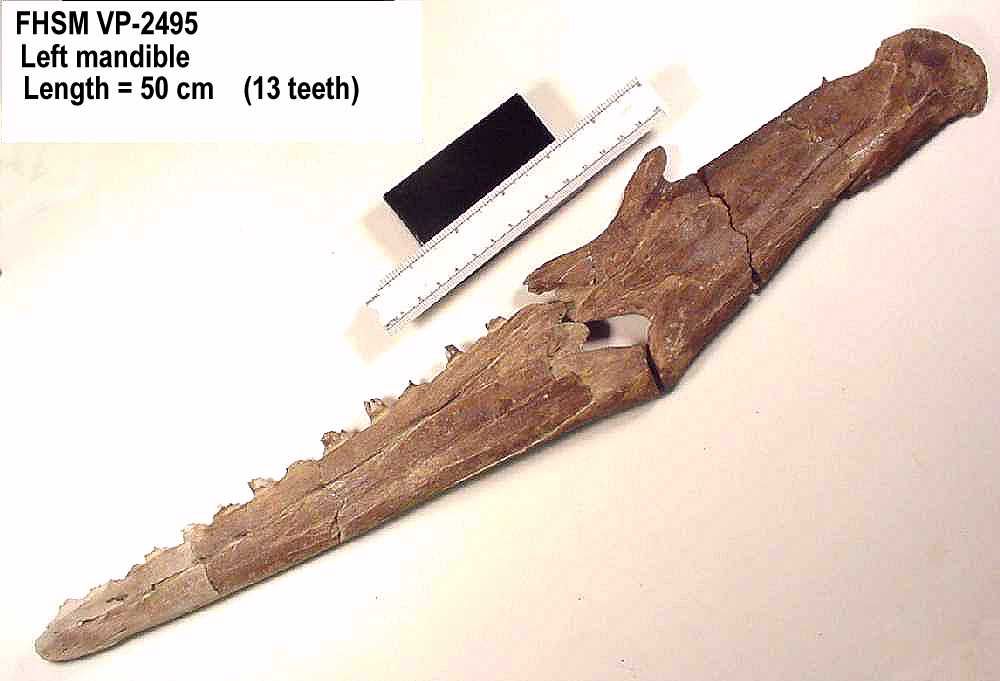
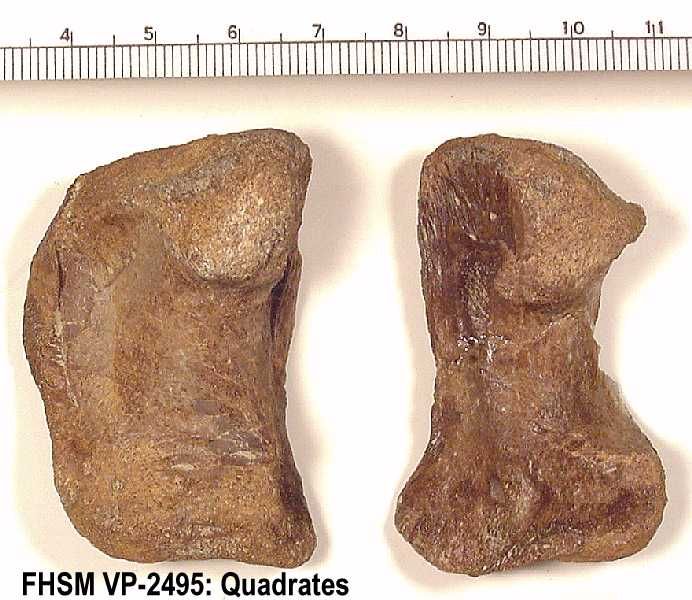
FHSM VP-2495 (paratype), a disarticulated, near-complete skull (missing the premaxilla) of a juvenile Tylosaurus and the anteriormost portion of the vertebral column (83 vertebrae). There was no limb material associated with the specimen. This is a common condition for the remains of many mosasaurs collected from the chalk and is most likely the result of scavenging by sharks. The remains were collected by R. Zakrzewski in November 1969 from the lower Smoky Hill Chalk of Trego County. The length of the left lower jaw is 50 cm, and represents an individual that would have been about 3.6 m long. Both quadrates were present. LEFT: The frontal and parietal of VP-2495 in dorsal view. Note the location of the parietal (pineal) foramen immediately adjacent to the frontal-parietal suture. It is unclear what function that this opening served in mosasaurs but in some lizards such as the Tuatara, the pineal gland has some light sensing function. |
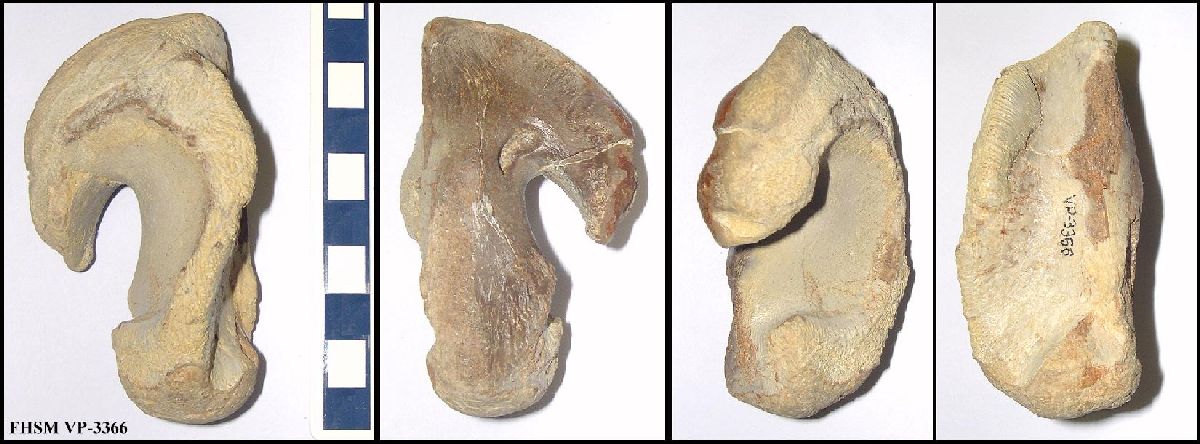 |
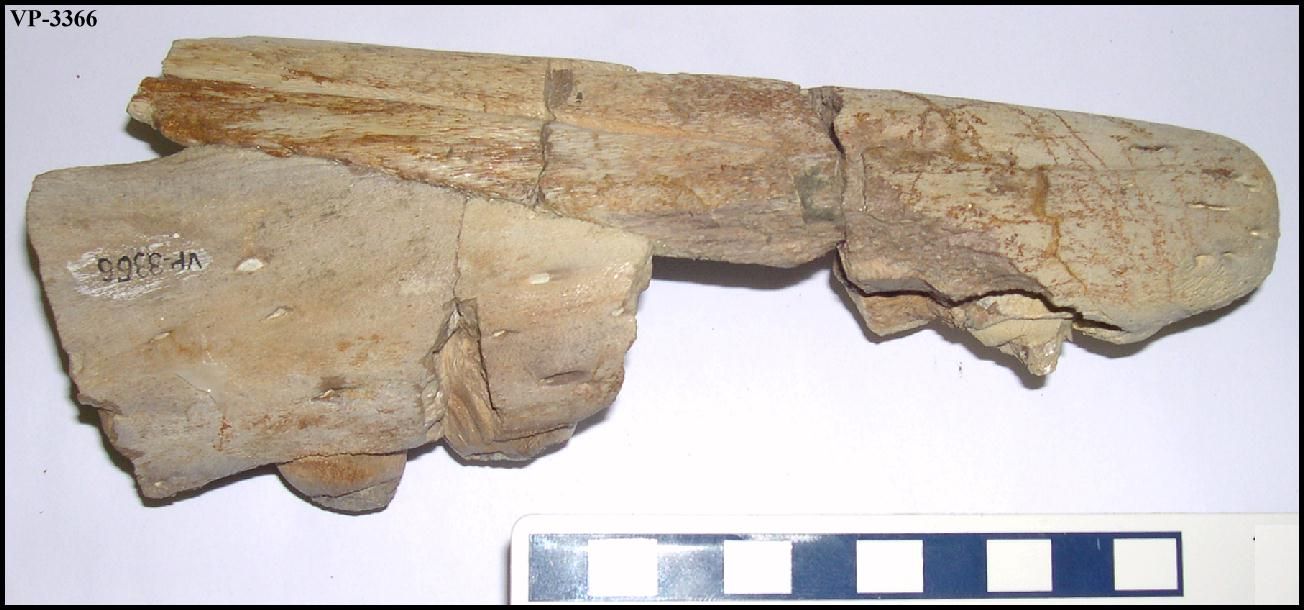
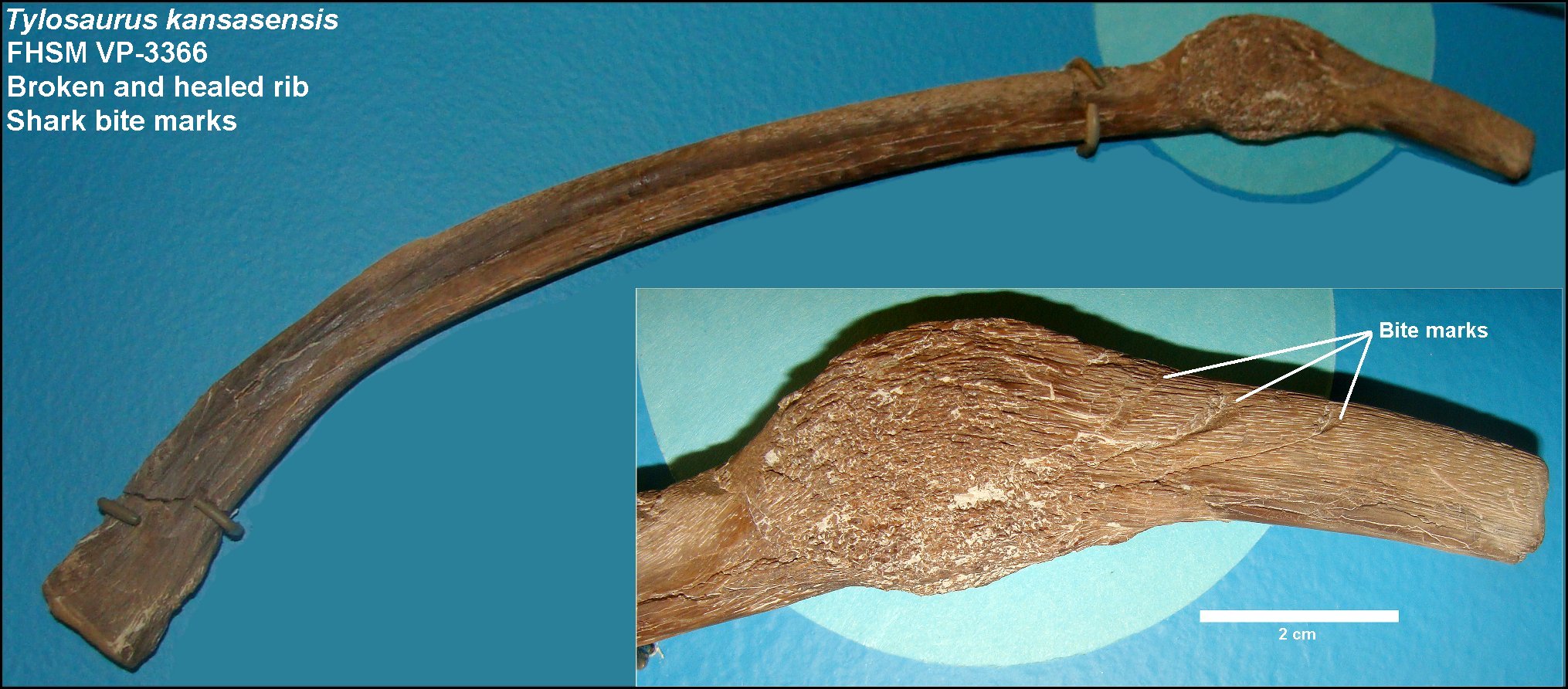
FHSM VP-3366, an unmounted, partial skull (including premaxilla and a right quadrate) with twenty-four cervical and dorsal vertebrae, rib fragments (two with healed fractures), and preserved thoracic cartilage. Scavenging by Squalicorax falcatus is indicated by serrated bite marks on the remains. Collected by R.L. Bliss in April 1972 from the lower Smoky Hill Chalk of Gove County, Kansas. Here is a right lateral view of the premaxilla and the anterior portion of the right maxilla. Note the relatively short extension of the predentary portion of the rostrum. Click here for a photo of a healed rib facture including shark bite marks. LEFT: The right quadrate of VP-3366 in lateral, medial, posterior and anterior views. The quadrates of Tylosaurus kansasensis lack (or have a very small) infrastapedial process. |
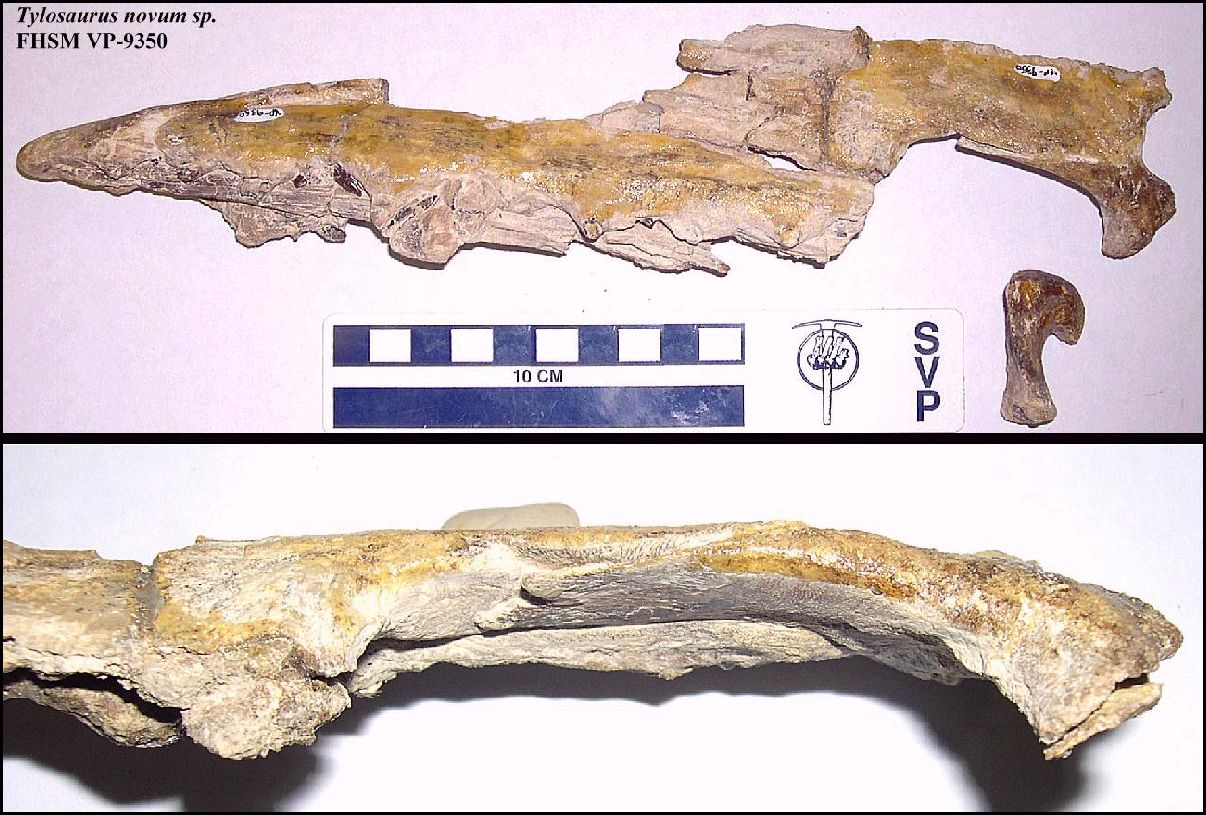 |
FHSM
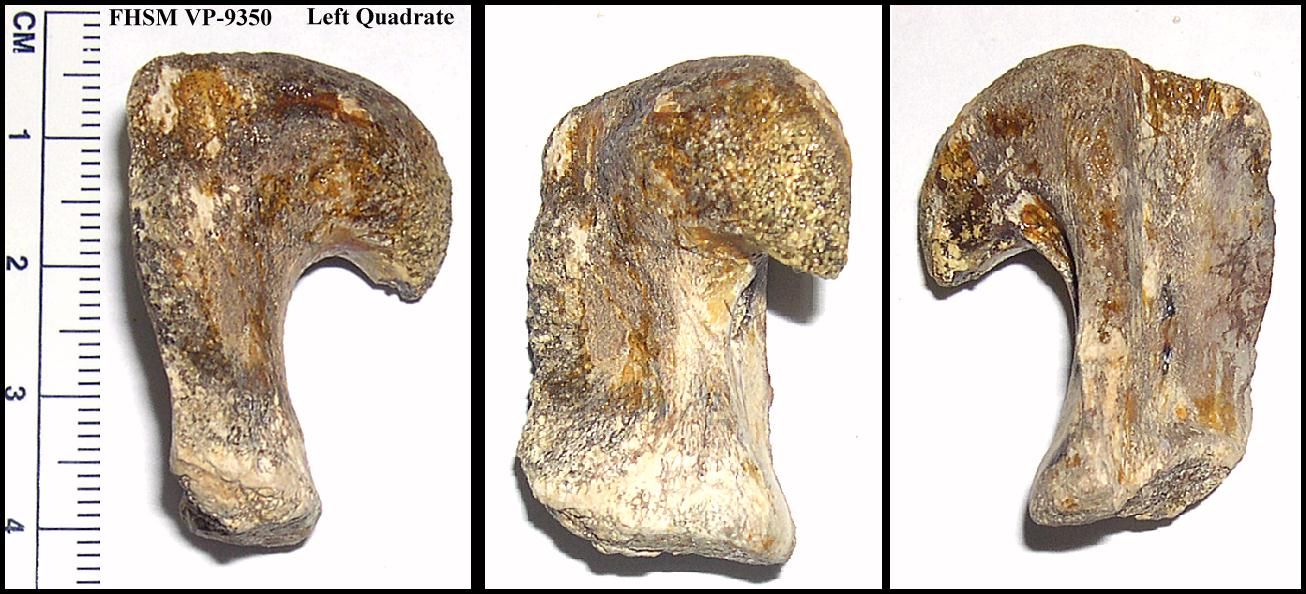
VP-9350, the unmounted, partial skull (including the premaxilla, left maxilla, left
quadrate and both lower jaws) of a juvenile Tylosaurus
that
was discovered lying on its right side on the surface of the chalk. The specimen was
weathered when collected and preservation is poor. Lower jaw length is 37 cm and the
height of the left quadrate is 3.6 cm. The remains were collected by H.E. LaGarry in
September 1987 from the lower chalk of Graham County and originally identified as Platecarpus.
Lateral, medial and posterior views of the left
quadrate. LEFT (Upper): Left lateral view of the partial skull of VP-9350, including the left quadrate. (Lower): A close-up of the left lateral edge of the frontal, showing the anterior extension of the post orbitalfrontal over the orbit of the eye. In Tylosaurus, this flange extends over the posterior extension of the prefrontal and excludes the frontal from the orbit of the eye. |
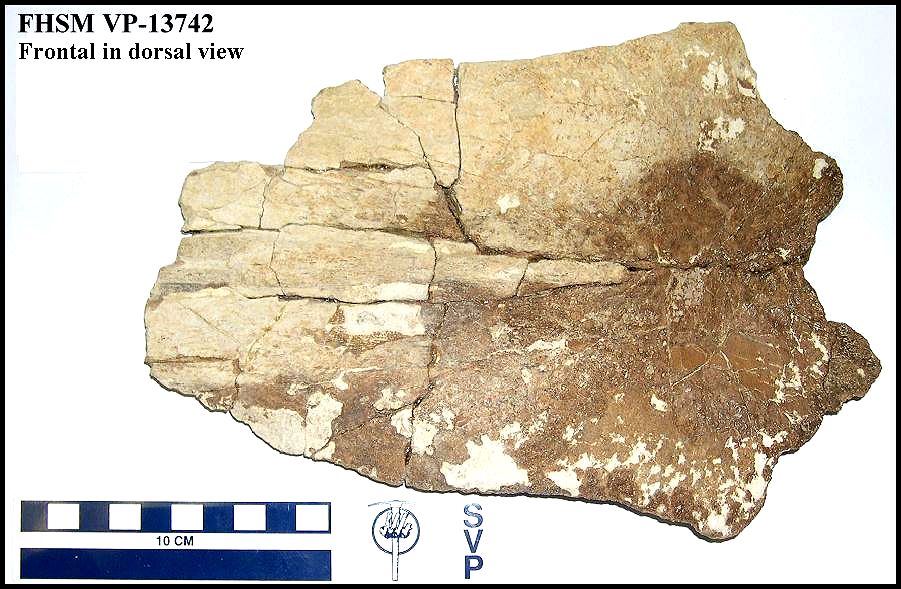 |
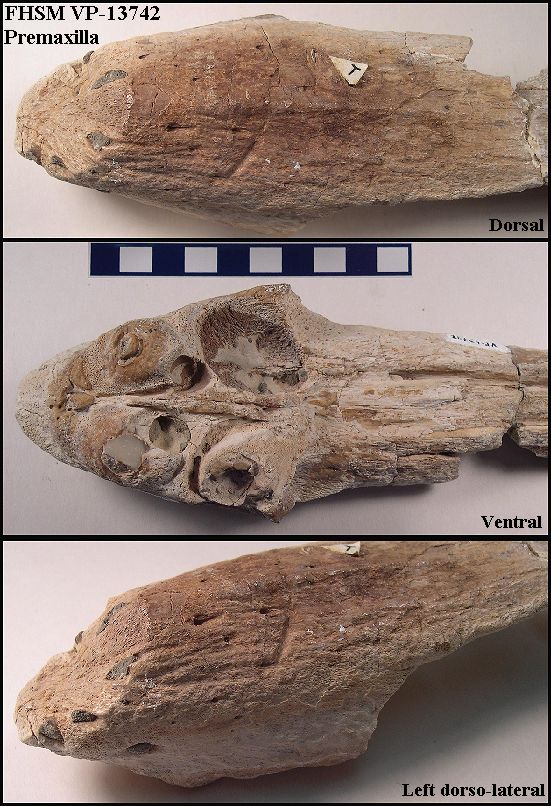
FHSM VP-13742, the weathered and fragmentary skull of an adult Tylosaurus including the premaxilla, portions of both maxillae, a complete frontal and both lower jaws (lacking both quadrates), and a few bones from the front limbs. The remains were discovered by the author in February 1990 on the surface of the low chalk (between mu4 and mu5) of Gove County. The tips of three shark teeth (Cretoxyrhina mantelli) were embedded in the top of the premaxilla and one each in the lateral side of both dentarys. In addition, the anterior end of the premaxilla had apparently been sheared off by the bite of a shark and the damaged bone shows no evidence of healing. The lower jaws measure 98 cm, suggesting a mosasaur of about 7 m in total length (Everhart, 2002). VP-13742 is the largest known example of Tylosaurus kansasensis. LEFT: The partial frontal of VP-13742 in dorsal view. |
 |
FHSM
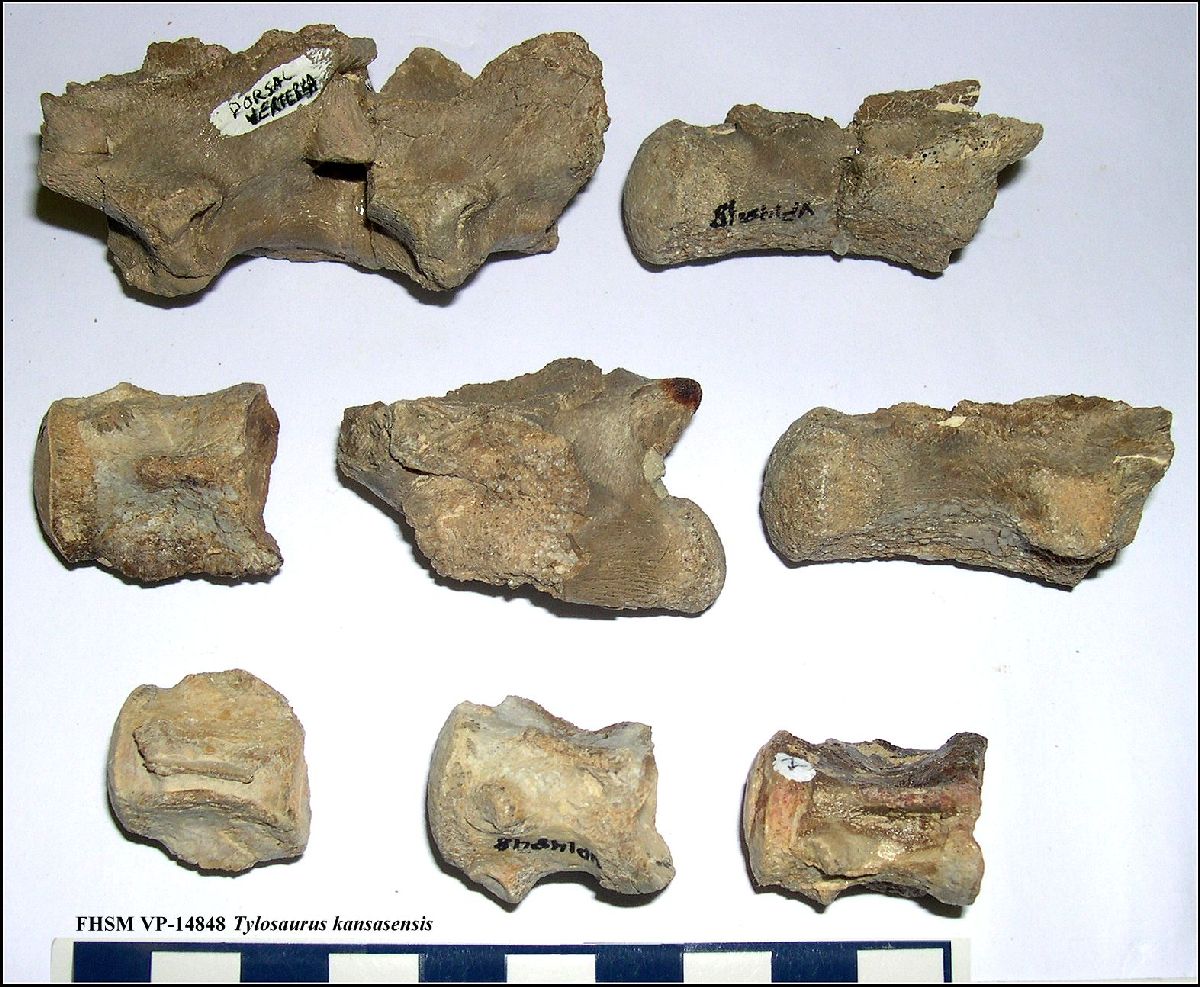
VP-14848, forty-eight cervical, dorsal and
caudal vertebrae and fragments of the skull, including the parietal, braincase and
left quadrate, of a small (2 m) Tylosaurus
kansasensis.
The specimen was discovered in 1990 in the lower chalk of Gove County by P.A. Everhart.
The left quadrate (about 3.7 cm in height) is broken at mid-shaft but complete. No limb
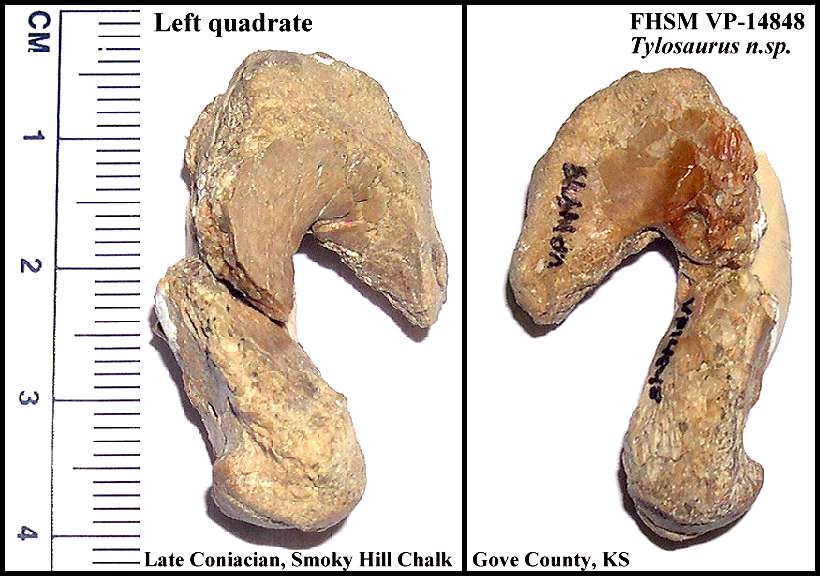
material is present. LEFT: Left quadrate of VP-14848 in lateral and medial view. Note the scale (cm) .. this quadrate is less than 1.5 inches in height. |
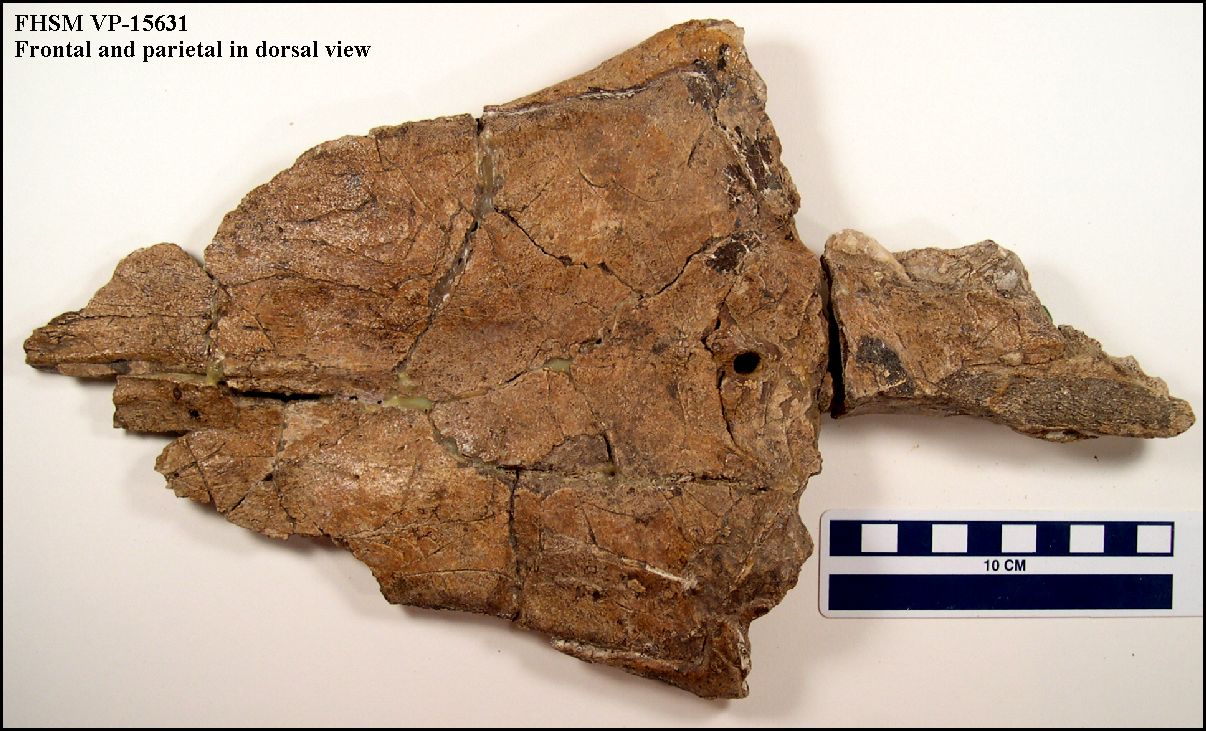 |
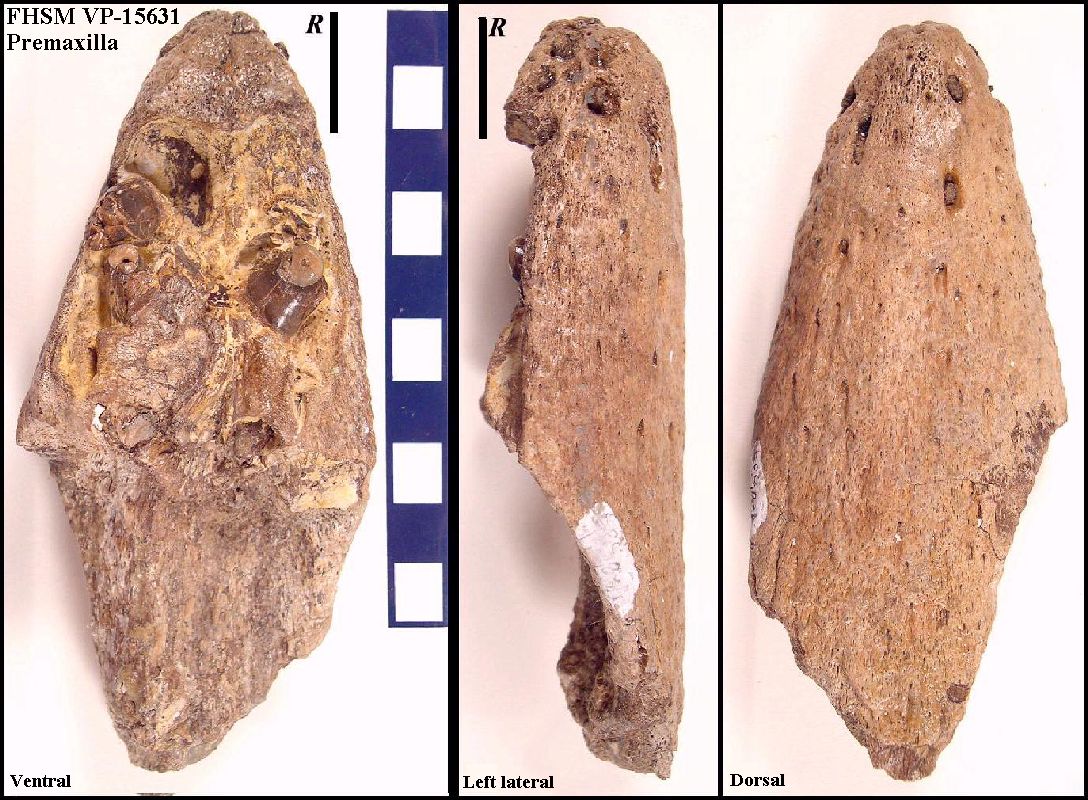
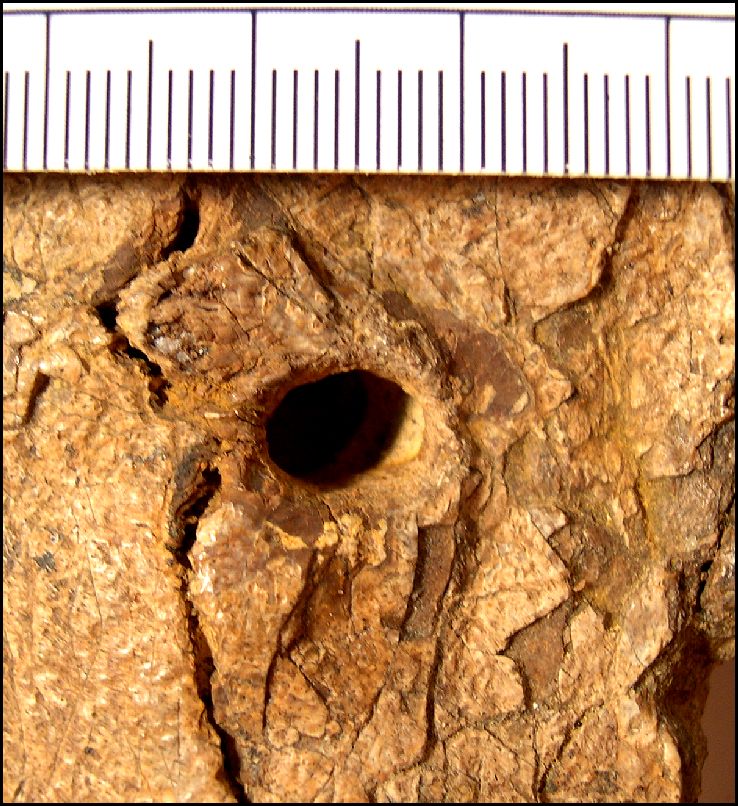
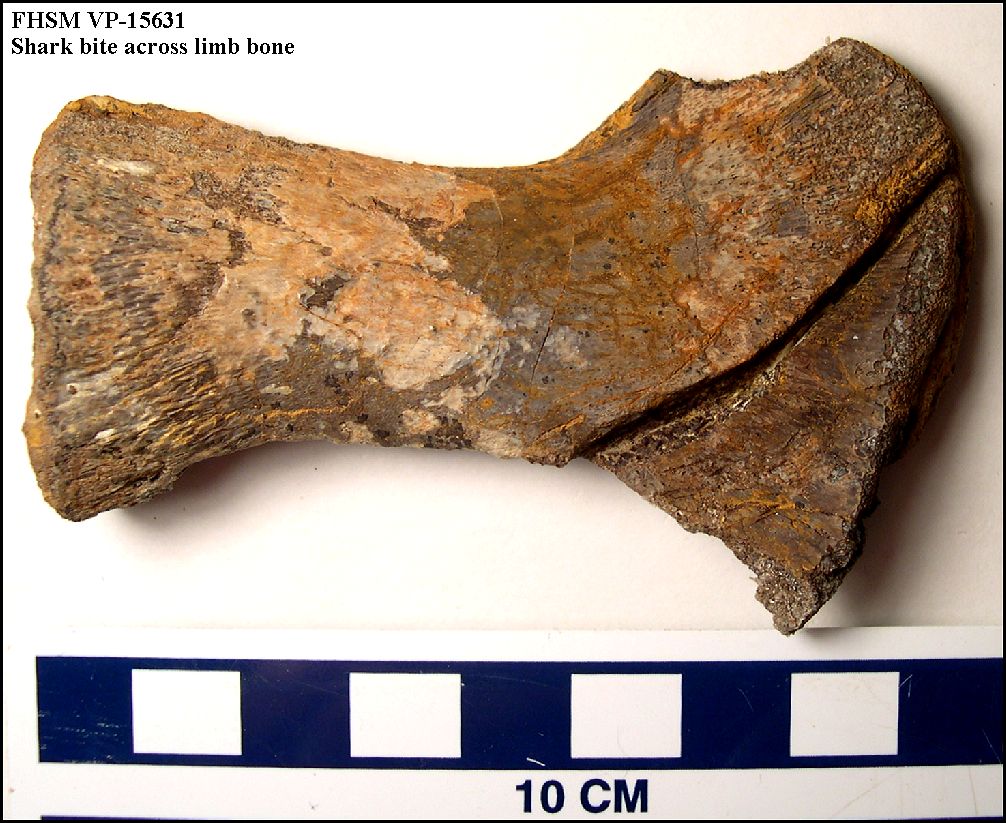
FHSM VP-15631, the complete skull (including premaxilla, frontal/parietal and partial right quadrate), pectoral girdle and most of both front limbs, several ribs and a series of forty-two consecutive cervical, dorsal and caudal vertebrae of an adult Tylosaurus. The specimen was collected by the author in November, 1979 from the lower chalk (MU1-MU2) of Ellis County. The overall condition is poor due to plant roots and subsurface weathering. The pre-dental process of the premaxilla is relatively short and the ventral surface appears to preserve some sort of bone modification due to an infection or disease (pathology). This close-up of the parietal (pineal) foramen shows its characteristic location next to the frontal- parietal suture. Evidence of scavenging by sharks is preserved in this deep cut across one of the front limb bones (radius or ulna). LEFT: Frontal and partial parietal of VP-15631 in dorsal view. |
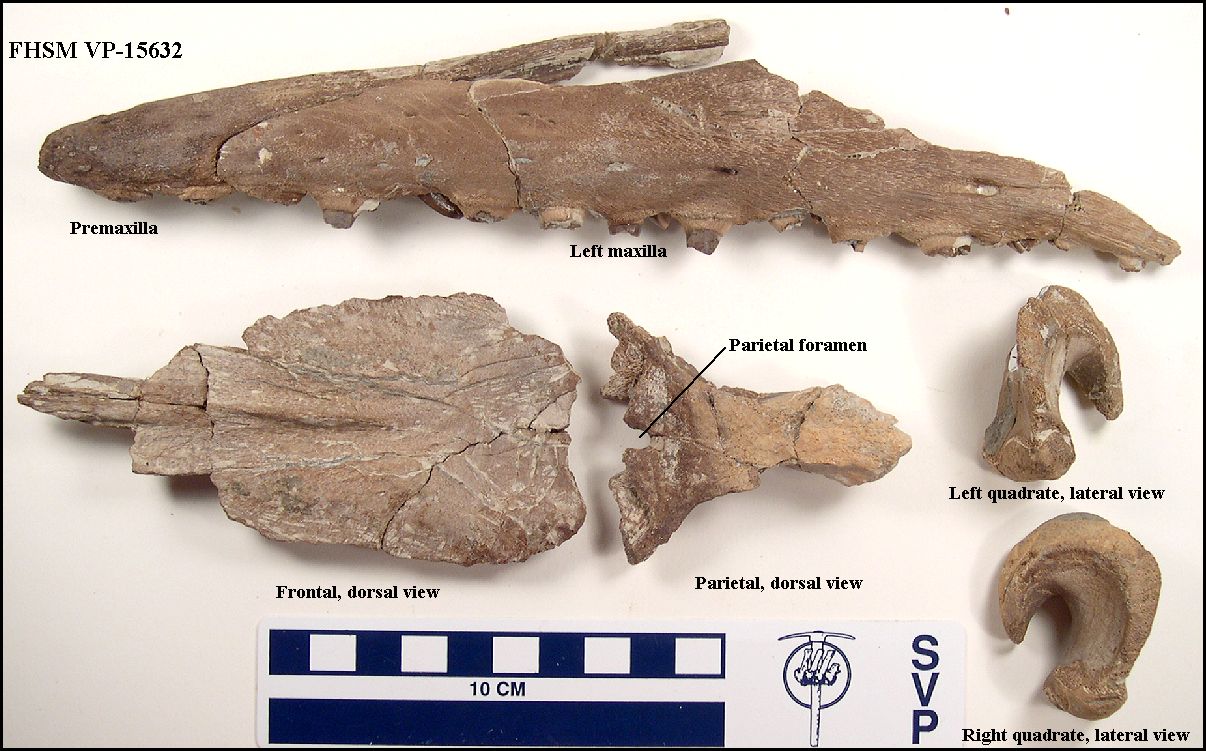 |
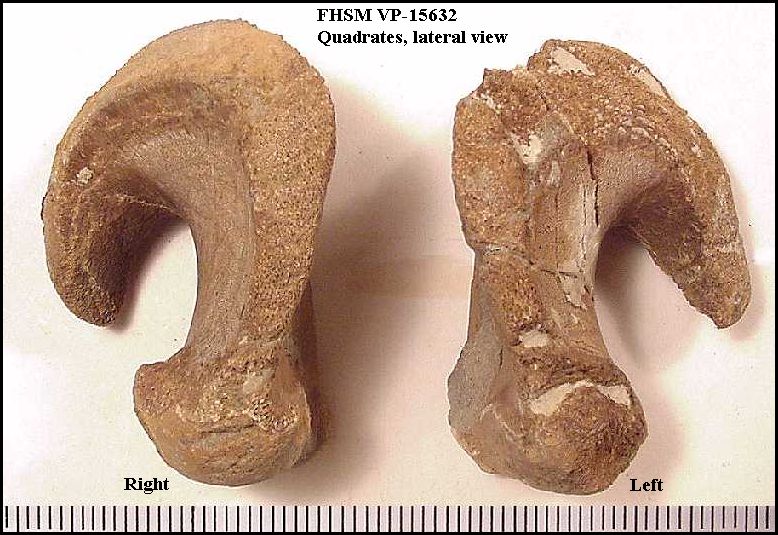
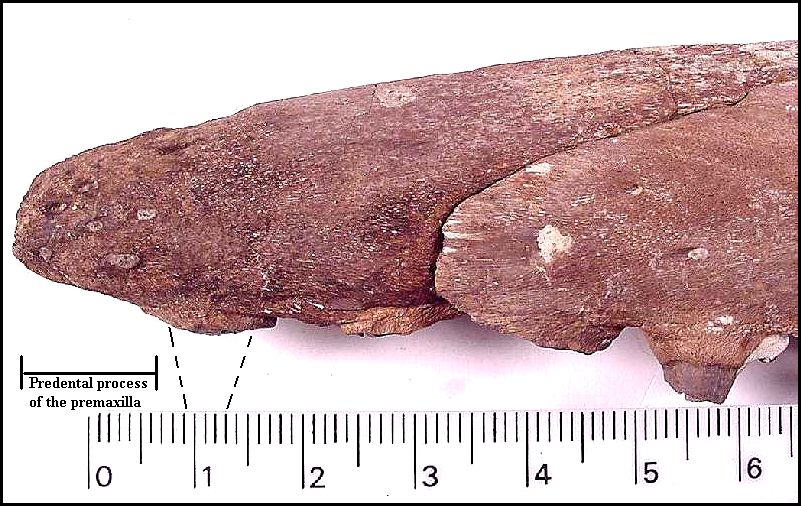
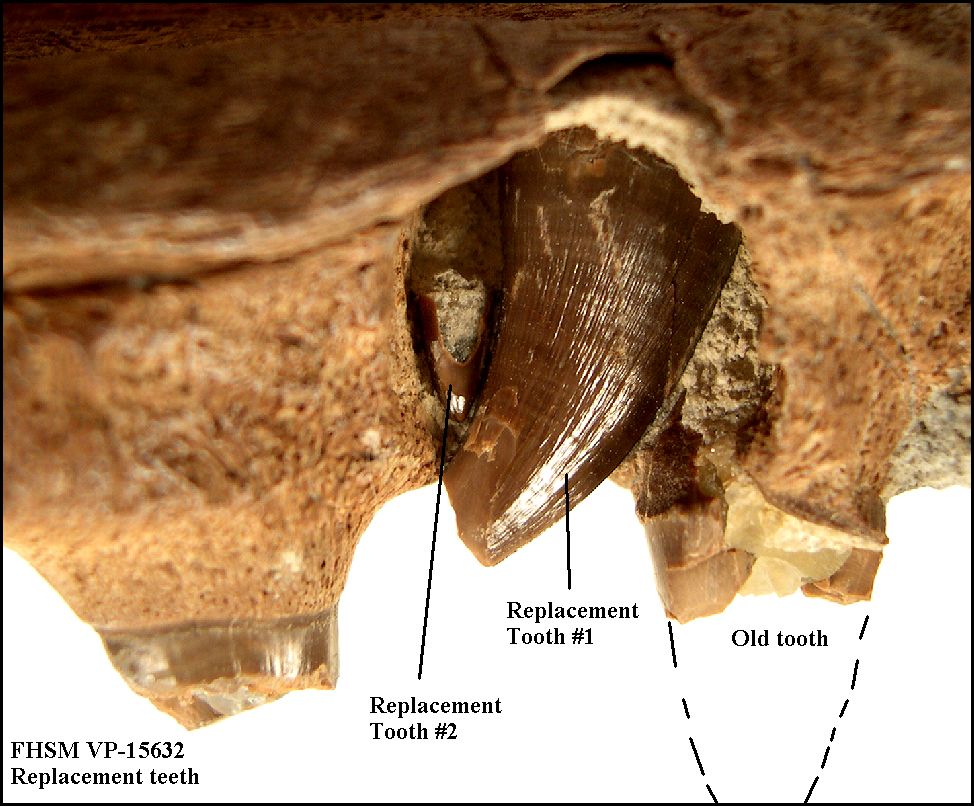
FHSM VP-15632, a fragmentary skull of a juvenile Tylosaurus (including the premaxilla, frontal/parietal, both quadrates and both lower jaws) and five cervical vertebrae. The left lower jaw measures 42 cm. The specimen was discovered by P.A. Everhart in June 1990 in the lower chalk (between MU 4 and MU 5) of Gove County. A portion of the remains were exposed on the surface and some bones were damaged by weathering and plant roots. Quadrates of VP-15632 in lateral view (NOTE: This photo was published on page 147 of my recent book (Sea Monsters) with the caption identifying these bones as vertebrae(?)... I know the difference, but someone at National Geographic didn't).... The premaxilla and anterior portion of the left maxilla in left lateral view. Again, note the relatively short pre-dental process. Medial (lingual) view of a portion of the left maxilla, showing two old teeth (broken), a replacement tooth and a replacement for the replacement tooth. The rapid replacement of teeth may be an indication of how quickly these animals were growing... Go here for the earlier web page about this specimen LEFT: A composite view of some of the elements of the skull of VP-15632, as labeled. |
The following picture are of the skull of the holotype specimen, FHSM VP-2295.
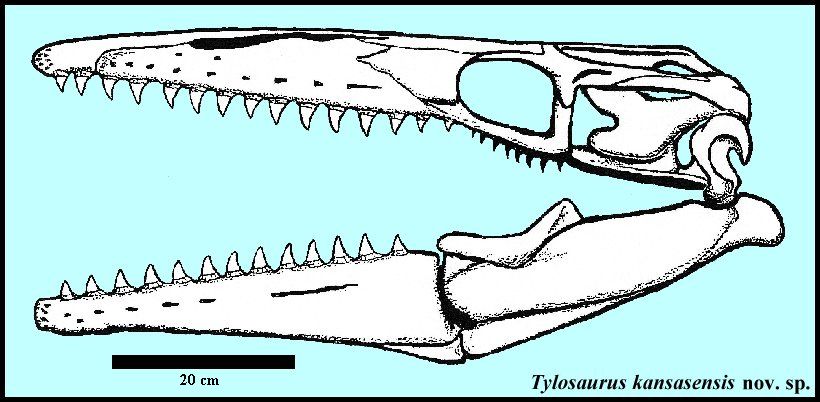 |
LEFT: A drawing of the skull of Tylosaurus kansasensis, nov. sp., adapted from a drawing of Tylosaurus nepaeolicus from Russell (1967, fig. 95) Note the shortened premaxilla compared to T. proriger or T. nepaeolicus. |
|
LEFT: The skull of the holotype specimen of Tylosaurus kansasensis (FHSM VP-2295) in left dorso-lateral view. Lower jaw length is 72 cm. The mosasaur would have been 5.5 m in length. |
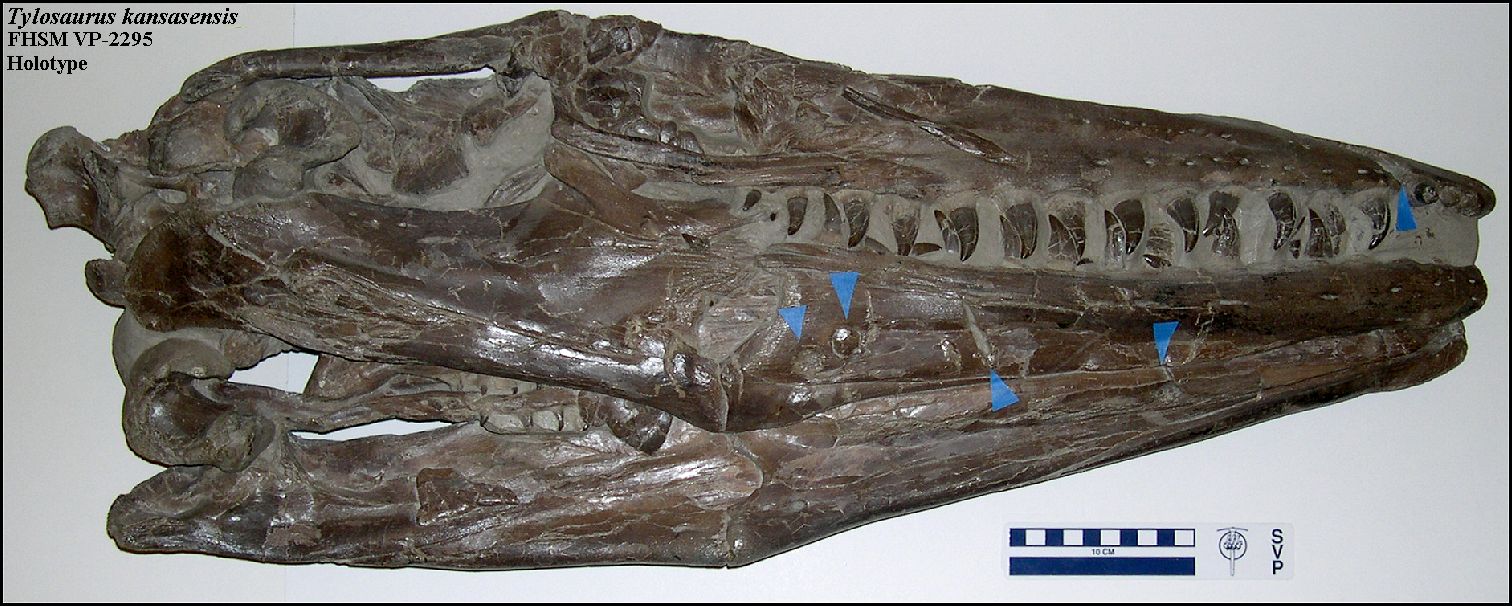 |
LEFT: The skull of the holotype specimen of Tylosaurus kansasensis (FHSM VP-2295) in right, ventro-lateral view. |
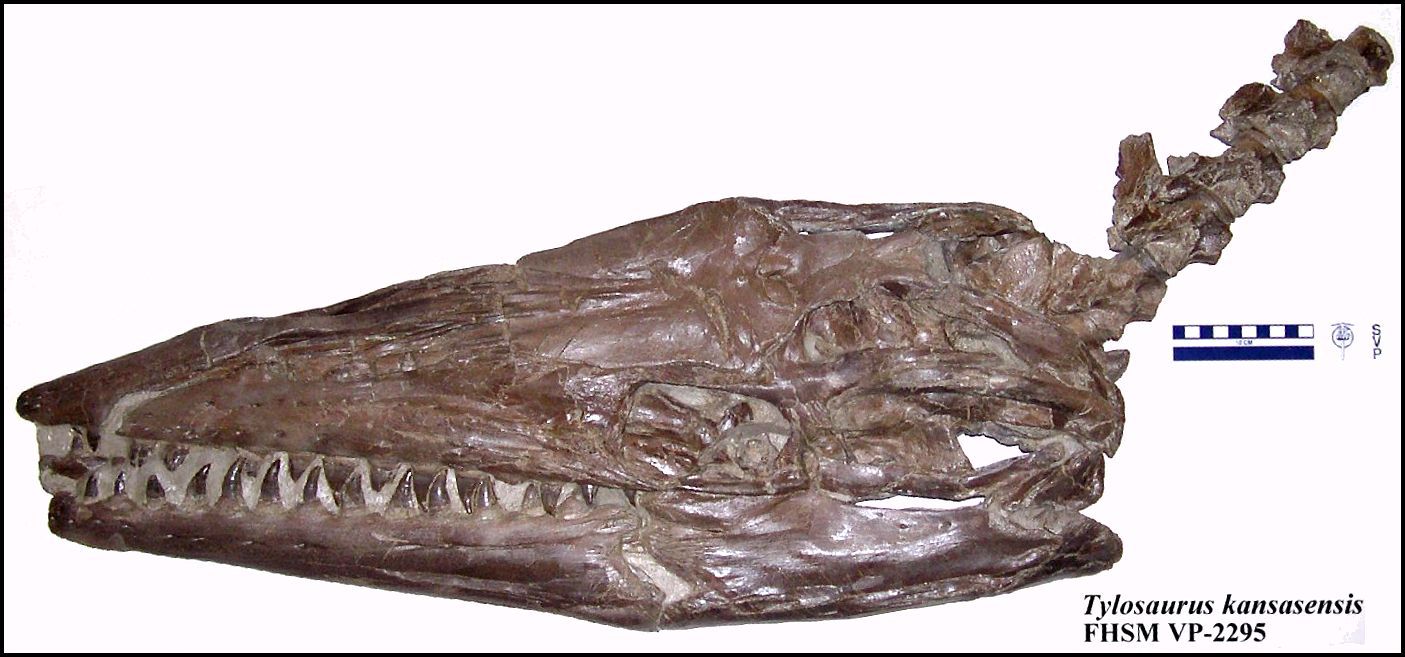 |
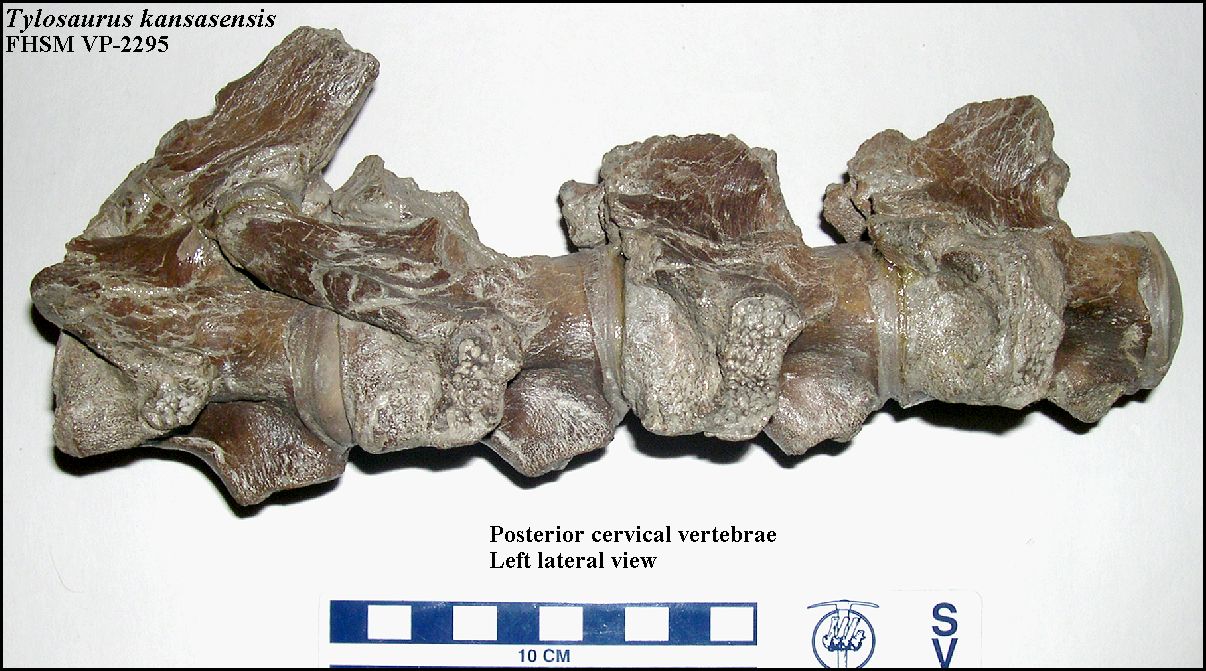
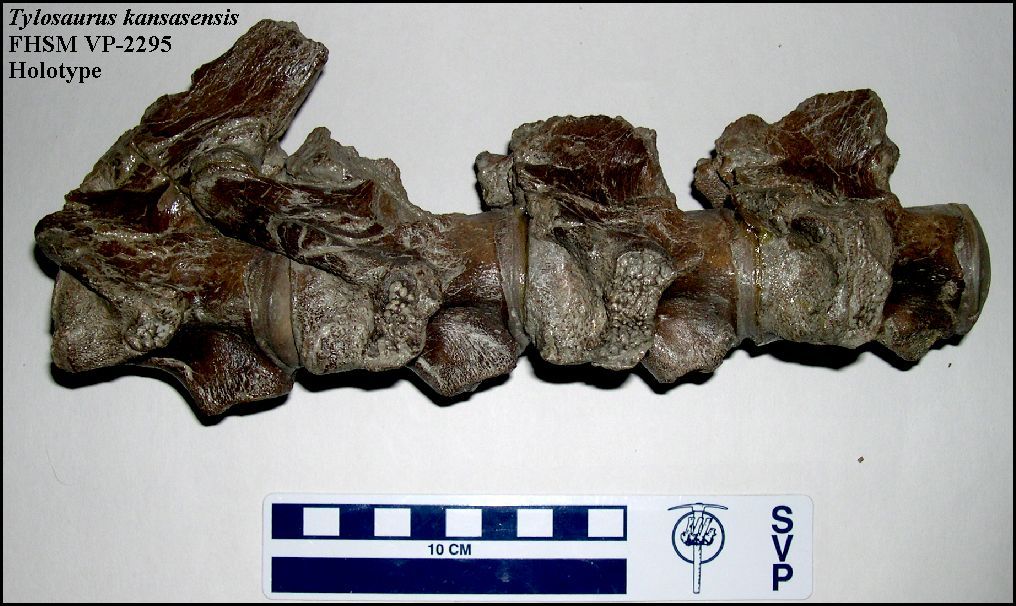
LEFT: This is the entire specimen (FHSM VP-2295); an articulated
skull and 6 cervical vertebrae. RIGHT: The four articulated cervical vertebrae that were the first portion of the remains of VP-2295 to be discovered. Note that these are preserved in almost a straight line compared to the 45 degree bend in the vertebral column closer to the skull. This suggests to me that the mosasaur's neck was broken by the larger mosasaur at the time of the attack. |
 |
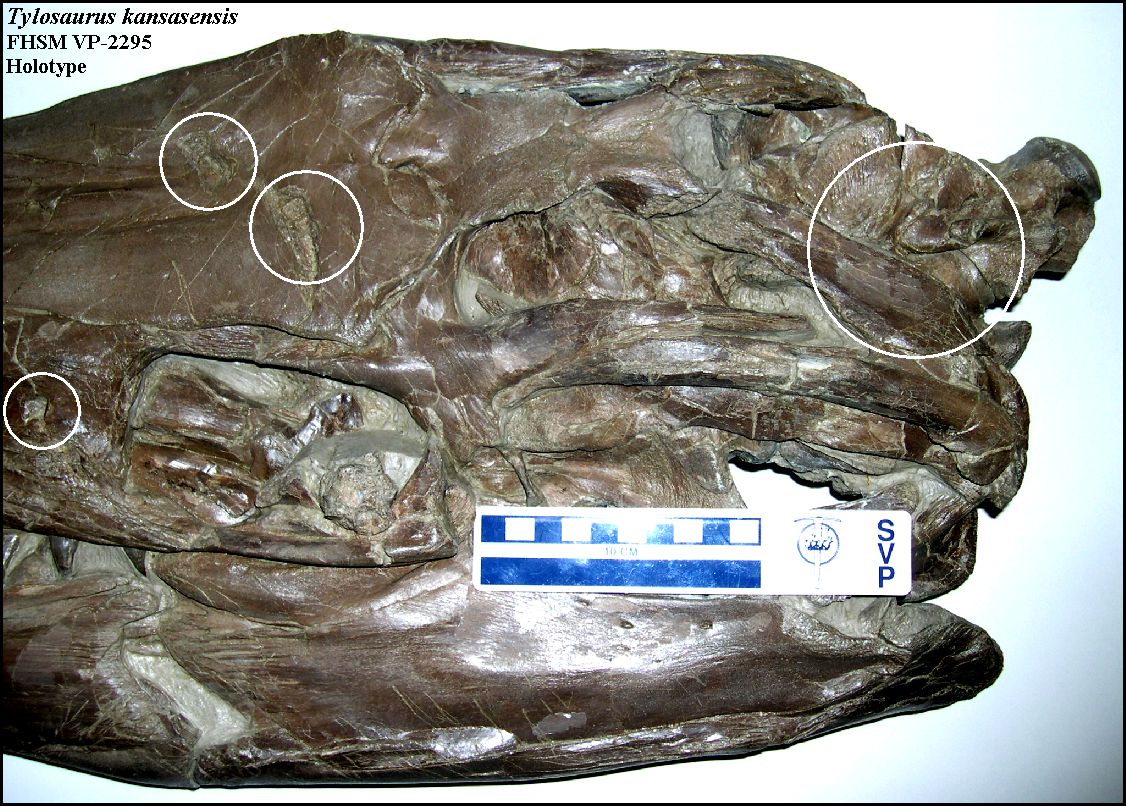 |
LEFT: A closer view of the front/parietal area of the FHSM
VP-2295 skull showing two large and deep bite marks on the front (Medium circles), a
puncture in the left prefrontal (small circle) and possible damage to a cervical vertebra
near the back of the skull. The lower edge of the left lower jaw also shows scratch marks
that are indicative of small sharks scavenging the around the fleshy throat of this
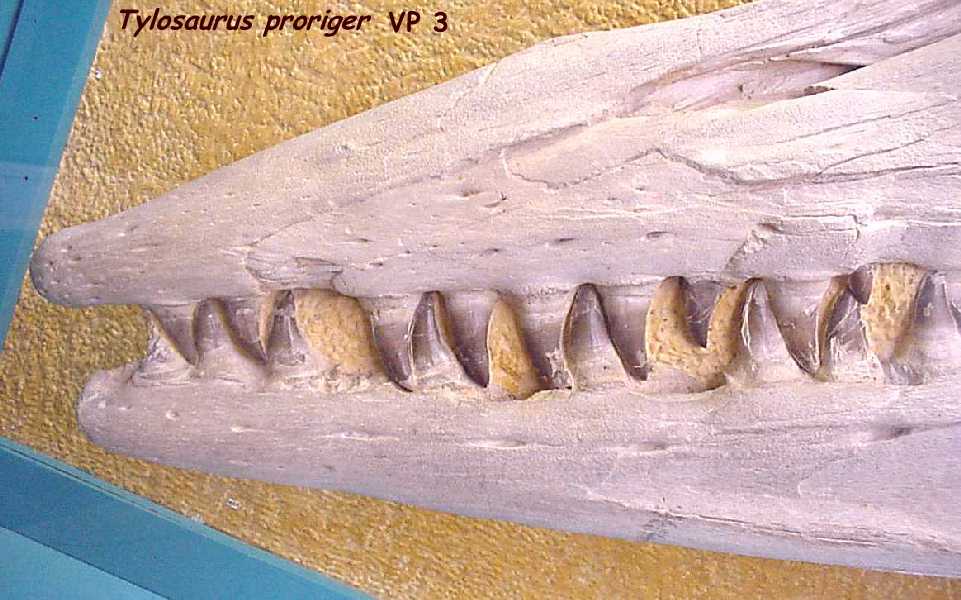
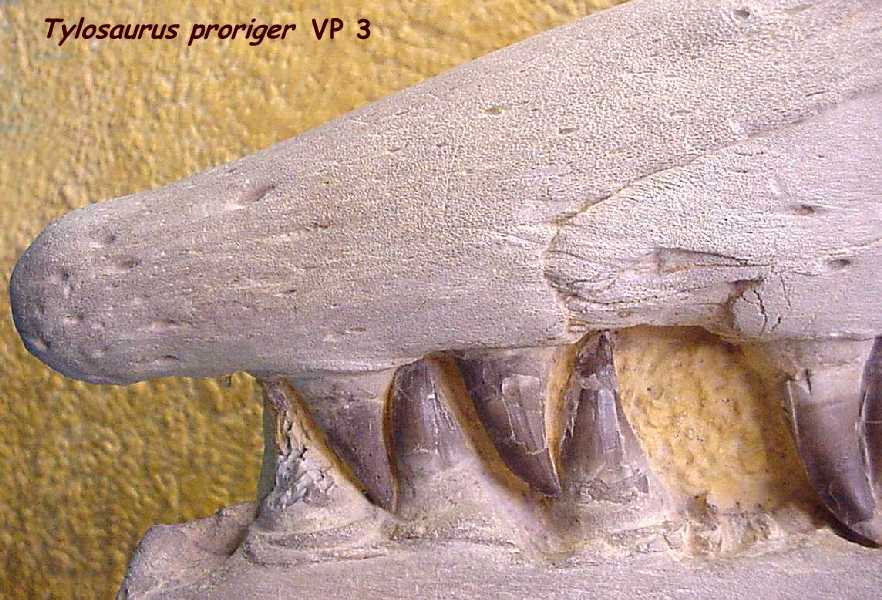
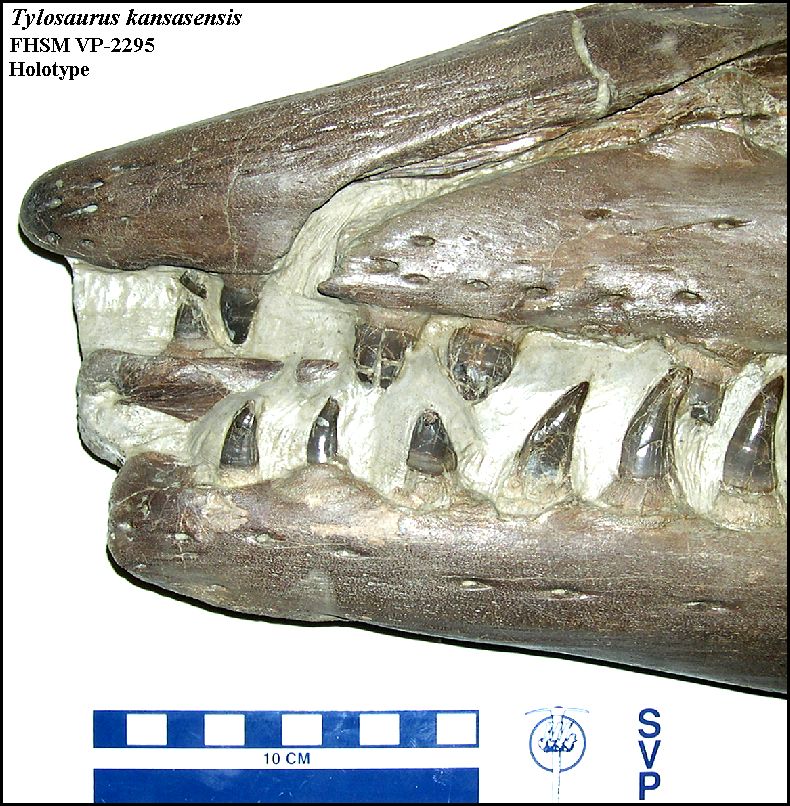
specimen. RIGHT: The premaxilla, anterior left maxilla and anterior portions of both dentarys in left lateral view. Note the relatively small size of the rostrum compared with Tylosaurus proriger (FHSM VP-3) |
 |
 |
LEFT: Right dentary of FHSM VP-2295 showing bite marks (blue
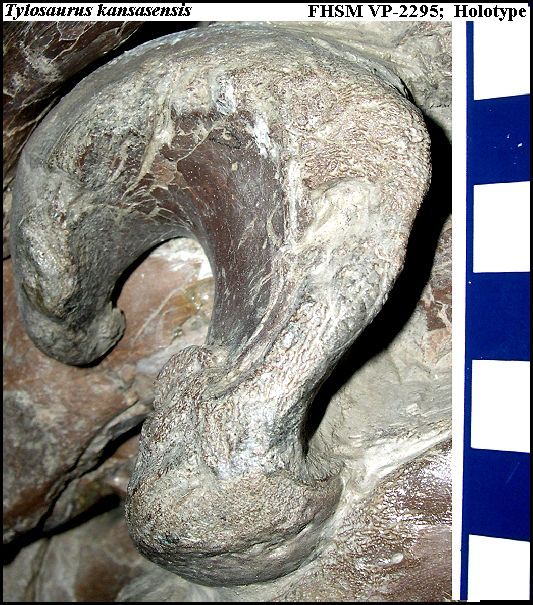
triangles) and scratches attributable to a larger mosasaur. RIGHT: The right quadrate in lateral view. The quadrates of Tylosaurus kansasensis are different from those of other tylosaurs because they lack an infrastapedial process... Go HERE for a picture of larger and more typical tylosaurine quadrate. |
 |
The following note (Everhart, 2004) was written for the First Mosasaur Conference (Maastricht, The Netherlands, 2004) and describes some of the history behind this new species:
Everhart, M. J. 2004. Tylosaurus novum sp. – An update on an unnamed species of basal tylosaurine. Abstract book and field guide of the First Mosasaur Meeting, Schulp, A. S. and John W. M. Jagt (eds.), Natuurhistorisch Museum Maastricht, the Netherlands, pp. 35-39. Tylosaurus novum sp. – An update on an unnamed species of basal tylosaurine. Michael J. Everhart Sternberg Museum of Natural History, Fort Hays State University, Hays, KS. . ABSTRACT Tylosaurines were among the earliest of the mosasaurs which flourished in the oceans of the earth during the last 25 million years of the Late Cretaceous. Tylosaurus (“Macrosaurus”) proriger was the first mosasaur described from the Niobrara Chalk of the Western Interior Sea by Cope in 1869. Since then, the remains of tylosaurine mosasaurs have been recovered from many localities around the world, including Europe, Japan, New Zealand and Antarctica. The remains of the earliest known tylosaurine species, T. nepaeolicus (Cope 1874), are found in the Late Coniacian in the western Kansas along with Platecarpus tympaniticus Cope 1869, and Clidastes liodontus Cope 1874. Another early species of tylosaurine, originally identified as “Tylosaurus n. sp.” by Stewart (1990), apparently co-existed with T. nepaeolicus and exhibited a number of primitive characters which place it in a basal position in the mosasaur phylogeny of Bell (1997). Differences between it and all other tylosaurs include: quadrates that lack an infrastapedial process; a shortened, more rounded premaxilla; and an anteriorly located parietal foramen that often invades the frontal-parietal suture. Except for a few fragmentary and problematic remains found in Texas, the third species of Tylosaurus is known only from the lower Smoky Hill Chalk Member of the Niobrara Chalk of western Kansas. The species apparently became extinct by the Early Santonian. Since 1990, other than brief, unpublished descriptions by Bell (1993) and Schumacher (1993), and inclusion within Bell’s (1997) phylogenetic revision of the Mosasauroidea, the new species has only been mentioned in the literature without further comment. For a variety of reasons, and somewhat without precedent, this species still does not have a formal name, even though there are a number of well preserved, articulated skulls and several reasonably complete skeletons in museum collections. The purpose of this paper is to update the information regarding this species and to begin the process of describing and naming Tylosaurus novum sp. INTRODUCTIONWhile the place of origin of mosasaurs is yet to be determined, it is reasonably certain that at least three genera flourished first in the Western Interior Sea. The isolated remains of early mosasaurs, cf. Clidastes, have been found in the Turonian Carlile Formation of Kansas (Martin and Stewart, 1977), and mosasauroids have been documented from the Turonian of Texas (Bell, 1995) and South Dakota (Bell and VonLoh, 1998). By the Late Coniacian, Clidastes, Platecarpus and Tylosaurus were well established in the shallow epicontinental sea covering the middle of North America (Russell, 1967). Following the end of the Coniacian (circa 85 mya), it appears that mosasaurs evolved rapidly and spread quickly around the world during the last 20 million years of the Late Cretaceous (Lingham-Soliar, 1999). Their remains are known from marine sediments on all continents, and are especially abundant and complete in the Smoky Hill Chalk Member (Late Coniacian through Early Campanian) of the Niobrara Formation in western Kansas and the overlying Pierre Shale (Campanian – Maastrichtian) of Kansas and South Dakota. During the five-year period between 1869 and 1874, most of the mosasaur species currently considered to be valid from the Smoky Hill Chalk Member of the Niobrara Formation in western Kansas were named by E. D. Cope (Everhart, 2001). These include: the genus Clidastes Cope 1868 and its type species, C. propython Cope 1869 (originally described from the Alabama chalk); the genus Platecarpus Cope 1869 and its type species, P. tympaniticus Cope 1869, and P. planifrons (Cope 1874); and the type species of Tylosaurus. The first mosasaur described from Kansas, “Macrosaurus” proriger (Cope 1869) was found in the upper (Santonian or Early Campanian) Smoky Hill Chalk near Monument Rocks in western Kansas in 1868, and was acquired by Louis Agassiz for the museum at Harvard. The genus Tylosaurus (Rhinosaurus) is only mosasaur genus named by Marsh (1872a; 1872b) to survive the test of time, but it was Leidy (1873, p. 271) who formally placed Cope’s “Macrosaurus” into Tylosaurus. While T. proriger had been originally reported only in the upper chalk (Williston, 1898; Russell, 1967; Schumacher, 1993; Sheldon, 1996), somewhat older remains (FFHM 1997-10) have recently been reported from the middle chalk (early Middle Santonian) by Everhart and Everhart (1997). A second species, T. nepaeolicus, was described from the Smoky Hill Chalk on the basis of fragmentary remains discovered by B. F. Mudge along the Solomon River (Cope, 1874). T. nepaeolicus is an early, somewhat smaller species that has only been collected from the Late Coniacian Smoky Hill Chalk (Everhart, 2002). A third species of tylosaurine was recognized but not described by Stewart (1990) from his biostratigraphic zone of Protosphyraena perniciosa (Late Coniacian) and designated “Tylosaurus n. sp.” Bell (1993) reviewed museum collections and designated seven specimens as Tylosaurus novum sp. About the same time, three specimens in the collection of the Sternberg Museum were assigned to an “undescribed species” of Tylosaurus by Schumacher (1993). Tylosaurus novum sp. was included a revision of mosasaur phylogeny by Bell (1997). Schumacher (1993), Sheldon (1996) and Everhart (2001) revised the stratigraphic occurrence of mosasaurs in the Smoky Hill Chalk, including Tylosaurus n. sp. However, Carpenter (2003) did not mention the third species in his report on the vertebrate stratigraphy of the Smoky Hill Chalk and Sharon Springs member of the Pierre Shale. ABBREVIATIONS AMNH, American Museum of Natural History, New York; FHSM, Fort Hays Sternberg Museum, Hays, Kansas; FFHM, Fick Fossil and History Museum, Oakley, Kansas; FM, Fryxell Geology Museum, Augustana College, Rock Island, Illinois; LACMNH, Los Angeles County Museum of Natural History, Los Angeles, California; MCZ, Museum of Comparative Zoology, Harvard University, Cambridge, Massachusetts; TMM, Texas Memorial Museum, University of Texas at Austin, Texas; and YPM, Peabody Museum of Natural History, Yale University, New Haven, Connecticut. MATERIAL Although the occurrence of the third species was first reported by Stewart (1990), he did not refer to any specimens in museum collections. A list of currently identified specimens is shown in Table 1. In his phylogenic revision of the Mosasauroidea, Bell (1993, p. 254; 1997, p. 328) listed seven specimens as Tylosaurus novum sp.: FHSM VP-2295, VP-78 and VP-2495; LACMNH 127815; MCZ 1589; YPM 3392 and 40796. Schumacher (1993) reported three specimens of an “undescribed tylosaur” in the Sternberg Museum collection: FHSM VP-2295, VP-78 and VP-3366. Two more recent additions to the Sternberg collection (VP-9350 and VP-13742) are here identified as belonging to the third species of Tylosaurus. An articulated skull and lower jaws of the third species of Tylosaurus (V-43) is currently on exhibit in the Fryxell Museum of Geology. In addition, the author’s collection includes two incomplete specimens that are attributable to the third species. Two unreported, fragmentary specimens from the Late Cretaceous of Texas in the collection of the Texas Memorial Museum exhibit characteristics similar to those of the Kansas specimens of Tylosaurus novum sp. DISCUSSION In 1979, a Tylosaurus specimen consisting of a nearly complete skull, articulated vertebrae and front limbs was collected by the author from near the base of the Smoky Hill Chalk (Late Coniacian). It was noted to have an unusually short anterior extension of the premaxilla and a parietal foramen that was adjacent to the fronto-parietal suture, and could not be identified to species until recently. Another specimen (FHSM VP-13742) which included a disarticulated skull and limb elements was collected by the author from the lower chalk in 1990. While neither the parietal or the quadrates were recovered with these remains, the medial posterior edge of the frontal is notched in a way that would suggest that it had been invaded by the parietal foremen. The anterior extension of the premaxilla is short and rounded, and does not resemble that of T. nepaeolicus or T. proriger. A portion of the anterior end of the premaxilla also appears to have been removed by the bite of a large shark and the tip of a Cretoxyrhina mantelli tooth is embedded in the dorsal surface of the bone. Later in 1990, a juvenile Tylosaurus skull and cervical vertebrae were collected by the author from the same general area and stratigraphic level as VP-13742. The specimen preserves both quadrates, the premaxilla, parietal and frontal. The anterior of the premaxilla is shortened and rounded compared to other species of Tylosaurus, the parietal foremen invades the suture between the frontal and the parietal, and neither of the well preserved quadrates exhibits an infrastapedial process. The remains are very similar in size and preservation to those of FHSM VP-2495 which was identified as Tylosaurus novum sp. by Bell (1993; 1997). In his discussion of the lowest biostratigraphic zone in the Smoky Hill Chalk, Stewart (1990, p. 22) indicated that “two tylosaurine species have been found in this horizon, Tylosaurus nepaeolicus and Tylosaurus n. sp.” He also noted (ibid., p. 25, 29) that “Tylosaurus n. sp. is limited to the zone of Protosphyraena perniciosa” and included the species in his taxonomic listing. Stewart’s (1990) biostratigraphic zone of Protosphyraena perniciosa is Late Coniacian in age and includes Hattin’s (1982) marker units 1 through 5. Bell (1990, pers. comm.) noted that one of the exhibit specimens at the Sternberg Museum (FHSM VP-78) was mis-labeled as Platecarpus and was, instead, the undescribed species of Tylosaurus. Bell (1993, p. 188) cited the LACMNH 127815 specimen as an example of Tylosaurus novum sp., and noted, among other characters (Table 2), that the infrastapedial process was absent and the “parietal foramen was close to the fronto-parietal suture.” Bell (ibid., p. 254) lists seven specimens in museum collections that he attributes to the third species. Schumacher (1993) noted independently (pers. comm., 2004) that the infrastapedial process was greatly reduced or lacking on the quadrates of three specimens of an undescribed species of Tylosaurus that he examined in the Sternberg Museum collection. He (1993) also reported that the rostrum of VP-78 and VP-2295 were “unusually pointed and rounded” compared to the blunt, cylindrical rostra Tylosaurus proriger and T. nepaeolicus, and that in VP-78, the parietal foremen invades the suture between the frontal and parietal. The parietal foramen is not visible in VP-2295 due to crushing. Another, more recently collected juvenile specimen in the Sternberg Museum collection (FHSM VP-9350) exhibits a shortened, rounded premaxilla and a quadrate without an infrastapedial process. An articulated Tylosaurus skull (FM V-43) collected from the Smoky Hill Chalk by George Sternberg and acquired by the Fryxell Geology Museum is another good example of the undescribed species. Although the parietal foramen is obscured by plaster in the exhibit mounting, the right quadrate and the premaxilla are typical of Tylosaurus novum sp. An isolated premaxilla (TMM 40092-27) and an associated premaxilla and right quadrate (TMM 31051-64) in the Texas Memorial Museum collection have similar characteristics to the Kansas specimens but have not been examined in detail. The basal tylosaurine mosasaur, Tylosaurus novum sp., is represented by a number of well preserved and documented remains recovered from the Late Coniacian Smoky Hill Chalk of western Kansas. As such, the species should be formally described and named. LITERATURE CITED Bell,
G. L., Jr. 1993. A phylogenetic revision of Mosasauroidea, unpublished doctoral
dissertation, The University of Texas at Austin, 293 pages.
Everhart,
M.J. 2008. A bitten skull of Tylosaurus kansasensis (Squamata:
Mosasauridae) and a review of mosasaur-on-mosasaur
pathology in the fossil record. Kansas Academy of Science, Transactions
111(3/4):251-262. |