Enchodus sp.
The Sabre-Toothed Fish of the Cretaceous
Copyright © 2003-2013 by Mike Everhart
Created 10/26/2003: last updated 026/12/2013
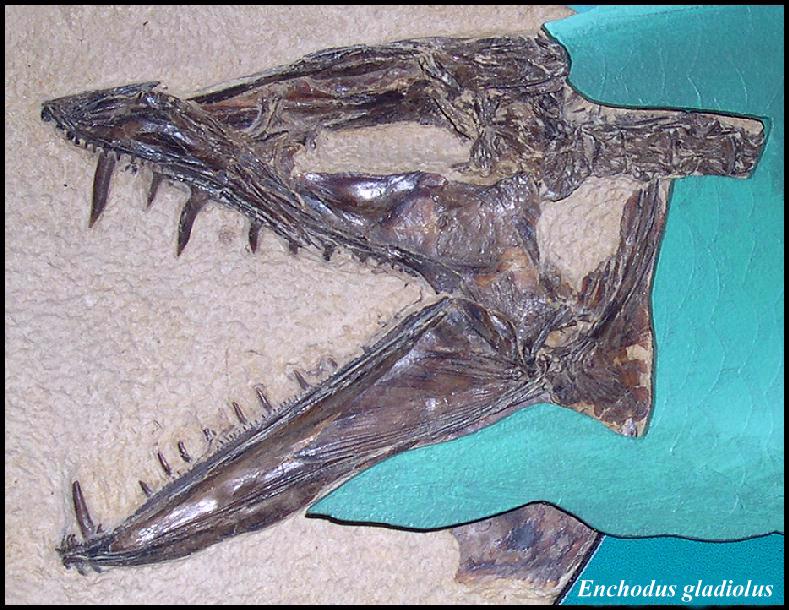
LEFT: The skull of an Enchodus gladiolus on exhibit in the Sternberg Museum of Natural History, Hays, KS.
|
Enchodus sp. The Sabre-Toothed Fish of the Cretaceous
Copyright © 2003-2013 by Mike Everhart Created 10/26/2003: last updated 026/12/2013
LEFT: The skull of an Enchodus gladiolus on exhibit in the Sternberg Museum of Natural History, Hays, KS. |
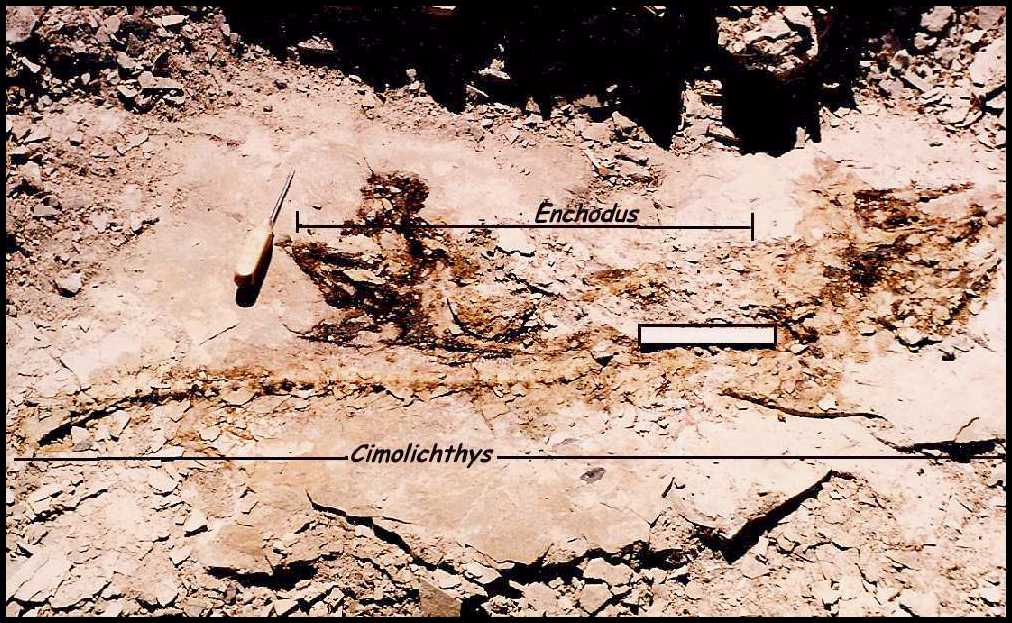
| During the Late Cretaceous, several species of fish in the genus Enchodus were common in the Western Interior Sea. They small to medium sized predators and their remains are commonly found as fossils. The characteristic that is most noticeable in all species of Enchodus is the presence of large "fangs" at the front of the upper and lower jaws. This fish has occasionally been referred to as the "Saber-Toothed Herring" because of the appearance of these unusually large, curved teeth but the genus is not related to modern Herrings. It is possible that the fish may used it's unique teeth to capture soft bodied animals like squid (Tusotuethids). This genus of fish survived the end of the Age of Dinosaurs (Mesozoic) by several million years and is well represented in the fossil record around the world. Enchodus was probably a very important part of the food chain in the oceans of the Cretaceous. From remains found recently in the chalk, we know that Enchodus was fed upon by a variety of larger animals including elasmosaurs, Cimolichthys and Squalicorax falcatus (See below). | Systematic Paleontology (Goody, 1976) Order Salmoniformes Greenwood, Rosen, and Myers, 1966 Suborder Enchodontoidei Goody, 1969 Family Enchodontidae Woodward, 1901 Genus Enchodus Agassiz, 1835 Enchodus petrosus Cope 1874 |
 |
Everhart, M. J., P. Everhart, E. M. Manning, and D. E. Hattin.
2003. A Middle Turonian marine fish fauna from the Upper Blue Hill Shale Member,
Carlile Shale, of north central Kansas. Journal of Vertebrate Paleontology, Volume 23
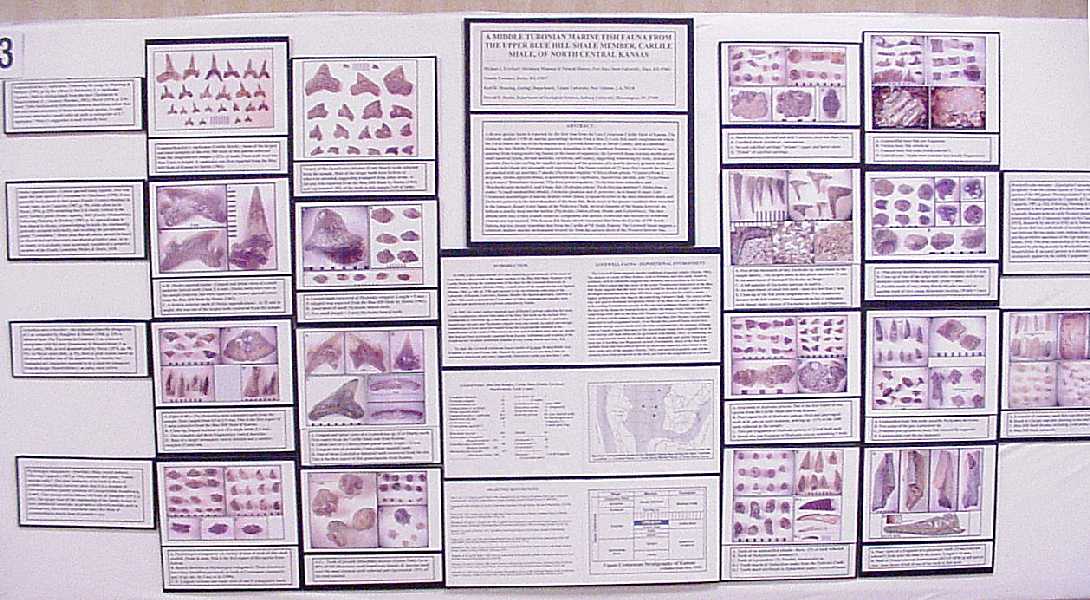
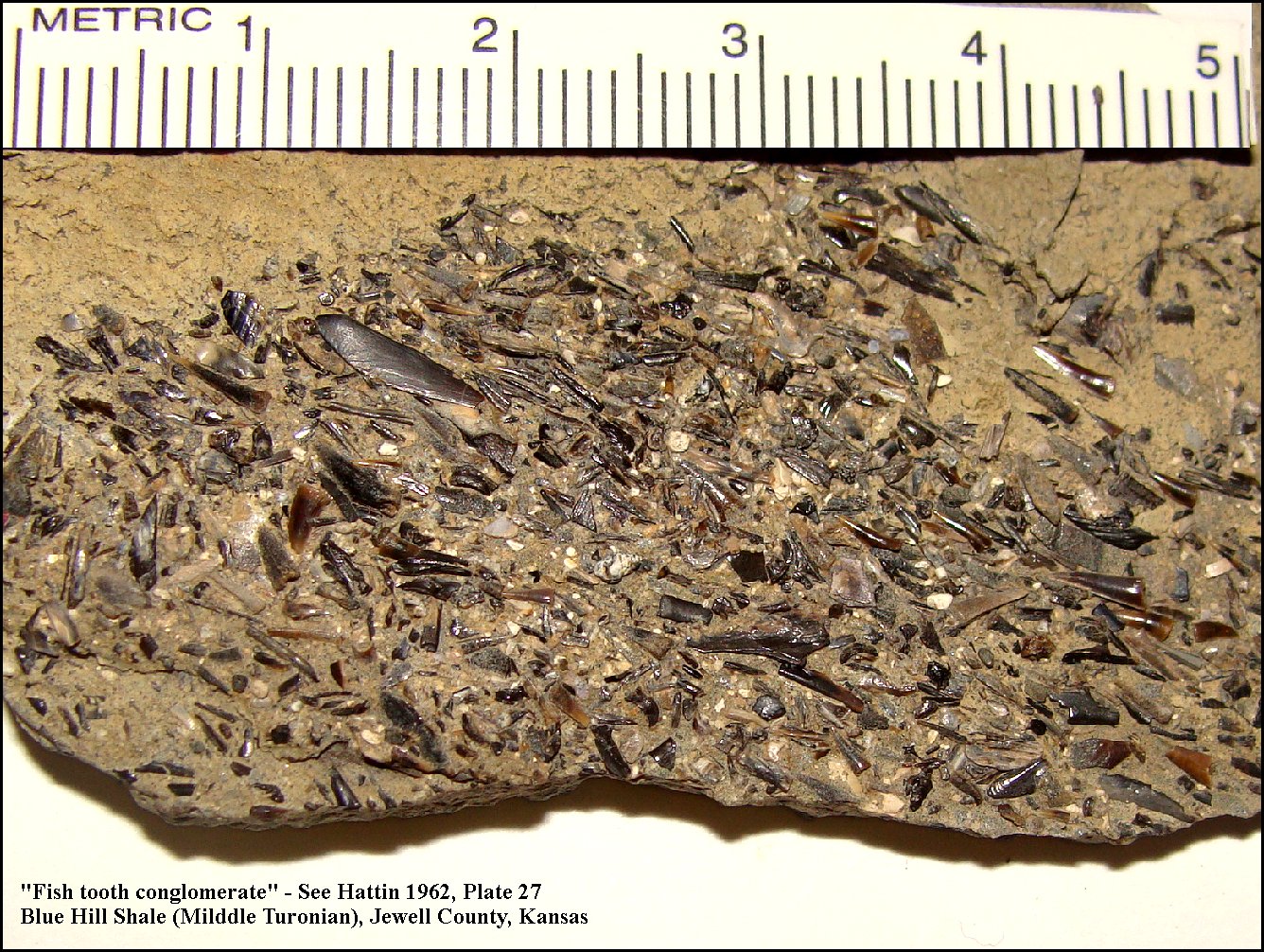
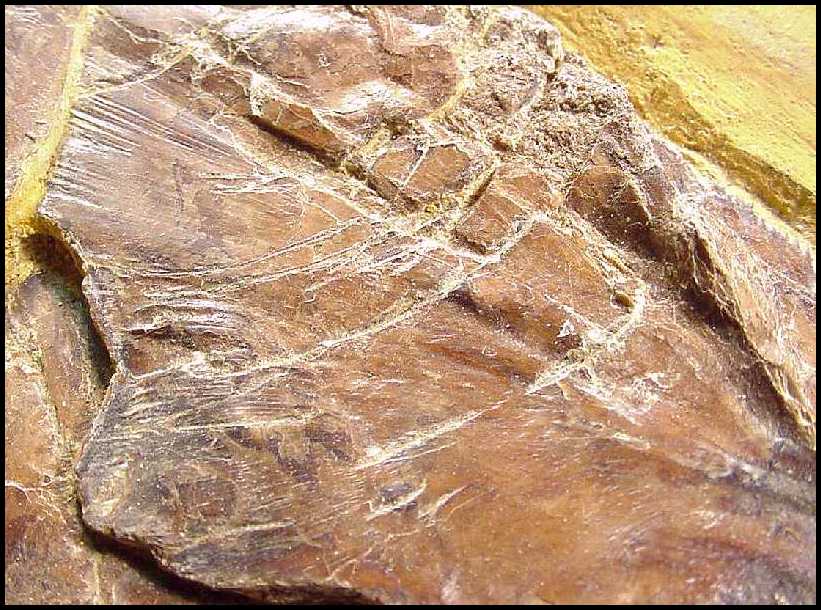
(Supplement to Number 3): 49A.(Abstract) (Picture 1) A diverse piscine fauna is reported for the first time from the Late Cretaceous Carlile Shale of Kansas. The relatively shallow (<100 m) marine assemblage derives from a thin (1-3 cm) fish-tooth conglomerate which lies 3-4 m below the top of the formation near Lovewell Reservoir in Jewell County, and accumulated during the late Middle Turonian regressive deposition in the Greenhorn Sequence. In contrast to larger material from transgressive lag faunas at the bases of sequences, the Lovewell fauna consists mostly of very small material (teeth, dermal denticles, vertebrae, and scales), suggesting winnowing by weak, intermittent currents. Due to size sorting for smaller particles, and the presence of a nearby nursery ground, teeth of juvenile individuals are unusually well represented. The fauna consists of 17 taxa (first records for Kansas are marked with an asterisk): 7 sharks (Ptychodus whipplei, *Chiloscyllium greeni, *Cantioscyllium d. decipiens, Otodus appendiculatus, Scapanorhynchus r. raphiodon, Squalicorax falcatus, and *Scyliorhinus sp.); 4 rays (*Rhinobatos incertus, *Ptychotrygon triangularis, *Ischyrhiza mira schneideri, and *Brachyrhizodus mcnultyi); and 6 bony fish (Hadrodus priscus, Pachyrhizodus minimus?, Xiphactinus a. audax, *a small unidentified albulid, Enchodus gladiolus and E. petrosus). As is found in many Late Cretaceous assemblages of marine shallow-water fishes, Scapanorhynchus is the most abundant shark and Enchodus petrosus is the most abundant of the bony fish. Both occur in far greater numbers than recorded in the younger, deeper water fauna of the Niobrara Chalk. Several elements of the fauna, however, do indicate a nearby deep-marine habitat (Ptychodus, Chiloscyllium, Otodus and Scyliorhinus). The rare albulid teeth may evince a small estuarine component, but neither freshwater nor terrestrial vertebrate remains are represented. This Kansas fish fauna closely resembles that from the Carlile of SW South Dakota, but less closely resembles that from the Carlile of NE South Dakota. The Lovewell fauna suggests a relatively shallow marine environment located far from the eastern shore of the Western Interior Sea. LEFT: A small fragment of the "Fish Tooth Conglomerate" of Hattin (1962), rediscovered in 2002 by Mike and Pam Everhart. |
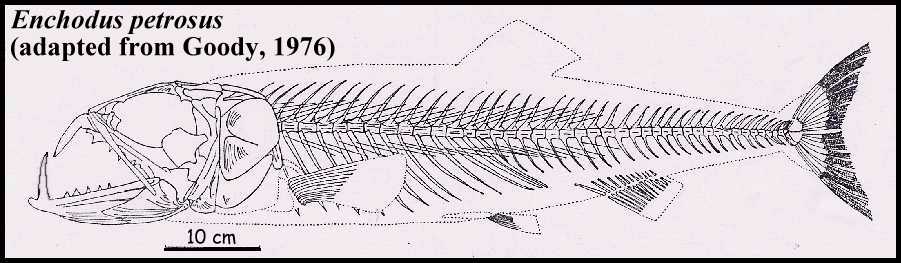 |
Note that this drawing by Goody is missing the pre- maxillae on the front of the upper jaws. |
|
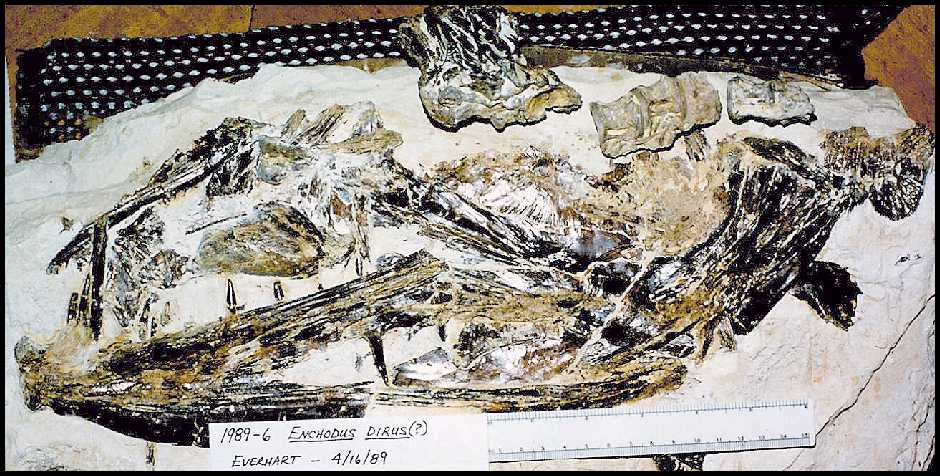 |
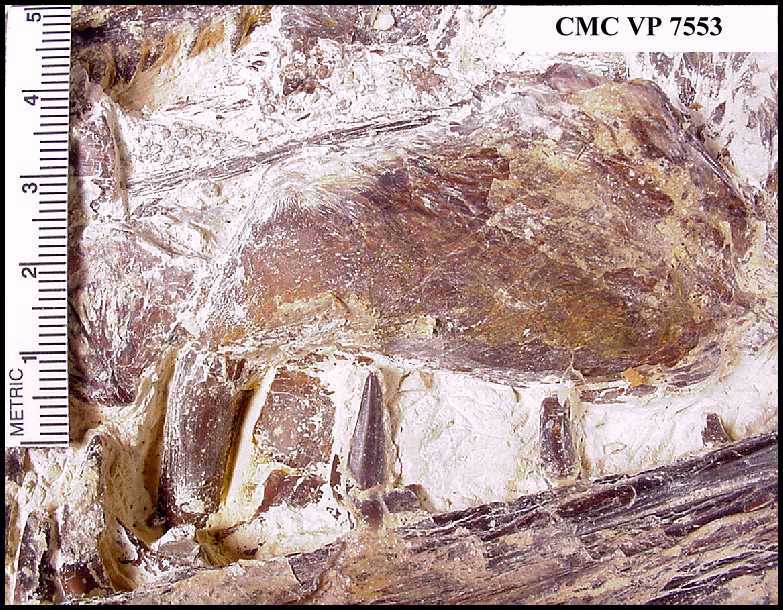
My wife, Pam, found this partial skull of a very large Enchodus petrosus (not E. dirus as indicated in the photo) in 1989. Most of what you can seen in this view is the left lower jaw stretching across the bottom of the photo. The lower jaw is about 35 cm long! Several vertebrae are shown at the top right, and the piece at the top of the photograph is the braincase. This specimen was donated to the Cincinnati Museum Center where it is curated as CMC 7553. |
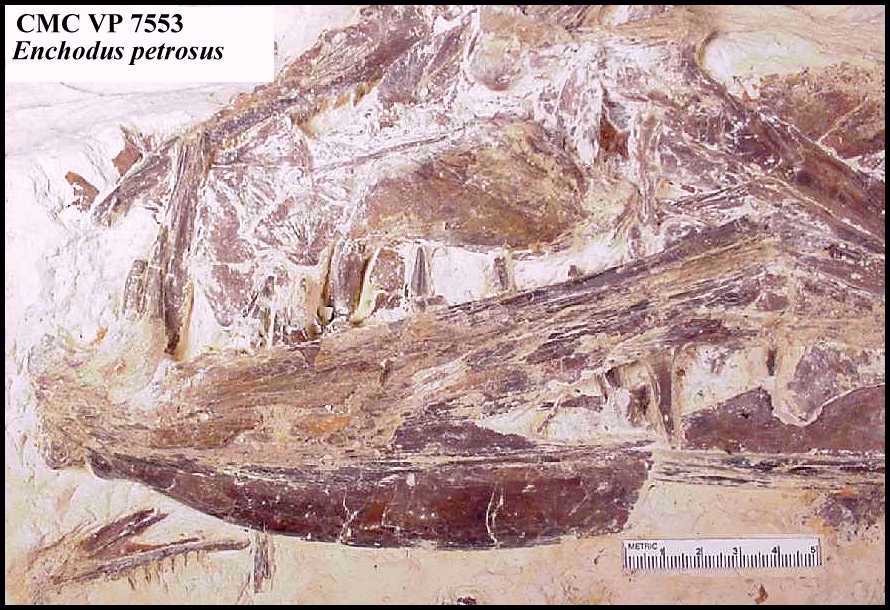 |
A closer view of the anterior end of the skull and lower jaw of CMC7553 shows more detail of the teeth in the lower jaw and the large palatine fang which is partially hidden underneath. For a larger view of the left palatine, CLICK HERE. Note the small lower jaw of a second Enchodus specimen at lower left. |
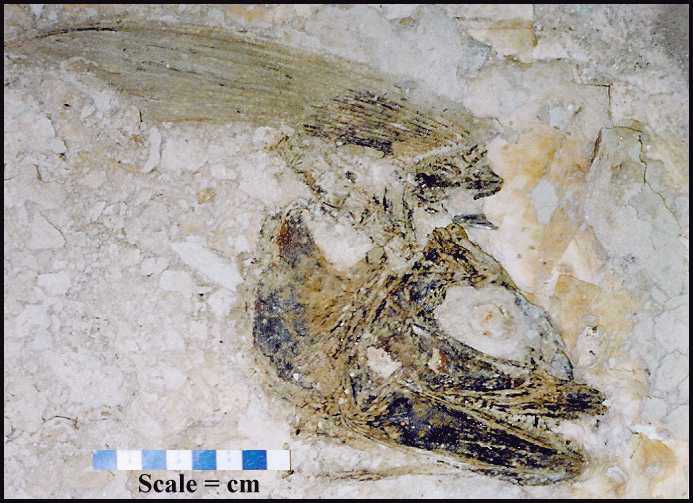 |
This was one of the first complete Enchodus (E. gladiolus, EPC1990-23 / NJSM 18777) skulls that we discovered back in 1990. It was donated to the New Jersey State Museum, and reported upon by Barbara Grandstaff at the 1990 Society of Vertebrate Paleontology annual meeting in Lawrence, KS. Note the large size of the pectoral fin above the skull. It has been suggested that Enchodus may have also been a "Flying Fish." |
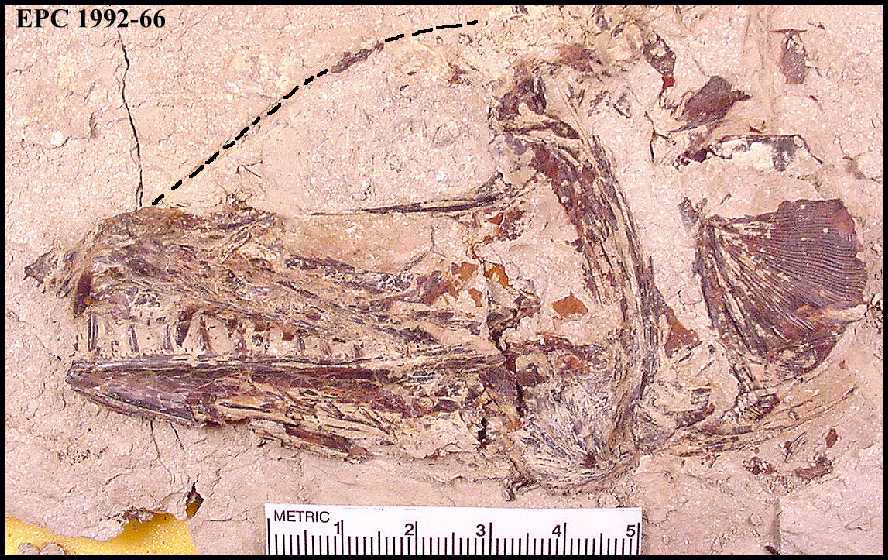 |
This was a very nice, nearly complete skull of a small Enchodus sp. (EPC 1992-66) before it eroded out of the chalk in southeastern Gove County (Late Coniacian). It was being quickly blown away by the Kansas wind when I found it in August, 1992. The dashed line indicates the missing upper margin of the skull. Scale in mm. |
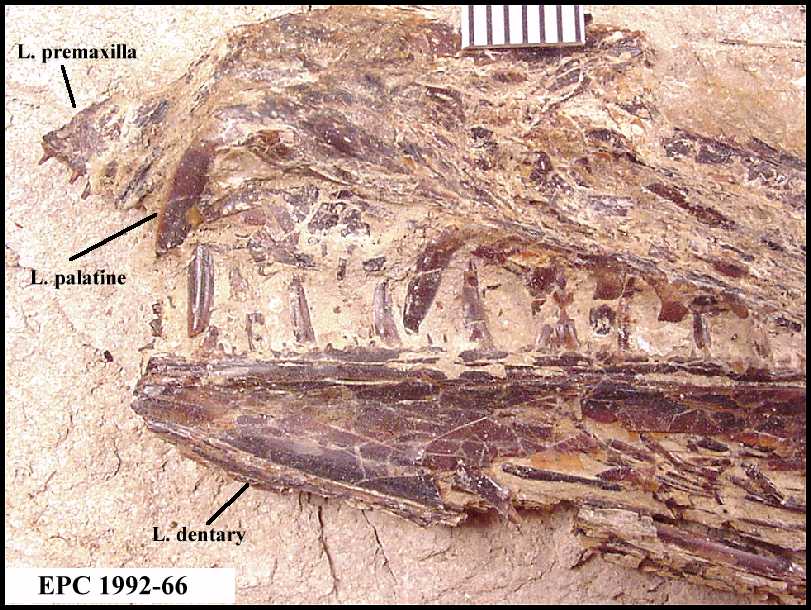 |
The anterior portion of the skull of EPC 1992-66 showing the location of the premaxilla, palatine and dentary. Scale in mm. |
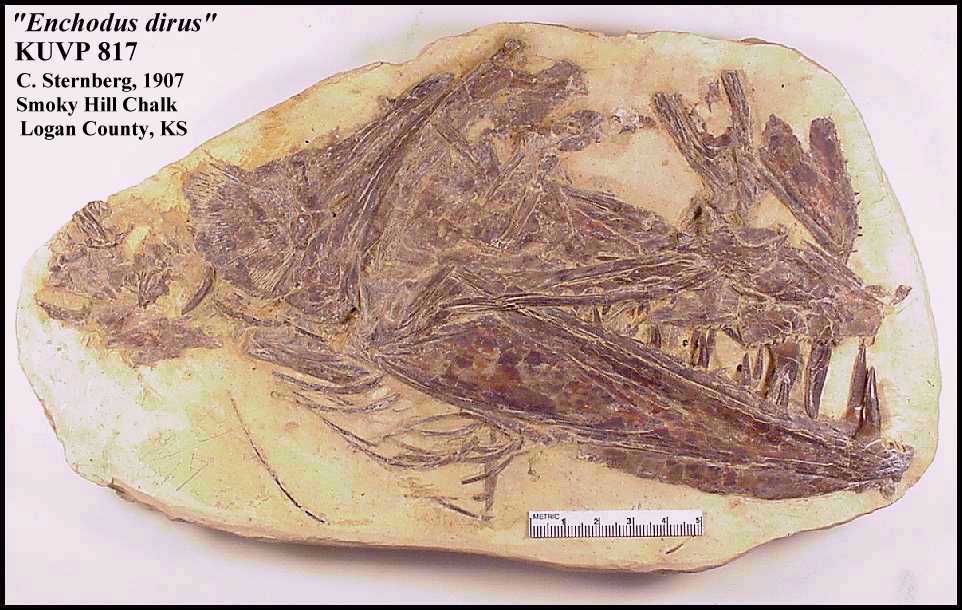 |
A partial skull of "Enchodus dirus" (KUVP 817) in the collection of the University of Kansas. Note that the premaxilla (small "V" shaped bone with teeth) is displaced upward from it's normal position ahead of the palatine (large fang at the front of the upper jaw). Scale = mm. |
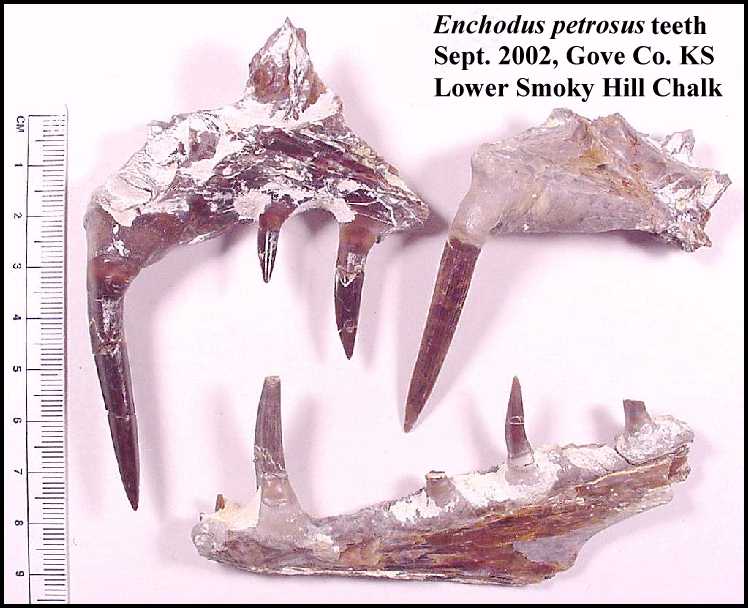 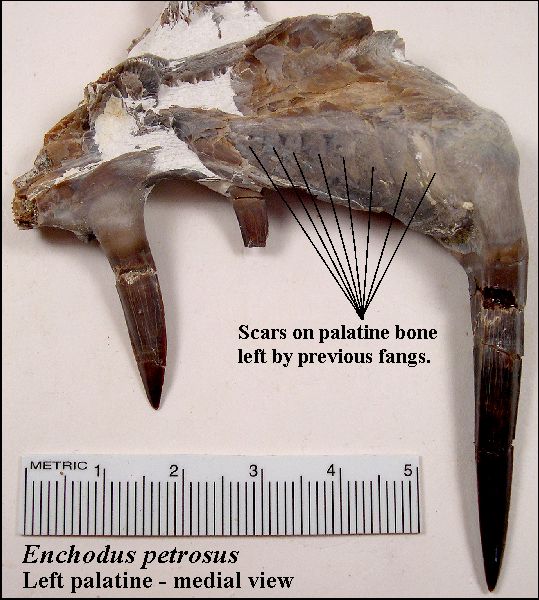 |
FAR LEFT: Tooth bearing elements from partial skull (right and
left palatine bones (above) and right dentary (below)) of an Enchodus petrosus
that I collected in Gove County in August, 2002. There are 8-9 (annual ??) tooth
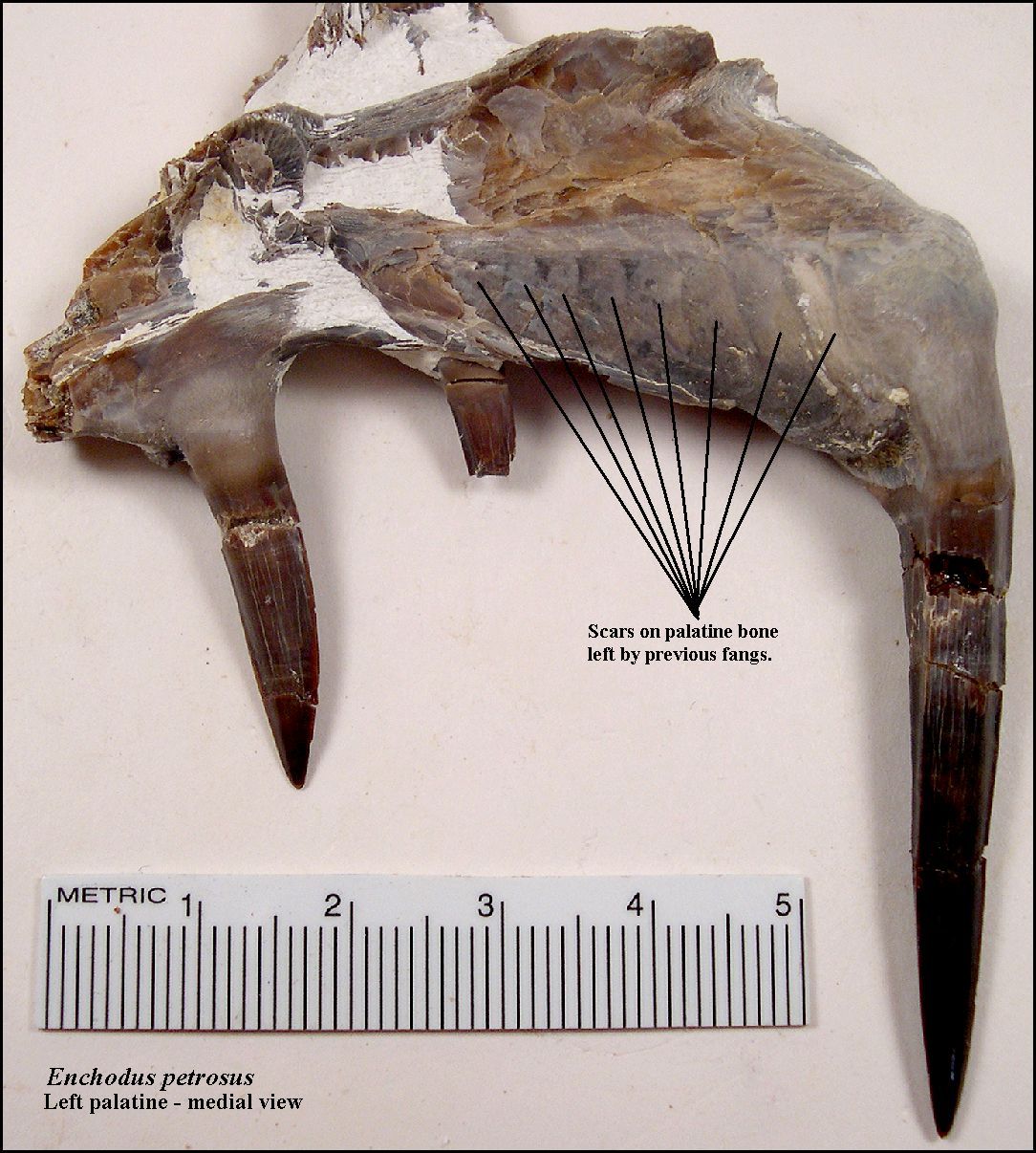
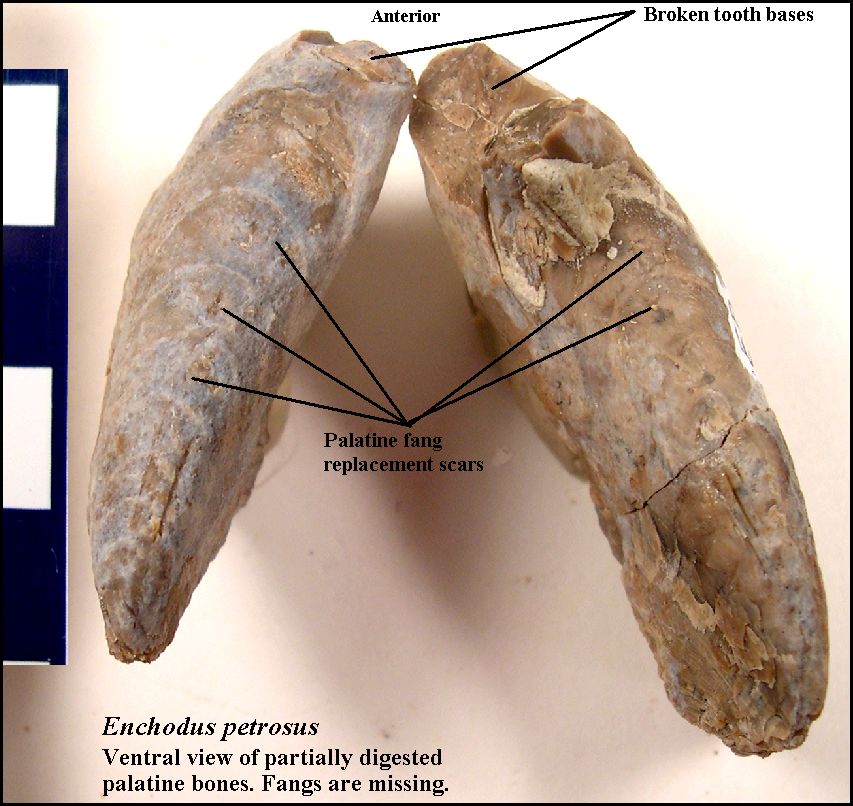
replacement scars behind the large fangs on the two palatine bones. LEFT: A medial view of the left palatine of this specimen showing at least 8 tooth replacement scars. LARGER PICTURE HERE GO HERE for a photo of a pair of partially digested palatine bones of Enchodus petrosus in ventral view, showing a series of tooth scars from replacement teeth. |
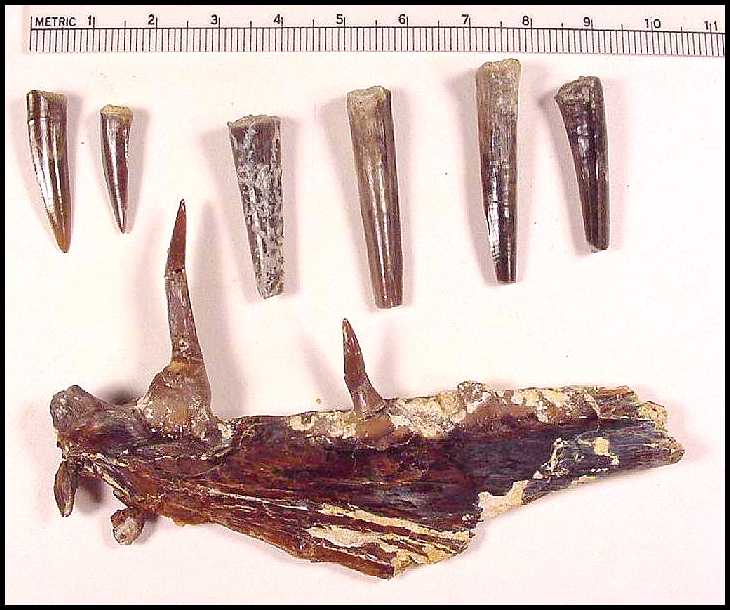 |
Part of a collection of large Enchodus fangs and a lower jaw of Enchodus petrosus that we have picked up in the chalk over the years. The fangs are shed periodically as the skull of the fish grows, with the new tooth forming behind (!) the existing tooth. |
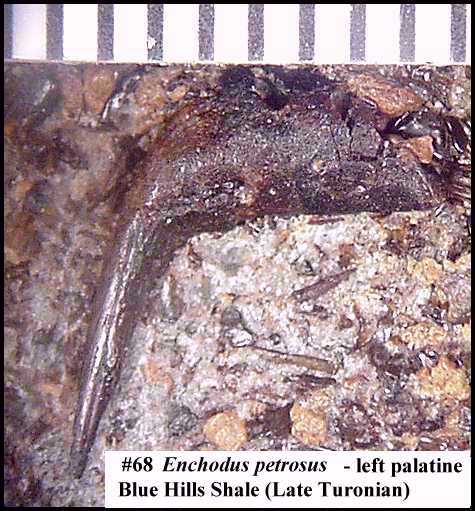 |
A very small Enchodus palatine fang from the "fish-tooth conglomerate" in the upper Blue Hill Shale (Carlile Shale Formation, middle Turonian) of Jewell County. In this sample there were tens of thousands of Enchodus teeth along with the teeth of other bony fish and sharks. Scale in mm. |
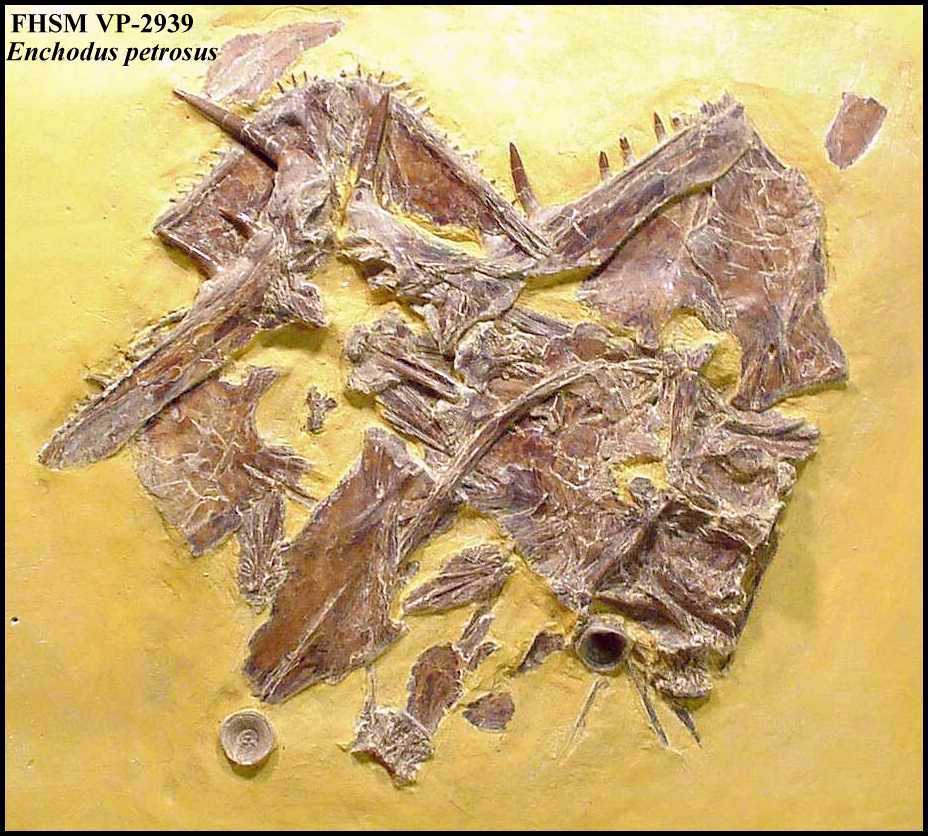 |
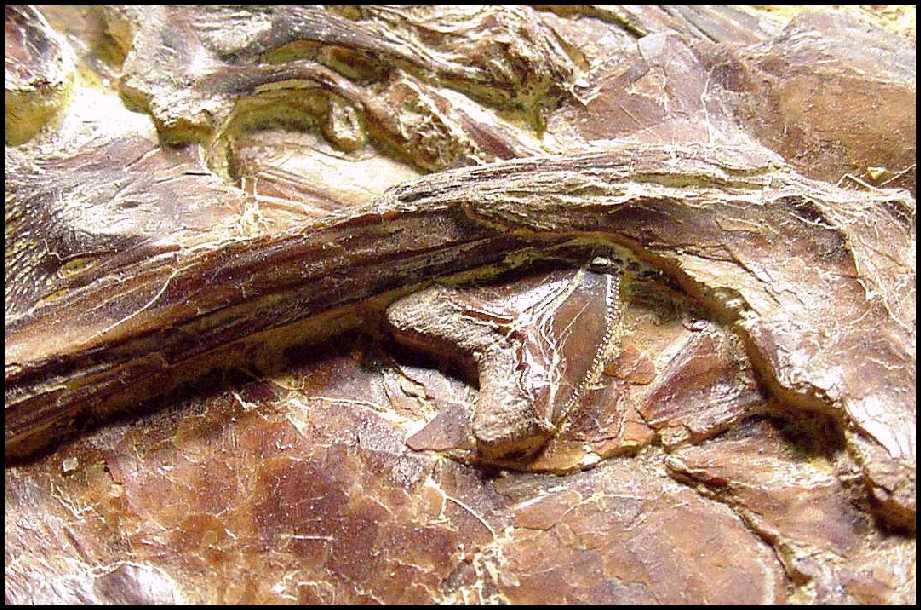
Left: An Enchodus petrosus (FHSM VP-2939) skull in the
Sternberg collection. Right: A Squalicorax falcatus tooth associated with the skull, probably from scavenging. Far right: Bite marks left on the bones by the shark or sharks that scavenged the remains. |
 |
 |
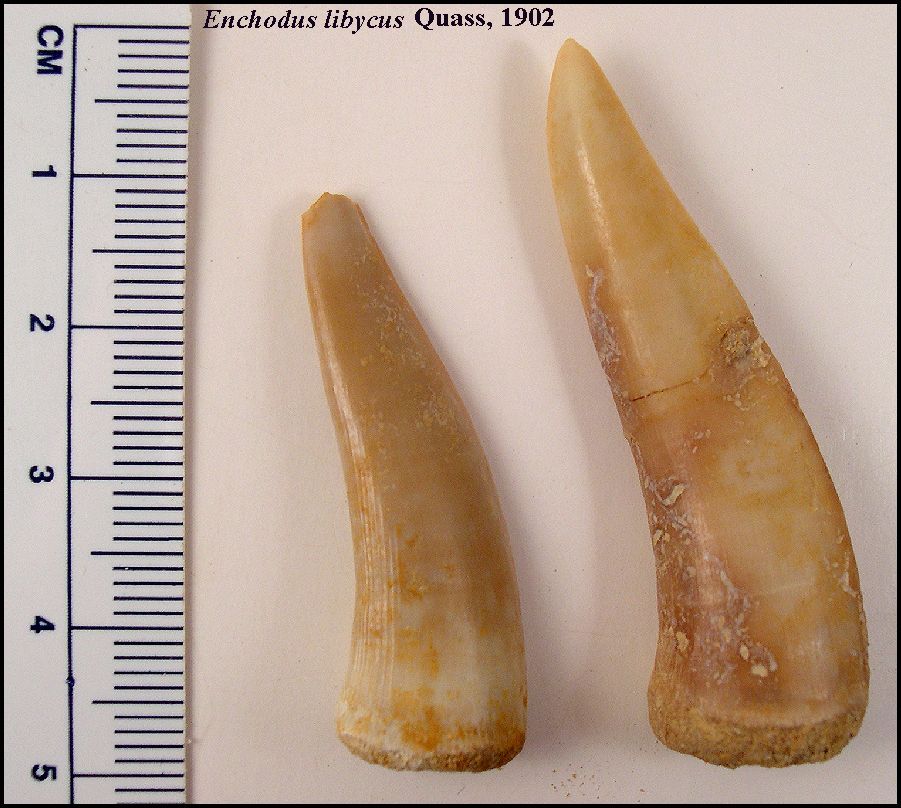 |
Left: Enchodus persisted through the Cretaceous and into
the Tertiary. These are shed lower fangs of Enchodus libycus Quass, 1902, which
were originally described from Libya, but are best known from the Maastrichtian lower
phosphate beds of Morocco. (See Arambourg, 1952, pl. 33, figs. 38-47). Earl Manning(01/2008) provided the identication and citation for these specimens. |
Other Oceans of Kansas webpages on Late Cretaceous fish:
Field Guide to Sharks and Bony Fish of the Smoky Hill Chalk
Sharks:
Bony Fish
Plethodids:
Suggested References:
Arambourg, C. 1952. Les vertebres fossiles des gisements de phosphates (Maroc, Algerie, Tunisie). Typographie Firmin-Didot, Paris.
Cope, E. D.
, 1868. Remarks on a new enaliosaurian, Elasmosaurus platyurus. Proceedings of the Academy of Natural Sciences of Philadelphia, 20:92-93. (for meeting of March 24, 1868 - wherein Cope reports finding the remains of Enchodus as likely stomach contents of Elasmosaurus)Everhart, M. J., P. Everhart, E. M. Manning, and D. E. Hattin. 2003. A Middle Turonian marine fish fauna from the Upper Blue Hill Shale Member, Carlile Shale, of north central Kansas. Journal of Vertebrate Paleontology, Volume 23 (Supplement to Number 3):49A.(Abstract) (Mostly Enchodus)
Fielitz, C., 2002. First record of endopterygoid teeth in the North American late Cretaceous teleostean fish Enchodus gladiolus (Aulopiformes: Enchodontidae). Kansas Academy of Science, Transactions 105(1-2):27-32.
Goody, P. C., 1970. Comments on enchodontid paper by McNulty and Kiensler. Texas Journal Science 21(4):455-457.
Goody, P. C., 1976. Enchodus (Teleostei: Enchodontidae) from the Upper Cretaceous Pierre Shale of Wyoming and South Dakota with an evaluation of the North American Enchodontid species. Palaeontographica Abt. A. 152:91-112.
Grandstaff, B. S. and Parris, D. C. 1990. Biostratigraphy of the fossil fish Enchodus Agassiz. Journal of Vertebrate Paleontology 10 (Supplement to 3):25A. (abstract)
Green, W. R., 1913. A description of the specimens of the teleostean genus Enchodus in the University of Kansas museum. Kansas University Science Bulletin 7(2):71-107, pl. I-XVII.
Hay, O. P., 1903. On certain genera and species of North American Cretaceous actinopterous fishes. Bulletin American Museum Natural History XIX 1-95, pls. i-v, 72 text-figs.
Leidy, J.,
1855. Indications of twelve species of fossil fishes. Proceedings of the Academy of Natural Sciences of Philadelphia, 7(10):395-397. (includes Enchodus ferox Leidy 1855....formally called Sphyraena; mis-identified by Cope (1868) as part of the stomach contents of Elasmosaurus platyurus)McNulty, C. L. Jr. and G. Kienzler, 1970. An enchodontid mandible from the Eagle Ford Shale (Turonian), Dallas County, Texas. Texas Journal Science 21(4):447-453.
Shimada, K and M. J. Everhart.
2003. Ptychodus mammillaris (Elasmobranchii) and Enchodus cf. E. schumardi (Teleostei) from the Fort Hays Limestone Member of the Niobrara Chalk (Upper Cretaceous) in Ellis County, Kansas. Kansas Academy of Science, Transactions 106(3-4):171-176.Shimada, K., Schumacher, B.A., Parkin, J.A. and Palermo, J.M. 2006. Fossil marine vertebrates from the lowermost Greenhorn Limestone (Upper Cretaceous: Middle Cenomanian) in southeastern Colorado. Journal of Paleontology 80(Supplement to 2), 45 p. The Paleontological Society Memoir 63.
Stewart, A., 1898. A preliminary description of seven new species of fish from the Cretaceous of Kansas. Kansas University Quarterly 7(4):189-196, pl. XVII. ( Protosphyraena recurvirostris sp. nov., Enchodus parvus sp. nov., Enchodus amicrodus sp. nov., Pachyrhizodus leptognathus sp. nov., Pachyrhizodus velox sp. nov., Beryx polymicrodus sp. nov. and Beryx multidentatus sp. nov.)
Stewart, A., 1900. Teleosts of the Upper Cretaceous. The University Geological Survey of Kansas. Topeka VI 257-403, 6 figs., pls. XXXIII-LXXVIII.