SAUROCEPHALUS, SAURODON AND PROSAURODON
Sword-eels of the Late Cretaceous
Copyright © 2004-2014 by Mike Everhart
Created 02/05/2004 - Updated 03/04/2014
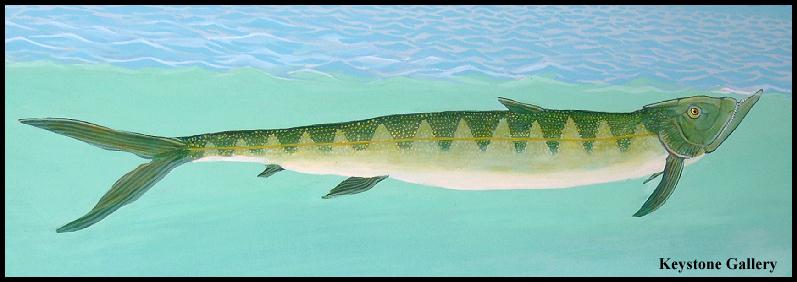
LEFT: Painting by Charles Bonner, Keystone Gallery
|
SAUROCEPHALUS, SAURODON AND PROSAURODON
Sword-eels of the Late Cretaceous Copyright © 2004-2014 by Mike Everhart Created 02/05/2004 - Updated 03/04/2014
LEFT: Painting by Charles Bonner, Keystone Gallery |
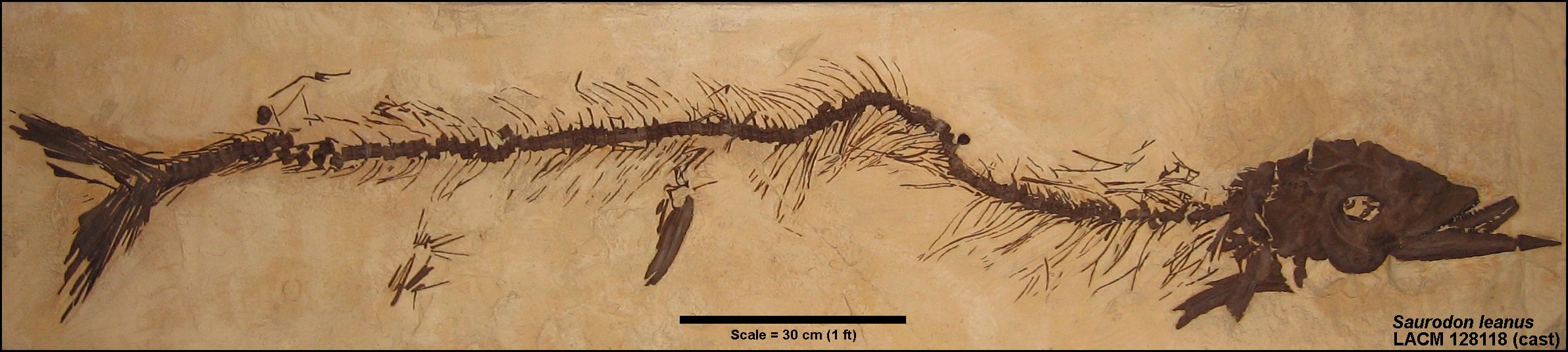 |
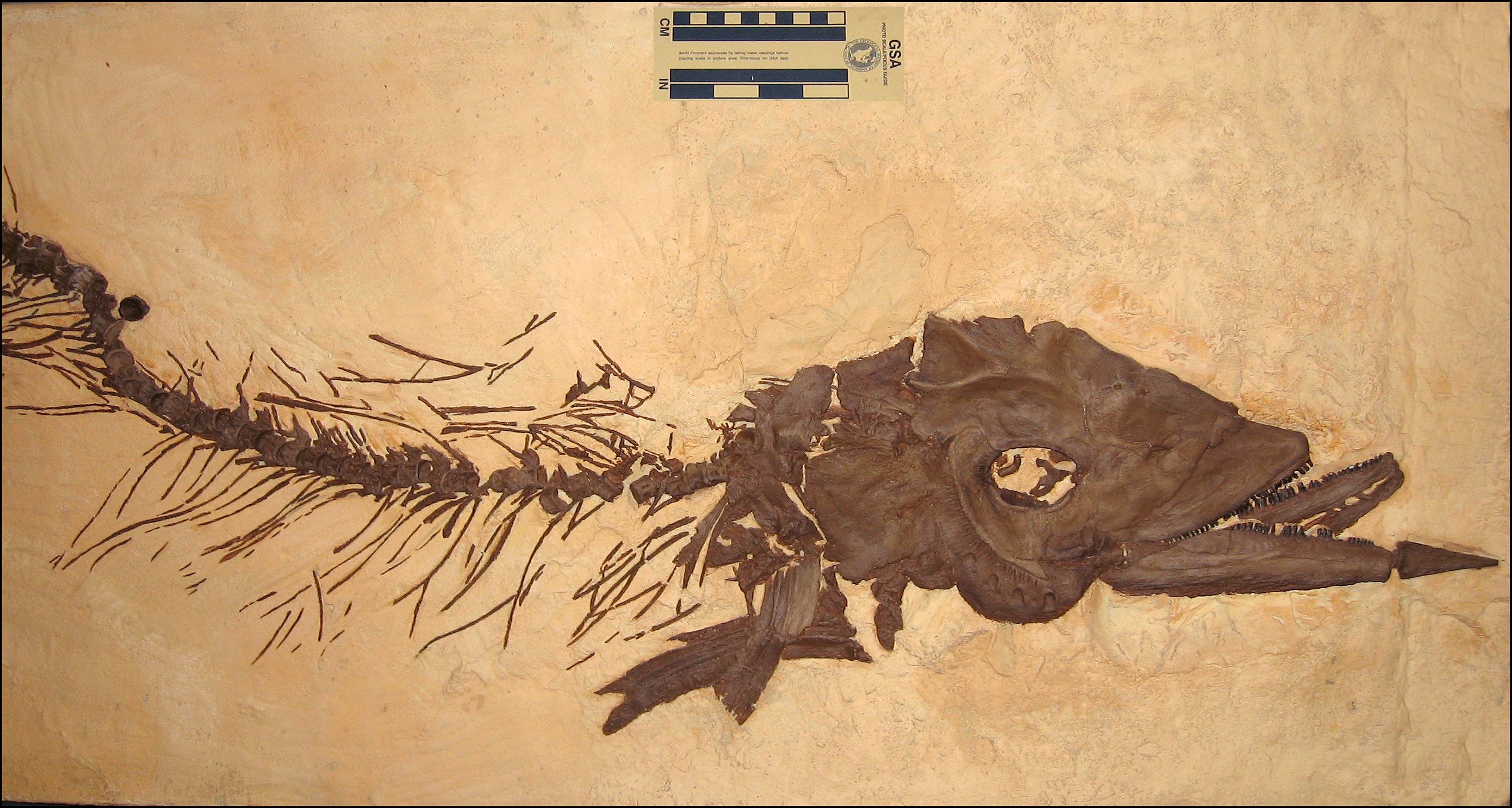
LEFT: One on the most on complete specimens of Saurodon leanus known, this specimen was collected by Marion Bonner from the Smoky Hill Chalk of Western Kansas and sold to the Los Angeles County Museum of Natural History. This photos shows a cast of the specimen in the Rocky Mountain Dinosaur Resource Center; a closer view of the skull is here. (Photo by Anthony Maltese, used with permission) |
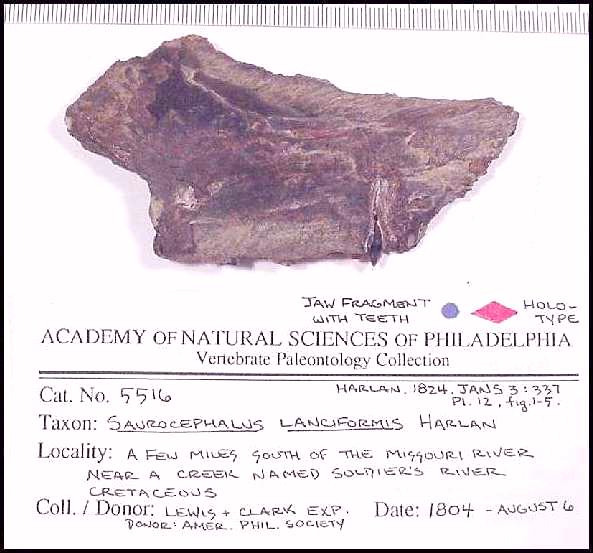
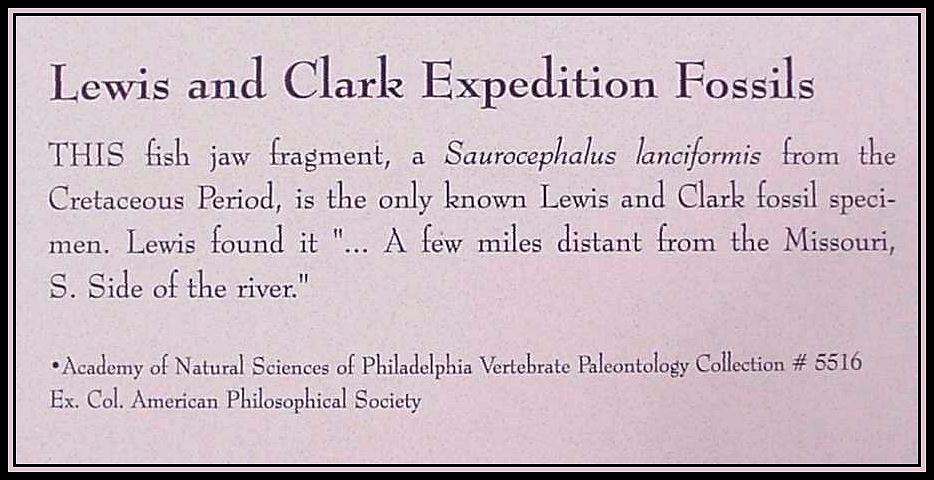
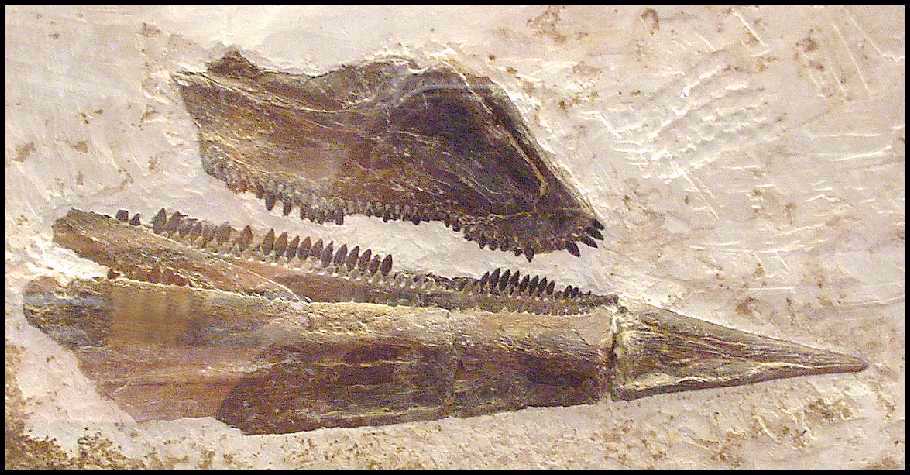
When Lewis and Clark set out in 1804 on their westward trek to explore the Louisiana Purchase, they had no idea that they would also be crossing the expanse of an ancient ocean that once covered the middle of North America. It was early in the trip when they found the only fossil specimen that survives today from the collections made by the expedition along the Missouri River, along the western border of what is now the Harrison County, Iowa. Meriwether Lewis described the remains in a note that survives along with the specimen as "the petrified jaw bone of a fish" (below; see Spamer, et. al., 2000, for a more detailed account). The specimen was eventually presented to the American Philosophical Society where it was studied, and then mis-identified some years later by Dr. Richard Harlan (1824) as a new species of marine reptile, Saurocephalus lanciformis. He believed it to be most closely related to the marine reptiles called ichthyosaurs.
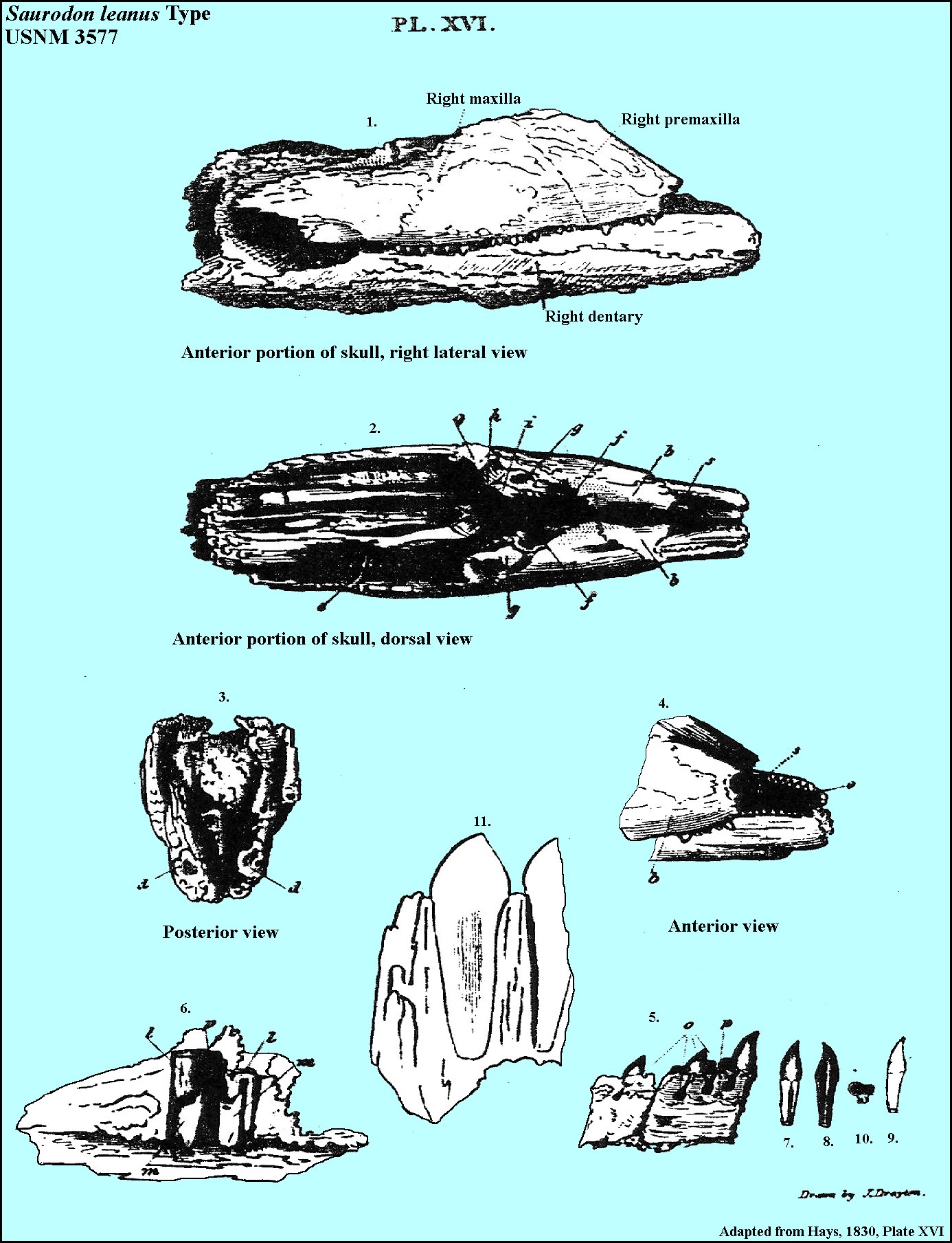
Hays (1830) described a partial skull from the green sand of New Jersey and also concluded that it was the skull of a reptile. However, based on what he could see of the teeth, he declined to use Harlan's genus name (Saurocephalus) and instead established a new genus (Saurodon) and species (leanus). The species name is in honor of the man (Isaac Lea) whose collection contained the specimen. As a note added to his paper, Hays decided that Saurodon could not be placed in the Genus Saurocephalus because of erroneous characters described by Harlan, but rather that Saurocephalus lanciformis should be placed in the Genus Saurodon. Neither specimen included the distinctive predentary bone. The predentary was first recognized and described by Albin Stewart (1898).
Later, Joseph Leidy (1857, p. 302) incorrectly noted that the specimen mis-identified by Harlan was a fragment of a "maxillary bone with teeth of peculiar genus of sphyrænoid (barracuda-like - see Protosphyraena) fishes from the Cretaceous formation of the Upper Missouri."
The type specimen of Saurocephalus lanciformis (ANSP 5516) was also the first fossil fish and the first vertebrate to be collected, illustrated and described from the Niobrara Formation. Over the years, the number of named Saurodon / Saurocephalus 'species' grew to eleven, but the number was reduced to two by Bardack and Sprinkle ( 1969). Stewart (1999) re-described a third species (Prosaurodon pygmaeus) that had originally been named Saurodon pygmaeus by Loomis in 1900. According to Stewart, Prosaurodon specimens have often been mis-identified as Ichthyodectes.
Saurodontinae is a sub-family of the Ichthyodectidae (Earl Manning, pers. comm., 2004) and includes three genus/species in the Western Interior Sea, of which Prosaurodon is the most primitive.
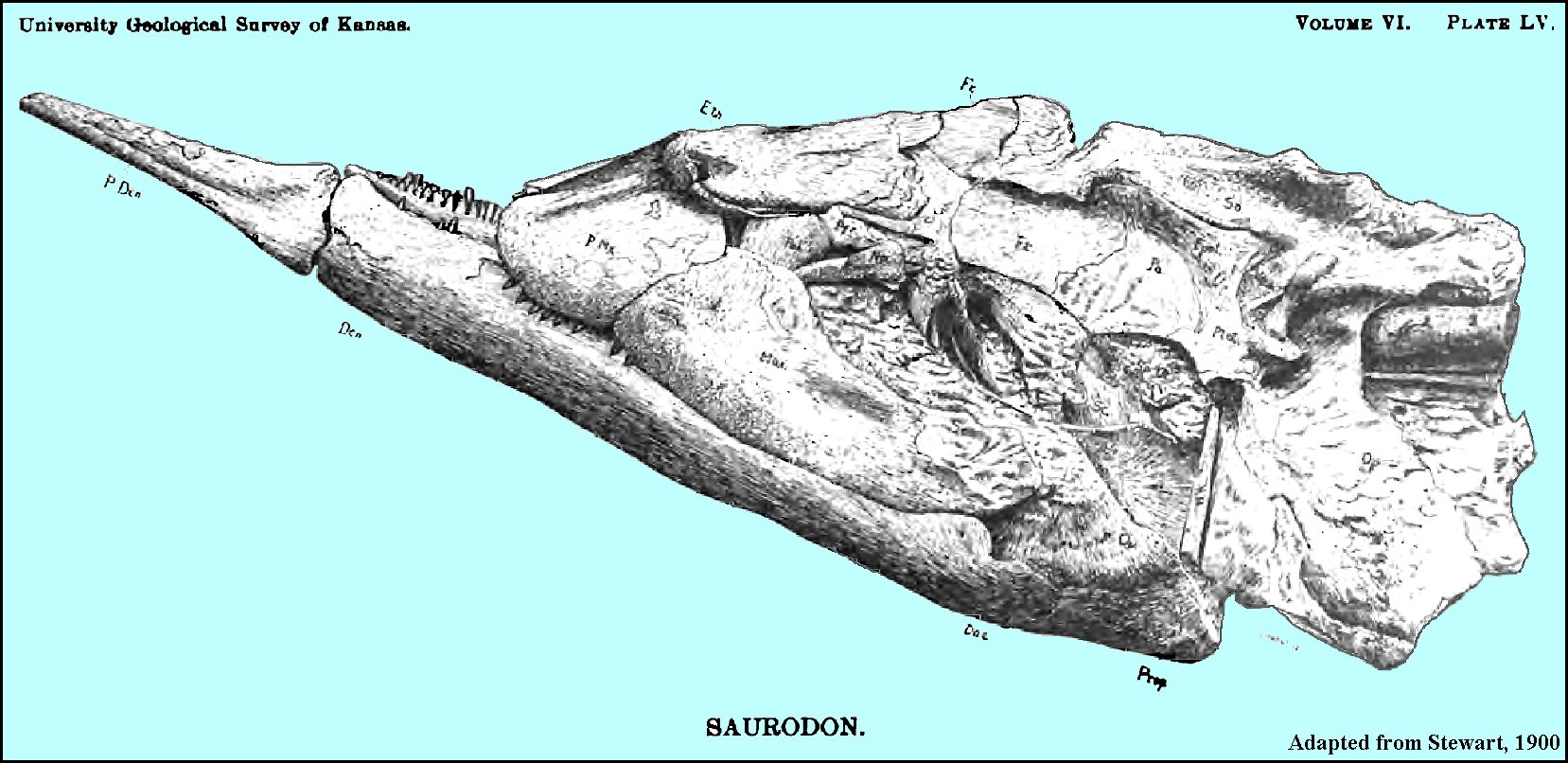 |
Family Ichthyodectidae Sub-family Saurodontinae Prosaurodon pygmaeus (Loomis, 1900) Saurodon leanus Hays, 1830 Saurocephalus lanciformis Harlan, 1824 LEFT: The skull of Saurodon leanus, showing the unusual extension of the lower jaw (predentary) from Stewart (1898, 1900). |
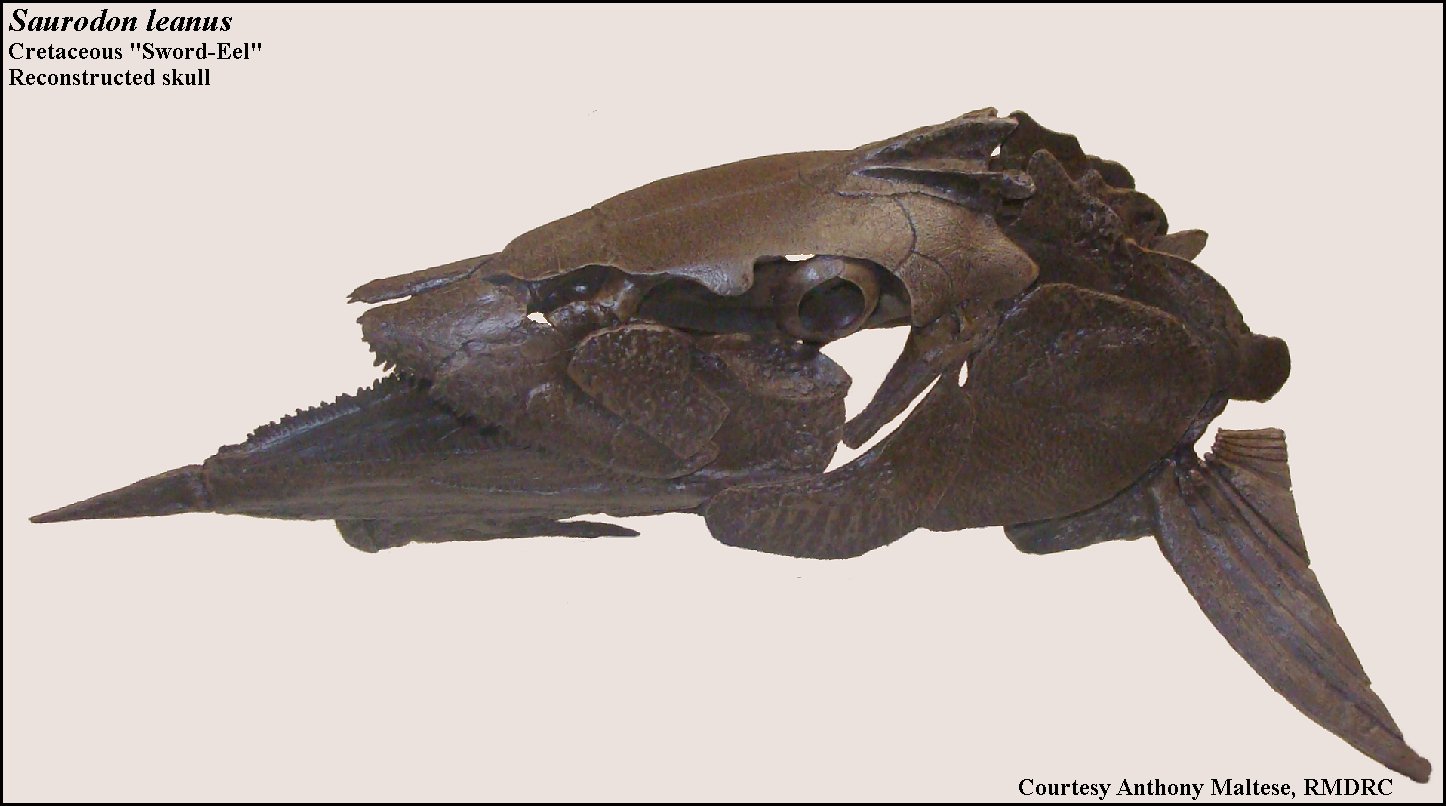 |
LEFT: A photo of the first
reconstructed skull of Saurodon leanus, courtesy of Anthony Maltese
(Rocky Mountain Dinosaur Resource Center). The total length of this
specimen is 2.6 m (8.5 ft)
|
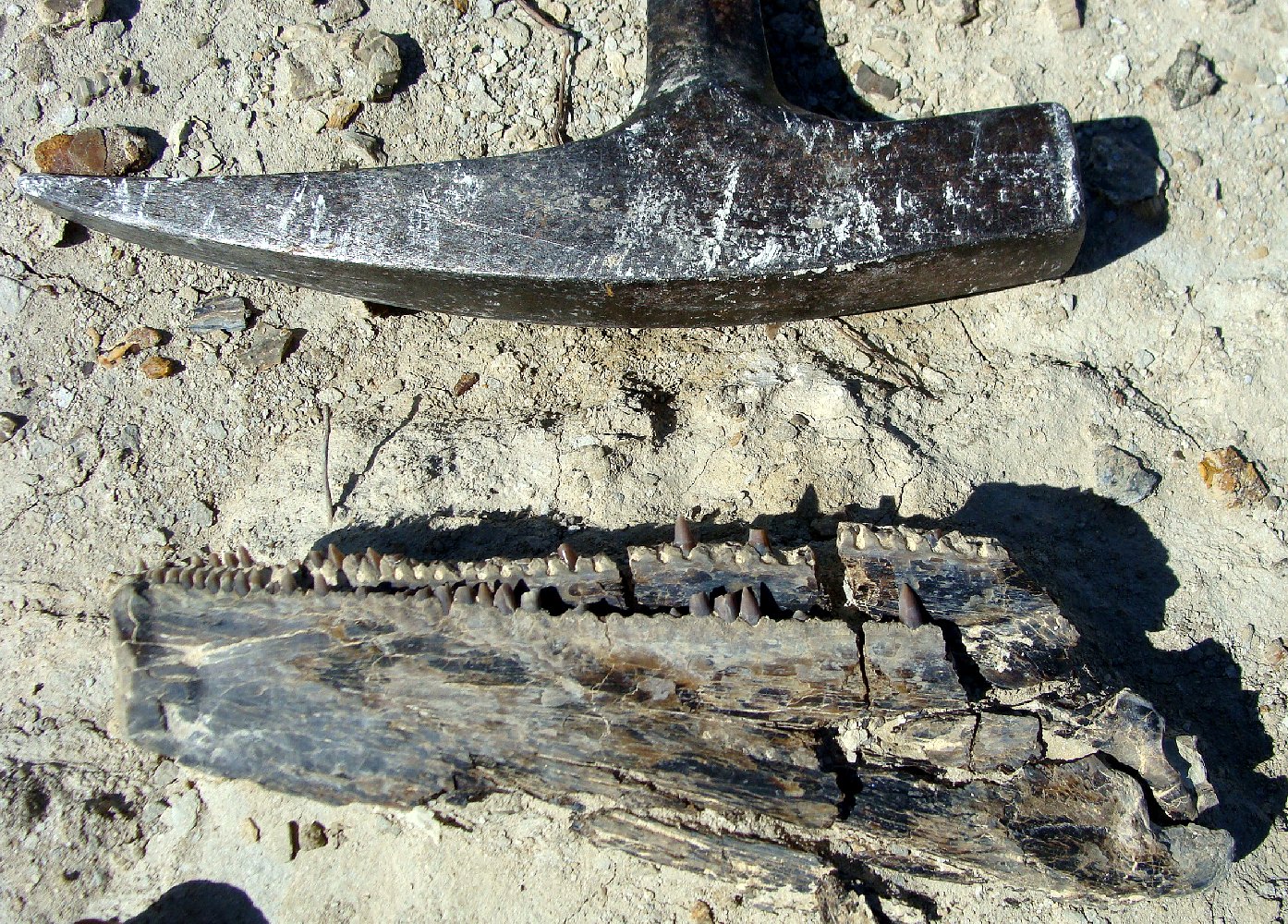 |
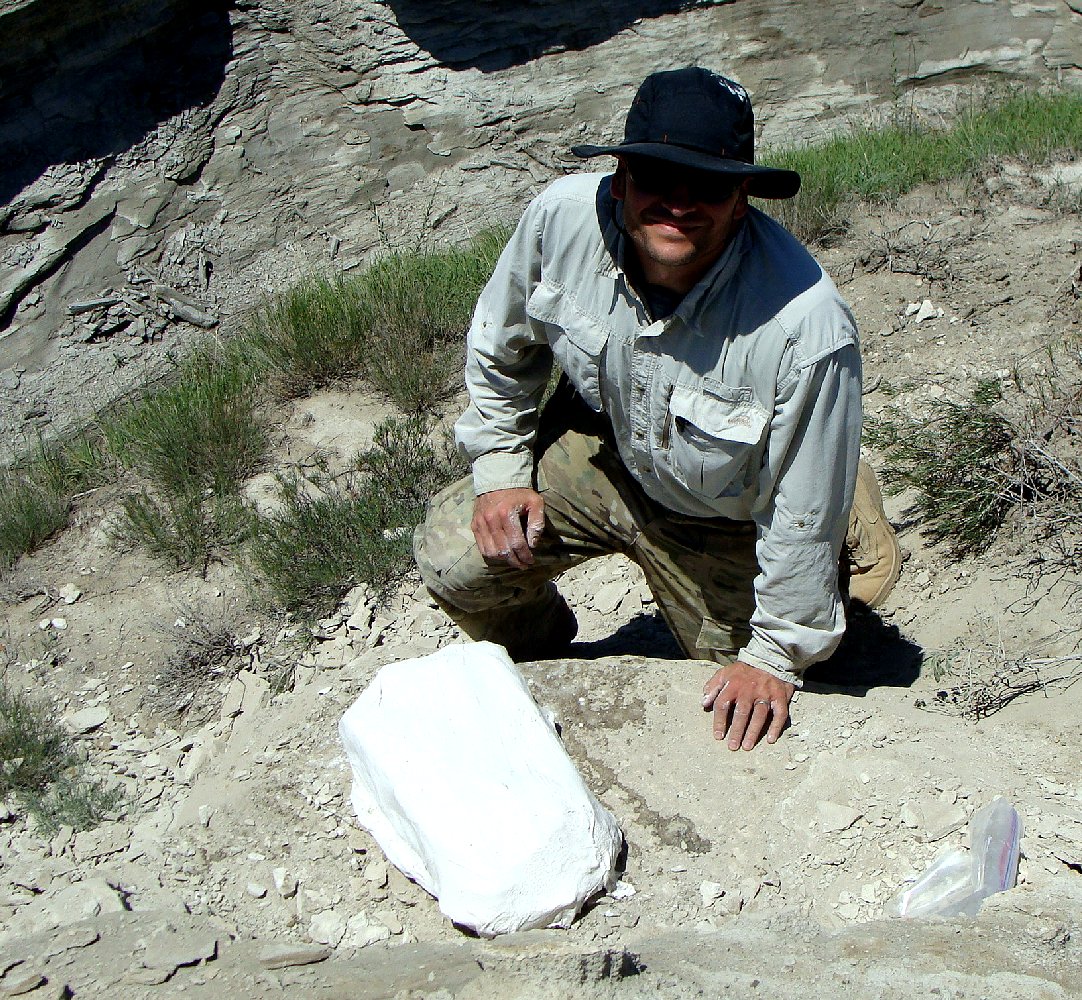
LEFT: A pair of Saurodon leanus dentaries
discovered by Tom Caggiano on June 15, 2013 in
the Smoky Hill Chalk of Gove County, Kansas. Scale - Head of rock hammer
is 7 inches (~18 cm) in length.
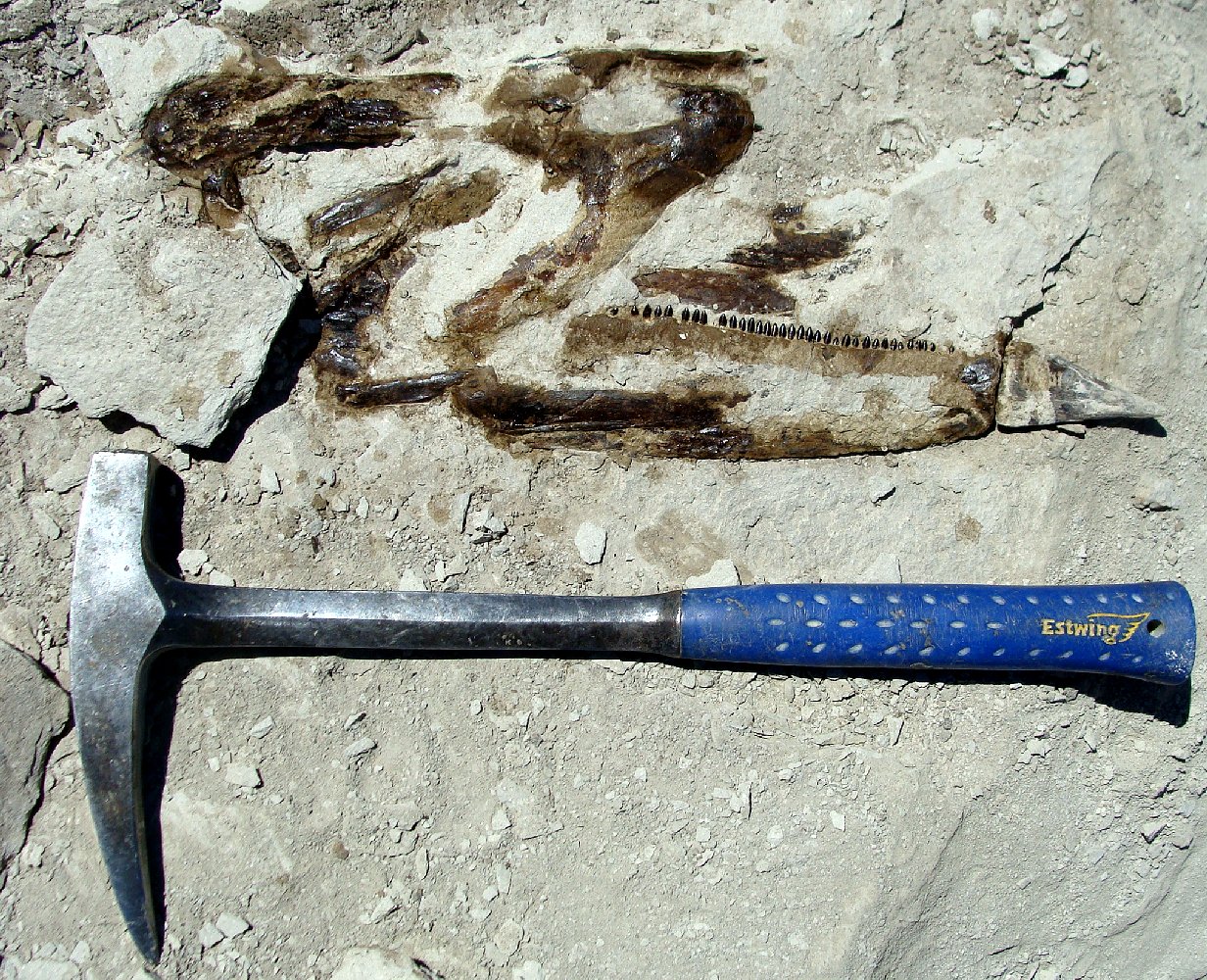
RIGHT: A new specimen of Saurodon leanus discovered by Matt Everhart on June 16, 2013 in the Smoky Hill Chalk of Gove County, Kansas. Scale - Rock hammer is 16 inches (~40 cm) in length. Only the predentary bone was exposed at the time of discovery. The specimen was removed in a plaster jacket and is in the process of being prepared. |
 |
All of the species were medium to large-sized (2-3 m / 5-9ft), elongate predatory fish and are relatively uncommon as fossils in the chalk. The most unusual character of these fish is the pre-dentary bone that projected forward from the lower jaw. The function of this under-slung extension of the lower jaw is unknown but it gives a different perspective to the phrase “leading with your chin.” Another characteristic of these fish their flat, blade-like teeth, set in a single row in the jaws. In Saurocephalus and Saurodon, the teeth are closely set, nearly vertical and have a “keyhole-like” notch at the base of each tooth on the inside of the jaws. In Prosaurodon, the teeth have a more rounded cross-section, are more widely set, inclined anteriorly, and do not have the basal notch found in the other two species. From Stewart’s (1999) phylogenetic analysis, it appears that Gillicus (Ichthyodectidae) is more closely related to Saurodon than to Xiphactinus. (click here for a picture of Gillicus teeth)
The three species apparently occur at differing times in the Western Interior Sea with little overlap. According to Stewart (1999), Saurocephalus lanciformis appears only in the uppermost chalk (Early Campanian) while Saurodon leanus is known from the lower through the middle chalk (Late Coniacian through the Santonian). Prosaurodon pygmaeus appears first about the middle of the chalk and continues upwards into the Sharon Springs Member of the Pierre Shale (Ibid.; Carpenter, 1996). Pre-Niobrara records of the Saurodontidae are unknown in Kansas. However, a much older specimen from the Cenomanian Eagle Ford Group of Texas (Stewart and Friedman, 2001) suggests that family existed for some time before the deposition of the Niobrara.
The type specimen of Saurocephalus lanciformis Harlan 1824 was discovered by Patrick Gass on August 6, 1804 near the present site of Council Bluffs, Iowa. His name is recorded on the label associated with the specimen:
“Gary Moulton (personal communication, 2002) confirms to us the 37 labels we cite here are the only field labels known to survive from the expedition. One label in Moulton’s possession (see later in this paper), not associated with surviving specimens, may have been part of the “missing 30” plant specimens that were part of the first shipment of about 60 specimens to arrive back East, in 1805. Another label associated with the fragmentary upper jaw of a fossil fish, Saurocephalus lanciformis, a new genus and species when Richard Harlan named it in 1824. On that label, “No. 9” relates numerically to Vaughan’s separate inventory of Lewis and Clark geologic specimens in the APS’s 1805 accession {American Philosophical Society]. The specimen was collected by Patrick Gass on 6 August 1804; it is in the Vertebrate Paleontology collection of the Academy.” … “The label accompanying the fish fossil was attached only by a spot of glue (when the label was so affixed to the specimen is not known). The small spot remains on the specimen; on it are the letters “pet” that begins the word “petrifed” [petrified].”
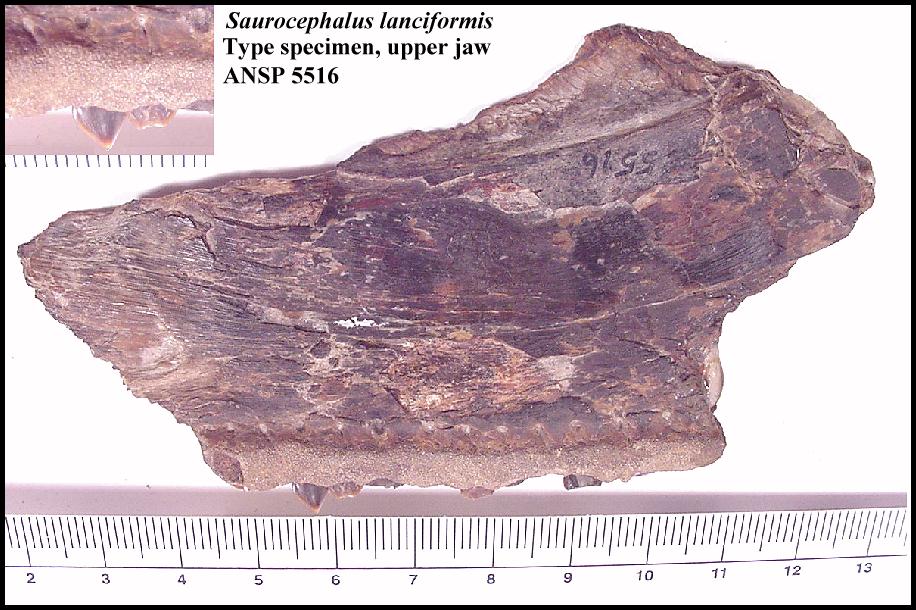 |
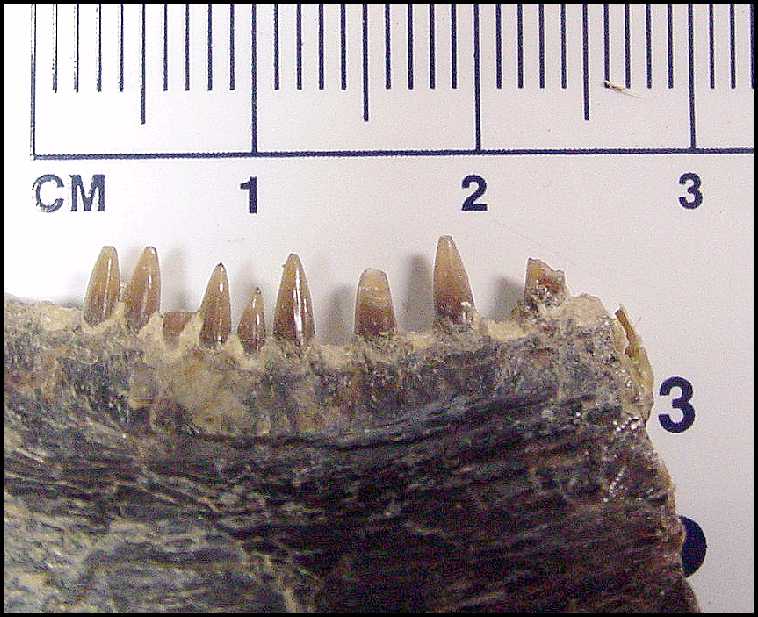
LEFT: A medial view of the right maxilla of the type
specimen of Saurocephalus
lanciformis Harlan 1824, including a detail showing a complete tooth.
This is the only surviving fossil specimen collected by the Lewis and
Clark Expedition, 1805-1805. It was found in western Iowa by Patrick Gass
(not mentioned in Gass 1807) on August 6, 1804, and is now in the Academy of Natural Sciences of
Philadelphia (ANSP 5516) -
(Exhibit Label) - See also
this historical paper: Harlan, R., 1824. On
a new fossil genus of the order Enalio sauri, (of Conybeare). Jour. Acad. Nat. Sci.
Philadelphia, ser.1, 3(pt. 2):331-337; pl. 12, figs. 1-5.
RIGHT: Hays 1830, Plate 16 illustrating the type specimen of Saurodon leanus. Note that neither of the type specimens include their distinctively different predentary bones. See: Hays, I., 1830. Description of a fragment of the head of a new fossil animal, discovered in a marl pit, near Moorestown, New Jersey. Transactions American Philosophical Society, ser. 2, 3(18):471-477, pl. 16. (read Dec. 4, 1829 and Jan. 1, 1830). |
 |
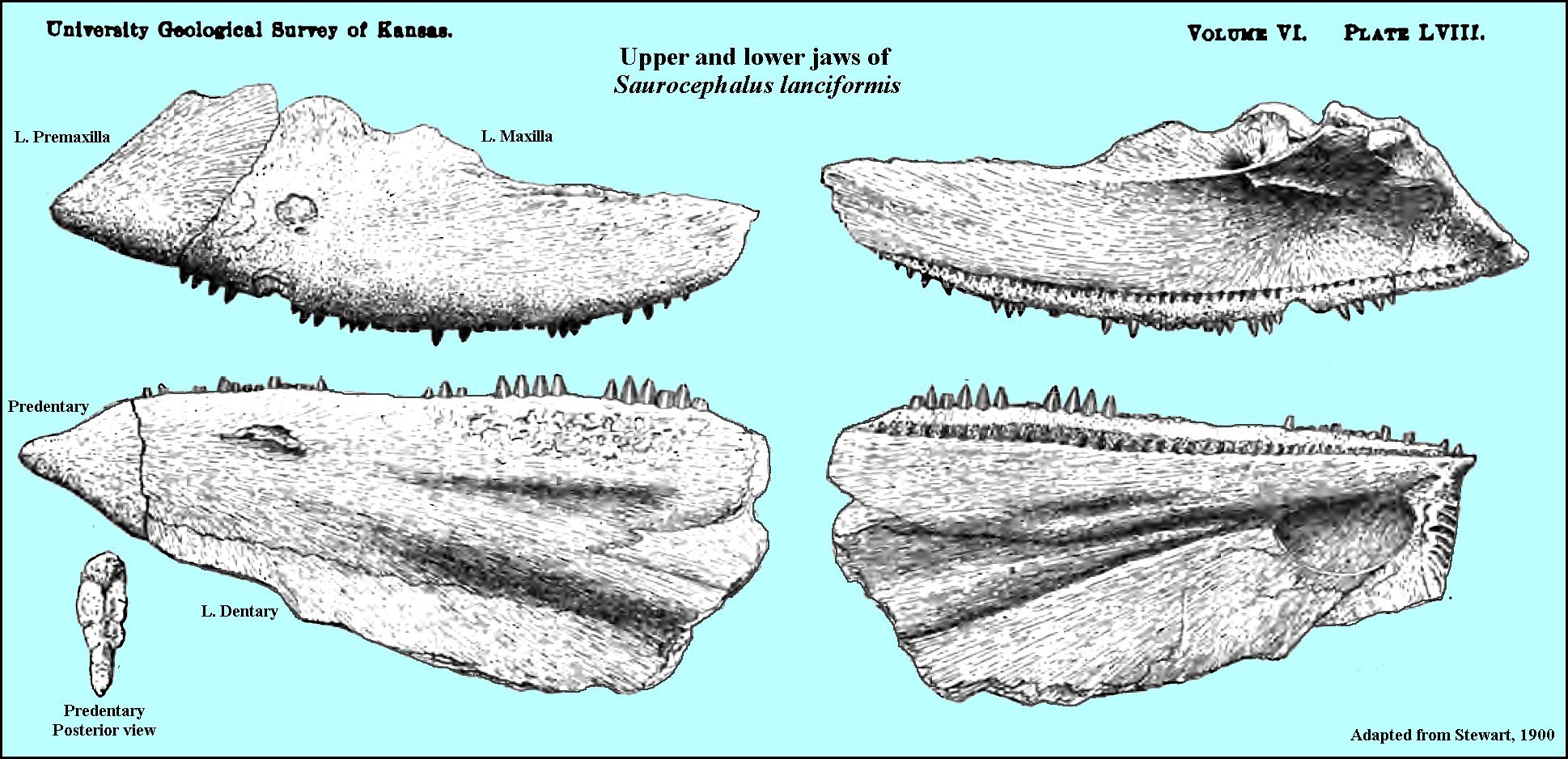 |
LEFT: A portion of the skull of Saurocephalus
lanciformis as illustrated by Stewart (1900, Plate LVIII) in the
University Geological Survey of Kansas.
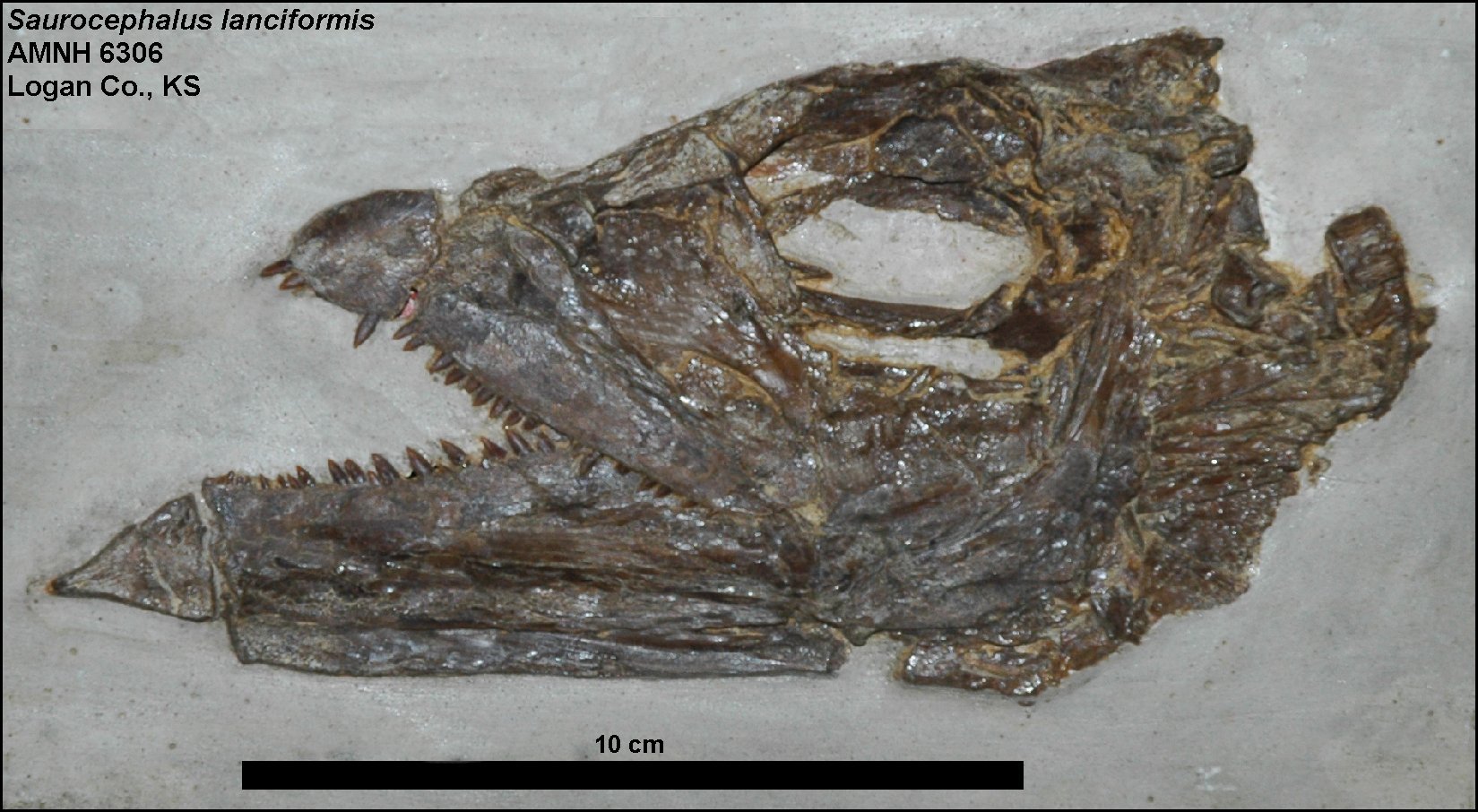
RIGHT: Skull of Saurocephalus lanciformis (AMNH 6306) in left lateral view. Note the reduced size of the predentary and that the upper and lower jaws are the same length. Collected from Logan County by G.F. Sternberg. |
 |
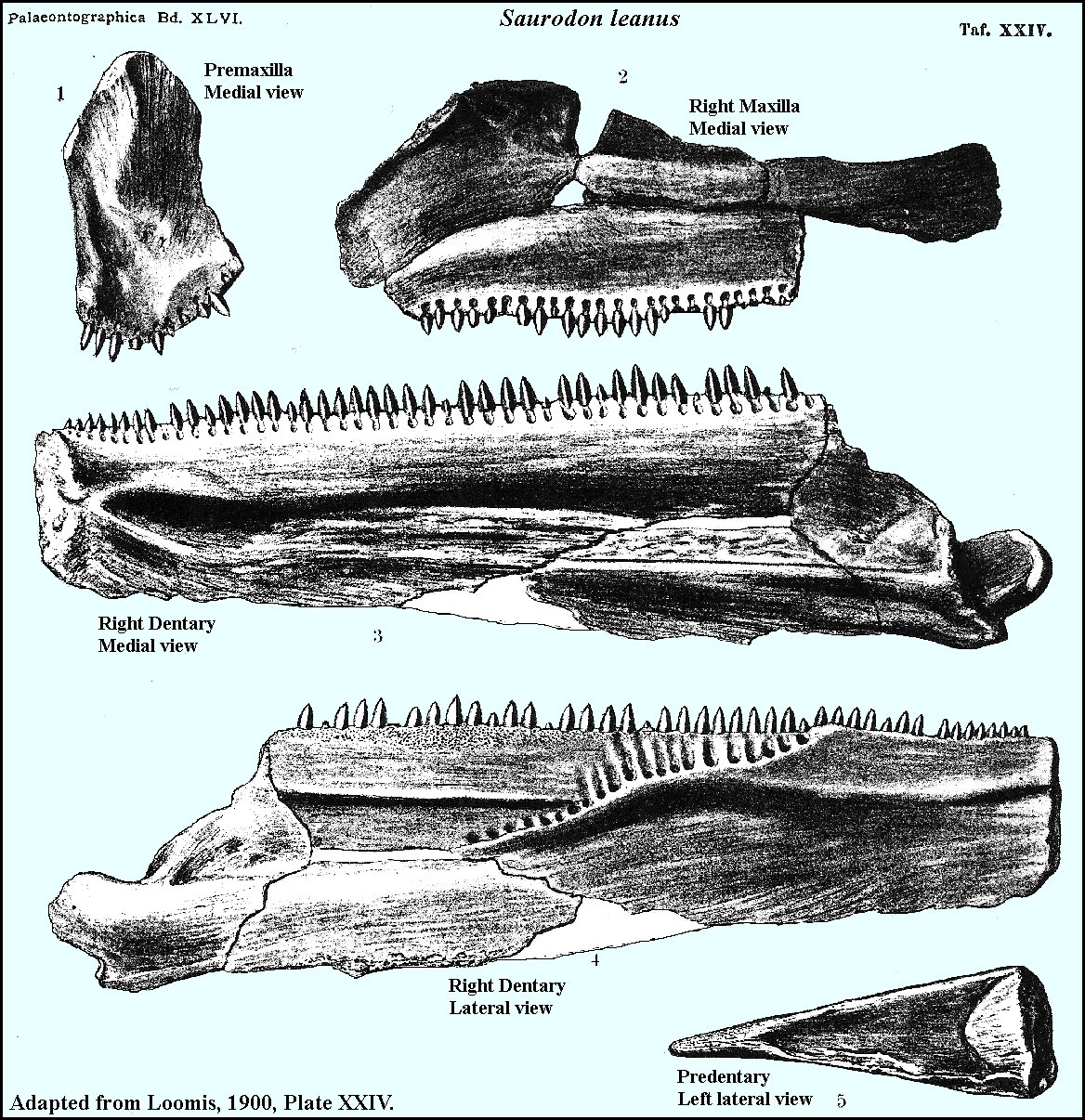 |
LEFT: Portions of the skull of Saurodon "phlebotomus"
Cope as figured by Loomis (1900, plate XXIV. Bardack and Sprinkle (1969)
concluded that Cope's original specimen (AMNH 1906) could not be
distinguished from Saurodon leanus.
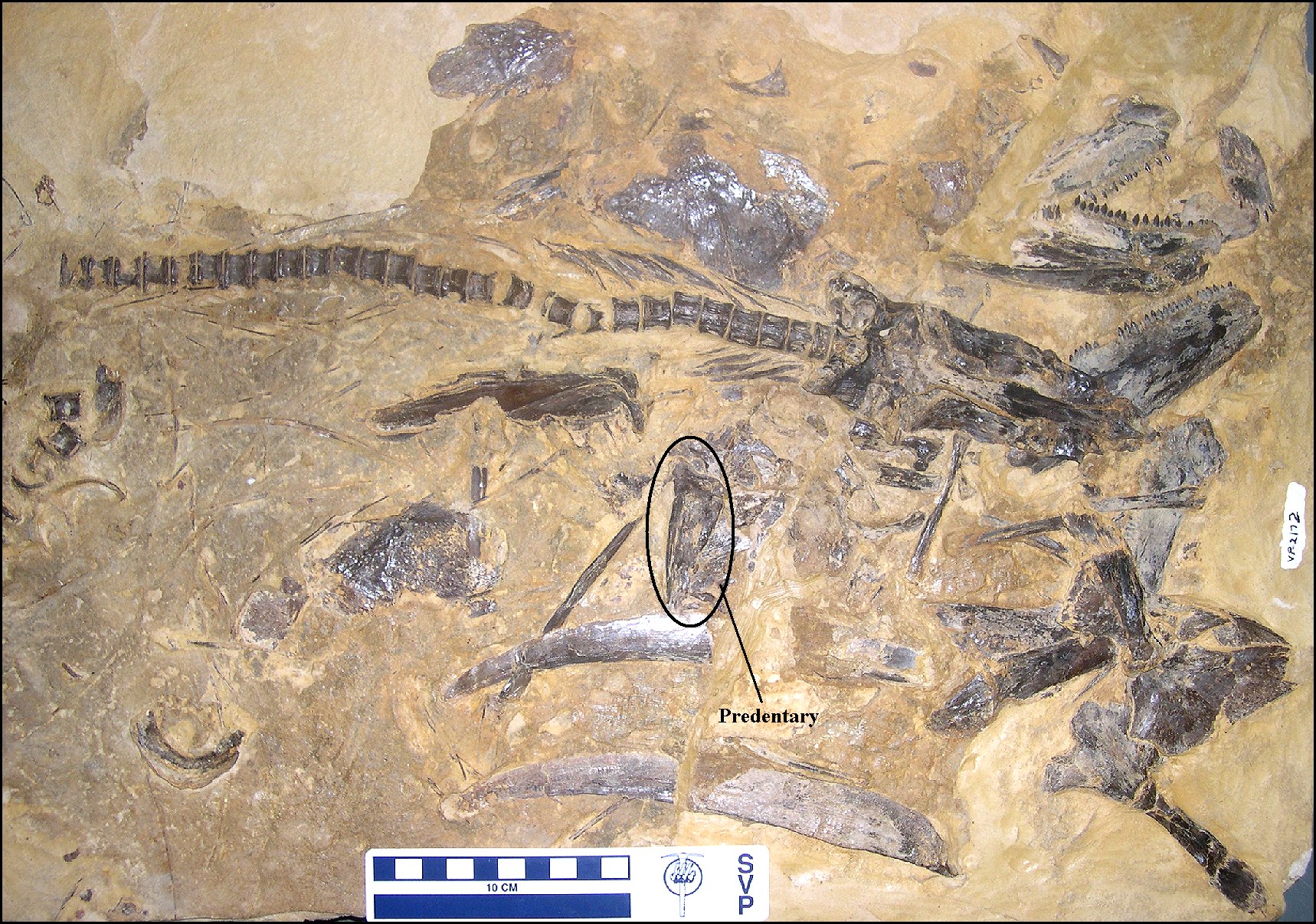
RIGHT: FHSM VP-2172 - Most of a dis-articulated Saurodon leanus specimen collected by George Sternberg and Marion Bonner in October, 1963 from Logan County, Kansas. The predentary is located near the center of the photo in the black oval. |
 |
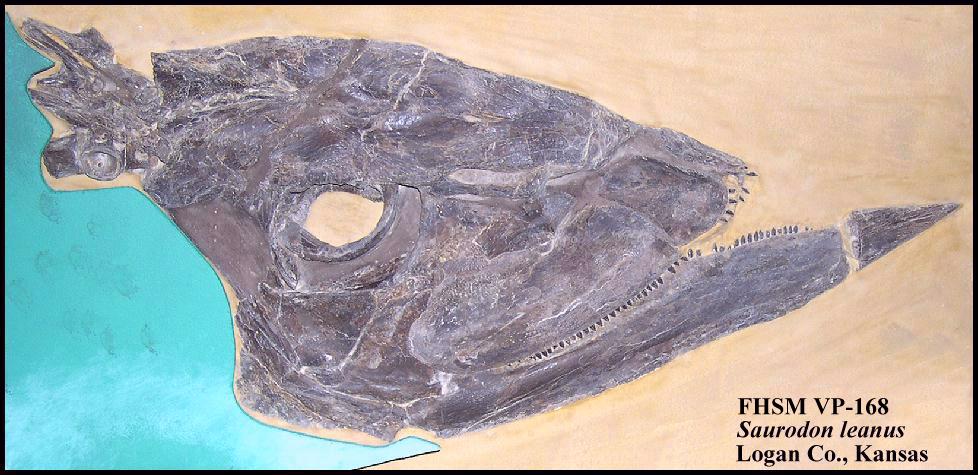 |
LEFT: The skull of Saurodon leanus Hays
(FHSM VP-168) on exhibit in the Sternberg Museum of Natural History.
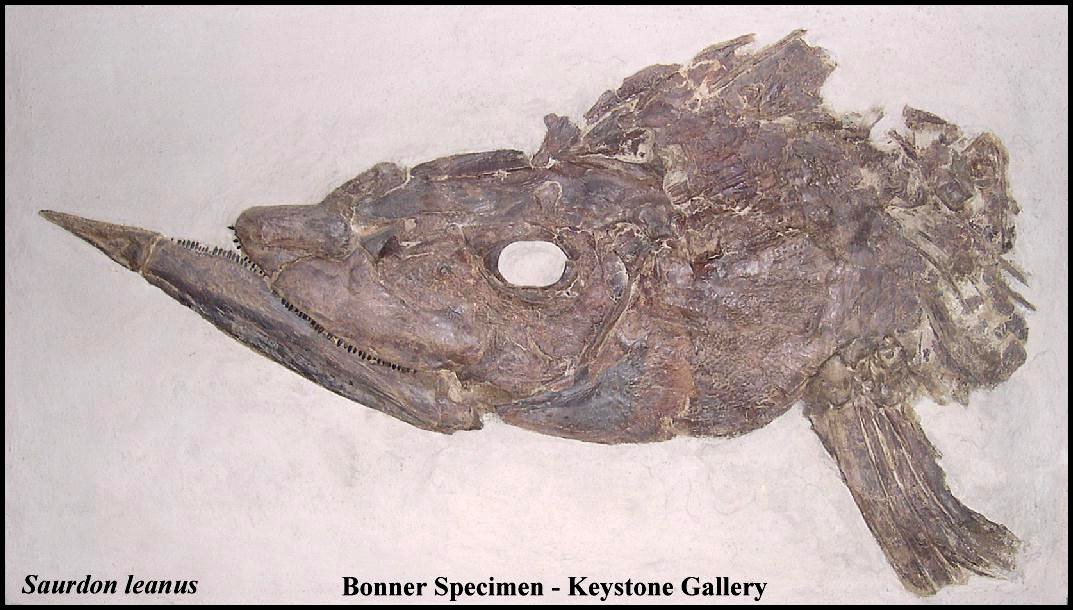
RIGHT: One of the most complete skulls of Saurodon leanus that I have seen. Discovered and prepared by Barbara Shelton and exhibited in the Keystone Gallery collection. |
 |
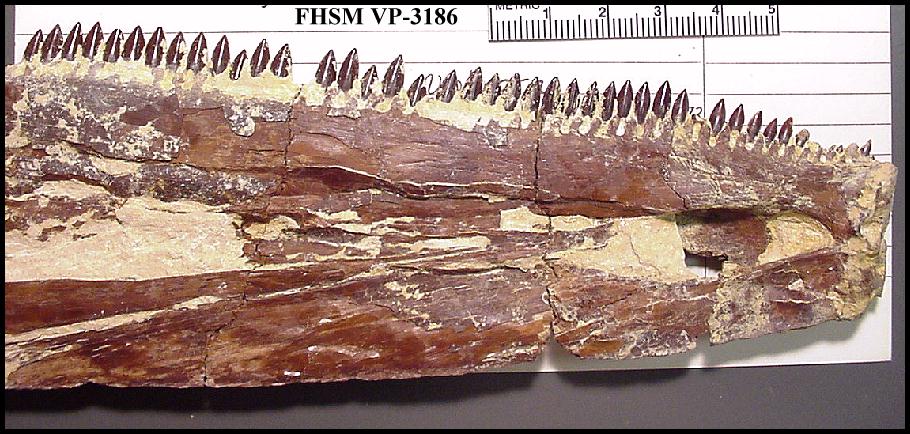 |
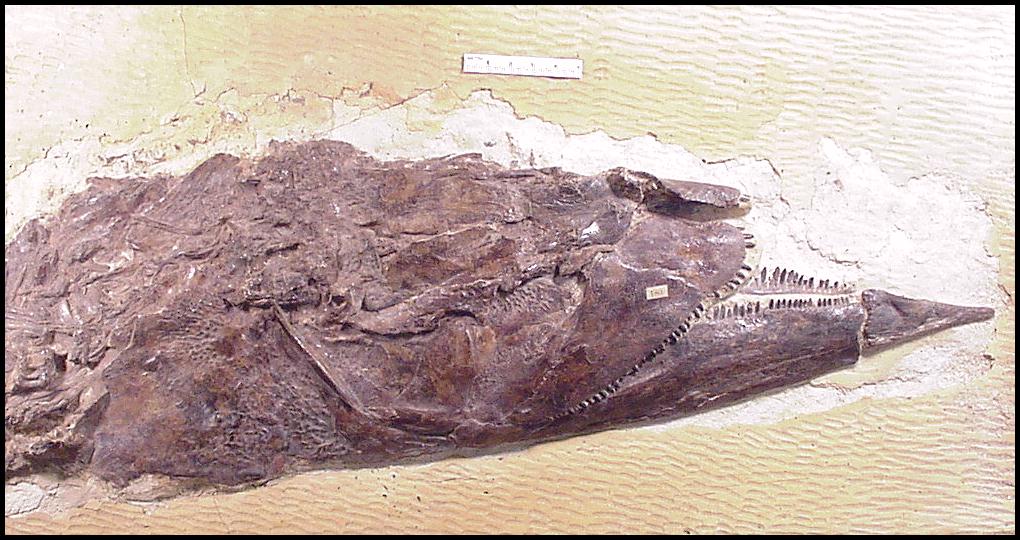
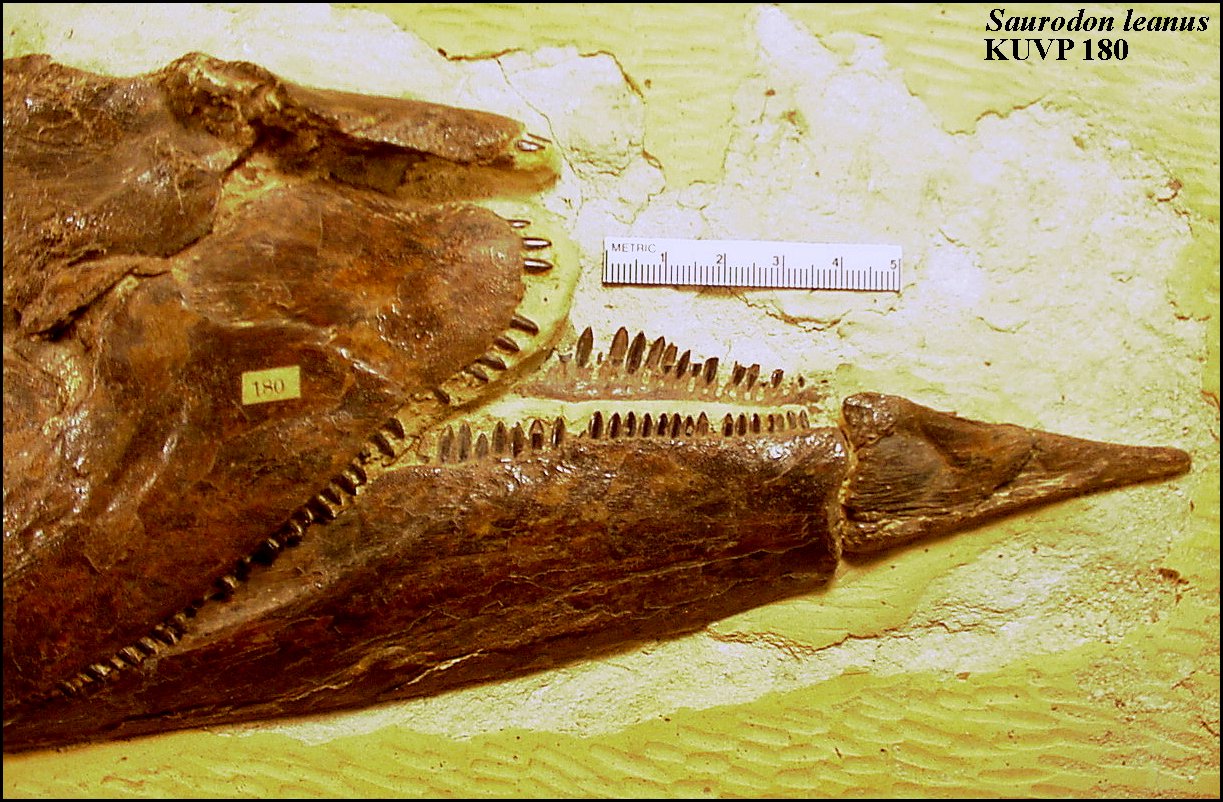
LEFT: The lower jaw of a Saurodon leanus specimen
(VP-3186) in the collection of the Sternberg Museum of Natural History.
RIGHT: The front half of a fairly complete Saurodon leanus (KUVP 180) from the Smoky Hill Chalk. |
 |
 |
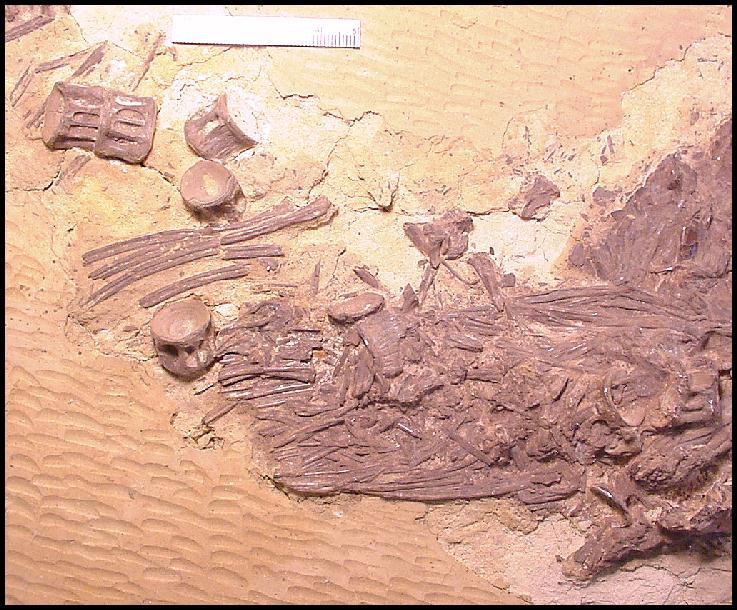
LEFT:
RIGHT: The damaged back portion of the KUVP 180 specimen, showing the vertebrae that are characteristic of Saurodontidae and Ichthyodectidae. |
 |
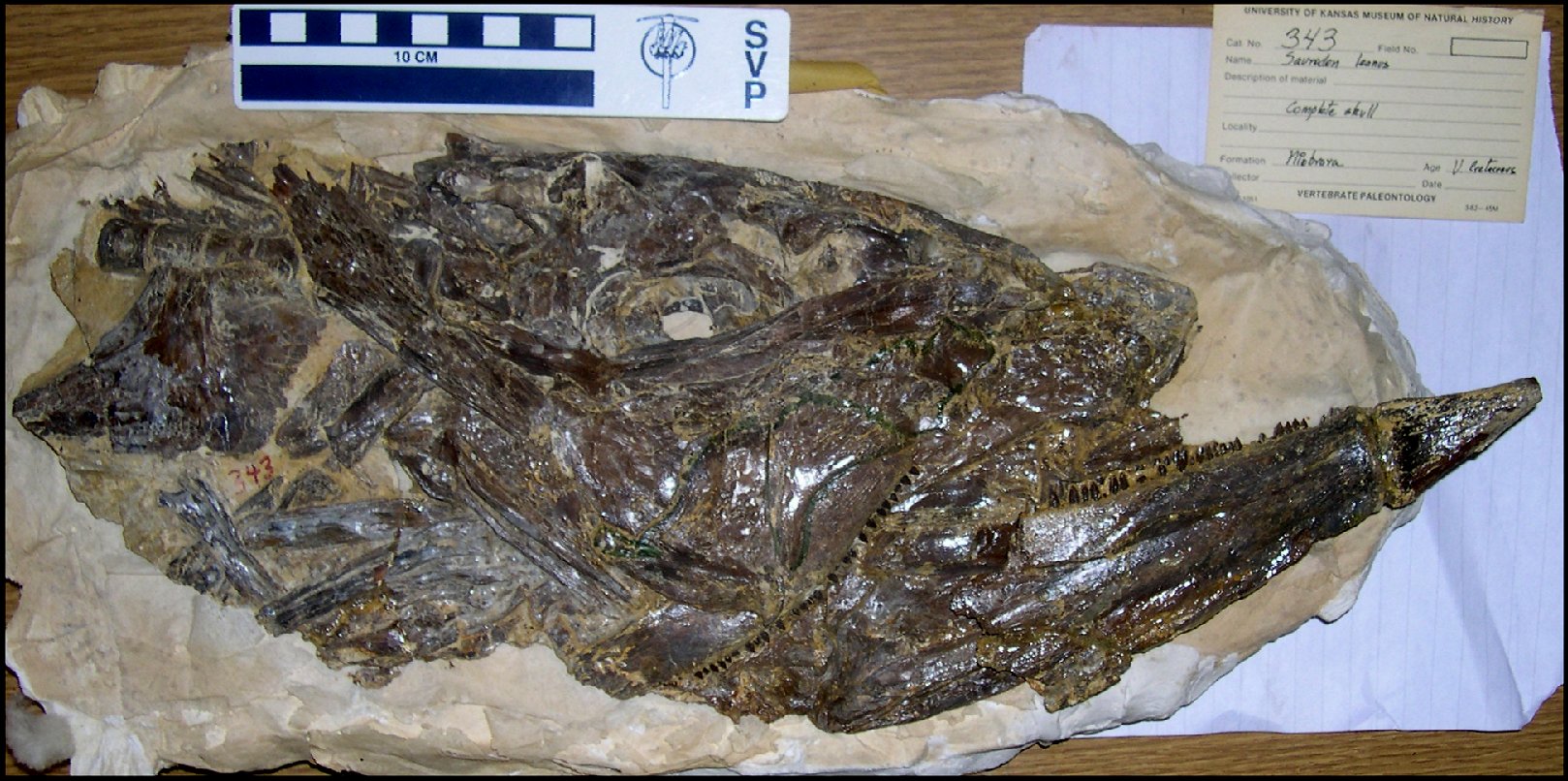 |
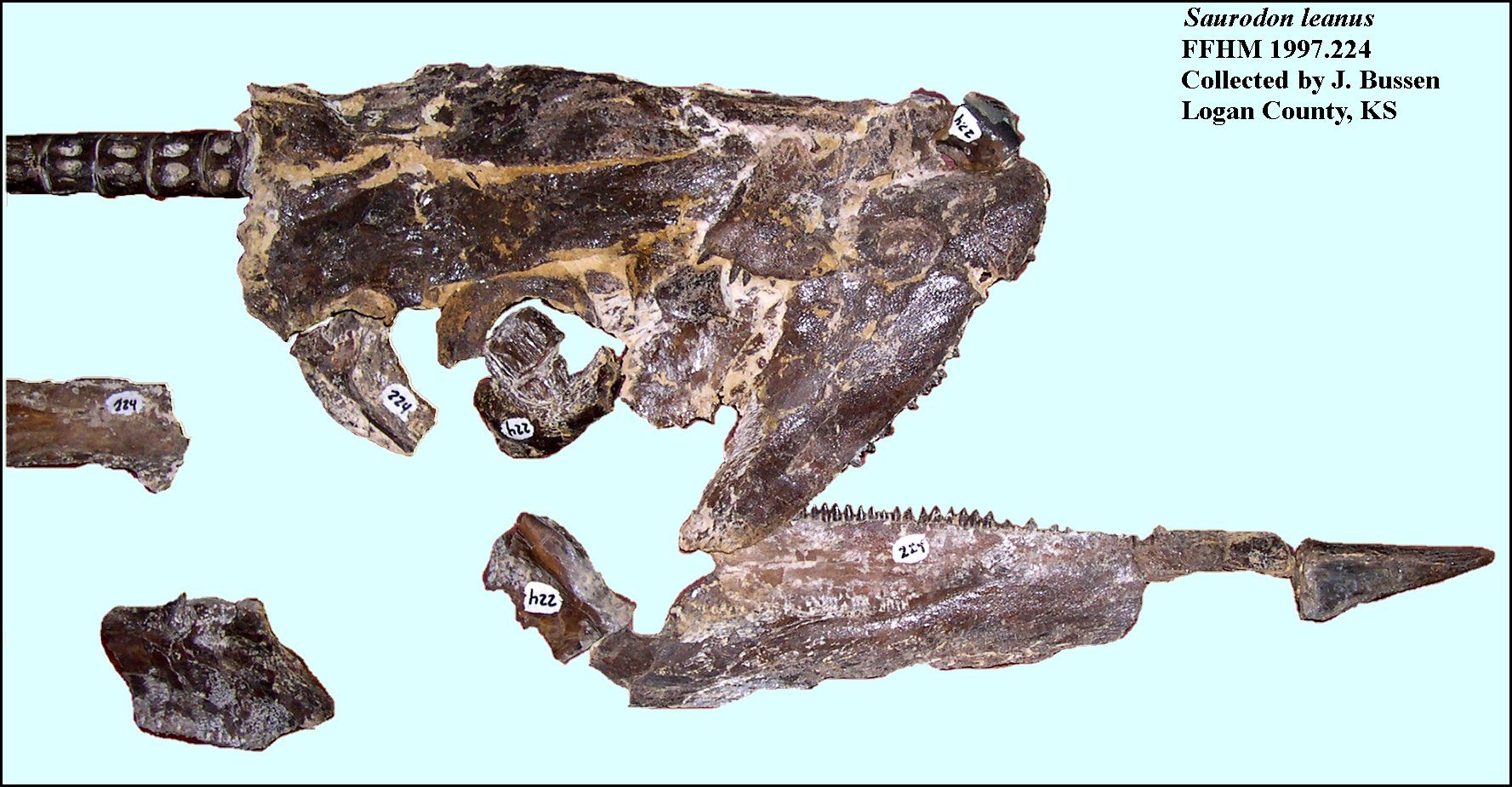
LEFT: KUVP 343 - Right lateral view of a Saurodon
leanus skull in the University of Kansas Museum of Natural History.
RIGHT: Right lateral view of a specimen of Saurodon leanus in the Fick Fossil and History Museum in Oakley, Kansas, collected by Pete Bussen from the Smoky Hill Chalk of Logan County. |
 |
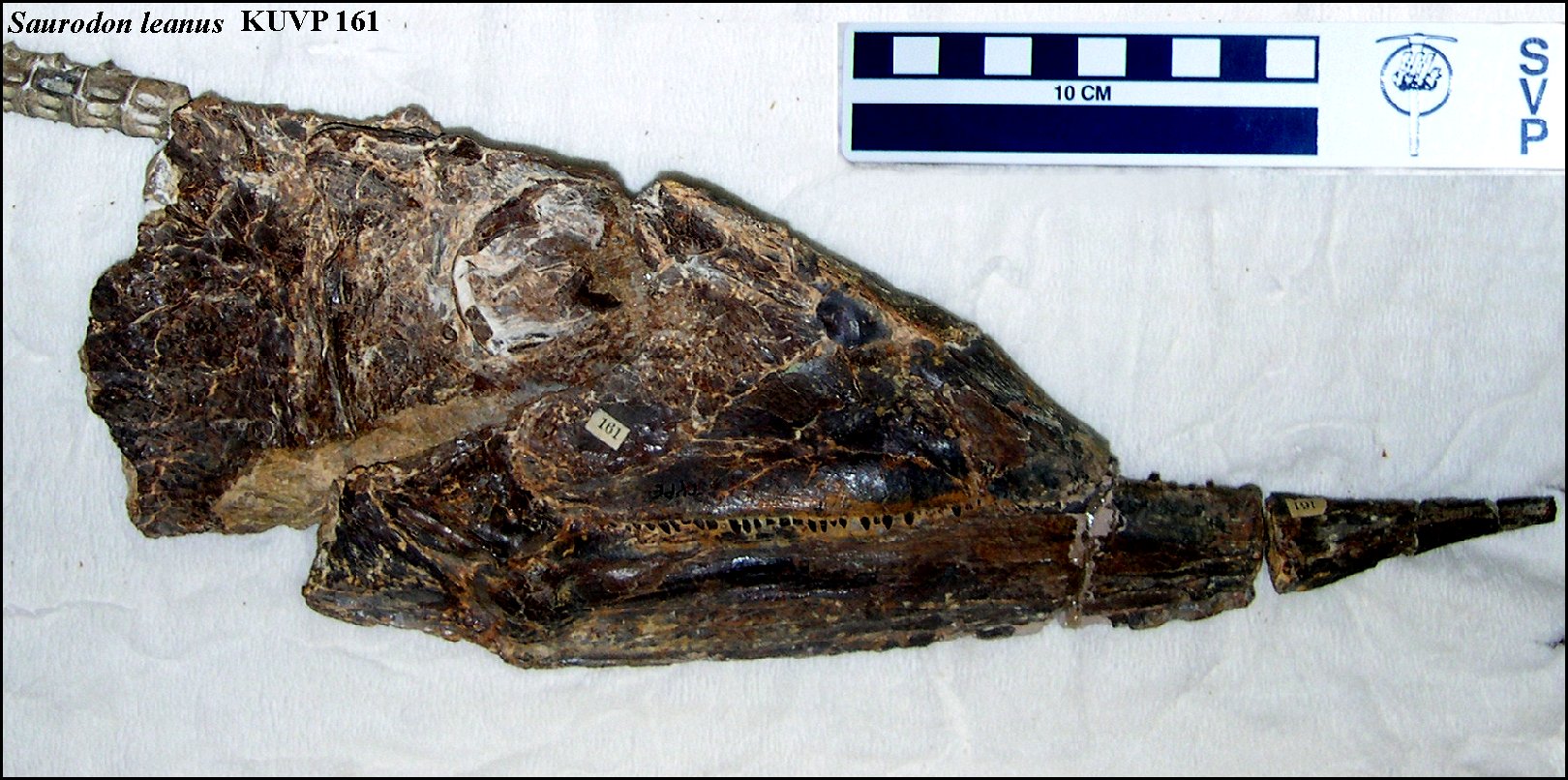 |
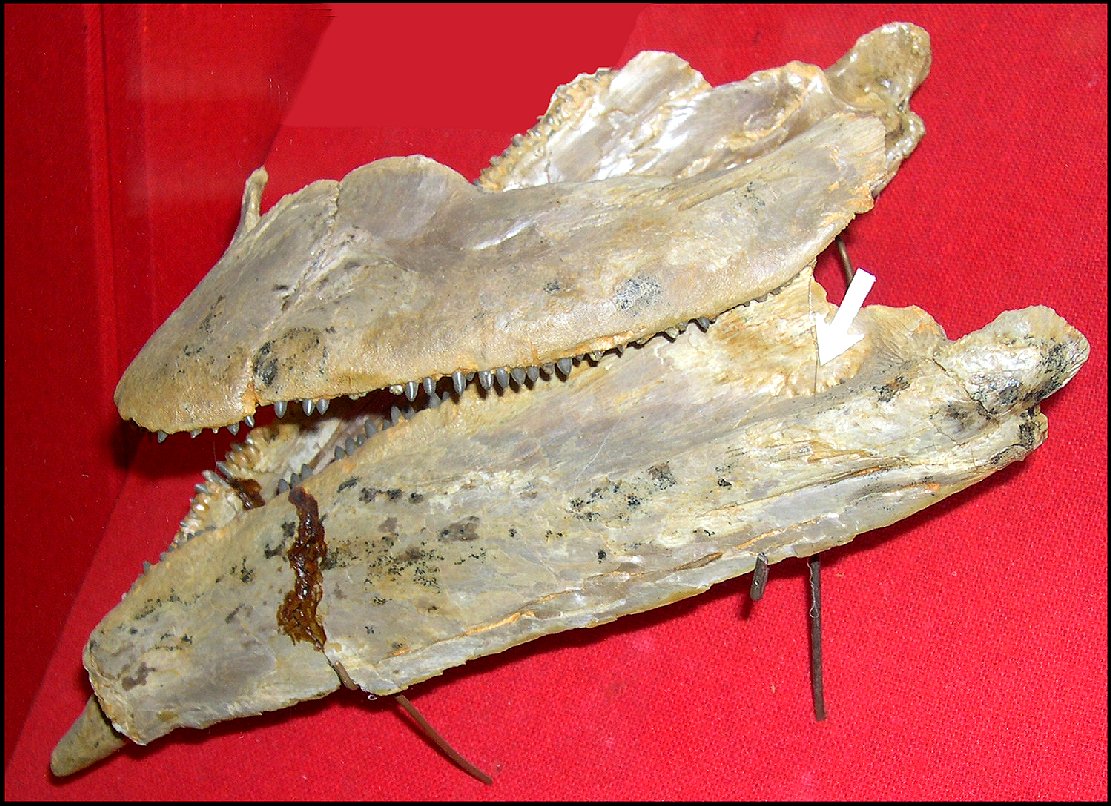
LEFT and RIGHT: Two views of the KUVP 161 Saurodon leanus skull. This skull was the model for the first drawing of a Saurodon skull by Albin Stewart (1898). It was published again 1900 in the University Geological Survey of Kansas. | 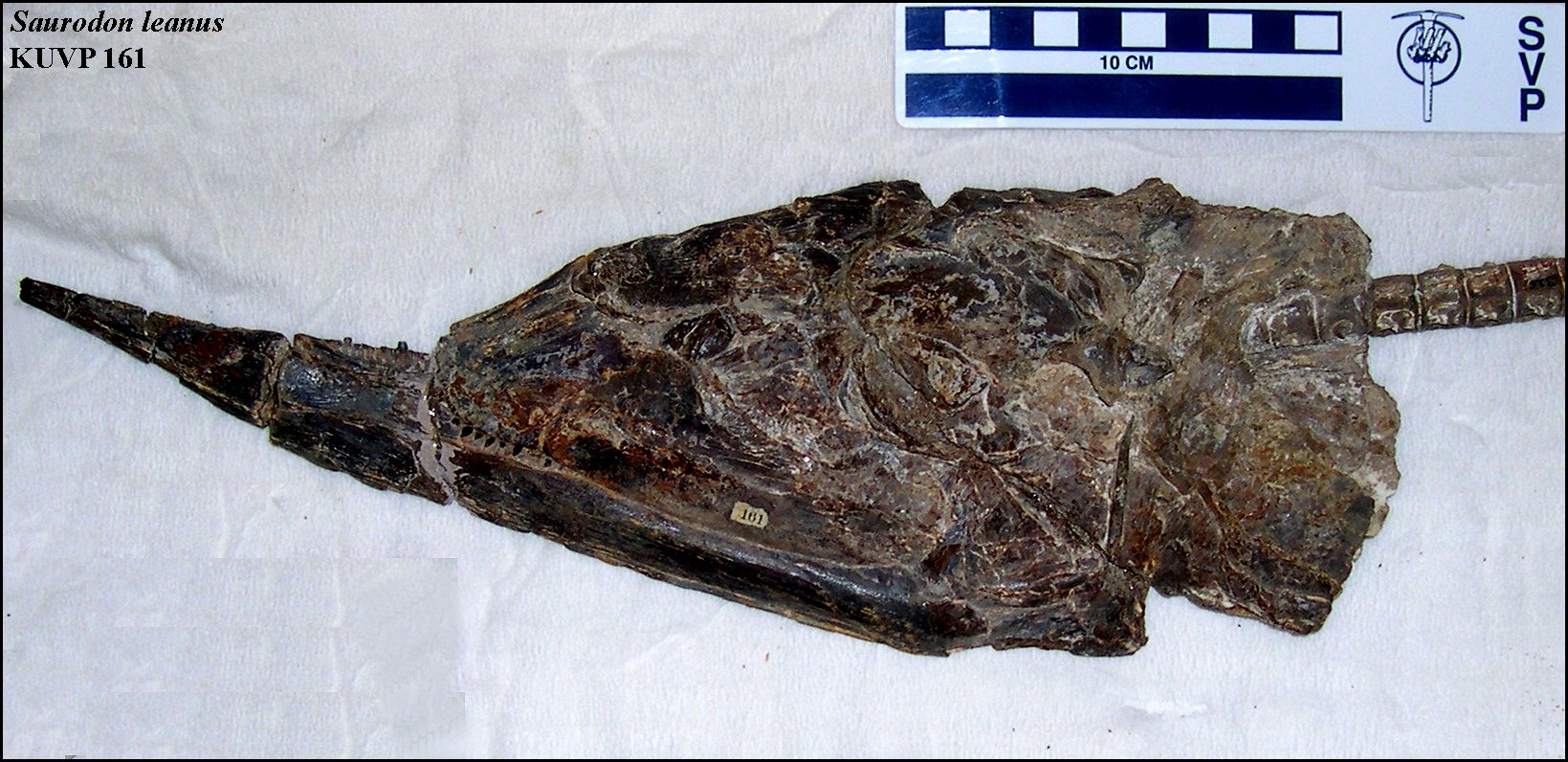 |
 |
LEFT: A 3-dimensional mount of the upper and lower jaws of a Saurodon
leanus skull (unnumbered) in the Johnston Museum of Geology, Emporia State University, Emporia,
KS. Note that the anterior of the left dentary is not articulated with the predentary
and is located too far forward.
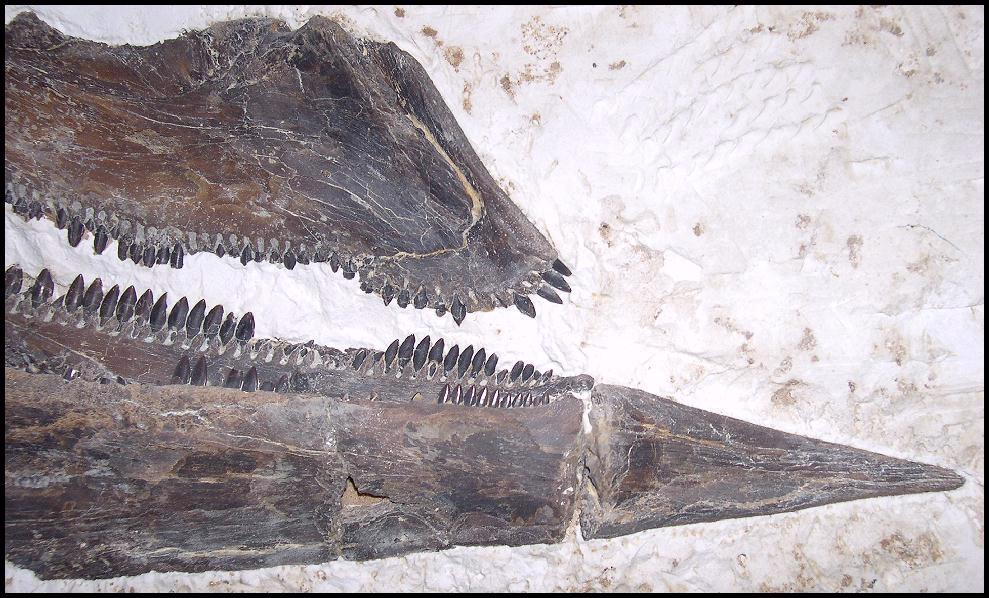
RIGHT: A close-up of the lower jaws / predentary, and partial left upper jaw / premaxilla of Saurodon leanus in medial view from the Fryxell Geology Museum at Augustana College in Rock Island, Illinois. This specimen was collected by George F. Sternberg from the Smoky Hill chalk and acquired from him by Augustana College. A different view of the specimen is HERE. |
 |
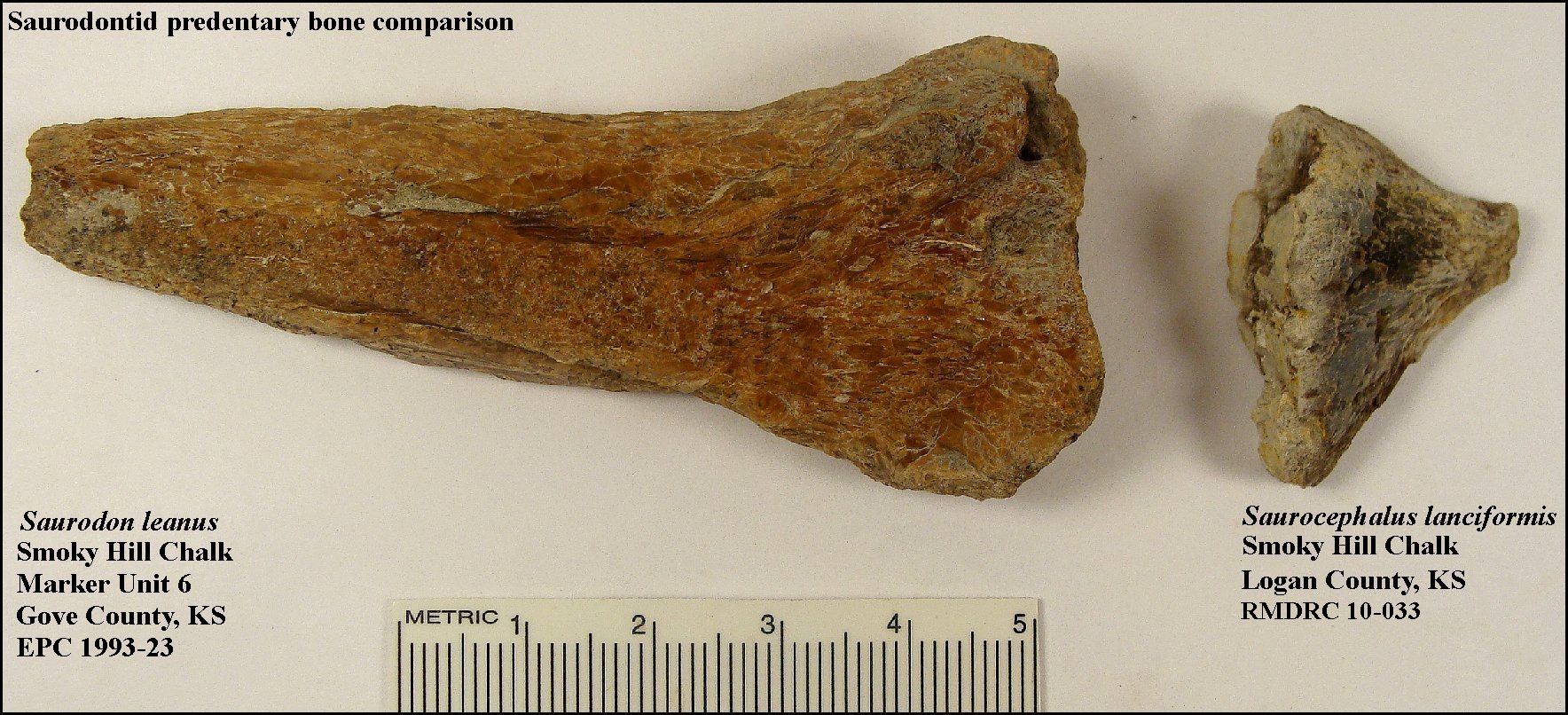 |
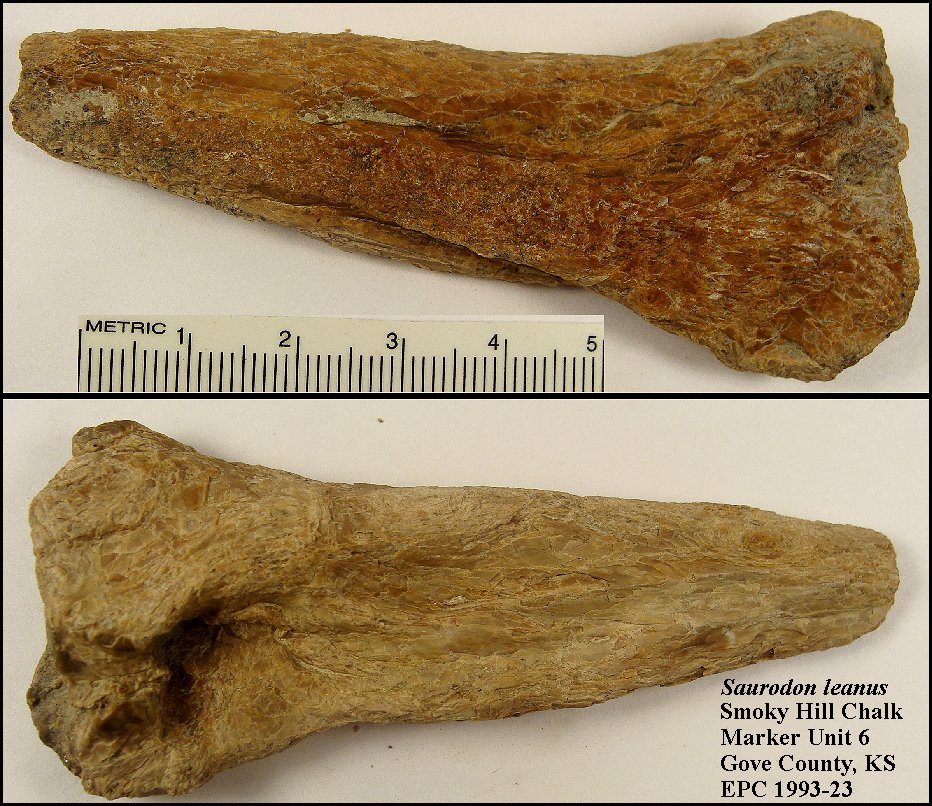
LEFT: The predentary of Saurodon leanus (EPC
1993-23) compared the dentary of Saurocephalus lanciformis. Both
predentarys would have come from fish of similar size.
RIGHT: Left and right sides of the predentary of S. leanus (EPC 1993-23). A circular depression on the right side appears to be a possible bite mark. Note that the predentary of S. leanus is more than twice as long as it is tall... a significantly different shape compared to Saurocephalus lanciformis. |
 |
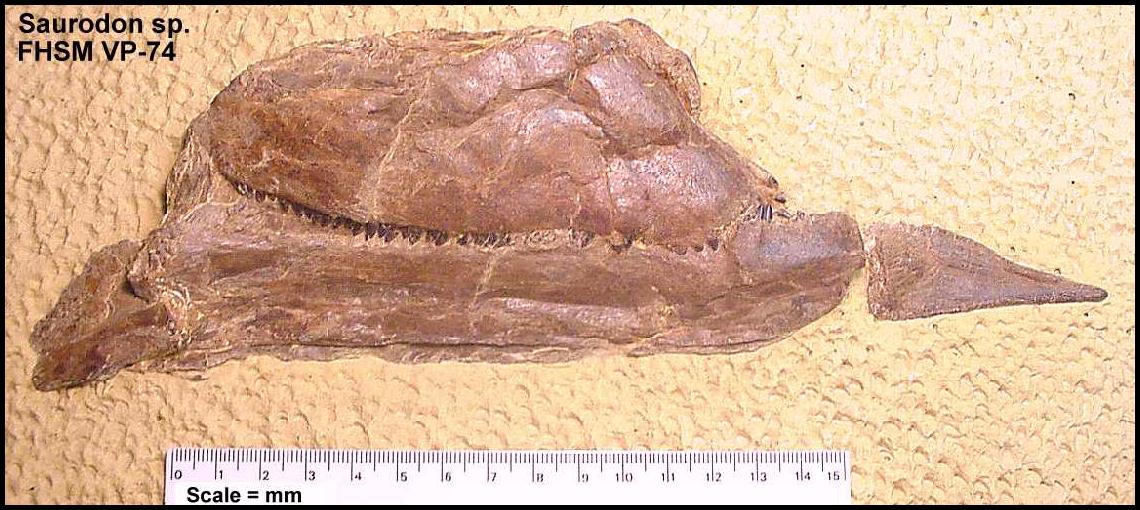 |
LEFT: This specimen of Saurodon leanus (FHSM VP-74) in the
Sternberg Museum collection preserves the upper and and lower jaws, the premaxilla and the
predentary. The specimen was collected and prepared by George F. Sternberg.
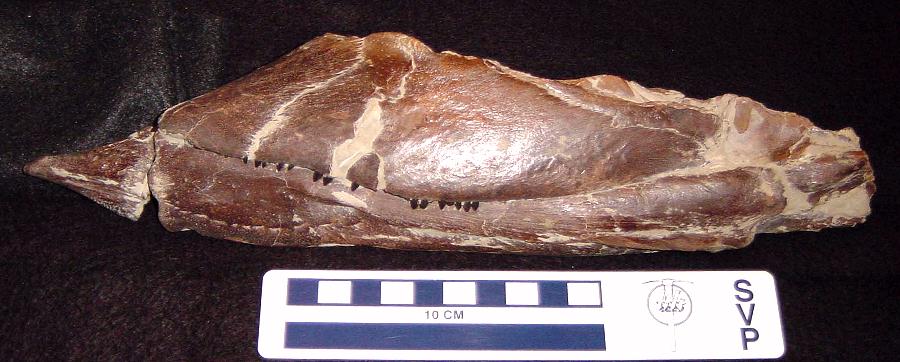
RIGHT: This is a photograph of a recently discovered specimen of a saurodontid fish from the Ozan Formation (Upper Campanian), Hempstead County, Arkansas. It is believed that this is the first record of this taxon from the Cretaceous of Arkansas. The initial identification appears to be Saurocephalus lanciformis. Photograph by Kelly Irwin. |
 |
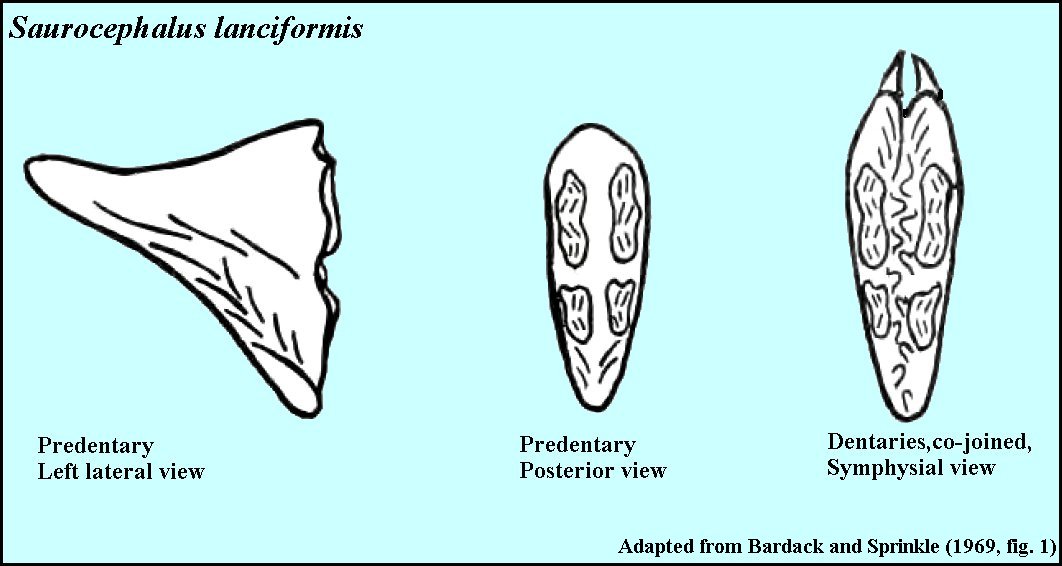 |
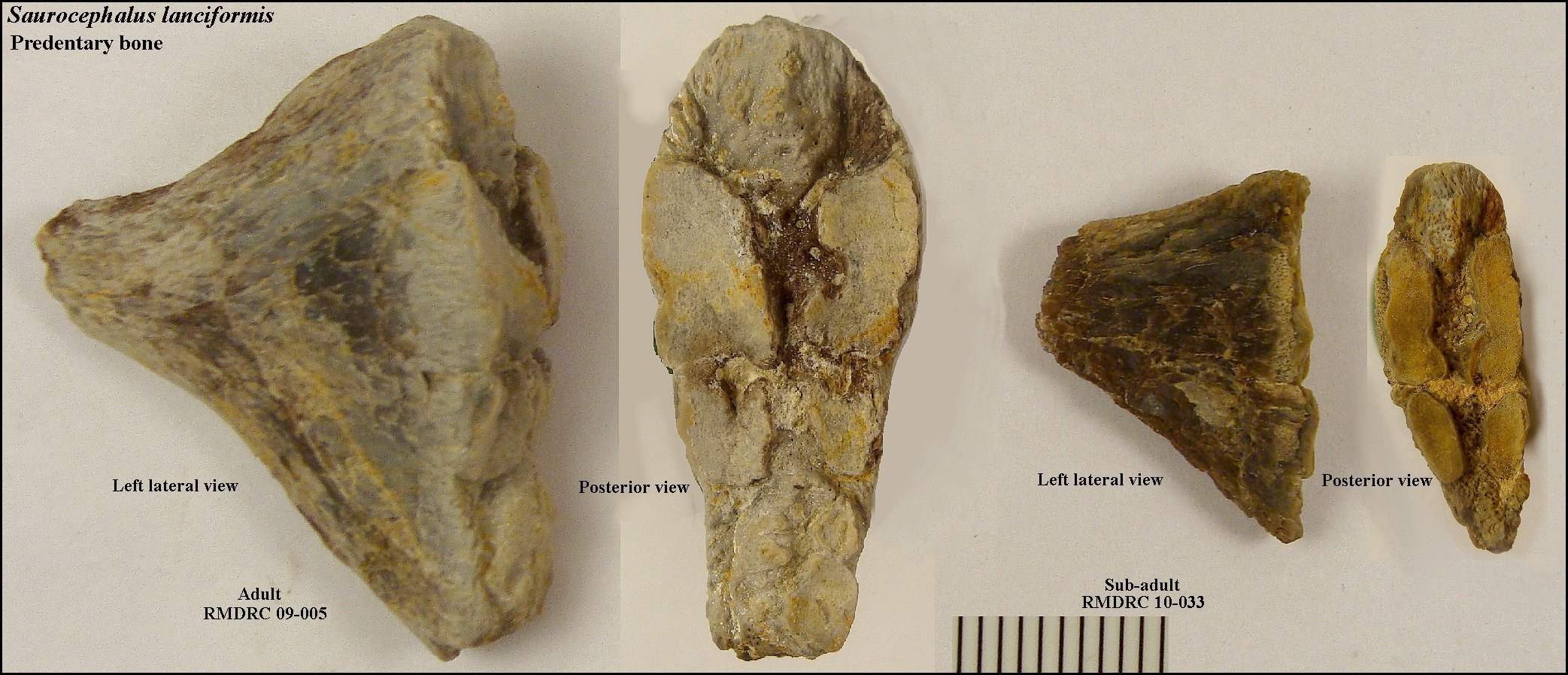
LEFT: The predentary of Saurocephalus lanciformis,
adapted from Bardack and Sprinkle (1969, fig.1), based on an unnumbered
specimen in the Museum of Comparative Zoology, Harvard University. The
predentary of S. lanciformis is roughly as tall as it is long. RIGHT: Two S. lanciformis predentarys from the upper chalk (Early Campanian), Logan County, Kansas, in left lateral and posterior view. Photographs of specimens courtesy of Anthony Maltese -RMDRC |
 |
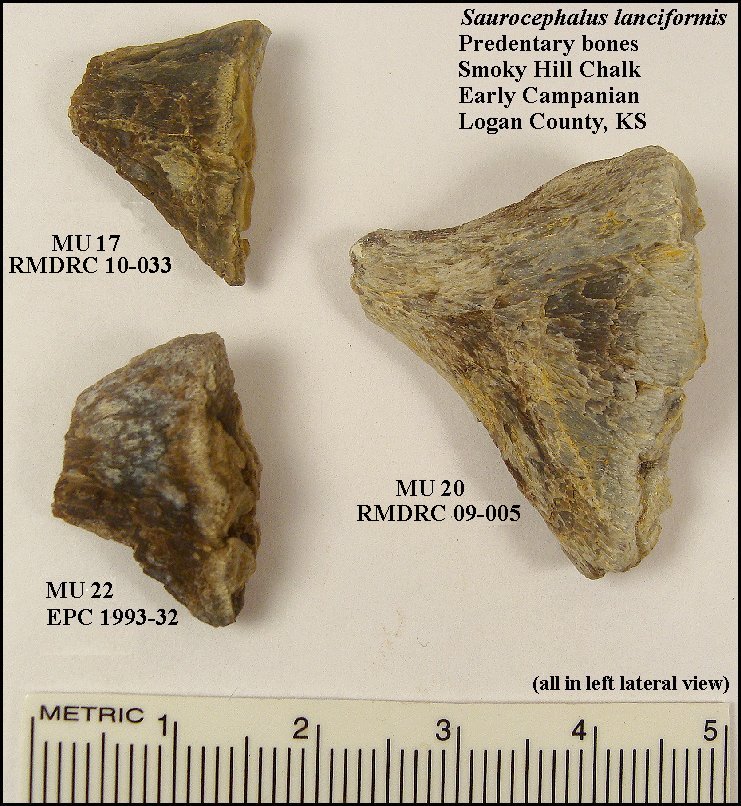 |
LEFT: Three predentarys of Saurocephalus lanciformis
in left lateral view. The two at far left are from sub-adult fish.
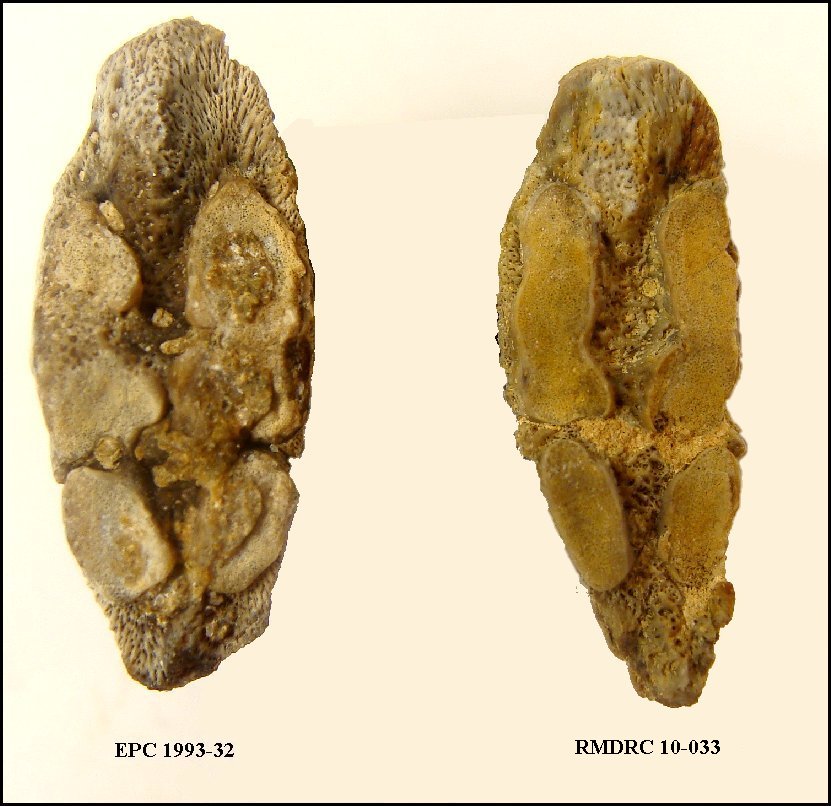
RIGHT: The posterior side of the two S. lanciformis predentarys showing the articular pads where the bone was joined to the dentarys. |
 |
Other Oceans of Kansas webpages on Late Cretaceous fish:
Field Guide to Sharks and Bony Fish of the Smoky Hill Chalk
Sharks:
Bony Fish
Plethodids:
SUGGESTED REFERENCES:
Bardack, D. and G. Sprinkle. 1969. Morphology and relationships of saurocephalid fishes. Fieldiana Geology 16(12):297-340.
Gass, P. 1807. A journal of the voyages and travels of a corps of discovery, under the command of Capt. Lewis and Capt. Clarke of the Army of the United States, from the mouth of the River Missouri through the interior parts of North America to the Pacific Ocean, during the years 1804, 1806 and 1806. Printed by Zadok Cramer, Pittsburg, for David McKeehan, Publisher and Proprietor, 262 pp.
Harlan, R. 1824. On a new fossil genus of the order Enalio sauri, (of Conybeare). Journal of the Academy of Natural Sciences of Philadelphia, Series 1, 3(pt. 2):331-337; pl. 12, figs. 1-5.
Hays, I. 1830. Description of a fragment of the head of a new fossil animal, discovered in a marl pit, near Moorestown, New Jersey. Transactions of the American Philosophical Society, Series 2, 3(18):471-477, pl. 16.
Leidy, J. 1856. Notes on the fishes in the collection of the Academy of Natural Sciences of Philadelphia. Proceedings of the Academy of Natural Sciences of Philadelphia, 8:221. (printed in 1857)
Leidy, J. 1857. Remarks on Saurocephalus and its allies. Transactions of the American Philosophical Society, xi pp. 91-95, with pl. vi. (Published 1860)
Loomis, F. B. 1900. Die anatomie und die verwandtschaft der Ganoid- und Knochen-fische aus der Kreide-Formation von Kansas, U.S.A. Palaeontographica, 46.
Spamer, E. E., R. M. McCourt, R. Middleton, E. Gilmore and S. B. Duran. 2000. A national treasure: Accounting for the Natural history specimens from the Lewis and Clark Expedition (western North America, 1803-1806) in the Academy of Natural Sciences of Philadelphia. Proceedings of the Academy of Natural Sciences of Philadelphia, 150:47-58.
Stewart, A., 1898. A contribution to the knowledge of the ichthyic fauna of the Kansas Cretaceous. Kansas University Quarterly 7(1):22-29, pl. I, II. (Portheus Lowii sp. nov., Daptinus broadheadi sp. nov., Saurocephalus dentatus sp. nov., Protosphyraena bentonia sp. nov., and Protosphyraena, sp. nov.) --- First description of predentary bone in Saurodon (Daphinus broadheadi).
Stewart, A. 1898. Some notes on the genus Saurodon and allied species. Kansas University Quarterly, 7(4):177-186, pls. XIV, XV, XVI.
Stewart, A. 1900. Teleosts of the Upper Cretaceous. The University Geological Survey of Kansas. Topeka VI 257-403, 6 figs., pls. XXXIII-LXXVIII.
Stewart, J. D. 1990a. Niobrara Formation vertebrate stratigraphy, pages 19-30, In Bennett, S. C. (ed.), Niobrara Chalk Excursion Guidebook, The University of Kansas Museum of Natural History and the Kansas Geological Survey.
Stewart, J. D. 1999. A new genus of Saurodontidae (Teleostei: Ichthyodectiformes) from Upper Cretaceous rocks of the Western Interior of North America. pp. 335-360, 2 fig. In Arrantia, G. and H-P Schultze (eds.), Mesozoic Fishes 2 - Systematics and Fossil Record, Verlage Dr. Friedrich Pfeil, München, Germany.
Stewart, J. D. and V. Friedman. 2001. Oldest North American record of Saurodontidae (Teleostei: Ichthyodectiformes). Journal of Vertebrate Paleontology 21(Supplement to 3):104A.
Taverne, L. and P. Bronzi. 1999. Les poissons cretaces de Nardò. 9°. Note complementaire sur le saurodontinae (Teleostei, Ichthyodectiformes): Saurodon elongatus, sp. nov. Studi e Ricerche sui Giacimenti Terziari di Bolca. VIII. Memor. Vol. Lorenso Sorbini, Museo Civico di Storia Naturale, Verona, pp. 105-116. (Illustration of a nearly complete fish)
Vullo, R., Buffetaut, E. and Everhart, M.J. 2012. Reappraisal of Gwawinapterus beardi from the Late Cretaceous of Canada: A saurodontid fish, not a pterosaur. Journal of Vertebrate Paleontology 32(5):1198-1201.