 |
Marine turtles from the Western
Interior Sea
Copyright © 2004-2014 by
Mike Everhart
Last updated 08/09/2014
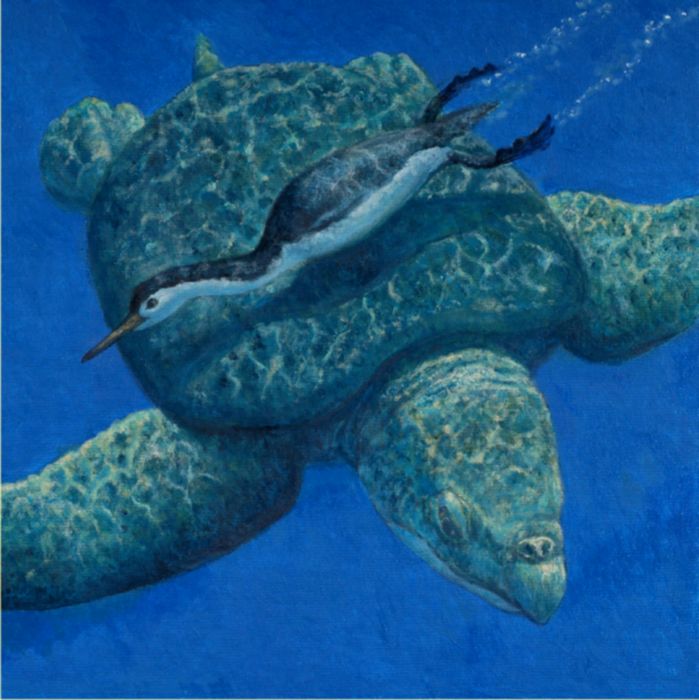
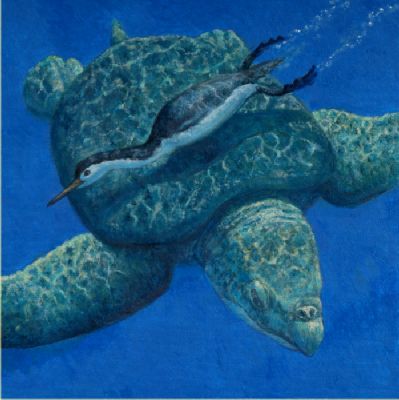
LEFT: A five-foot-long Hesperornis regalis swims over the top of a giant Protostega
gigas turtle in the middle of the Western Interior Sea during the early Campanian.
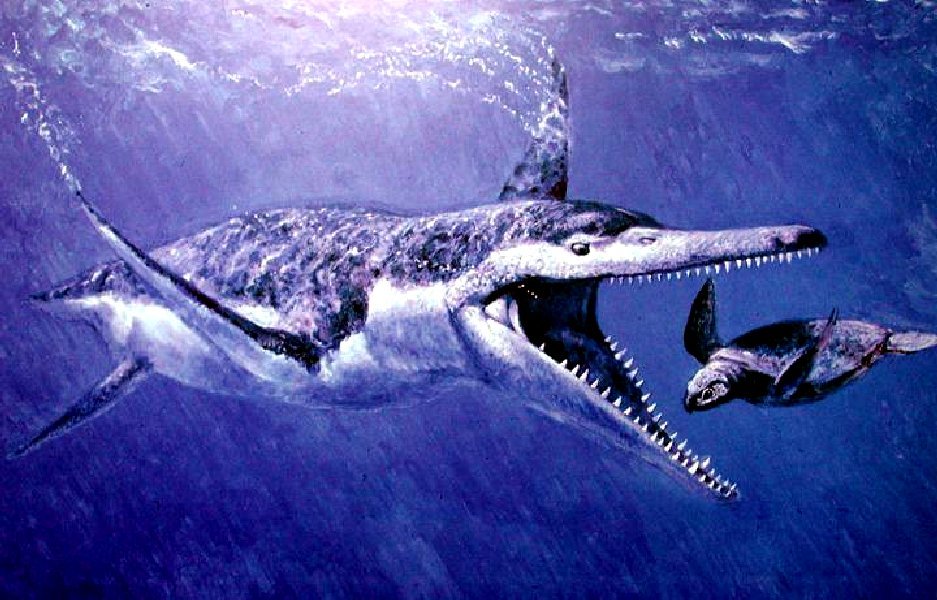
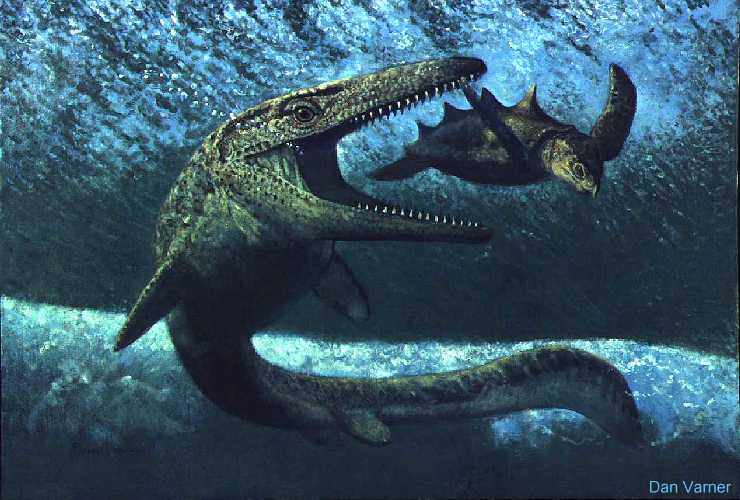
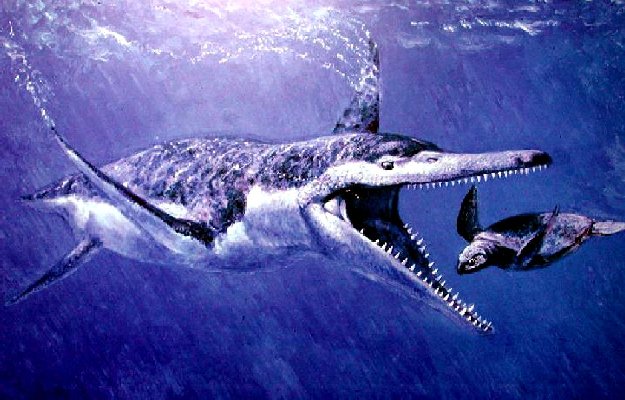
RIGHT: Brachauchenius takes a turtle
out for lunch. Paintings copyright © 2005 by Dan Varner and may not be reproduced in any form without the
express written permission of Dan Varner and Mike Everhart. |
 |
There were two major groups of marine turtles that lived in the
Western Interior Sea during the Late Cretaceous; the Toxochelyids and the
Protostegids. These turtles probably ate seaweed and jellyfish, or may have scavenged
floating carcasses, much the same as modern turtles. Although their remains are found in
the middle of the sea, the females must have periodically migrated hundreds of miles to
the east or west to find sandy shorelines where they could lay their eggs above the high
tide mark. Turtle bone found in the Smoky Hill Chalk is dense and very finely grained, and
is readily differentiated from mosasaur or plesiosaur bone.
 |
Did mosasaurs eat turtles?
Well, according to most authors, including me, "Yes, they
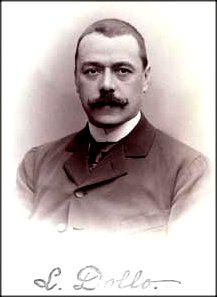
did." Do we have proof of that? Well, maybe.... In 1887, Louis Dollo,
a respected Belgian naturalist published a paper in which he wrote (page
520), "Quoi qu'il en soit, le Hainosaure se nourrissait assurément
de tortues marines, car nous en avons trouvé des restes dans sa carcasse."
Translated, he said, "However, Hainosaurus undoubtedly
fed upon marine tortoises, because their remains have been found in its
carcass."
Unfortunately he did not identify which specimens or where they were
housed. Since Dollo's work is certainly well respected, most of us simply
took his word for it. Recently I began asking questions about the
whereabouts of the specimens that he was describing. While none have been
located as of today (January, 2011), the search is on.
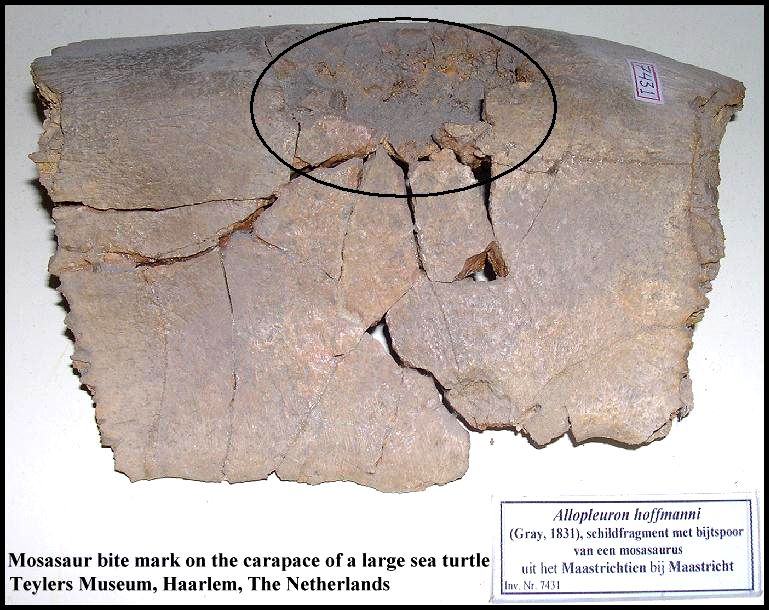
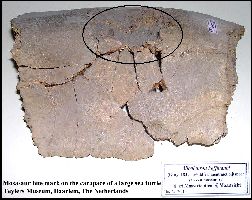
This crushing injury
on a turtle shell fragment in the Teylers Museum in Haarlem, The
Netherlands appears to indicate that it was bitten by something very large
and powerful. It is likely that turtles in the Western Interior Sea were
also eaten by the larger mosasaurs, initially by Tylosaurus and
then by Mosasaurus and Prognathodon nearer the end of the
Cretaceous.
REFERENCE: Dollo, L. 1887. Le hainosaure et les nouveaux vertébrés
fossiles du Musée de Bruxelles. Revue des Questions Scienfiques XXI
504-539. (April 1887) |
Family Toxochelyidae
In 2010, I became interested in finding the correct source of the family name
(Toxochelyidae) or this group of extinct marine turtles, which led me in circles for several hours
fruitless searching the Internet. There are many hits for “Baur 1895, emended by Zangerl (1953)” .... which goes exactly nowhere, since few papers I found actually
provide the full citation for Baur (1895).
However, my friend, the late Betsy Nicholls (1988) did cite “Baur, G. 1895. Ueber die Morphologie des Unterkiefers der Reptilien
[On the morphology of the lower jaw of reptiles]. Anatomischer Anzeiger
11:410-415.” Unfortunately, that article by Baur turned out to be published in 1896, not 1895, and discusses
the comparative anatomy of lower jaw of reptiles… and while Baur does illustrate a turtle dentary, he does not mention Toxochelyidae.
So far as I can determine, the family name Toxochelyidae was first used by Baur
in another 1896 paper. The correct citation is:
Baur, G. 1896. Bemerkungen über die Phylogenie der Schildkröten
[Remarks on the phylogeny of turtles]. Anatomischer Anzeiger 12:561-570. The term “Toxochelyidae”
first occurs in print on page 564.
Note that Hay (1903) uses the term, but gives no citation:
Hay, O.P. 1903. A revision of the species of the family of fossil turtles called Toxochelyidae, with descriptions of two new species of
Toxochelys and a new species of Porthochelys. Bulletin of the American Museum of Natural History
21(10):177-185.
However, Hay(1908, p. 164) credits Baur as the source of the name,
but again, provides no citation:
Hay, O. P. 1908. The fossil turtles of North America.
Carnegie Institution of Washington, Publication No. 75, 568 pp, 113 pl.
Zangerl (1953), on the other hand, uses the term, but credits no
one:
Zangerl, R. 1953. The vertebrate fauna of the Selma formation of Alabama, Part IV, The turtles of the family Toxochelyidae. Fieldiana, Geology Memoirs 3(4):
137-277.
In my opinion, “emended by Zangerl” gives credit where it is not
due.
Baur (1896, p. 564) should be cited as the original source of the
family name Toxochelyidae.
|
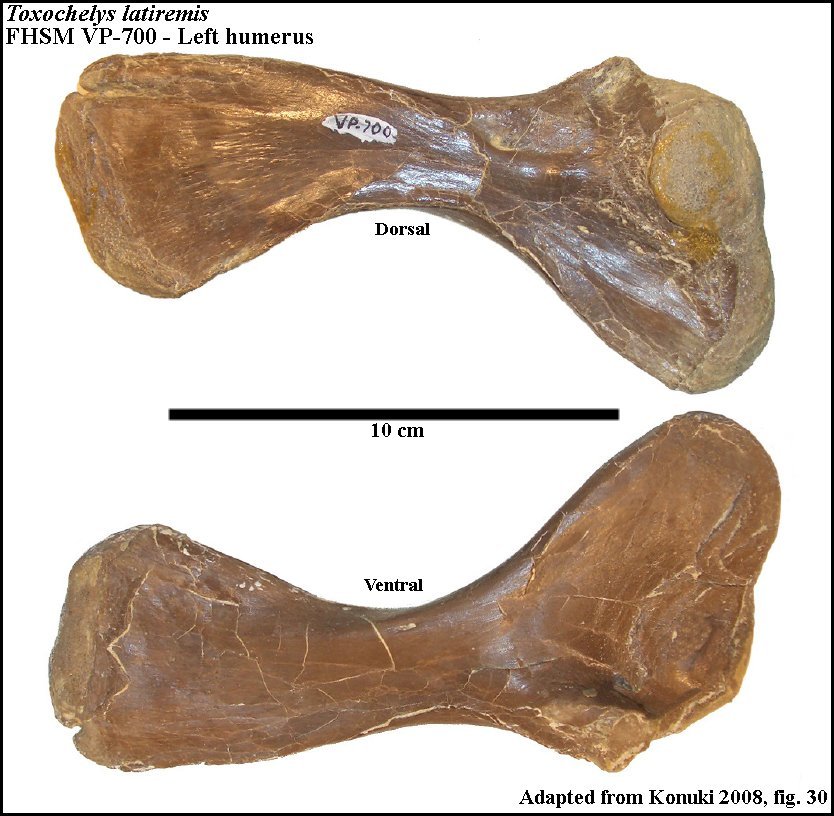
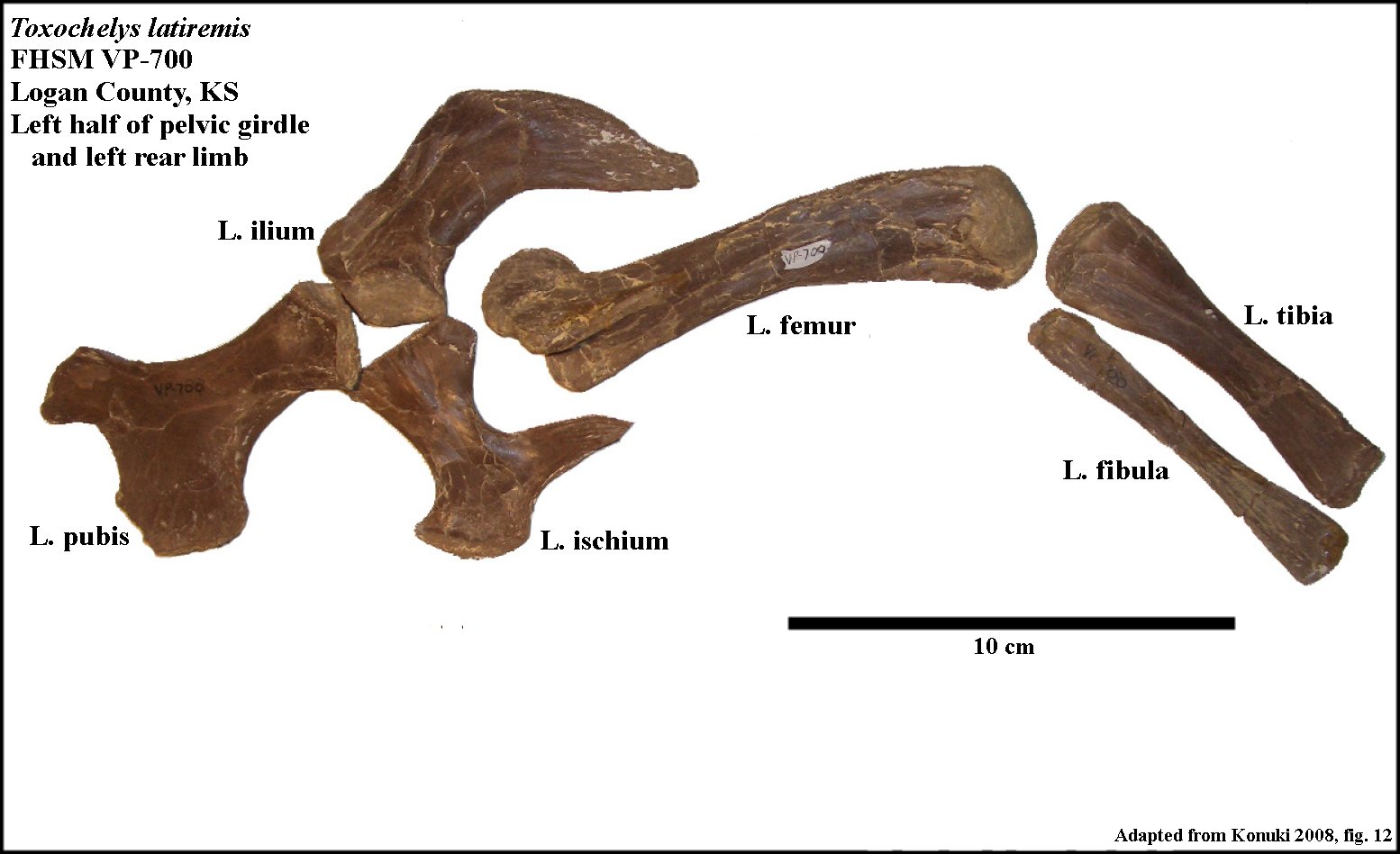
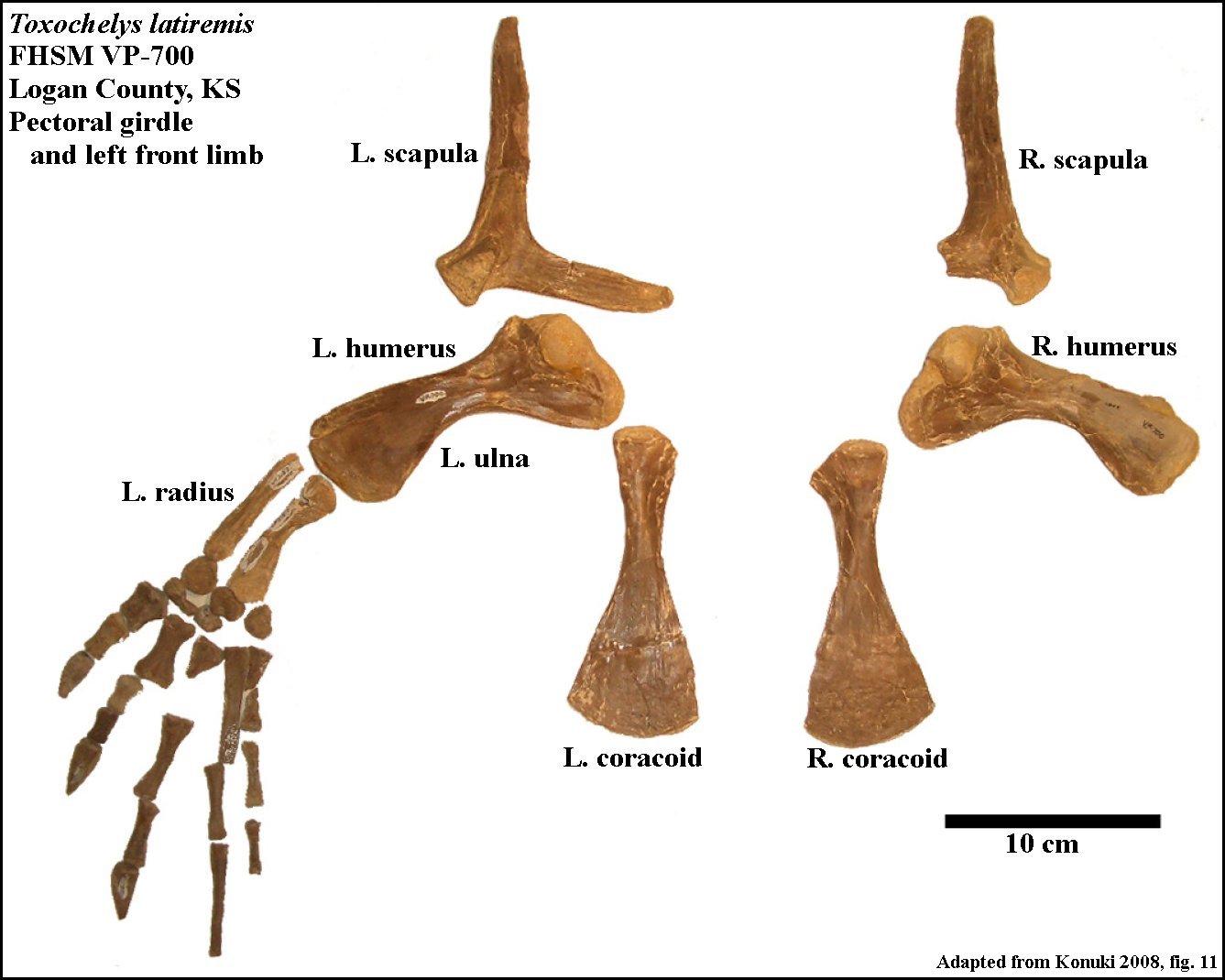
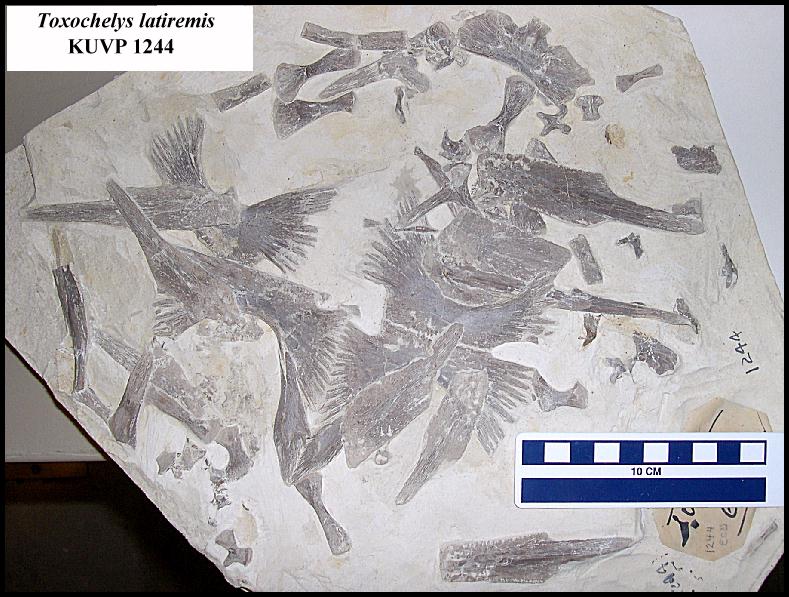
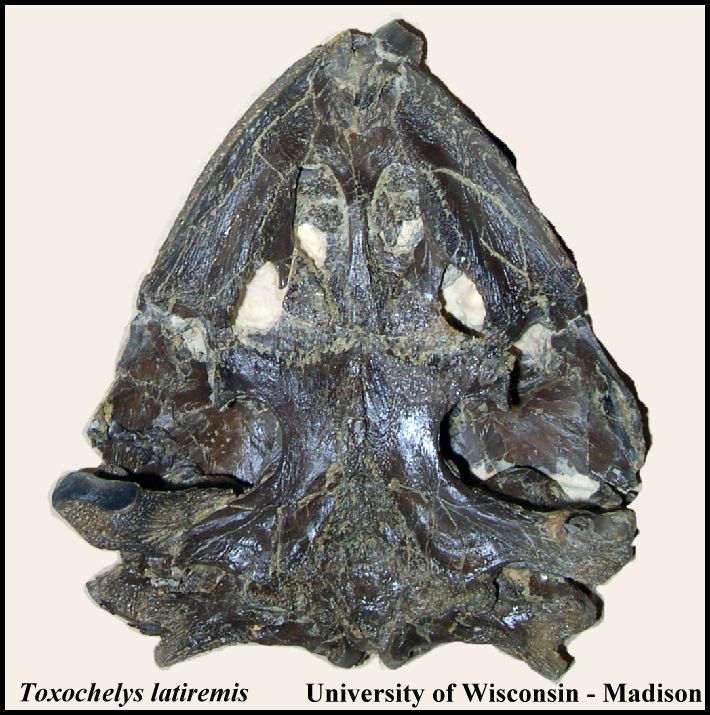
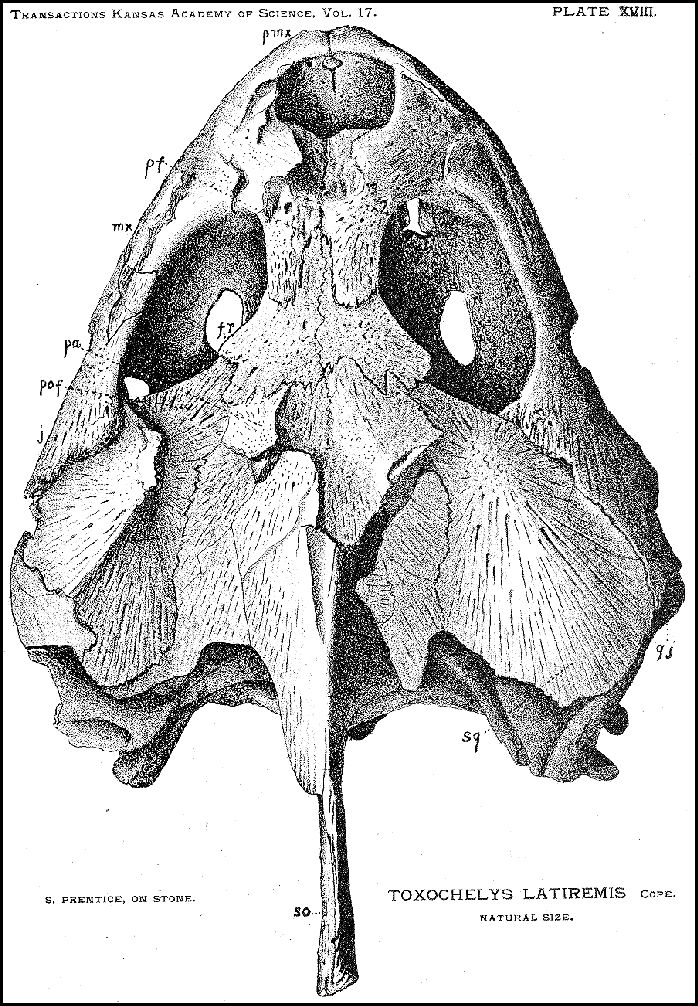
Toxochelys latiremis Cope is the most common
species of marine turtle found in the Smoky Hill Chalk in western Kansas.
 |
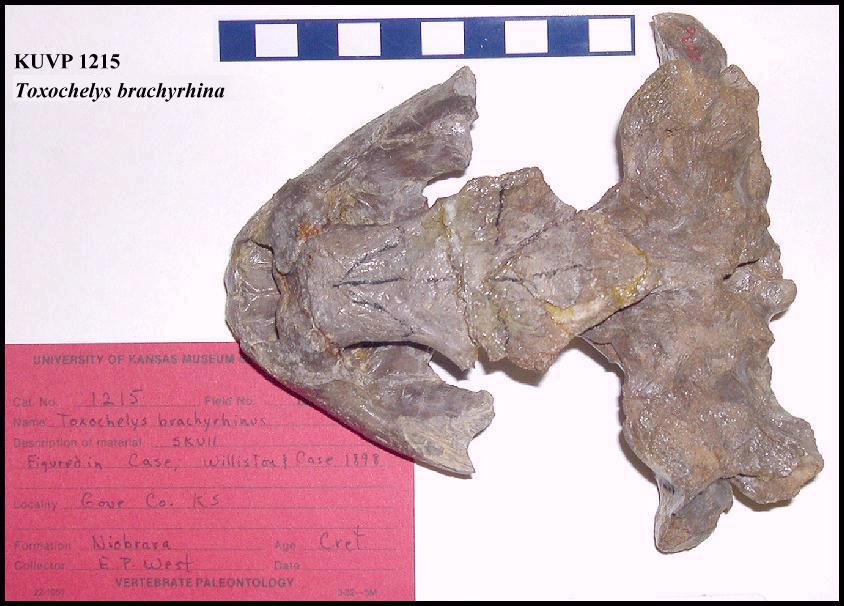
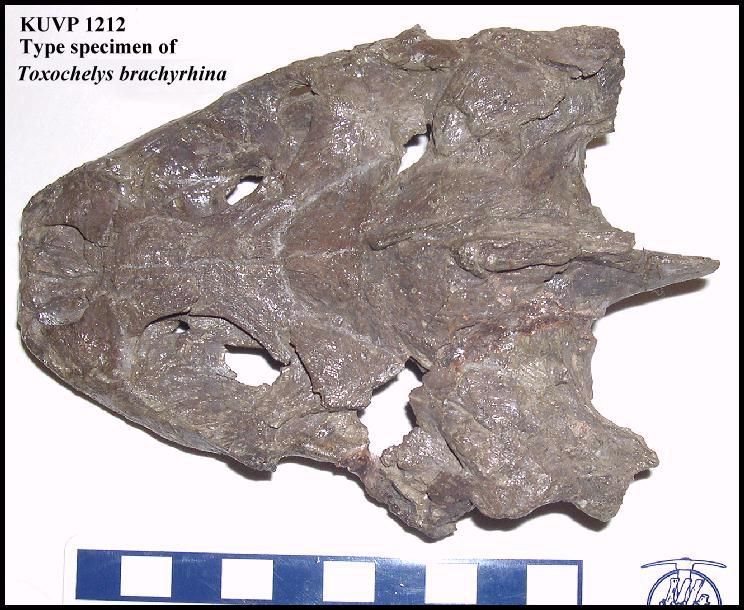
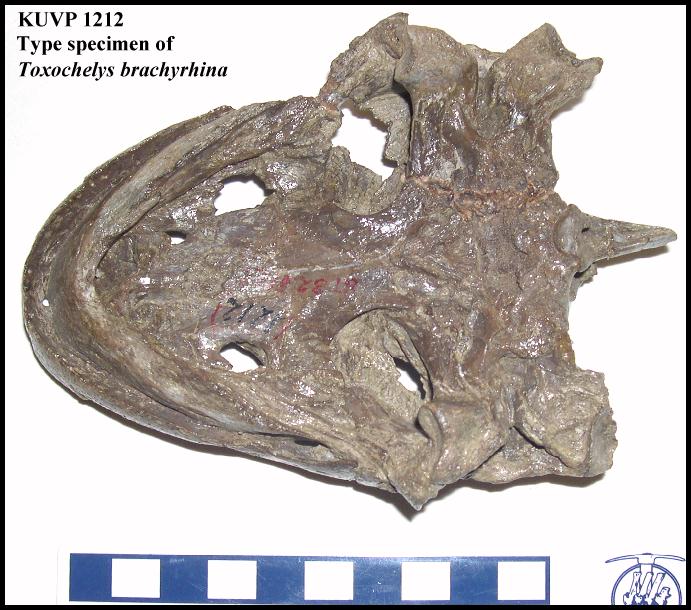
Toxochelyids - Toxochelys was a small to medium sized
turtle (up to 2 m (6 ft) in length) that is found throughout the chalk. This turtle was
similar in outward appearance to a modern leatherback turtle (i.e. the Green Turtle, Dermochelys coriacea) but is not closely related. Common fossils
include shell, limb and skull material. Several species have been described from the chalk
but T. latiremis is the most common.
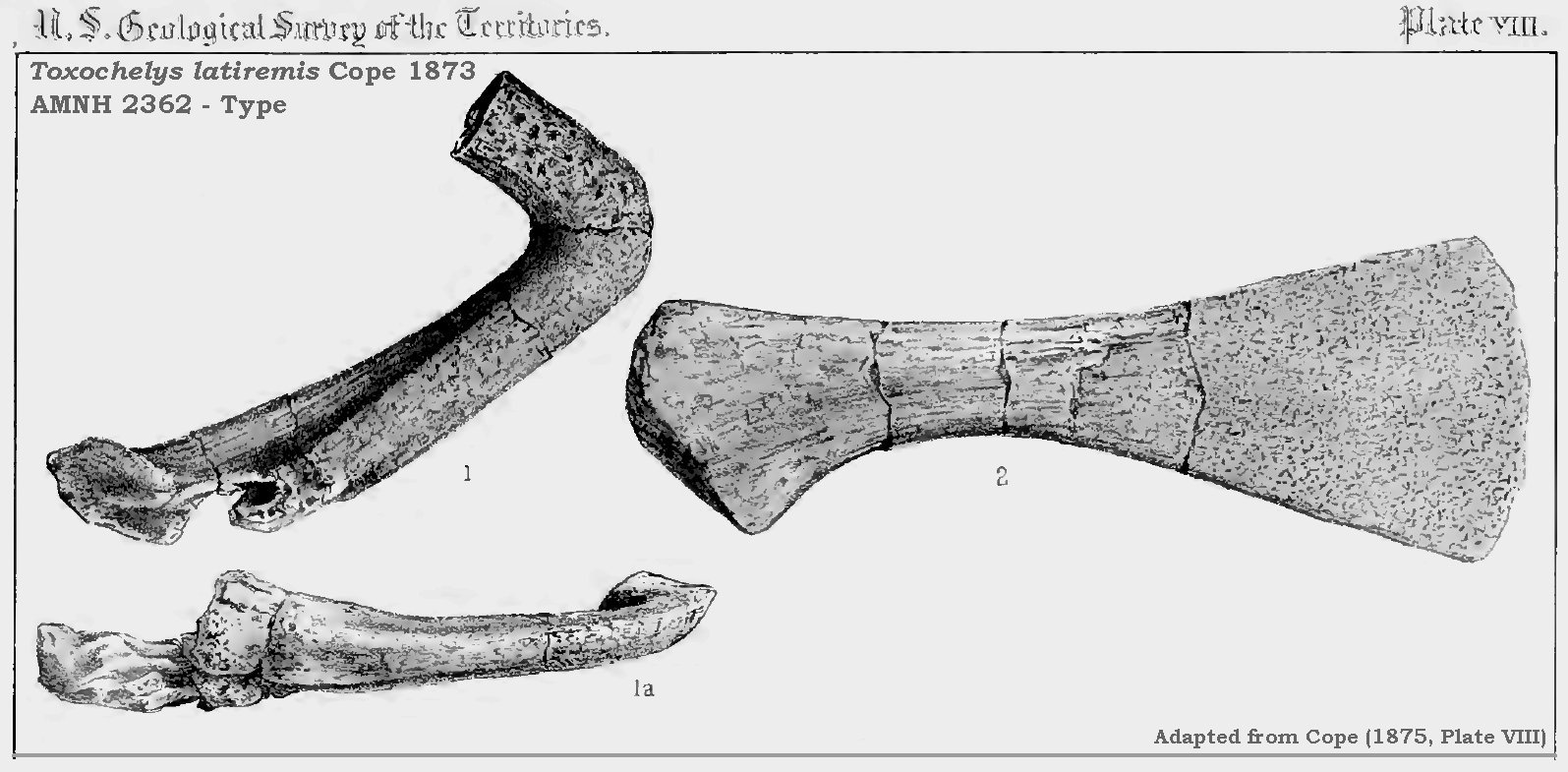
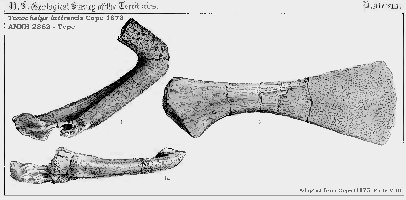
LEFT: The type specimen (AMNH 2362) was described by Cope(1873)
and figured in his 1875 Vertebrata (Plate VIII). It consists of a
partial lower jaw (1 and 1a) and a coracoid bone (2), and was most likely
collected from the Pierre Shale, and not the Smoky Hill Chalk as
originally reported (See Nicholls, 1988). |
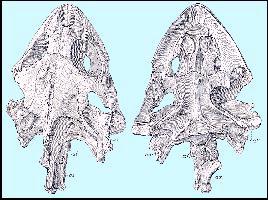 |
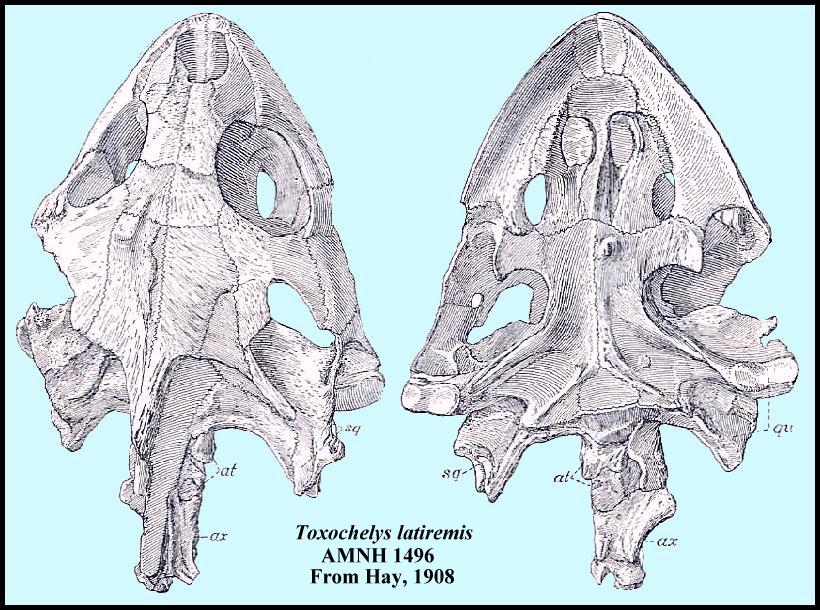
LEFT: The first complete skull of Toxochelys latiremis,
found by B. F. Mudge about 1876 (From Hay, 1908). It is interesting to note that skull and
limb material is found far more often than the carapace and plastron that covered the
turtle's body. Composed of thin bone under a leathery covering, it is likely that the
bodies of these turtles were quite edible to sharks, large fish, and mosasaurs.
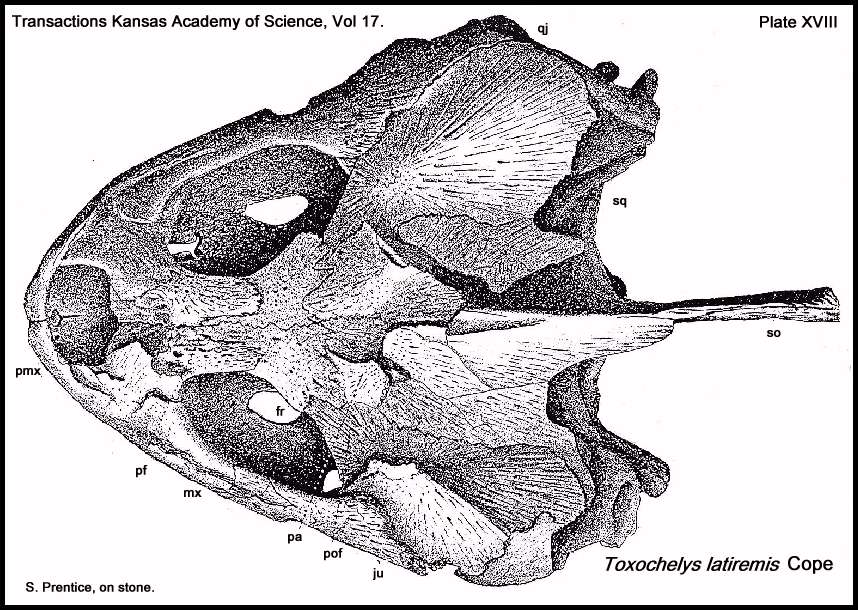
RIGHT:
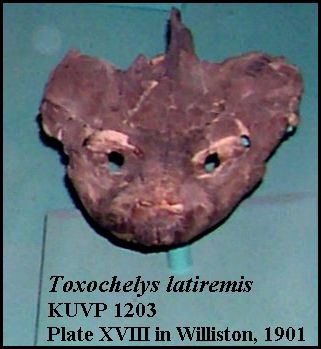
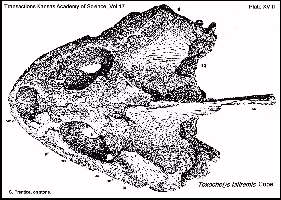
Drawing of the skull of Toxochelys latiremis Cope - Dorsal view, from Williston,
1901). Click to enlarge. This figure is drawn from KUVP
1203 and KUVP 1212. KUVP 1203 is currently on exhibit (and difficult to photograph!) |
 |
 |
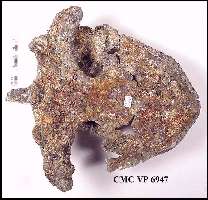 |
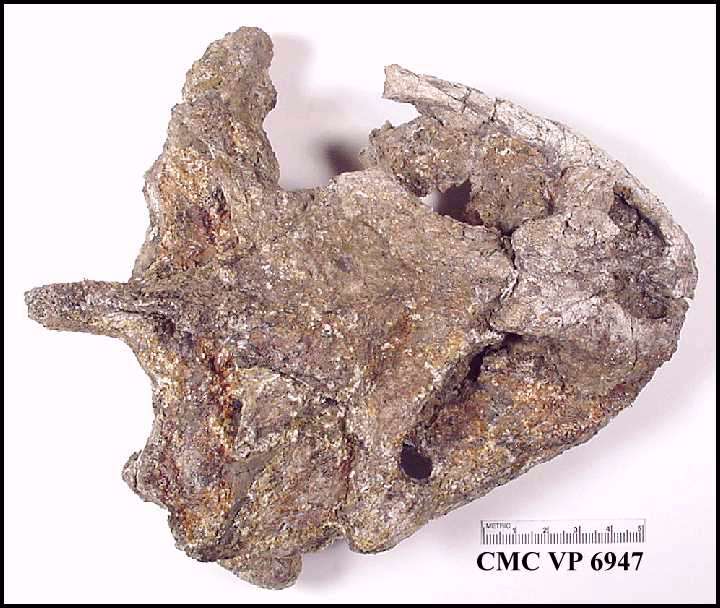
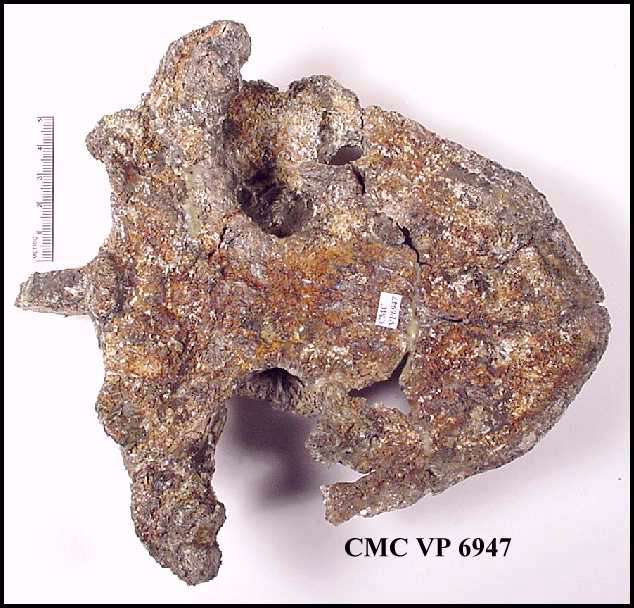
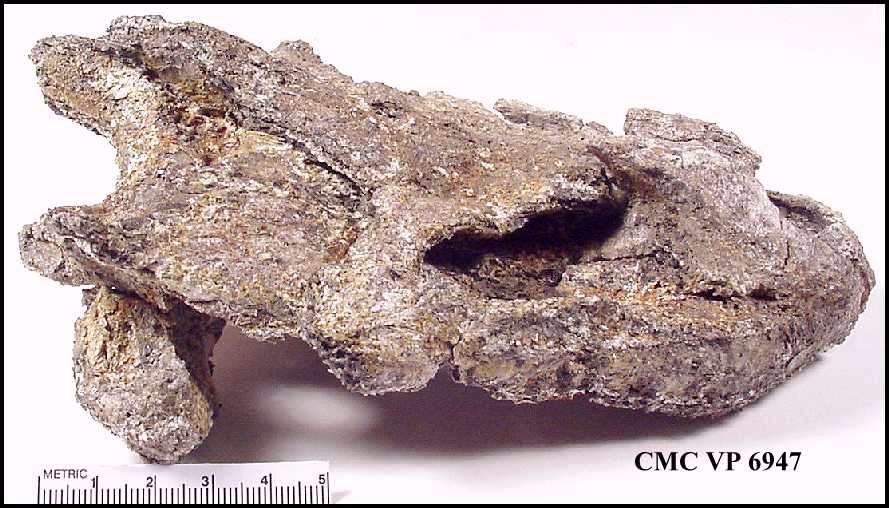
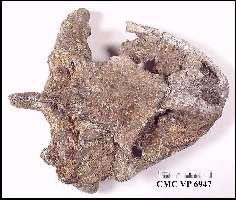
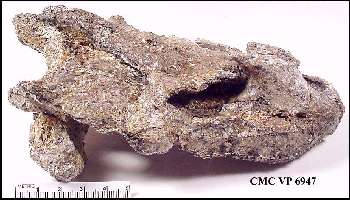
Three views of a large toxochelyid skull (CMC VP-6947) from the Pierre
Shale of Logan Co., KS. Donated by Pete Bussen to the Cincinnati Museum
Center. |
 |
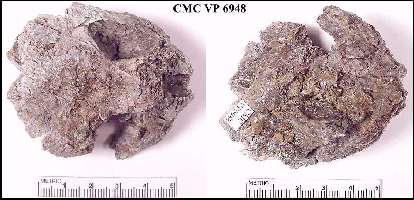 |
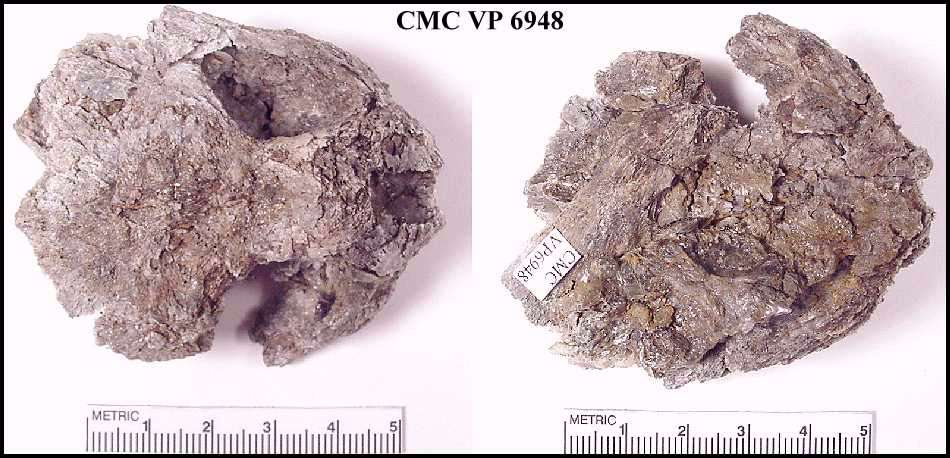
LEFT: Dorsal and ventral views of a smaller Toxochelyid skull (CMC
VP-6948) from the Sharon Springs Member of the Pierre Shale of Logan Co., KS. Donated by
Pete Bussen to the Cincinnati Museum Center. Note poor preservation due to the intrusion
of calcite crystals into the bone. This a common problem in all vertebrate remains from
the Pierre Shale in Kansas. It is of some interest to note that the type
specimen of Toxochelys latiremis (AMNH 2362) was actually collected from the
Pierre Shale by B. F. Mudge near McAllaster Butte in Logan
County, and not in the Smoky Hill Chalk as is often assumed (see Cope 1875; Nicholls,
1988). |
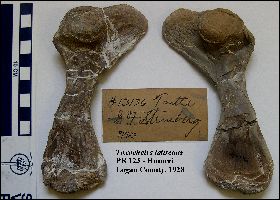 |
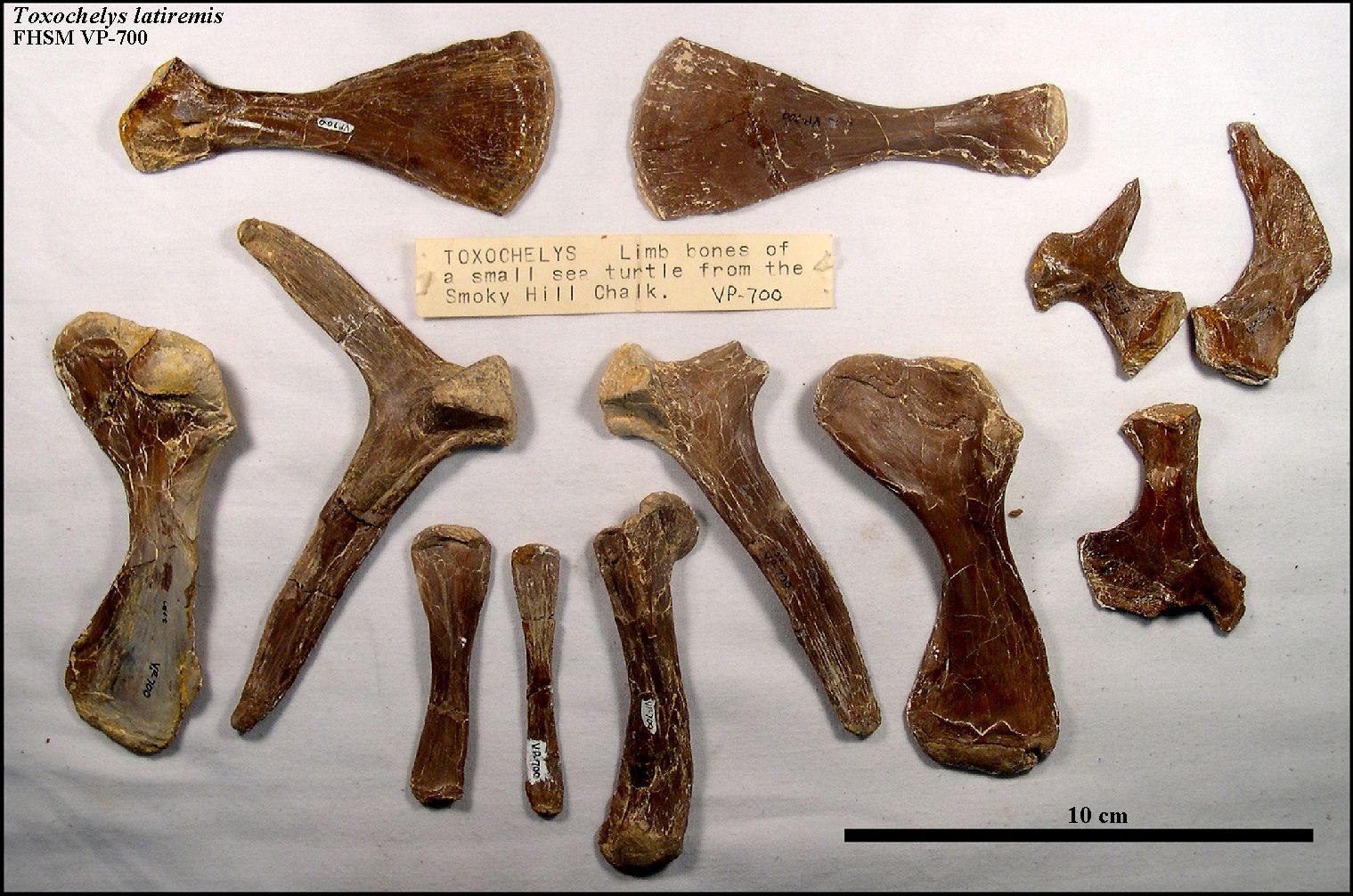
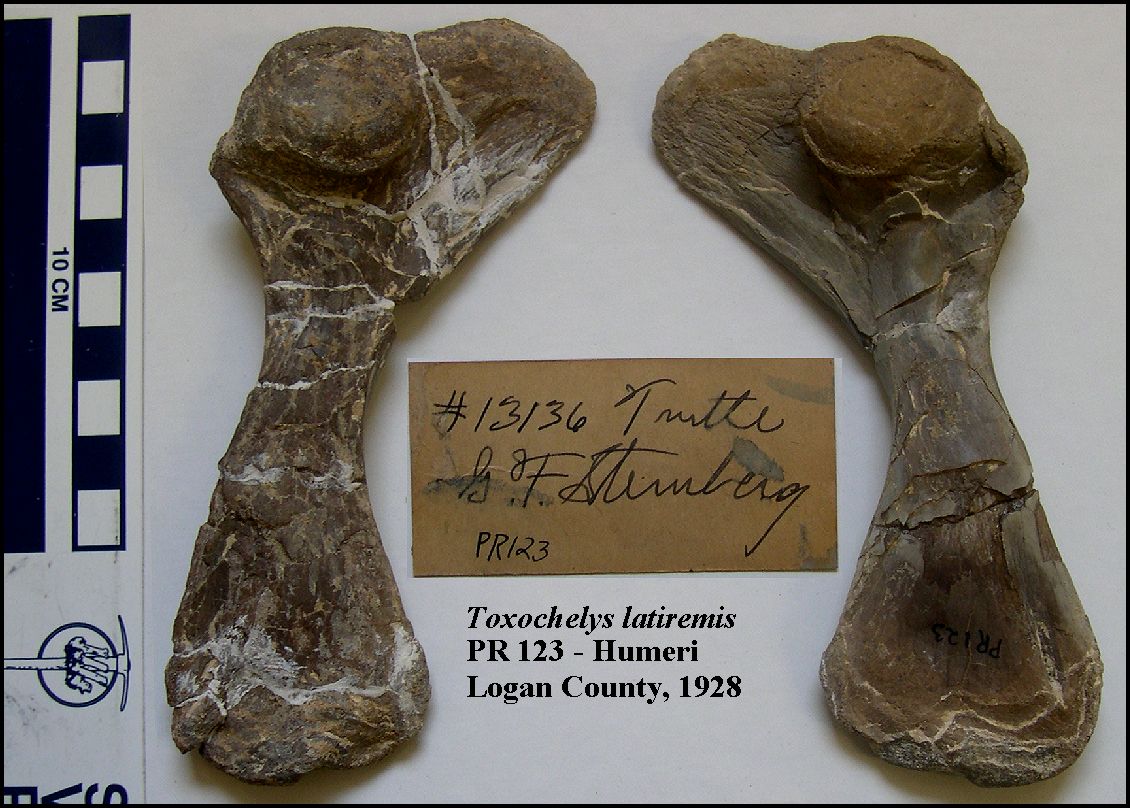
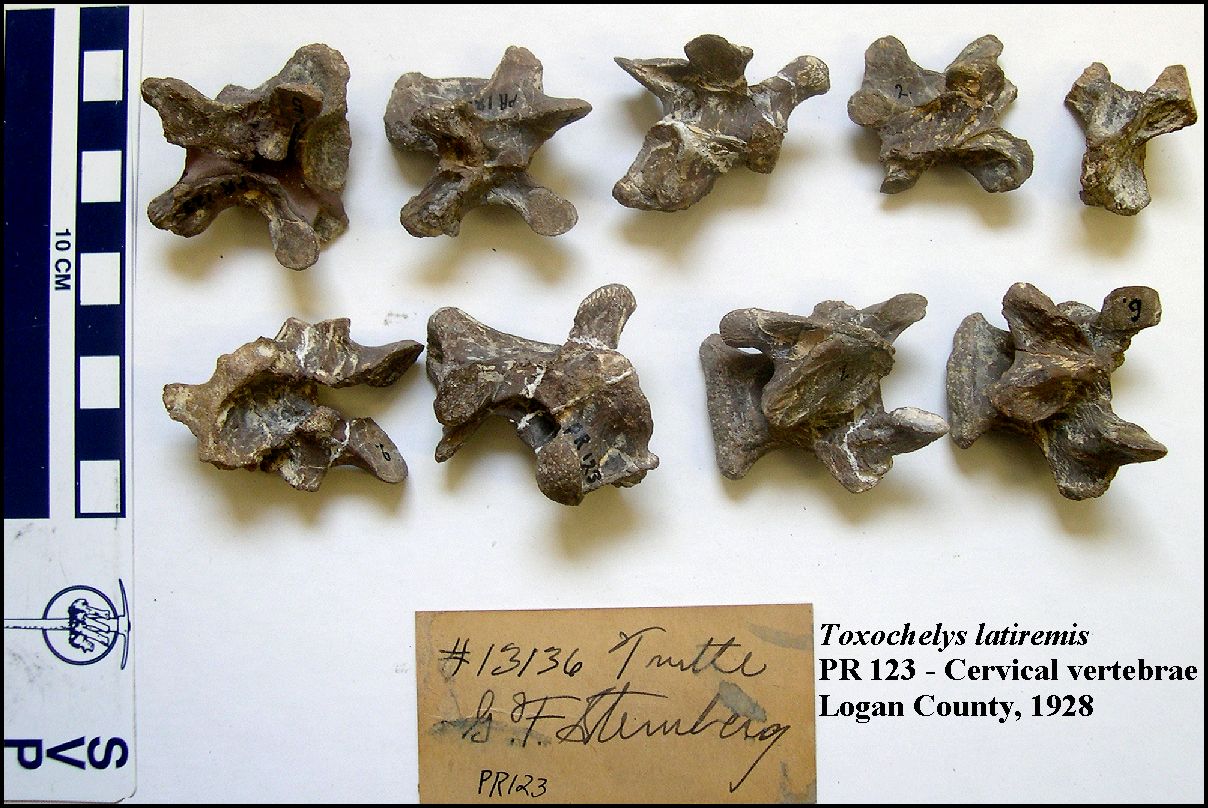
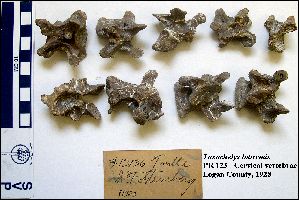
LEFT: PR 123 - Right and left humeri of Toxochelys latiremis collected by George F. Sternberg from Logan County in the collection of the Field Museum,
Chicago, IL.
RIGHT: PR 123 - Cervical vertebrae from the same specimen
(Toxochelys latiremis). |
 |
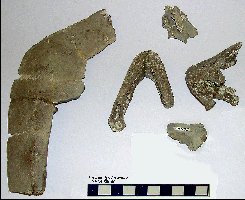 |
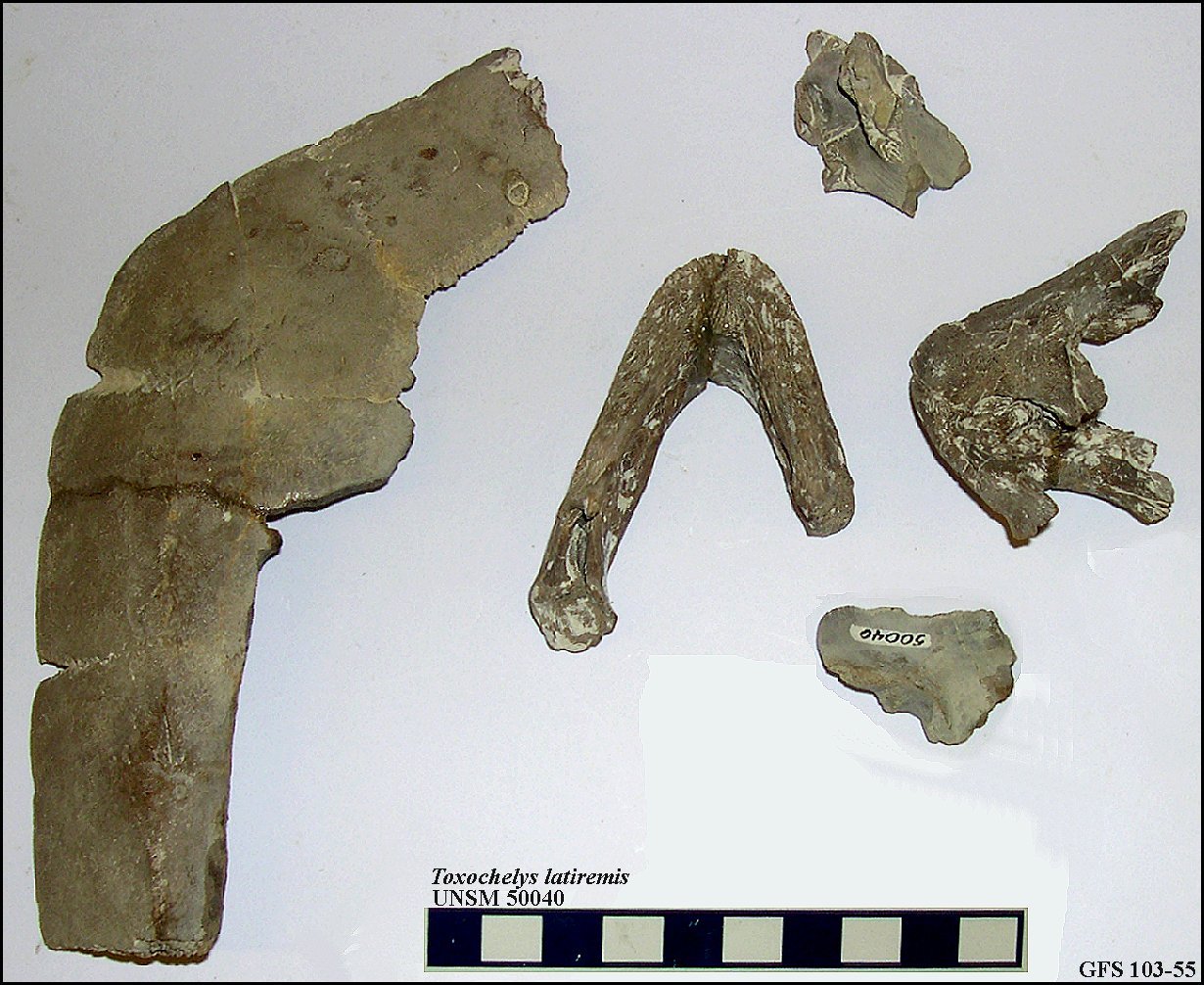
LEFT: A fragmentary specimen of Toxochelys latiremis (UNSM 50040) collected by George Sternberg in 1955 (GFS 103-55) from the
Smoky Hill Chalk of Gove County, southeast of Oakley, Kansas, between
Hackberry Creek and the Smoky Hill River. The specimen was purchased by
the University of Nebraska State Museum. |
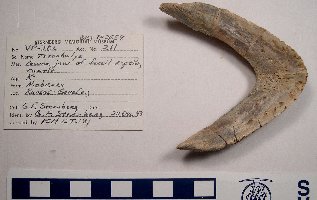 |
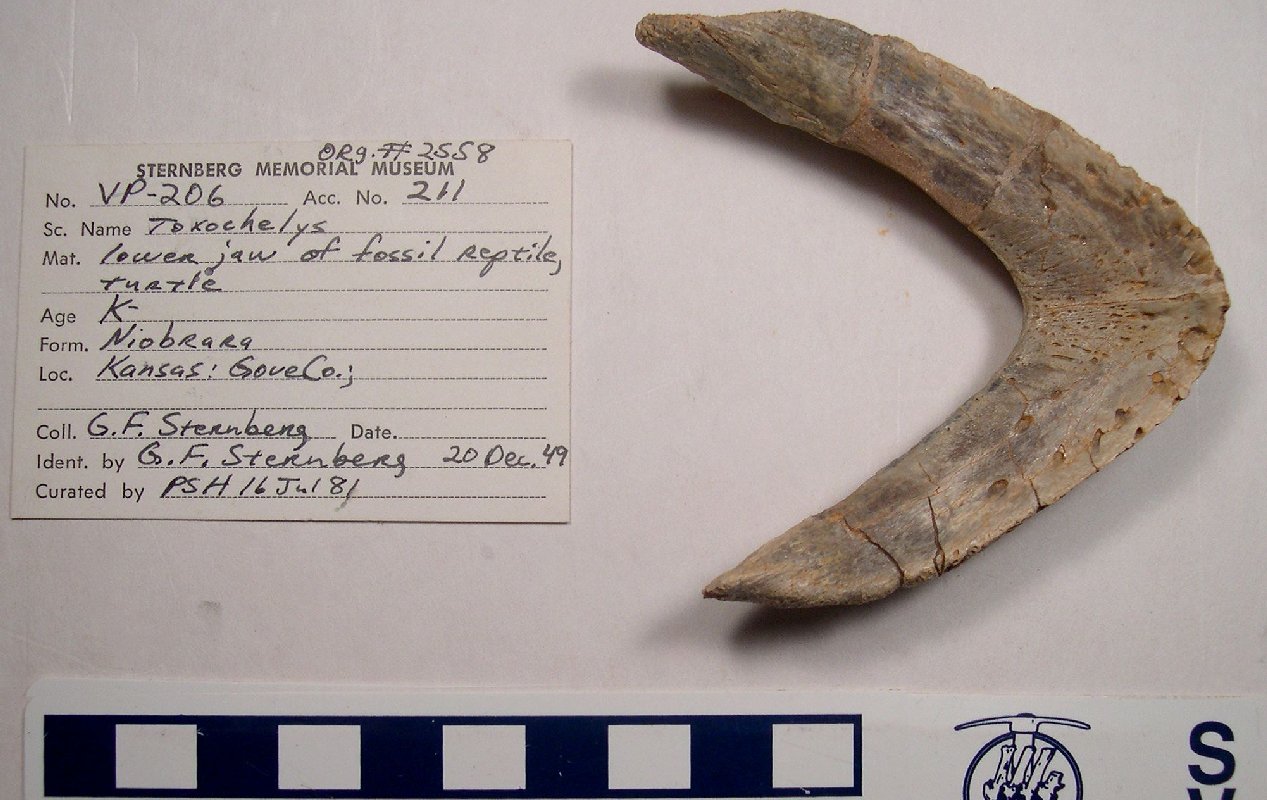
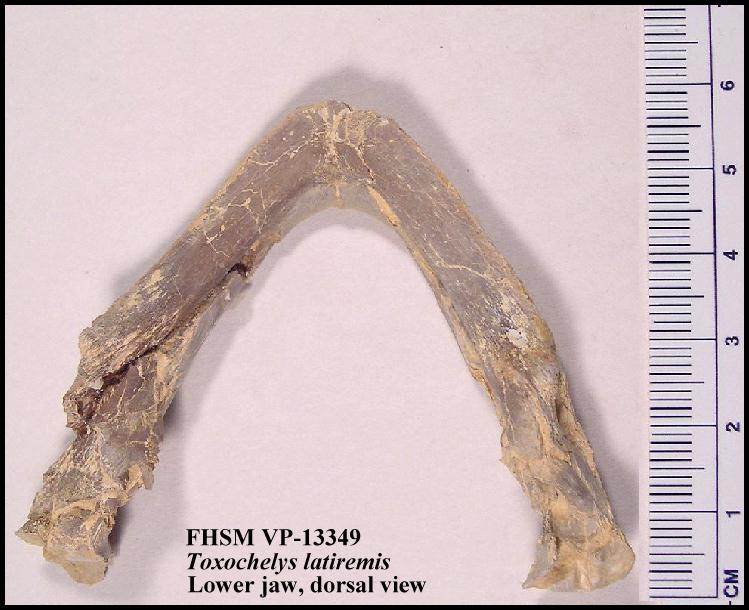
LEFT: The lower jaw of a Toxochelys turtle
(FHSM VP-2006) collected by George Sternberg in 1949 from Gove County.
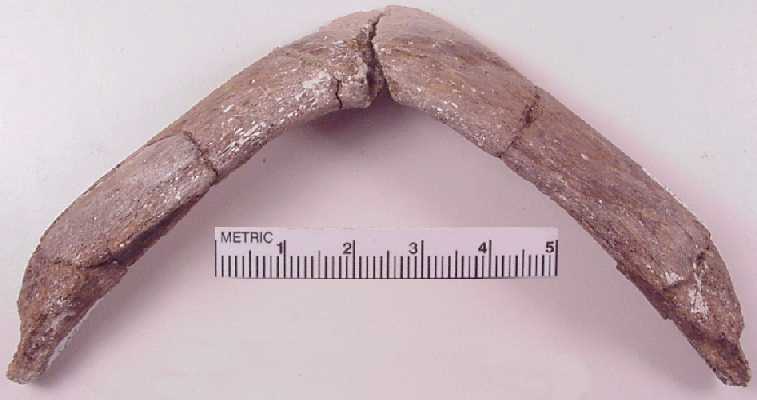
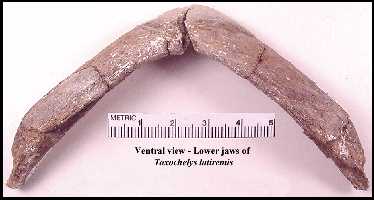
RIGHT: (FHSM
VP-1344) The anterior
portion of a lower jaw (right and left dentarys) of a large Toxochelys turtle
collected from the upper Smoky Hill Chalk (MU 17) of Logan County. |
 |
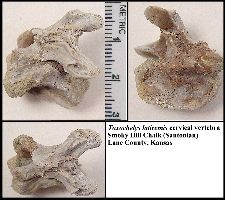 |
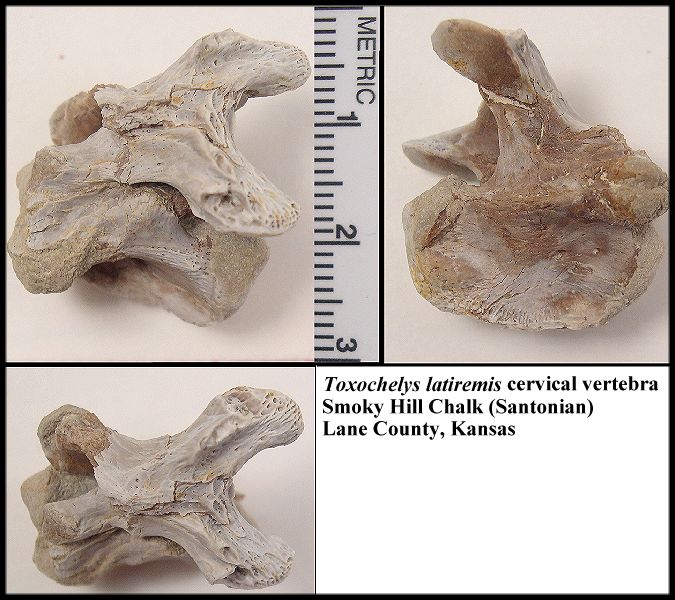
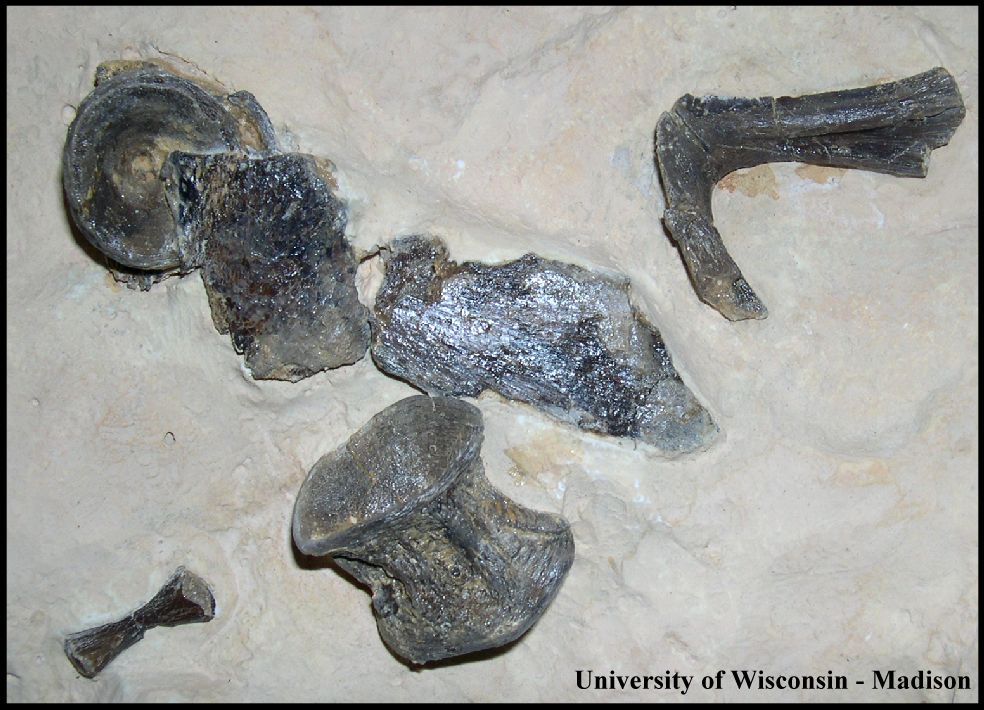
LEFT: Clockwise, dorso left-lateral view, ventral right-lateral
view and dorsal view of a slightly crushed cervical (?) vertebra from a Toxochelys
latiremis (FHSM VP-17432) specimen discovered in 2005.
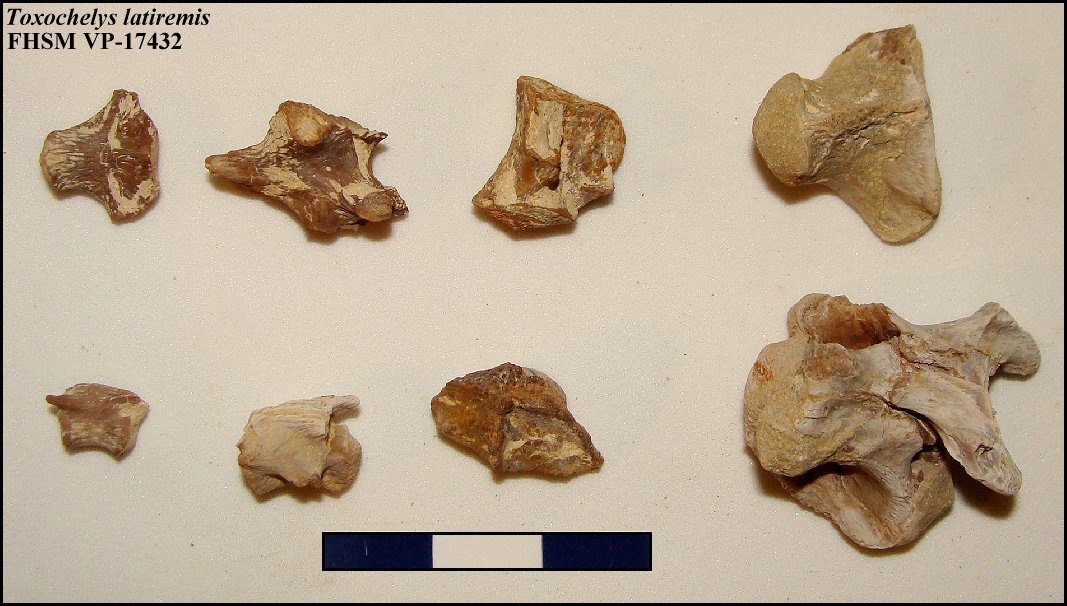
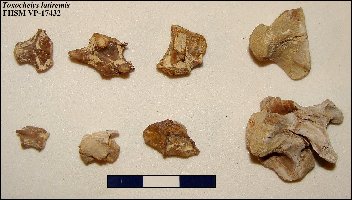
RIGHT:
We finally were able to recover the turtle remains in 2009 (The original site had been
"lost" after a heavy rain in the summer of 2005)... Here are additional photos
of the vertebrae from the neck, body and tail. (scale = cm) |
|
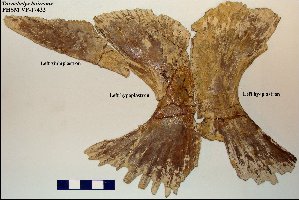 |
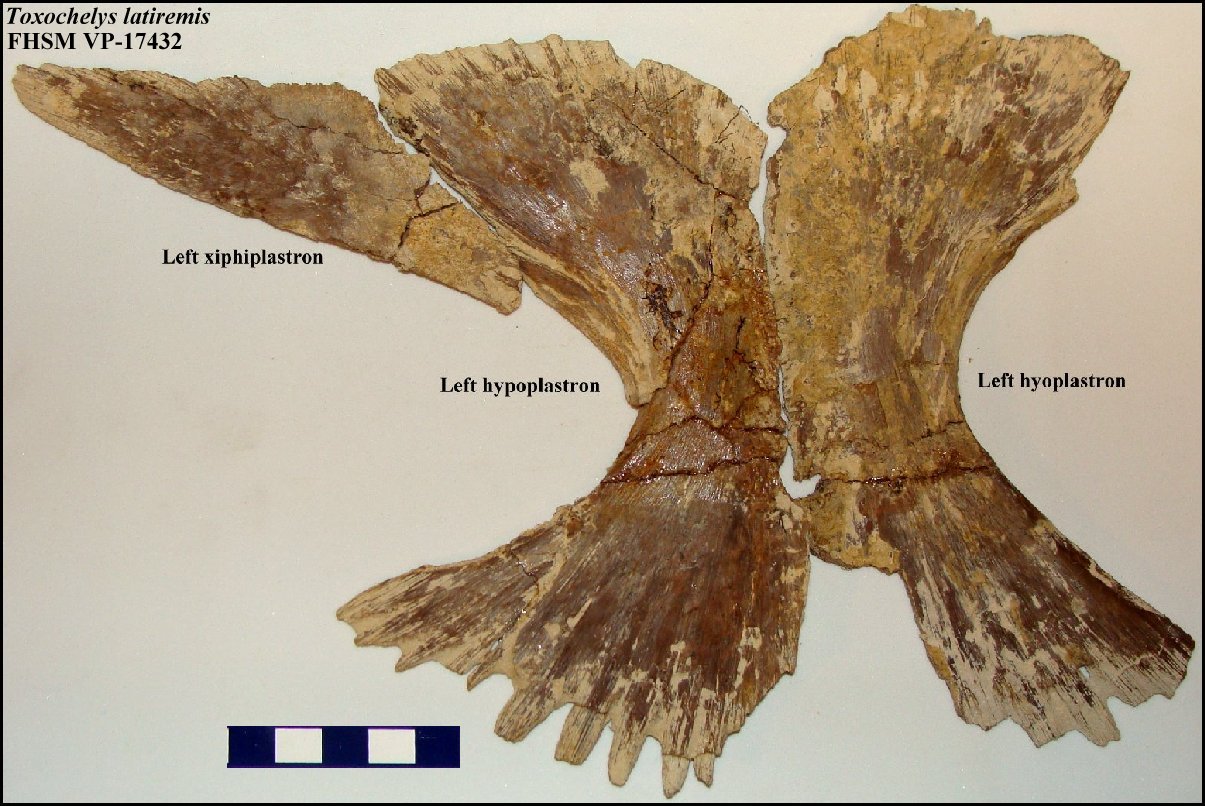
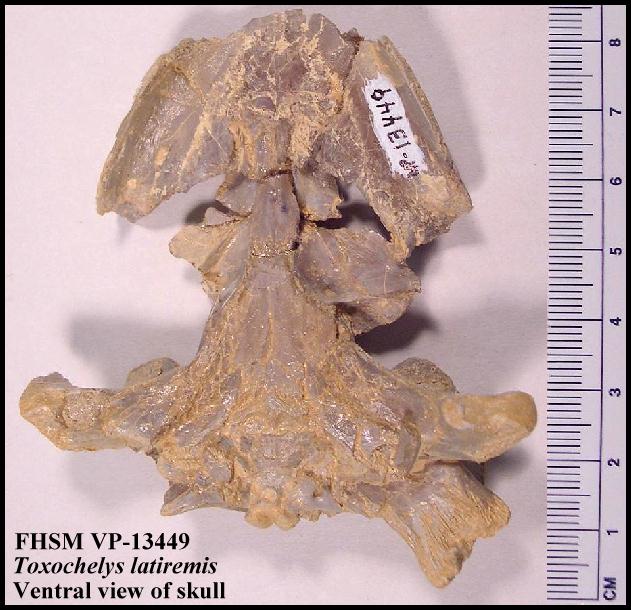
LEFT: The hyoplastron, hypoplastron and xiphiplastron of the FHSM
VP-17432, bones making up the left half of the turtle's lower shell (plastron). See
drawing below.
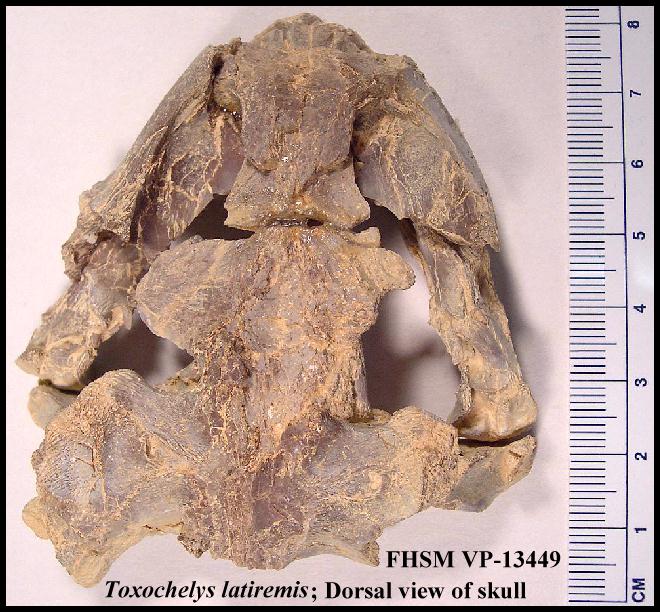
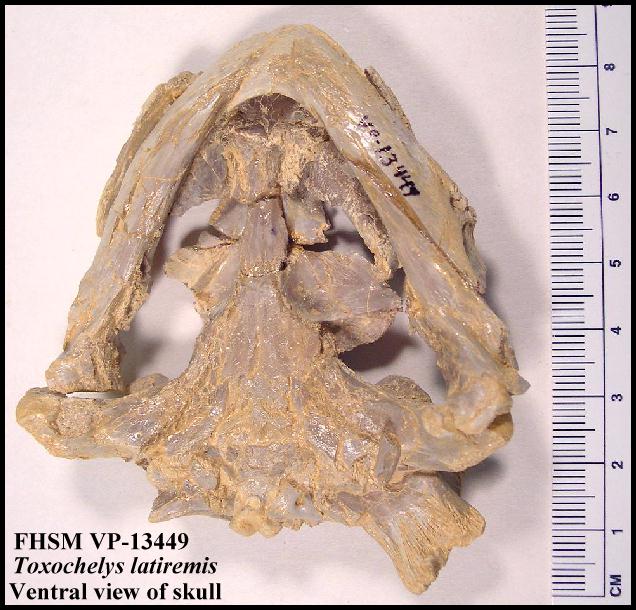
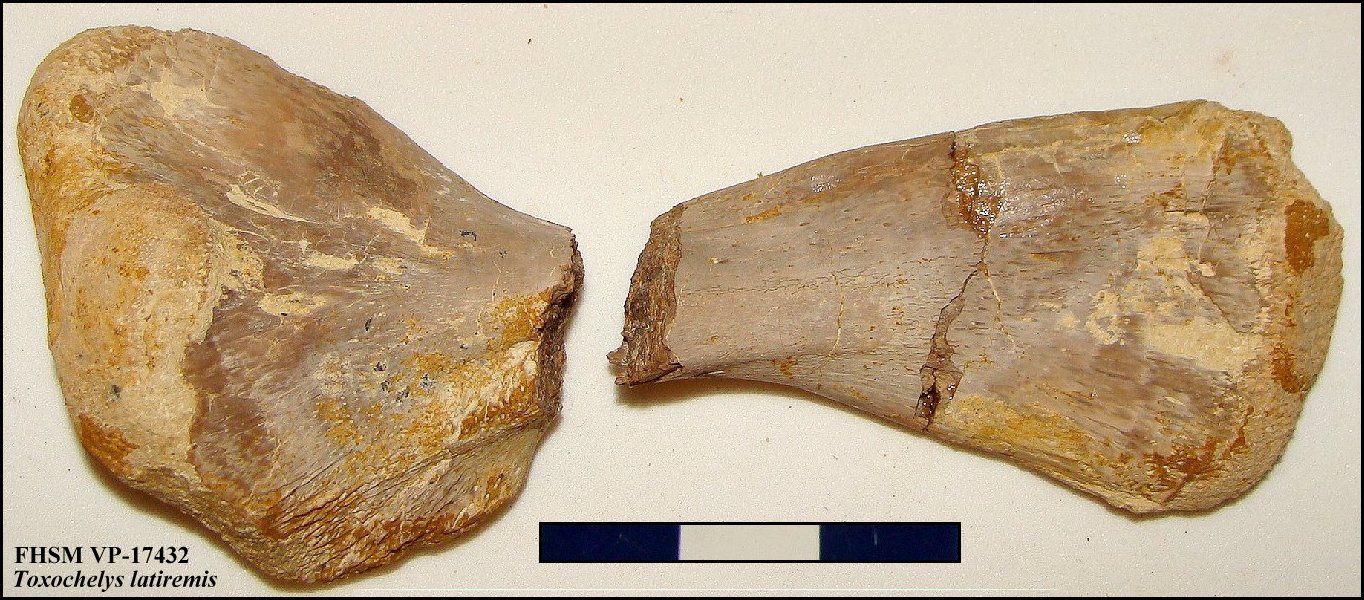
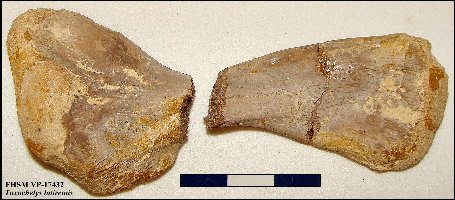
RIGHT: The broken right humerus of FHSM VP-17432. Based on a comparison with the humerus
of FHSM VP-13449 (see skull above), these two specimens would have been about the same
size. |
 |
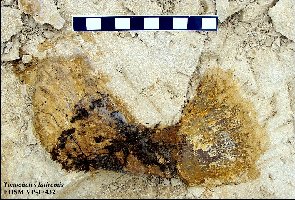 |
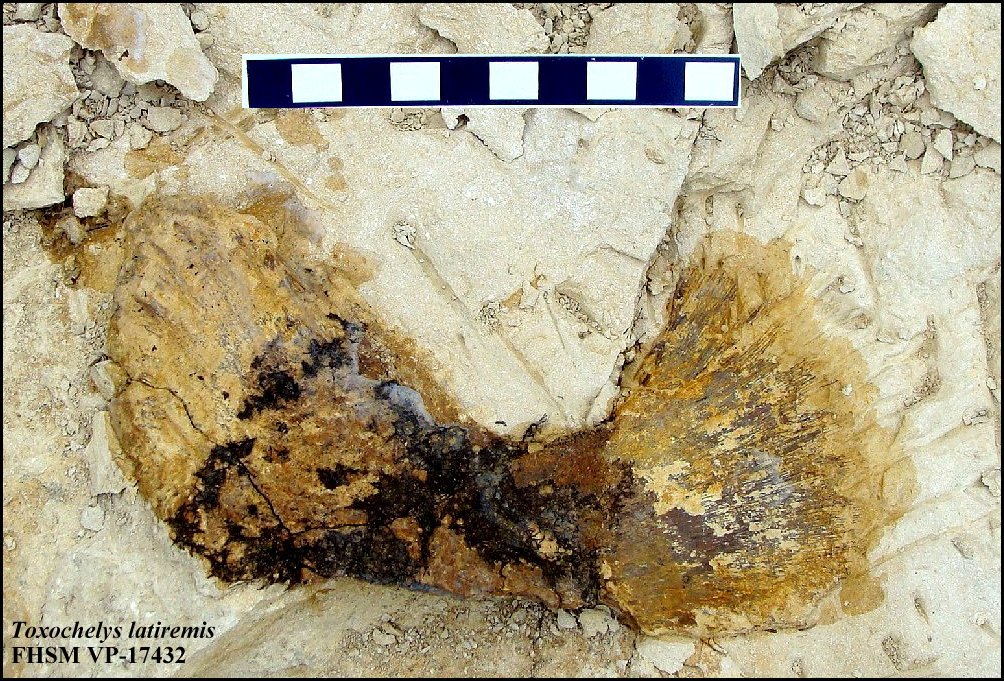
LEFT: Field shot of the hyoplastron of FHSM VP-17432.
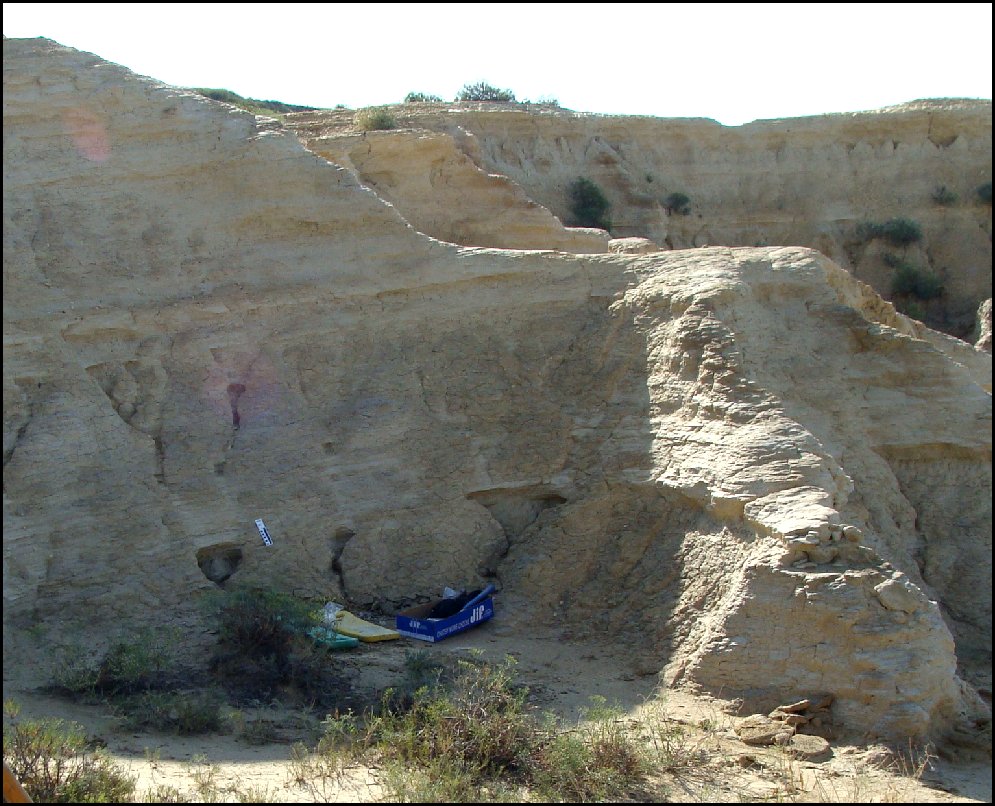
RIGHT:
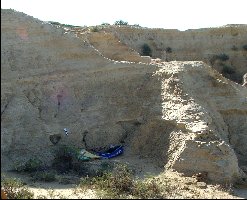
The dig site where FHSM VP-17432 was discovered. Hattin's marker unit 7 was about 5 cm
below the turtle bones... |
 |
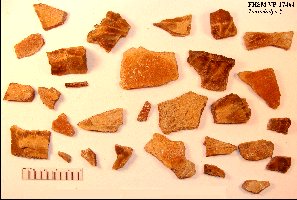 |
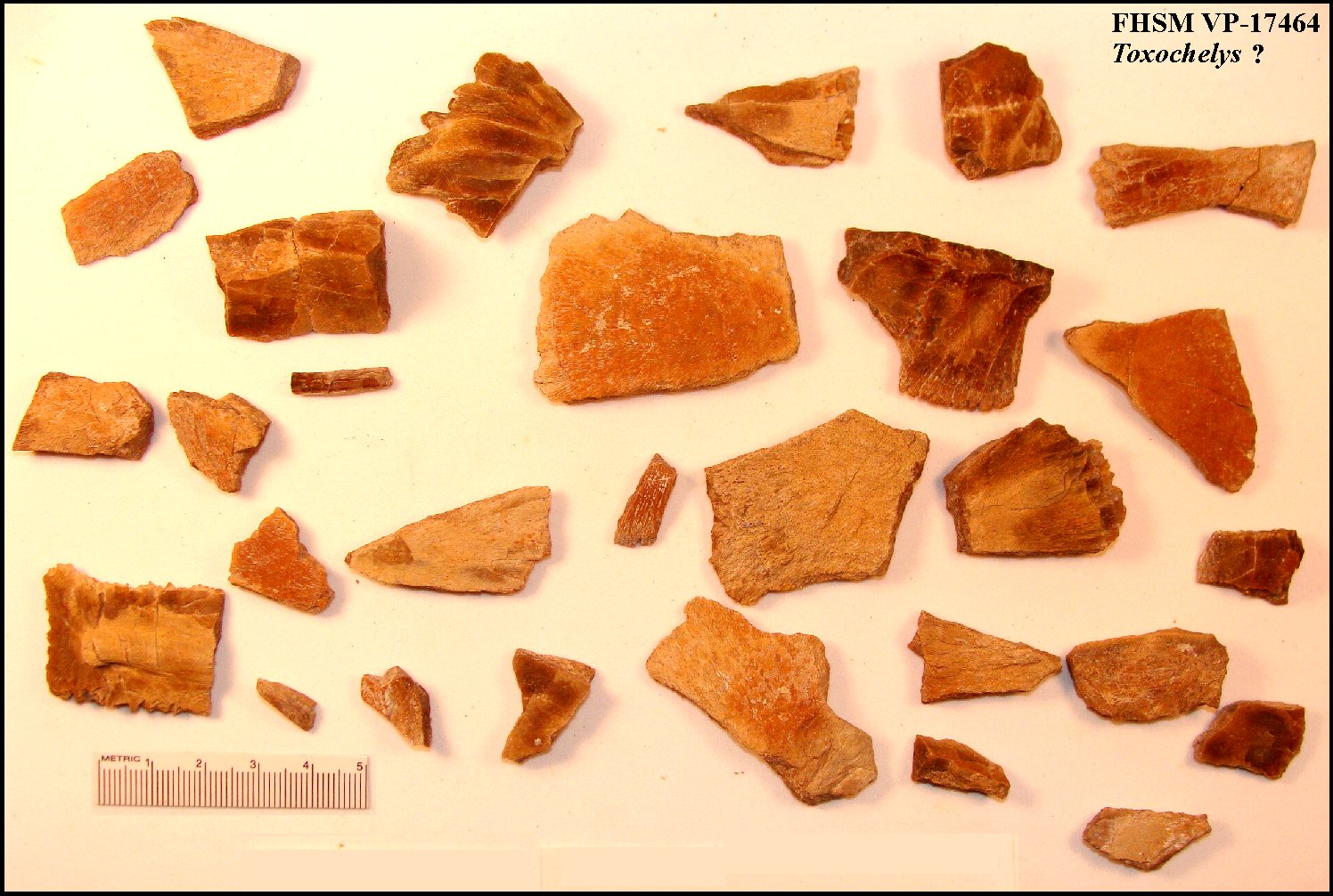
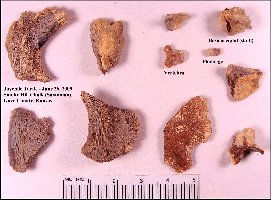
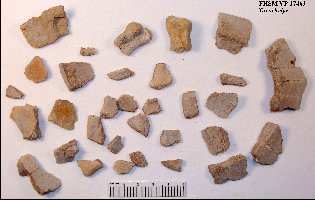
LEFT: The fragmentary remains
of a small toxochelyid (?) turtle (FHSM VP-17464) that I collected in 1991
from southeastern Gove County. Pieces of the carapace /
plastron had eroded out earlier and were scattered over a wide area.
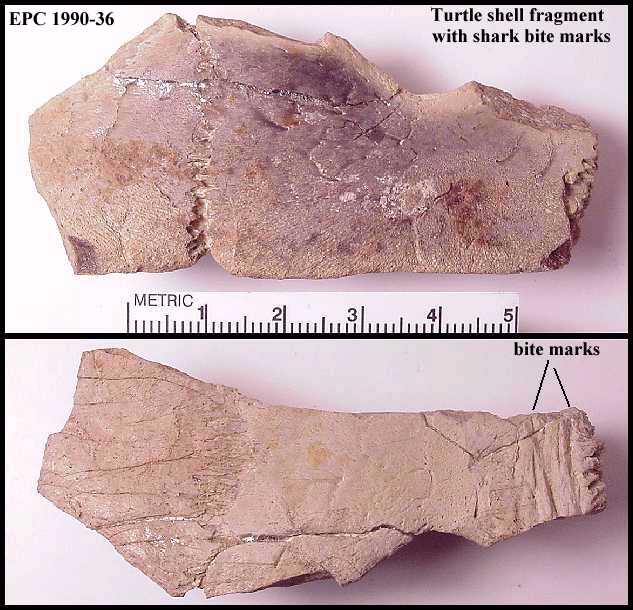
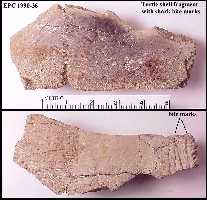
RIGHT:
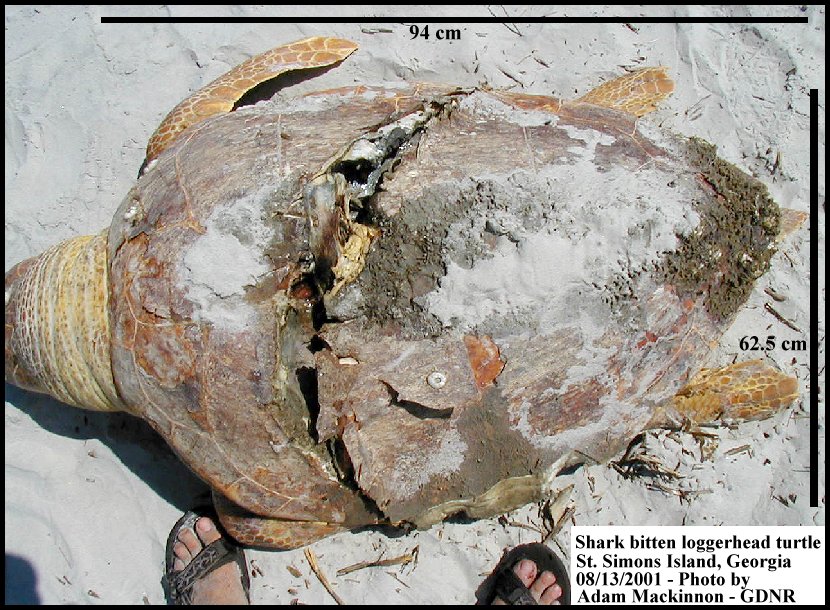
(FHSM VP-17018) A fragment (peripheral or marginal
bone) from the carapace of a large turtle, probably Toxochelys,
found in Gove County (Late Coniacian). Note the bite marks from a large shark (Cretoxyrhina)
on the right side of the fragment in the lower frame. This piece was the only part found
of the turtle. The thin shells of even the largest turtles were no match for the strong
jaws and sharp teeth of predators. Go here for a photo of
a modern Loggerhead turtle bitten by a large shark, most likely a Great White. (Photo
by Adam McKinnon, used with permission). |
 |
 |
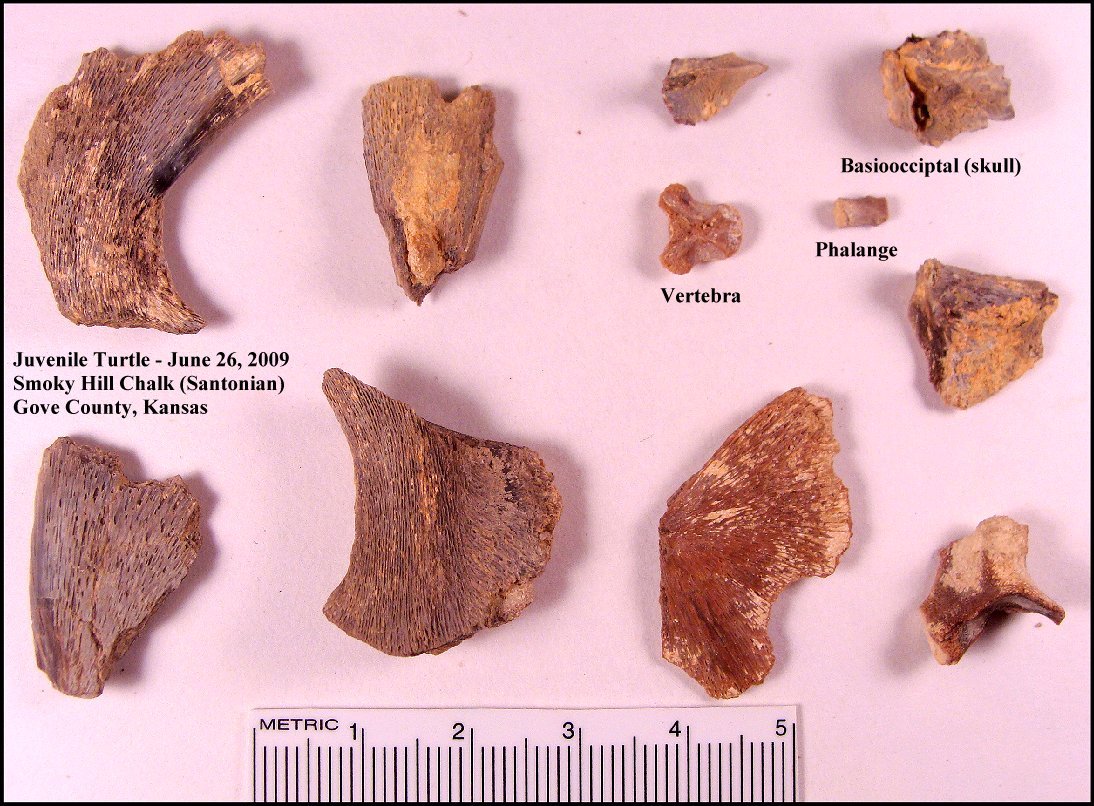
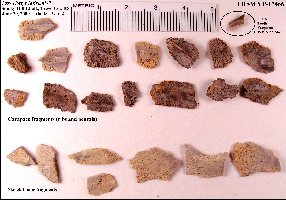
LEFT: Keith Ewell and I collected fragments of an even smaller
individual (FHSM VP-17572) in July, 2009....Probably newly hatched, this little one didn't live very
long. Shell was less than 4 inches long.
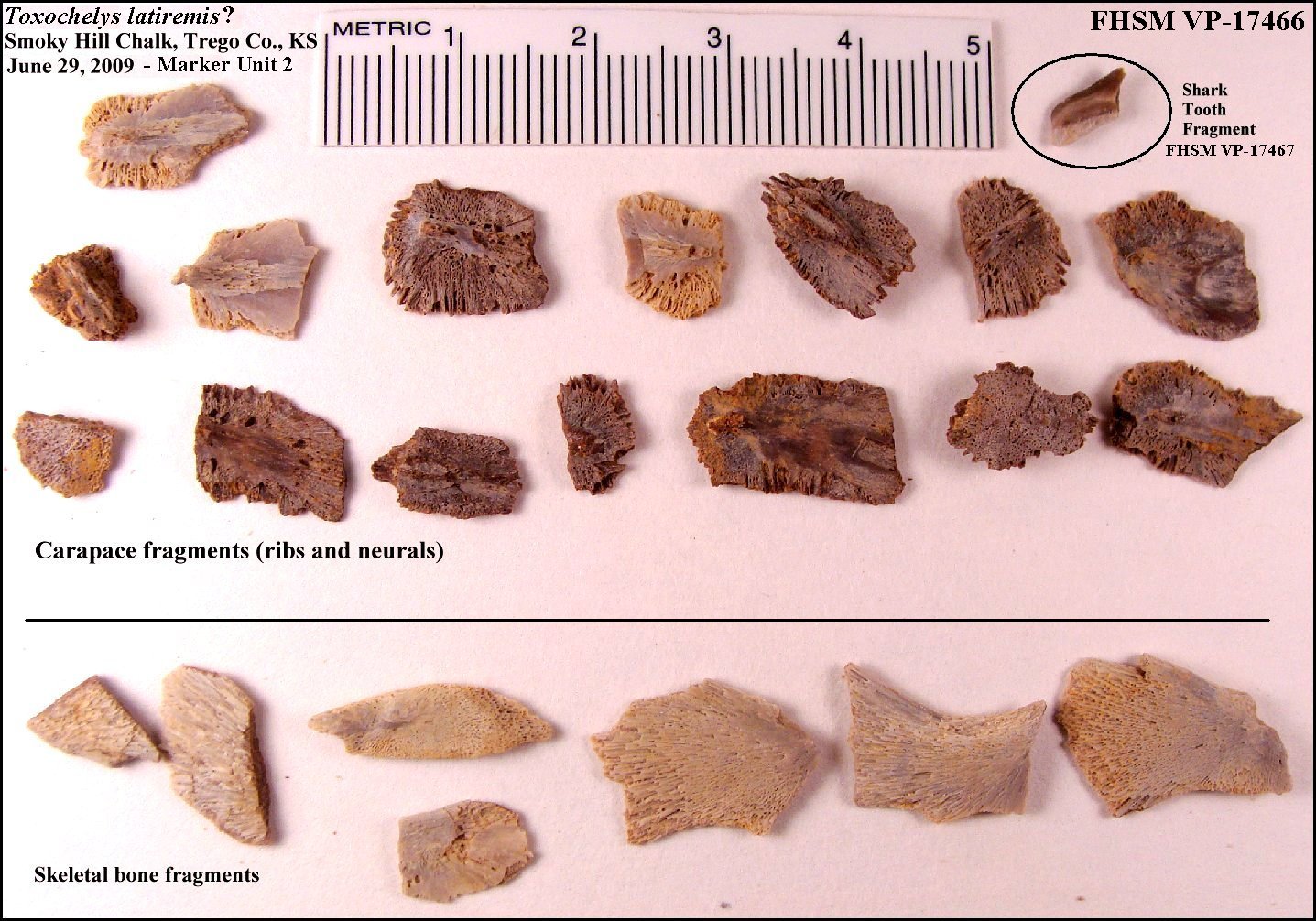
RIGHT: The remains of a very small (hatchling) turtle (FHSM
VP-17466) discovered by Keith Ewell in the lower chalk of western Trego
County in July, 2009. Although the remains are too fragmentary for a
positive identification, they are most likely from a baby Toxochelys
latiremis. |
 |
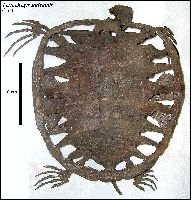 |
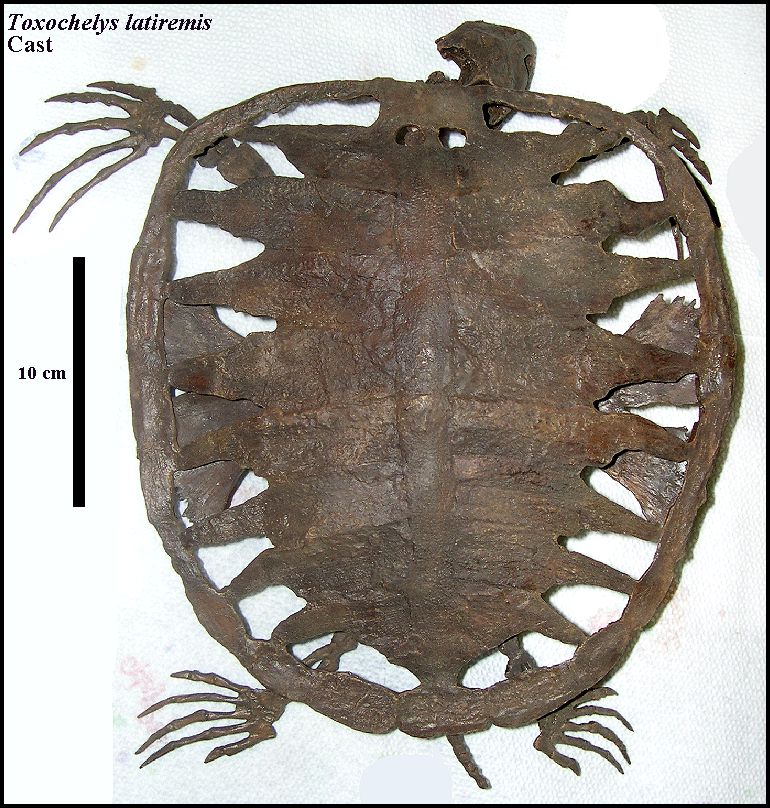
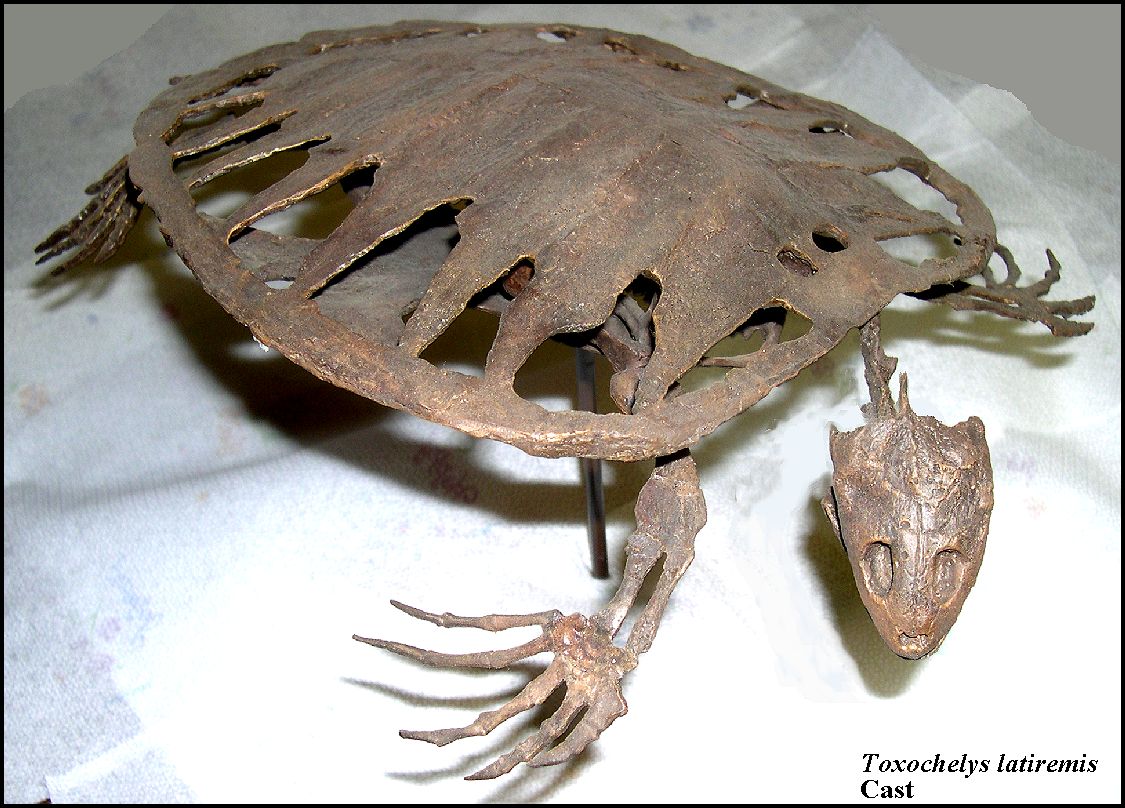
LEFT: A cast of a small but complete specimen of Toxochelys
latiremis in dorsal view. Another view is HERE.
The upper shell is called the carapace.
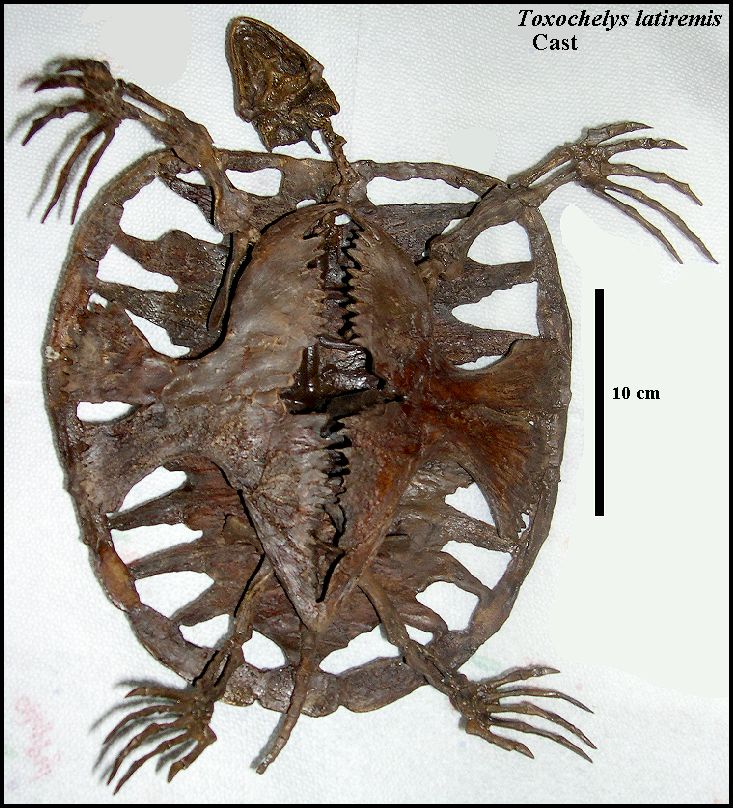
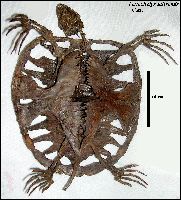
RIGHT: The same cast of a small
but complete specimen of Toxochelys latiremis in ventral view. The lower shell is
called the plastron. Cast by Triebold Paleontology, Inc.
Note that Gudger (1949) reported the remains of marine turtles in the stomachs
of 5 out of 5 Tiger sharks (Galeocerdo tigrinus) that were caught near Key West,
Florida. It appears that things haven't improved much for turtles in 85 million years. |
 |
 |
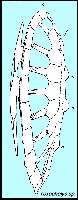 |
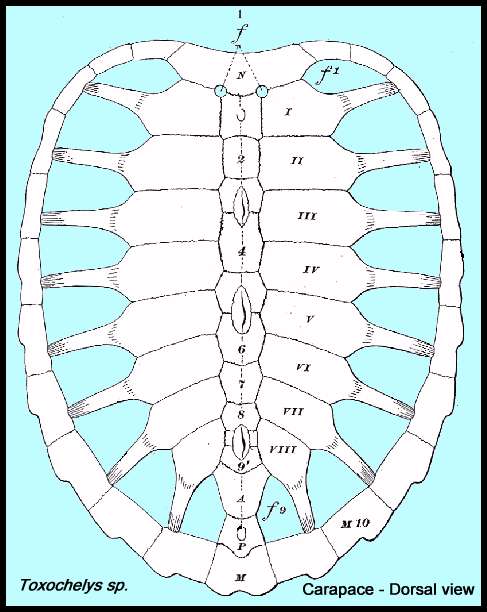
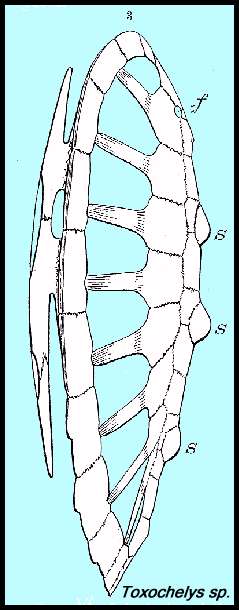
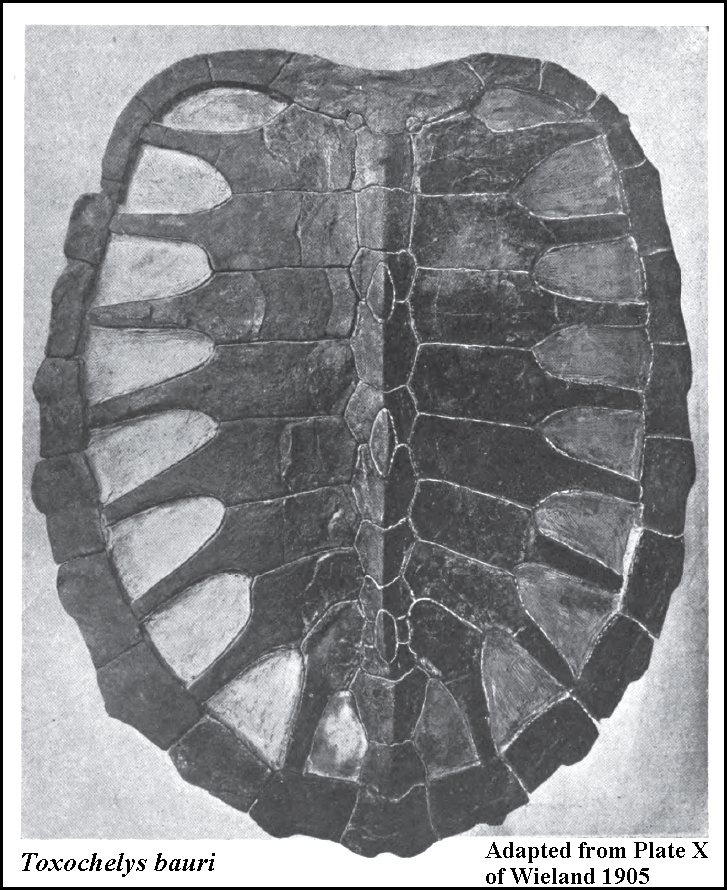
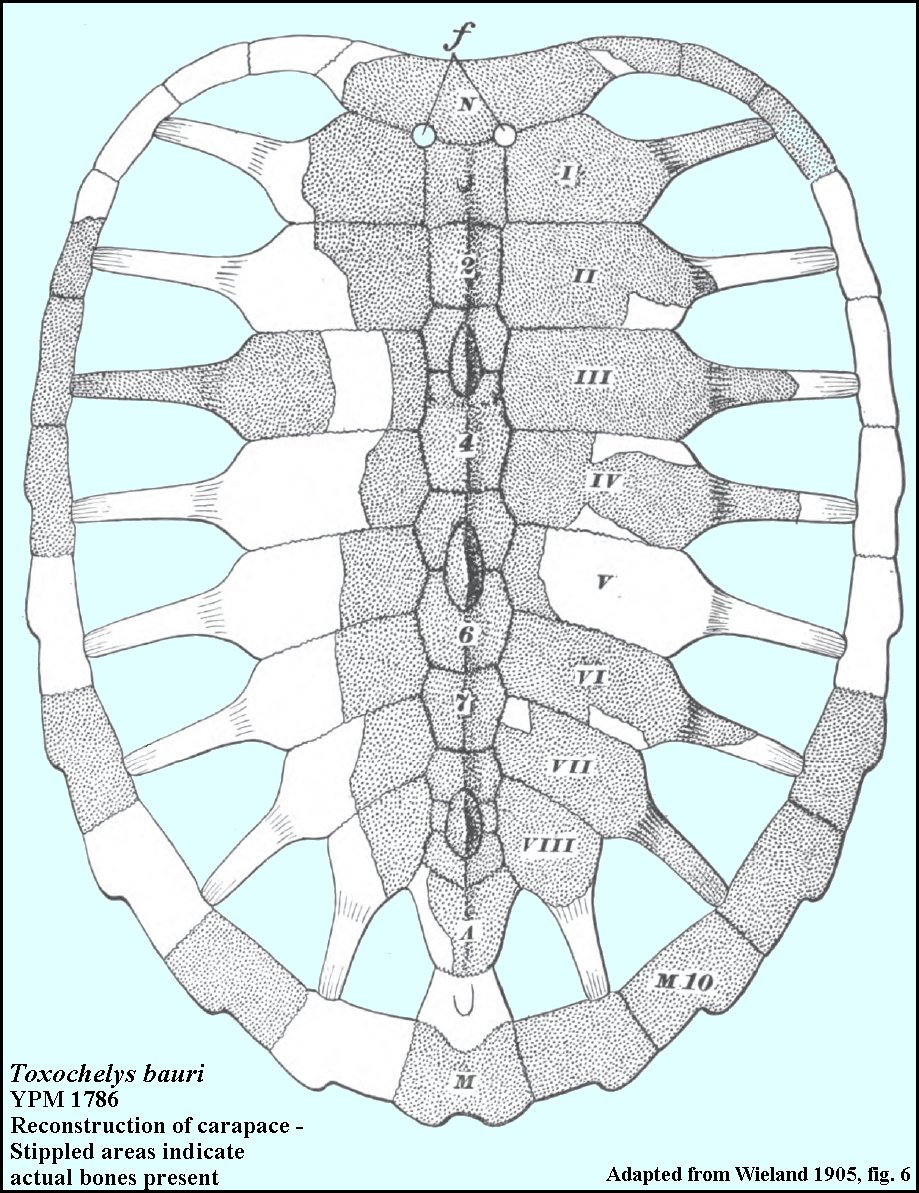
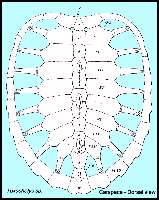
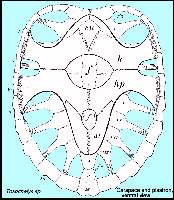
The type specimen of Toxochelys bauri (YPM 1786)
was collected by Charles H. Sternberg about 1904 from the Smoky Hill Chalk
in western Gove County, Kansas. It was subsequently described by Wieland
in 1905, who published these figures and a photograph of the reconstructed carapace. The actual
bones present are shown here. The carapace is a 39 cm (15 in) by 23 cm
(14 in). It was named in honor of Georg Baur (1859-1898).
FAR LEFT: Reconstructed dorsal view of the carapace of Toxochelys bauri (neurals,
ribs and marginals / peripherals).
LEFT: Left lateral view of same
specimen.
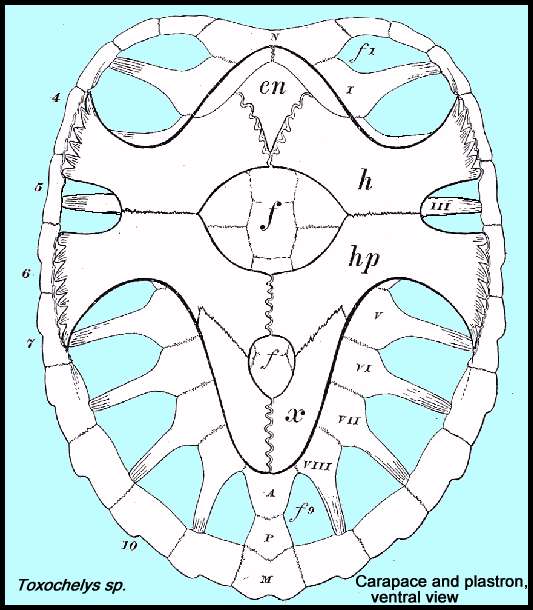
RIGHT: Ventral view of same specimen, showing the components of
the plastron. (Abbreviations: en - entoplastron; h - hyoplastron; hp - hypoplastron; x -
xiphiplastron. |
 |
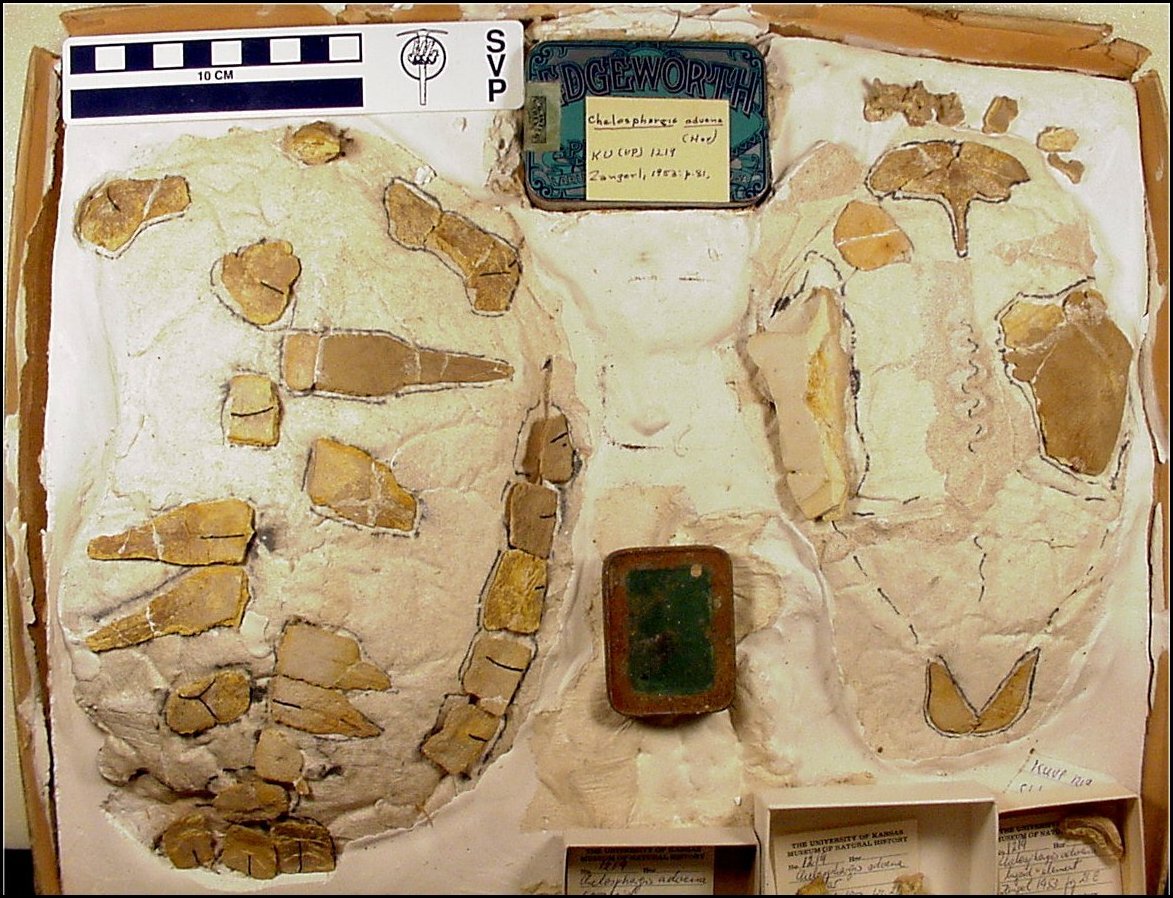
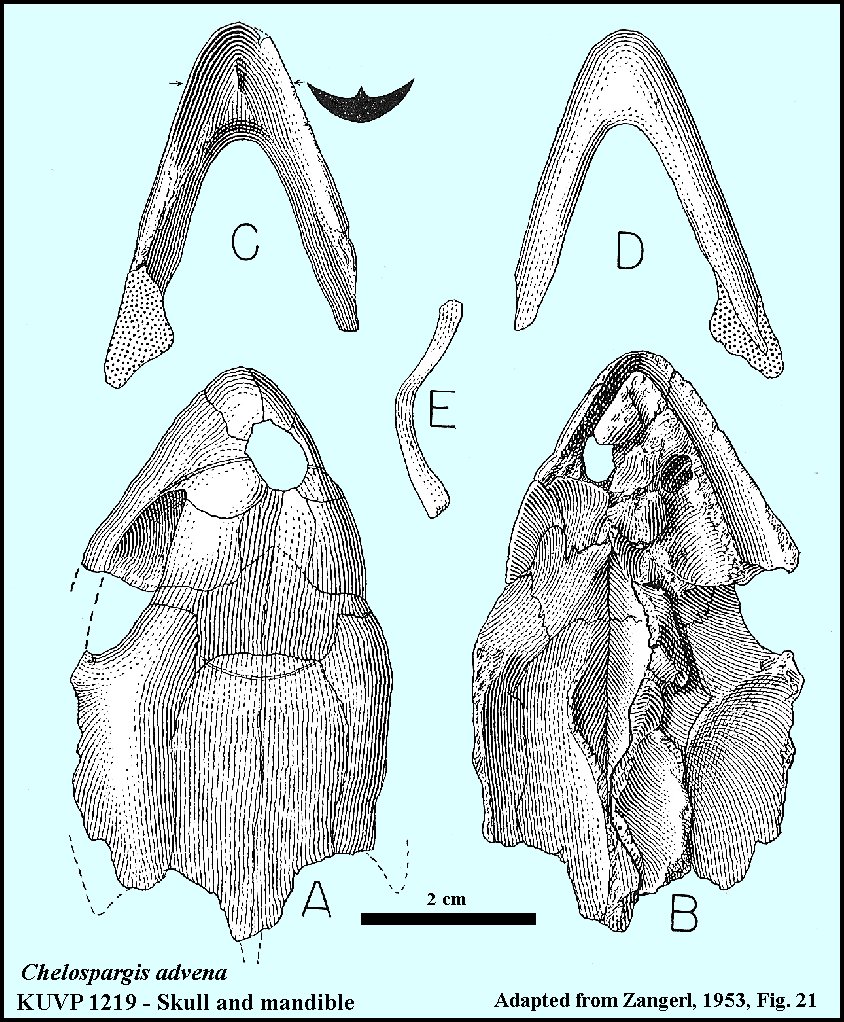
Chelospargis advena - The type specimen of Protostega advena (KUVP
1219) was described by Hay (1908). It was collected by S.W. Williston in 1891,
probably from Gove County. While showing some protostegid characters, it is a
relatively small individual with only a little cranial or limb material present
in the specimen. The genus name was changed to Chelosphargis by Zangerl
in 1953.
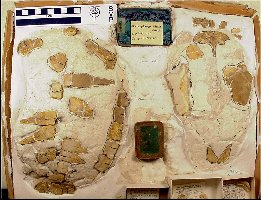 |
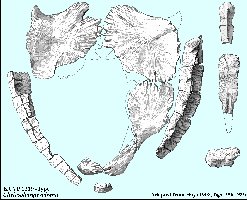
LEFT: The type specimen of Chelospargis advena in the collection at the University of Kansas.
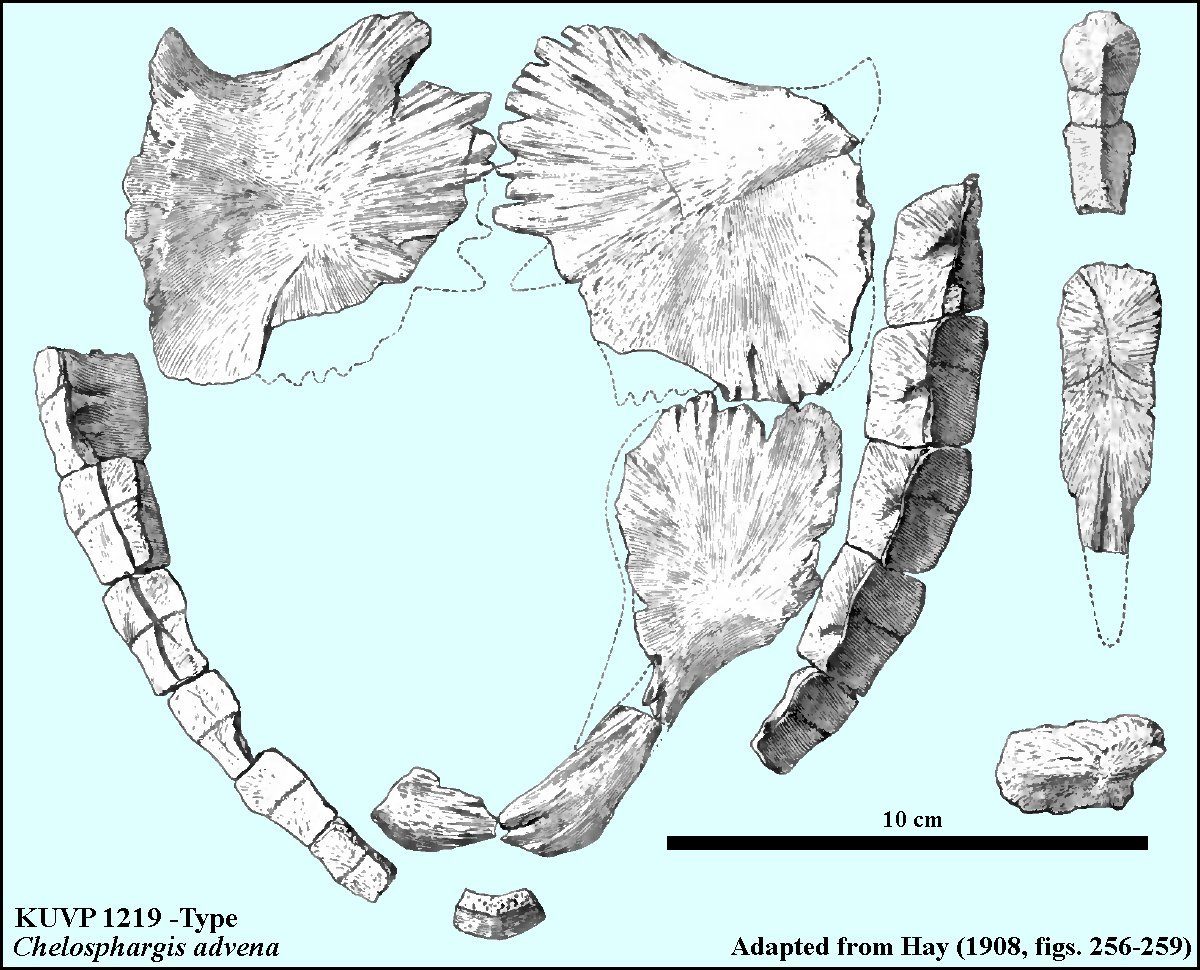
RIGHT: Figures 256-259 from Hay (1908) of the type specimen. Zangerl
(1953, fig. 21) figured the skull, mandible and hyoid. |
 |
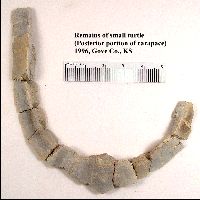 |
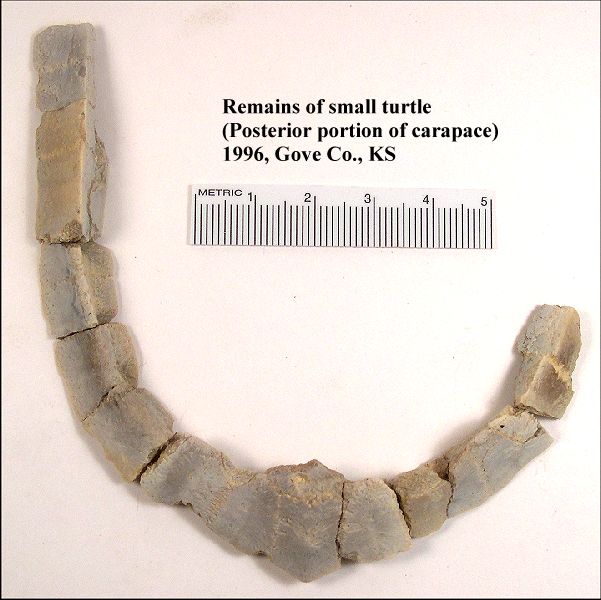
LEFT: The peripherals (marginals) of a partial carapace of a
very small Chelospargis advena turtle that
I discovered in 1996 in Gove County, between MU 6 and MU7. The shell would have been about 3 inches wide and less than 6 inches
long. The Western Interior Sea would not have been a good place to be for a turtle this
size! The remains indicate that it was probably bitten in two by a larger predator,
probably a shark.
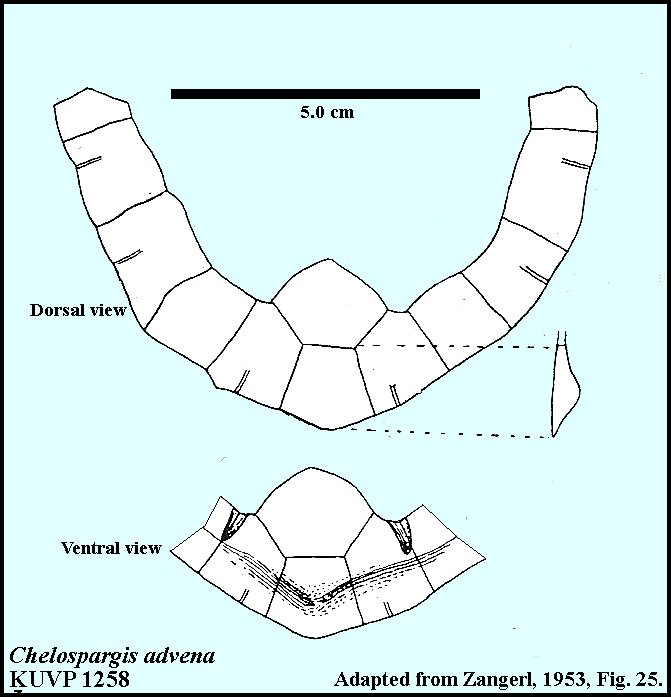
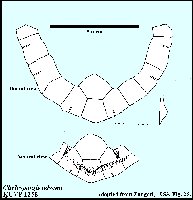
RIGHT: A similar sized specimen of Chelospargis advena (KUVP
1258) showing the distinctive shape of the peripheral bones that make up
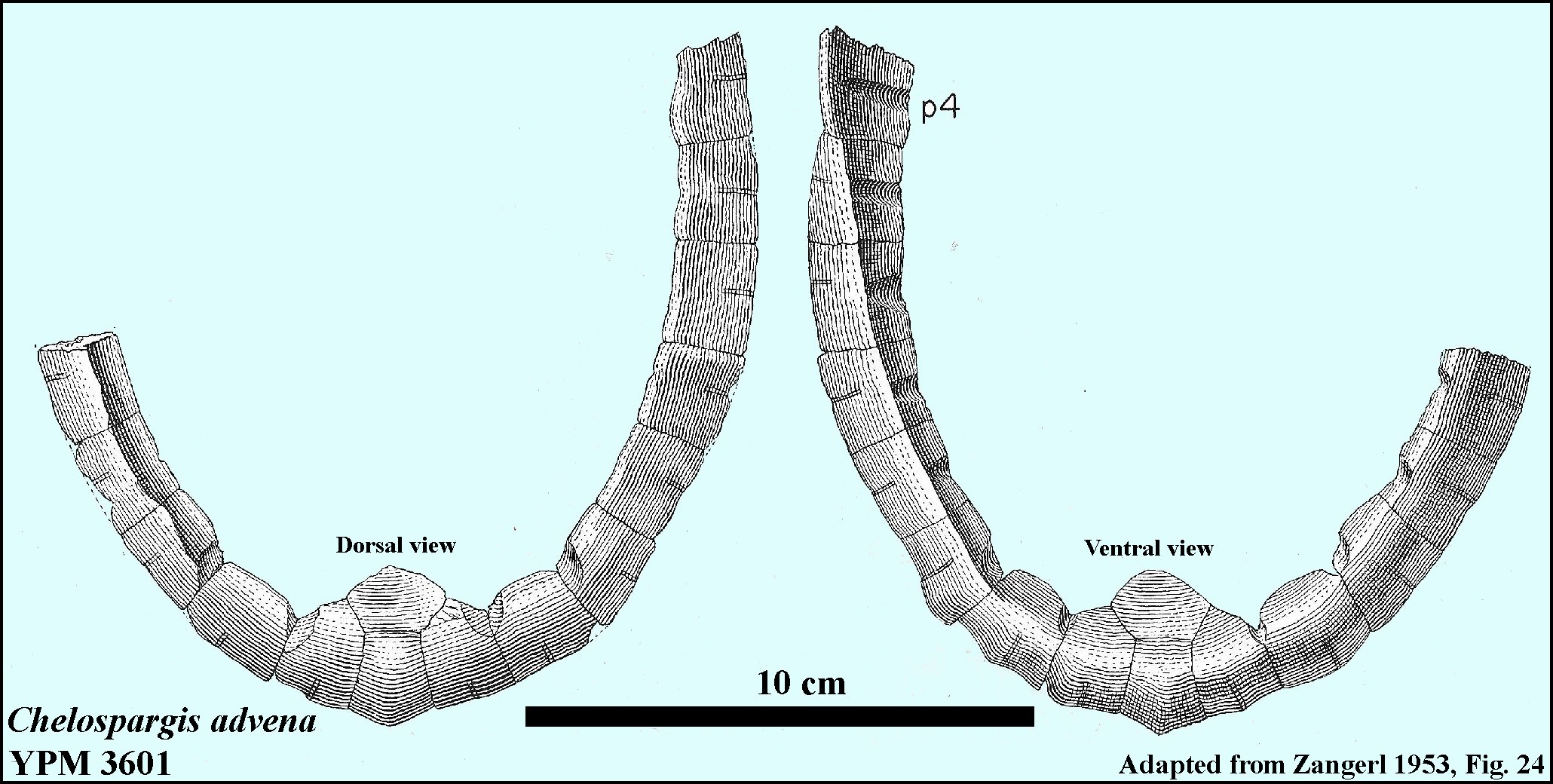
the rim of the carapace. Another specimen in the Yale Peabody collection (YPM 3601) is shown here. |
 |
 |
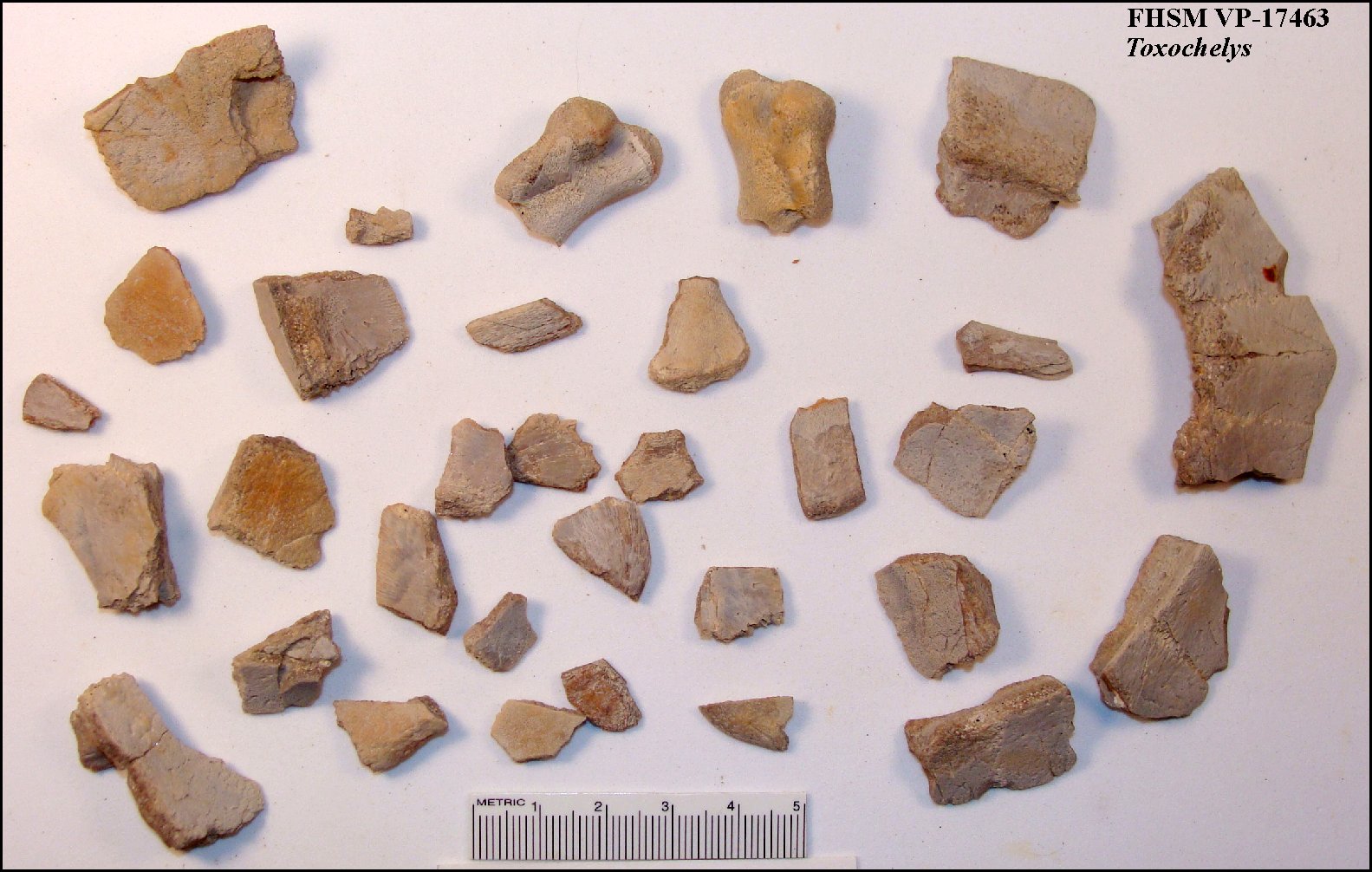
LEFT: The remains of another small Chelospargis turtle (FHSM
VP-17463) collected in 1989 (EPC 1989-31) from the Smoky Hill Chalk in southern Gove
County. The remains show evidence of scavenging (serrated bite marks) by Squalicorax
and it appears that both front paddles had been bitten off.
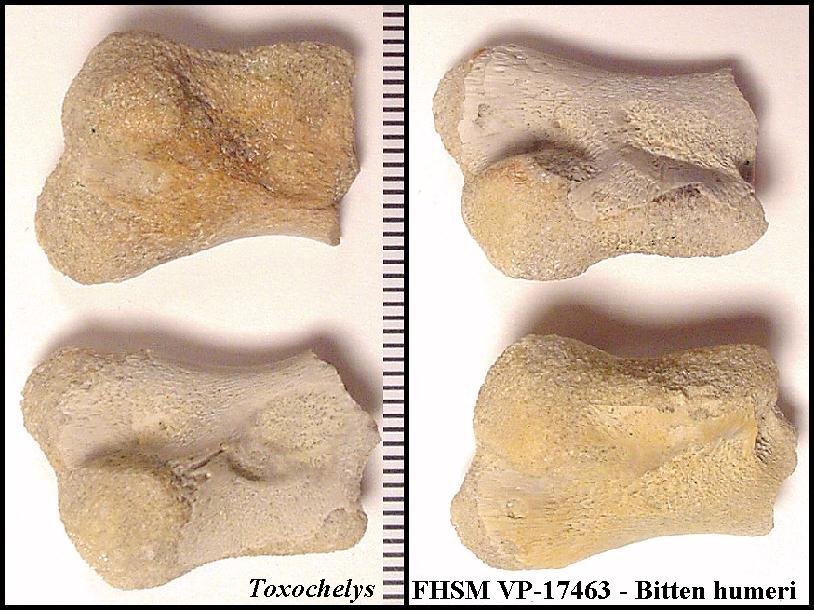
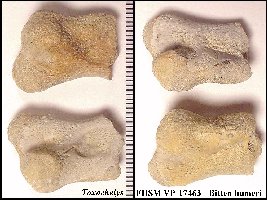
RIGHT: The severed humeri of FHSM VP-17463, possibly evidence of
predation / scavenging by a larger shark like Cretoxyrhina.
|
 |
Prionochelys galeotergum
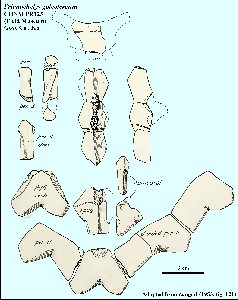 |
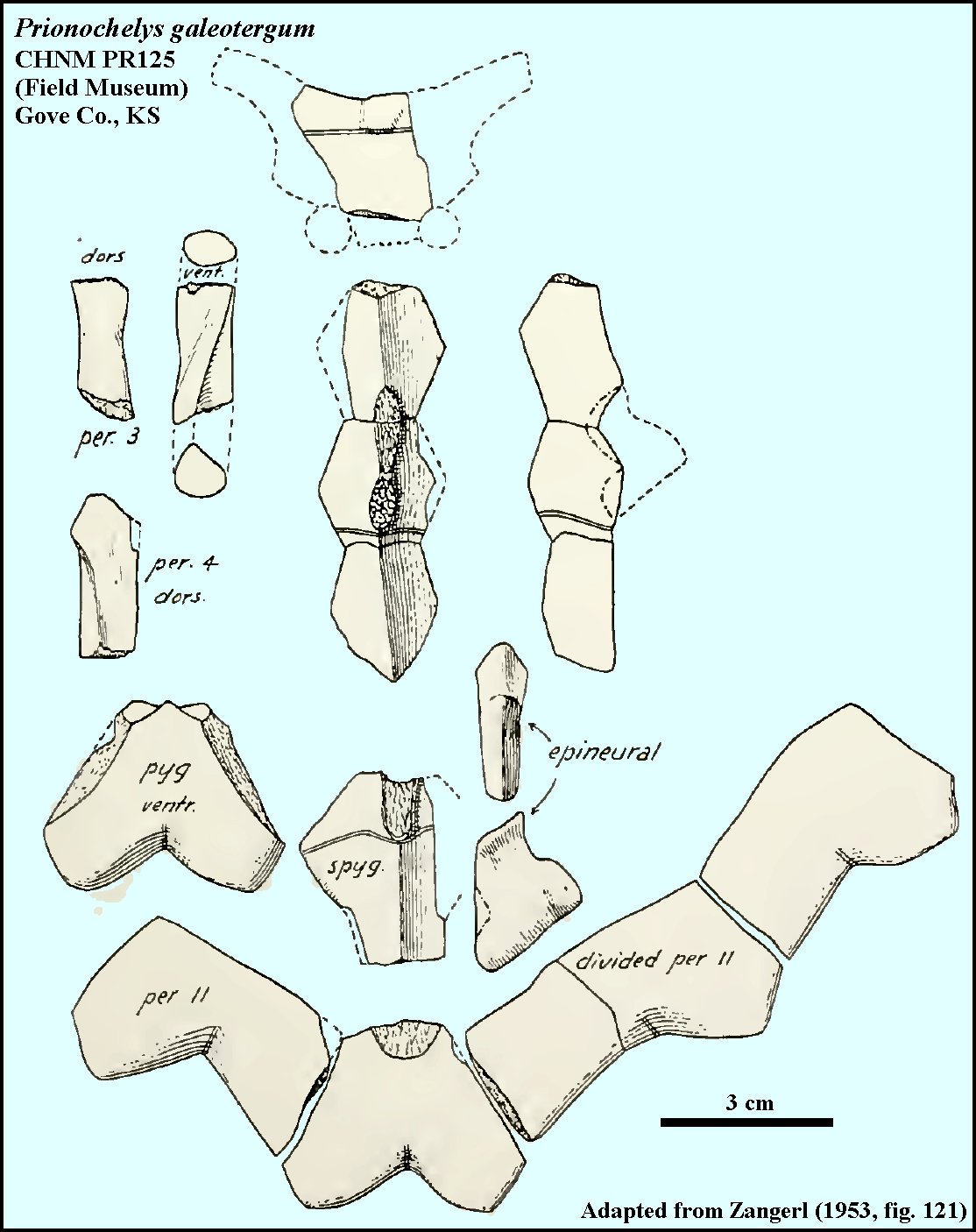
LEFT: The type specimen of Prionochelys galeotergum (CMNH PR125) from the Smoky Hill Chalk of Gove County, Kansas, collected
by G.F. Sternberg in 1931 and sold to the Chicago Museum of Natural
History (Specimen is now in the Field Museum). The genus and species were
described by Zangerl (1953).
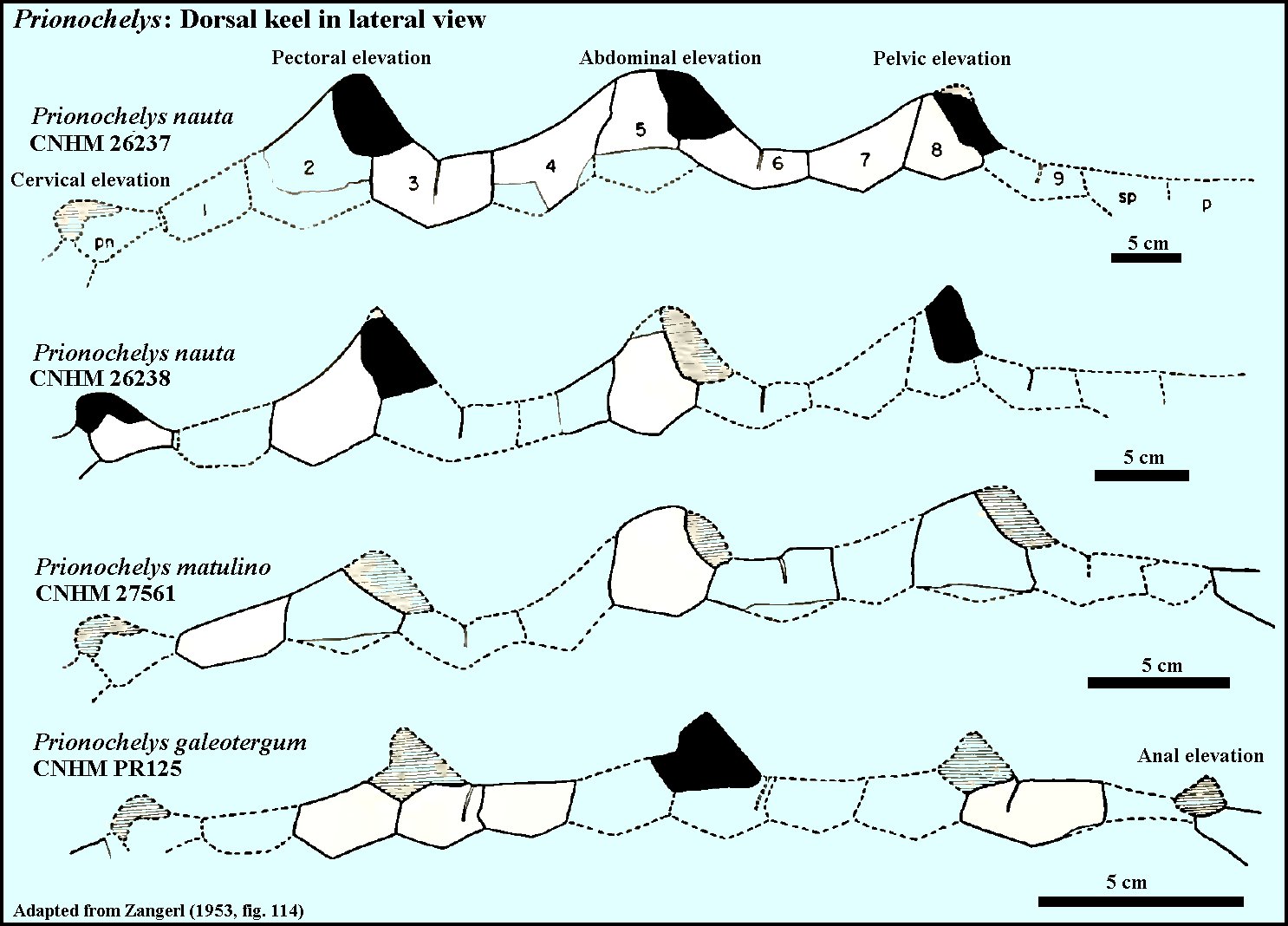
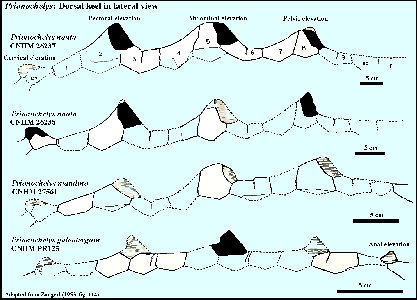
RIGHT: Figure 114 from Zangerl (1953) showing a comparison of the
"saw-back" dorsal keel of Prionochelys in lateral view
among the three known species. Prionochelys nauta and P.
matulino are found in Late Cretaceous Gulf Coast deposits.
HERE
is a model of Prionochelys nauta reconstructed by the
Rocky Mountain Dinosaur Resource Center (Triebold Paleontology, Inc.) |
 |
Ctenochelys stenoporus
|
Order
TESTUDINES
Suborder CRYPTODIRA
Superfamily CHELONOIDEA
Family CHELONIIDAE Gray, 1825
Genus CTENOCHELYS Zangerl, 1953
Ctenochelys stenoporus (Hay,
1905) |
BELOW: Note that, contrary to some
Internet web pages that credit the name to Sternberg (1904), this species
was actually named by two other authors in 1905. Charles Sternberg never
named a species of anything that he collected and in
1907 credits Wieland with the name.
Ctenochelys stenopora (Yale Peabody Museum collection; YPM-1786) was collected by C. H. Sternberg on December 14, 1904, near Monument Rocks in
western Gove County, Kansas. It was originally named Toxochelys bauri Wieland
(1905), AND Toxochelys stenoporus by Hay (1905).
Apparently Hay's name had precedence and Hay (1908) changed the species
name to stenopora. Zangerl (1953, p. 227) assigned the species to a
new genus (Ctenochelys) and used Hays 1908 revision of the species
name. Matzke (2007) referred back to Hay's original species
name.
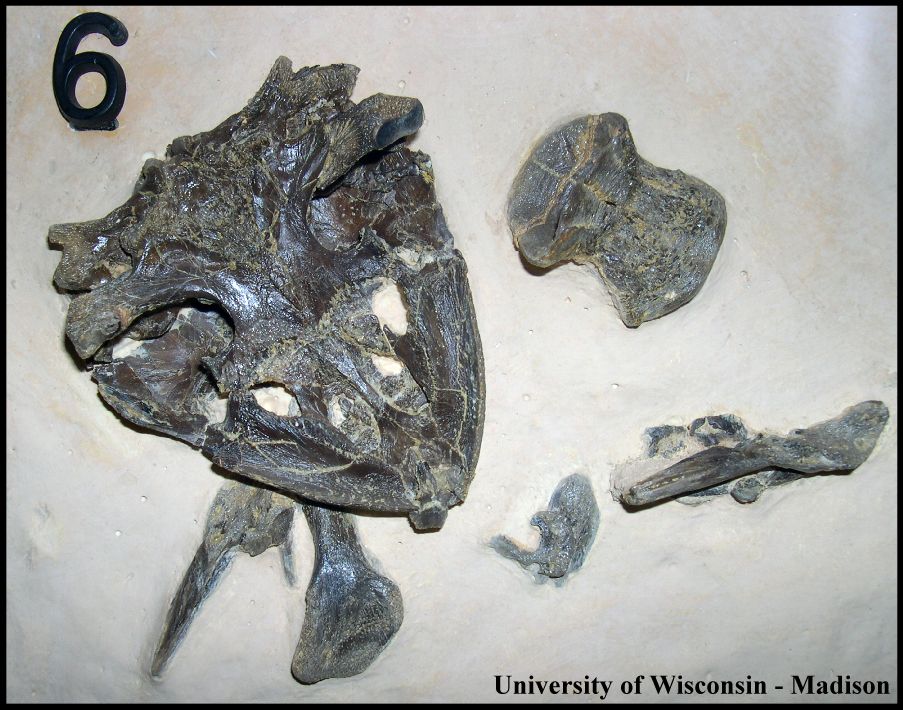
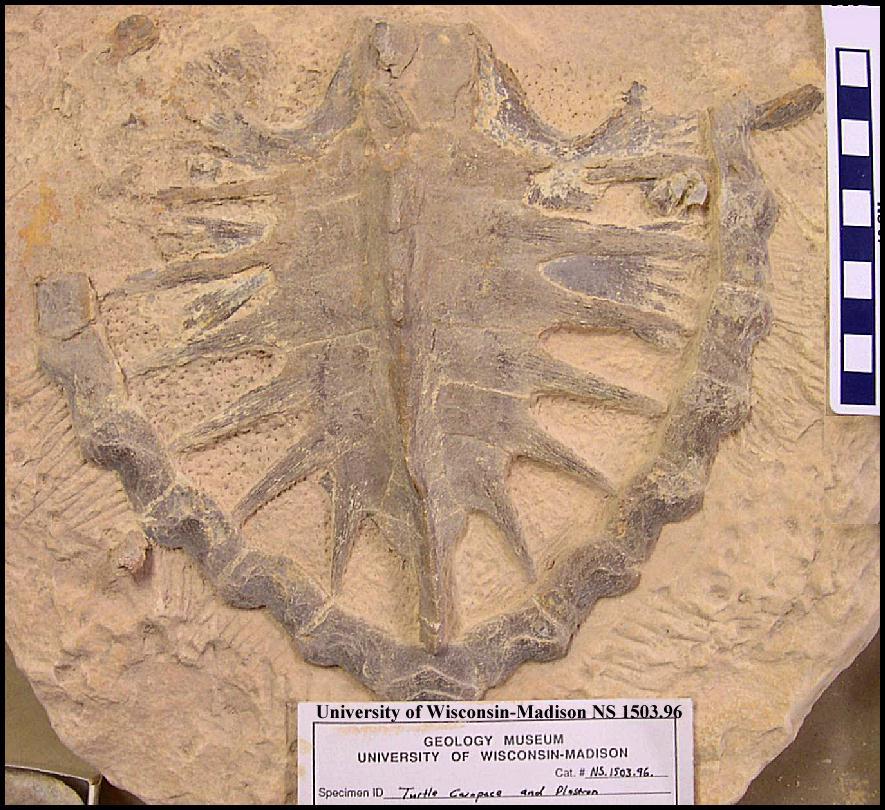
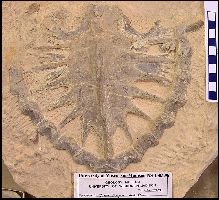
LEFT: A nearly complete carapace and plastron of Ctenochelys
stenopora in the University of Wisconsin-Madison collection. |
 |
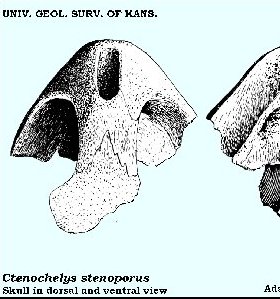 |
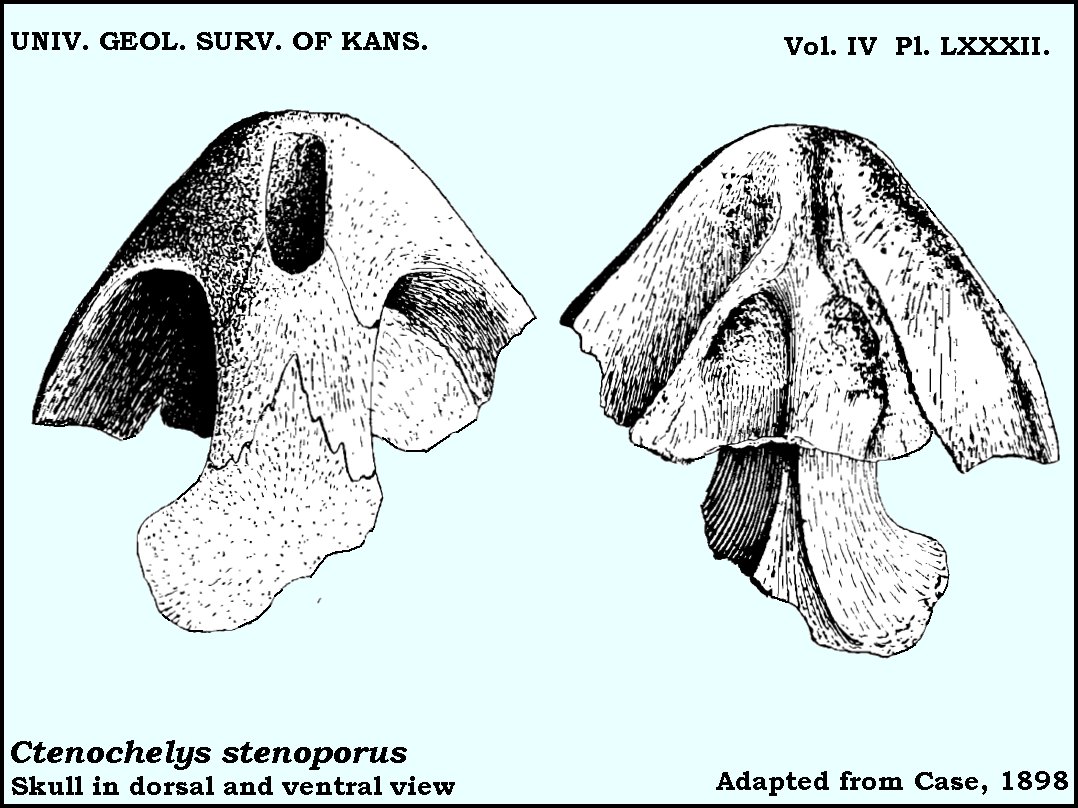
LEFT: The skull of Ctenochelys stenoporus in
dorsal and ventral views as figured originally by Case (1898).
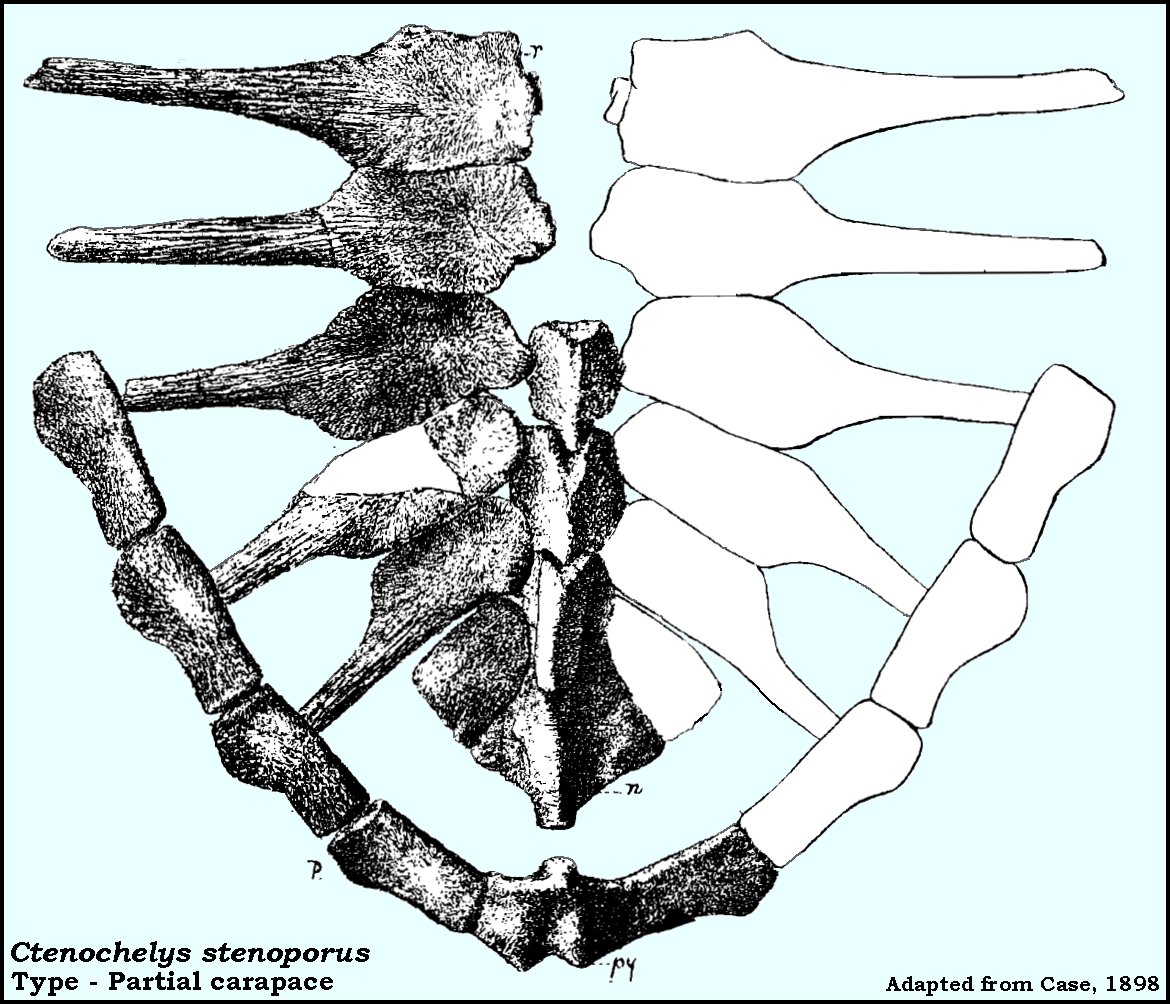
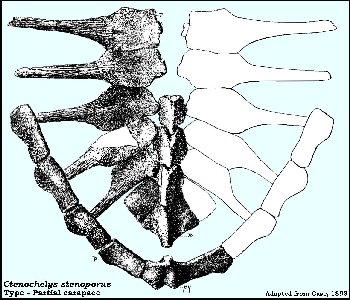
RIGHT: A partial carapace of the type specimen of Ctenochelys stenoporus as figured by
Case (1898). |
 |
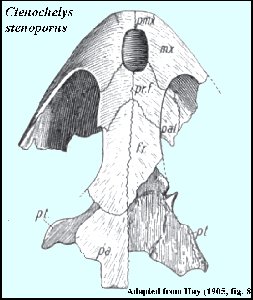 |
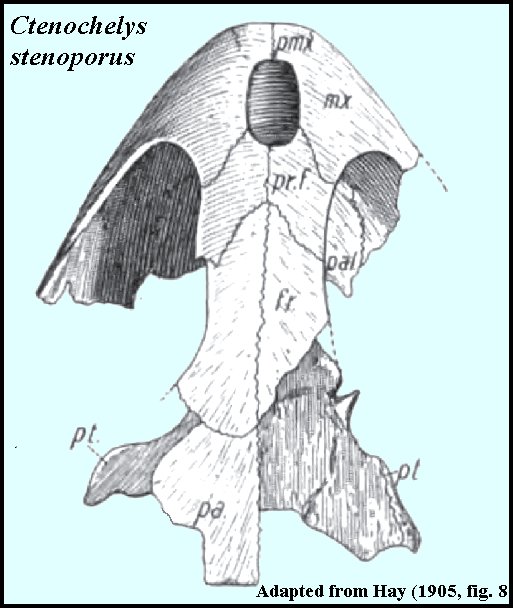
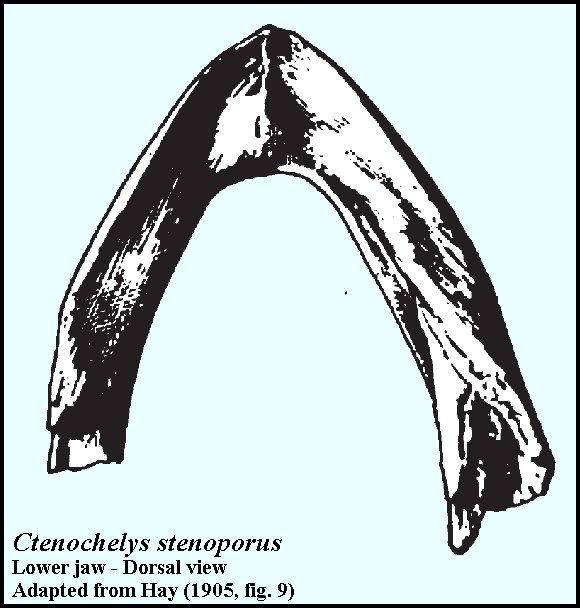
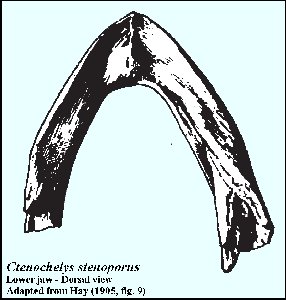
Originally described as Toxochelys stenoporus by
E.C. Case in 1898, it was recognized as a new genus by Hay (1905)
LEFT: Skull of the type specimen at the University of Kansas Museum
of Natural History as figured by Hay (1905).
RIGHT: Lower jaw of the type specimen at the University of Kansas
Museum of Natural History as figured by Hay (1905). |
 |
 |
.
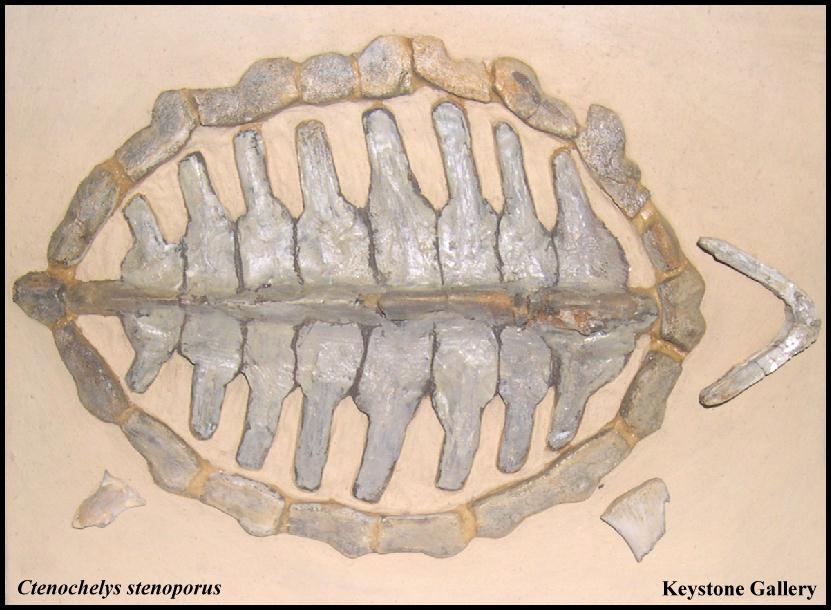
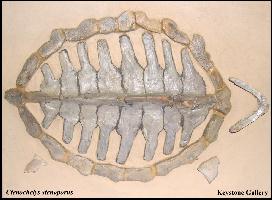
LEFT: The carapace and lower jaw of a small Ctenochelys
stenopora turtle in the collection of the Keystone
Gallery. The carapace is about 8 inches long. See Sternberg
(1907) for a brief description of this turtle. See Matzke 2007 for
comments on nearly complete specimen (USNM
357166).
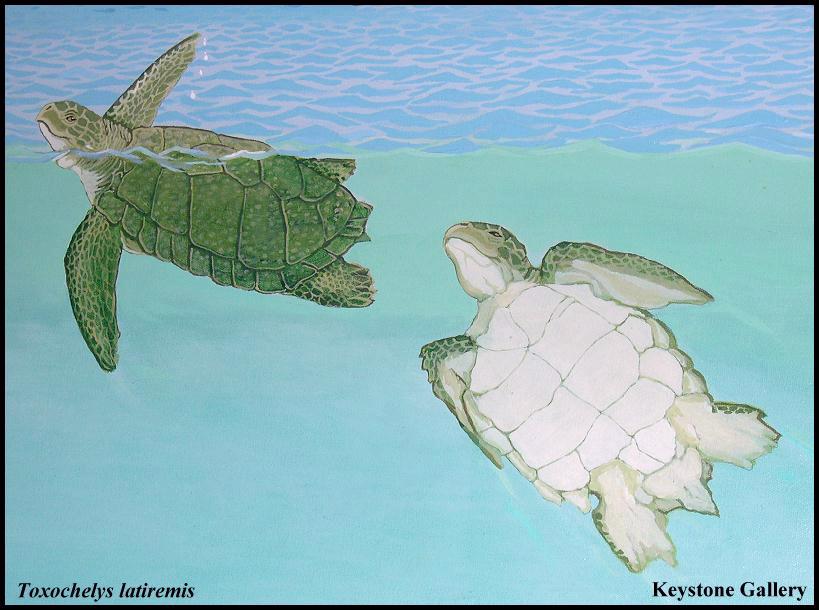
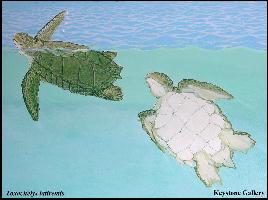
RIGHT: A detail from a mural
painted by Charles Bonner (Keystone Gallery)
showing what these small turtles might have looked like when they were living in the
Western Interior Sea. |
 |
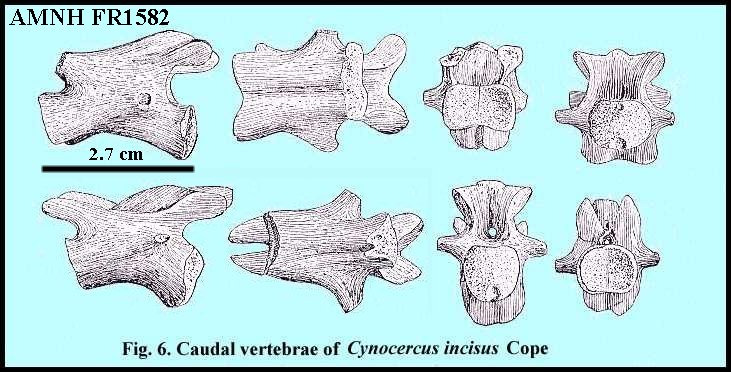
Cynocercus incisus - The second turtle to be described from
the Smoky Hill Chalk.
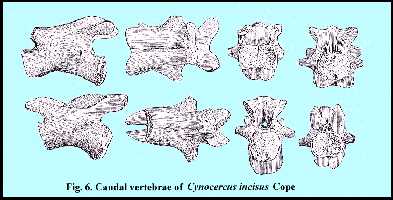 |
While Cope was collecting fossils in western Kansas in 1871, one of the
Army personnel (Sgt. William Gardner) assigned to escort him found two
caudal vertebrae of a
small turtle "two or three hundred yards" from the type locality of Protostega
gigas, southeast of Fort Wallace. Although the remains were very
limited, Cope (1872)
described and named the species Cynocercus incisus in an article read before the
American Philosophical Society on January 19, 1872. Lane (1946) considered them to be very
similar to Toxochelys, and if so, the name would have precedence by date.
LEFT:
Two caudal vertebrae of Cynocercus incisus (AMNH FR1583), in left
lateral, ventral, anterior and posterior views; republished by Williston (1898) from
Cope (1875, Plate VIII). A metapodial (3.4 cm in length) is also included
with the specimen. |
Porthochelys laticeps Williston 1901 - Holotype
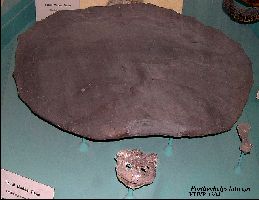 |
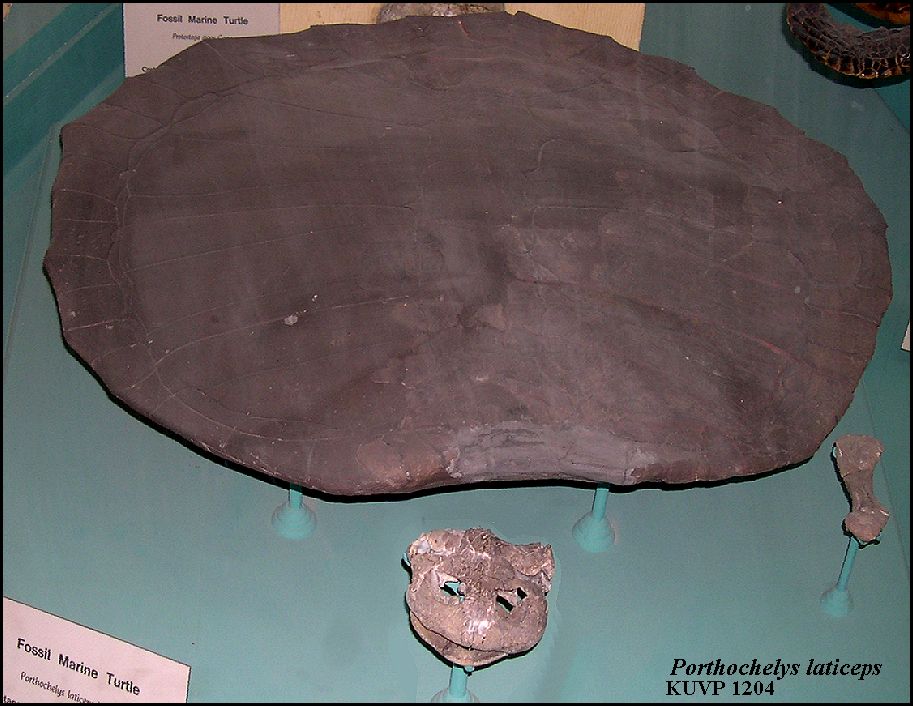
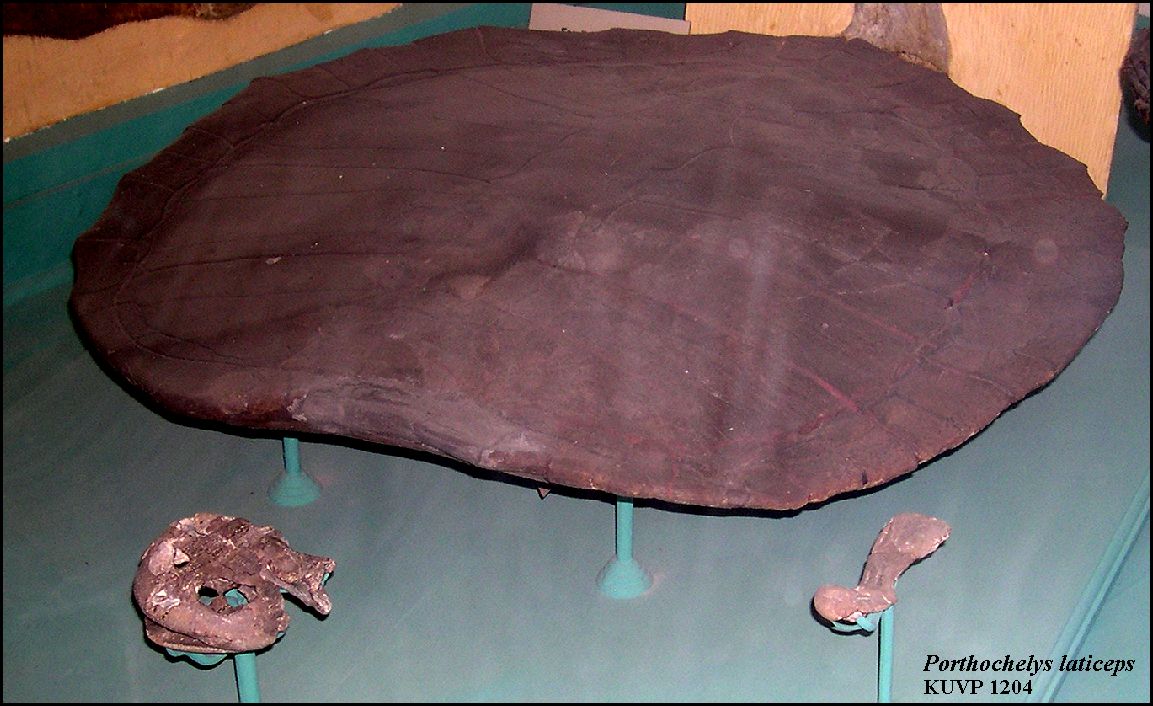
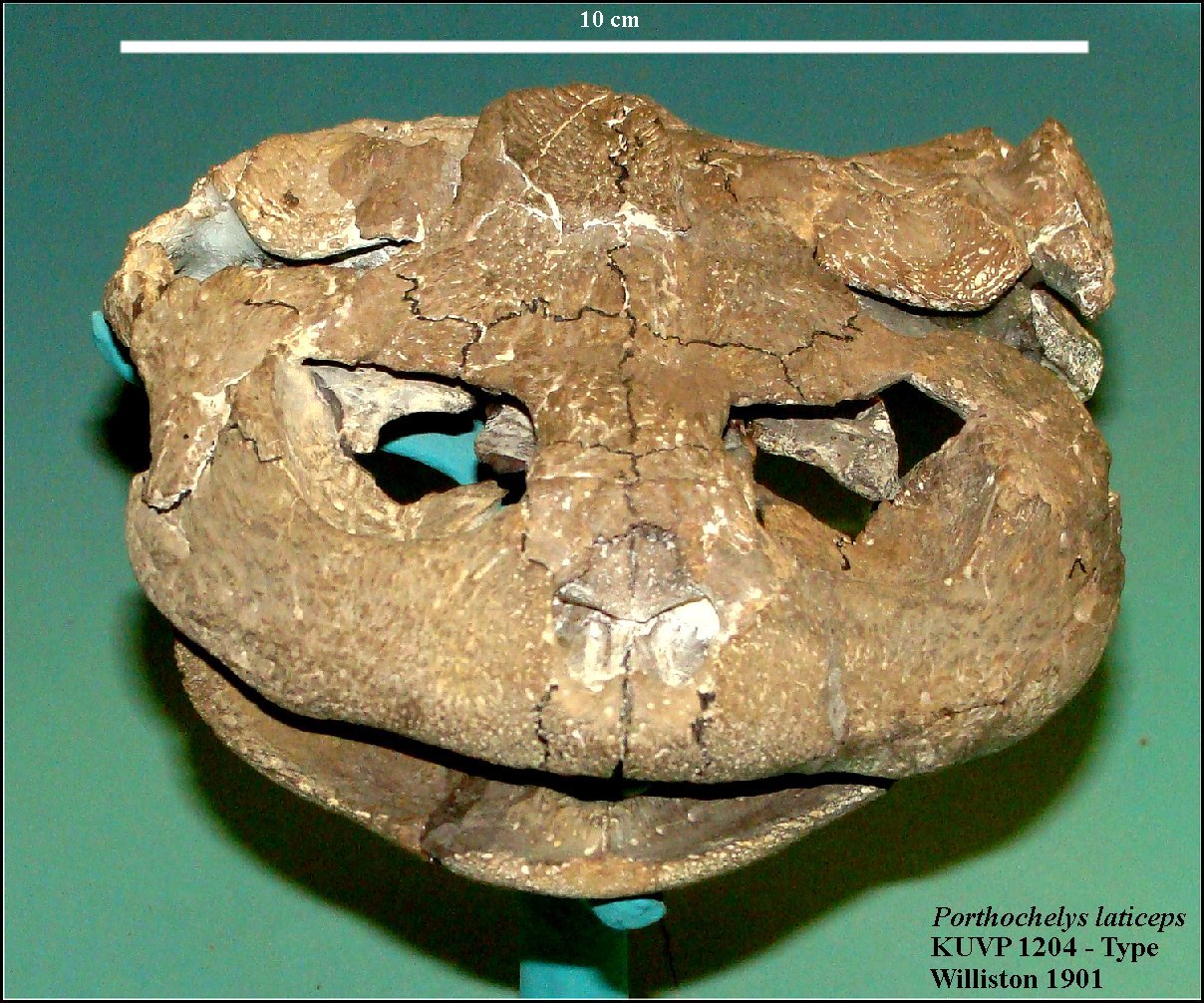
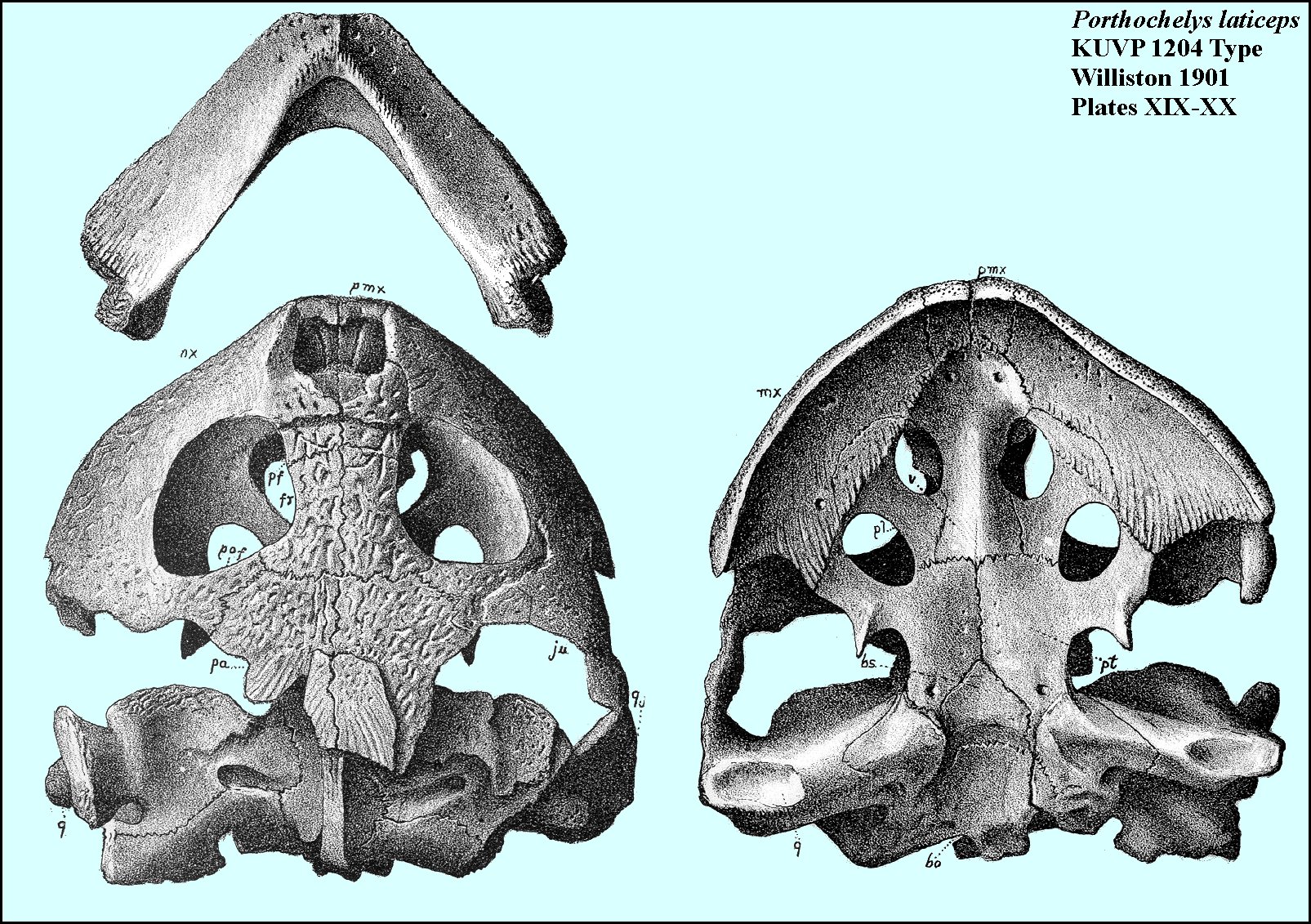
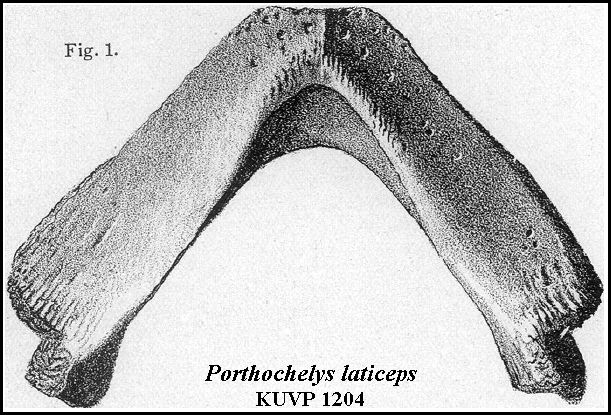
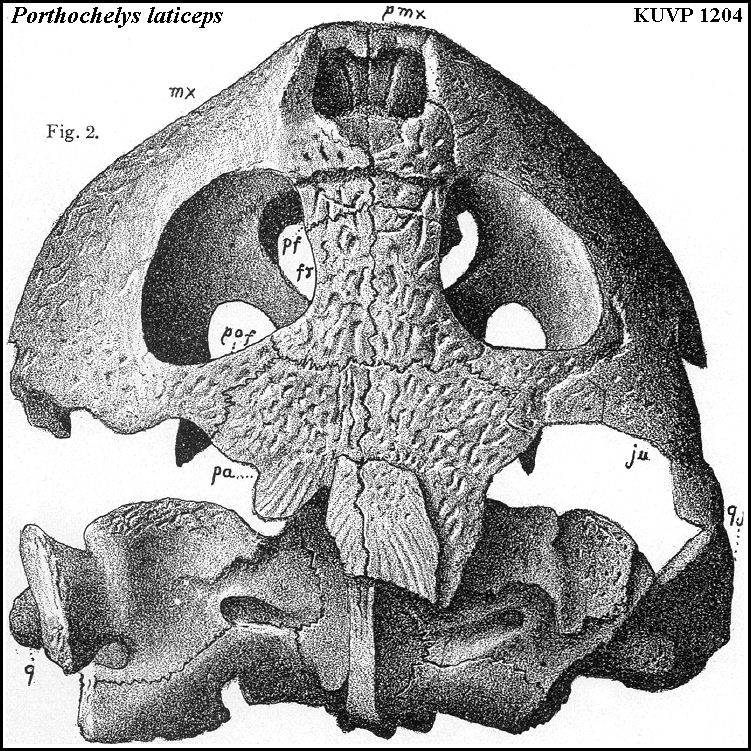
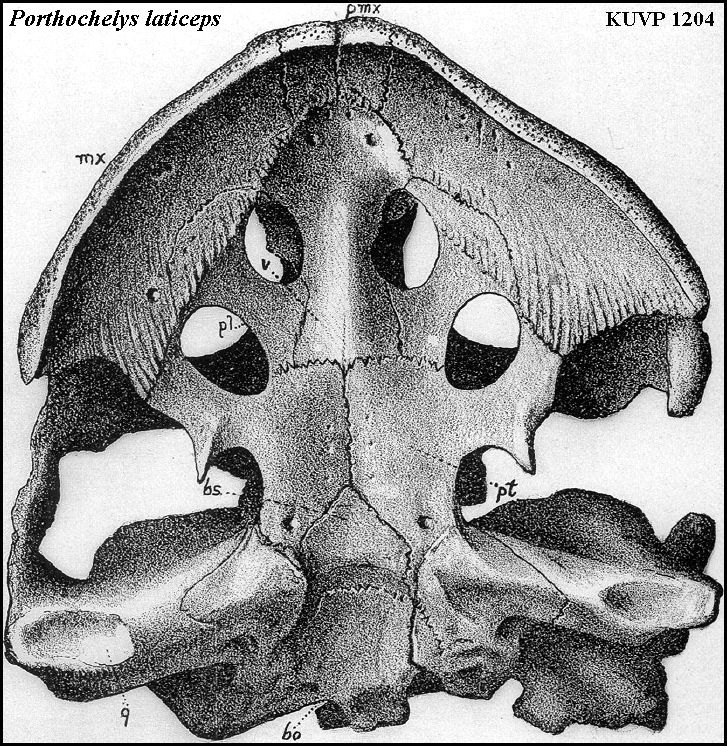
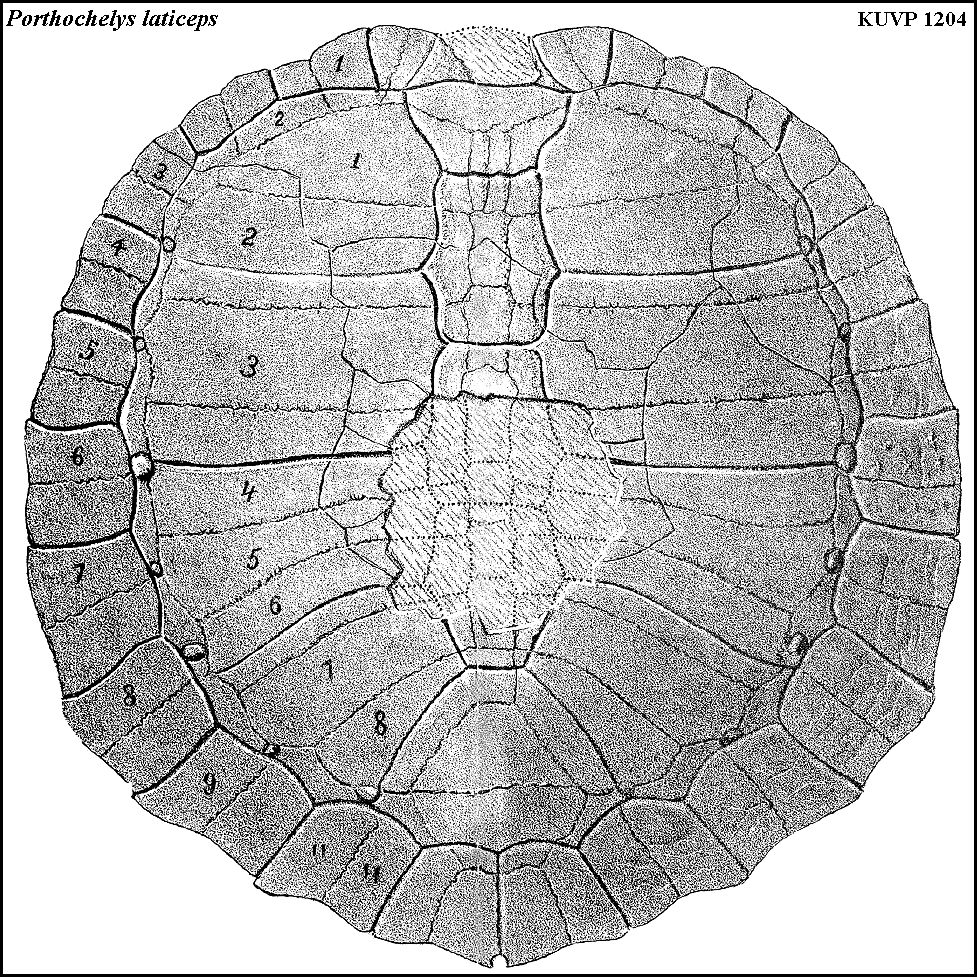
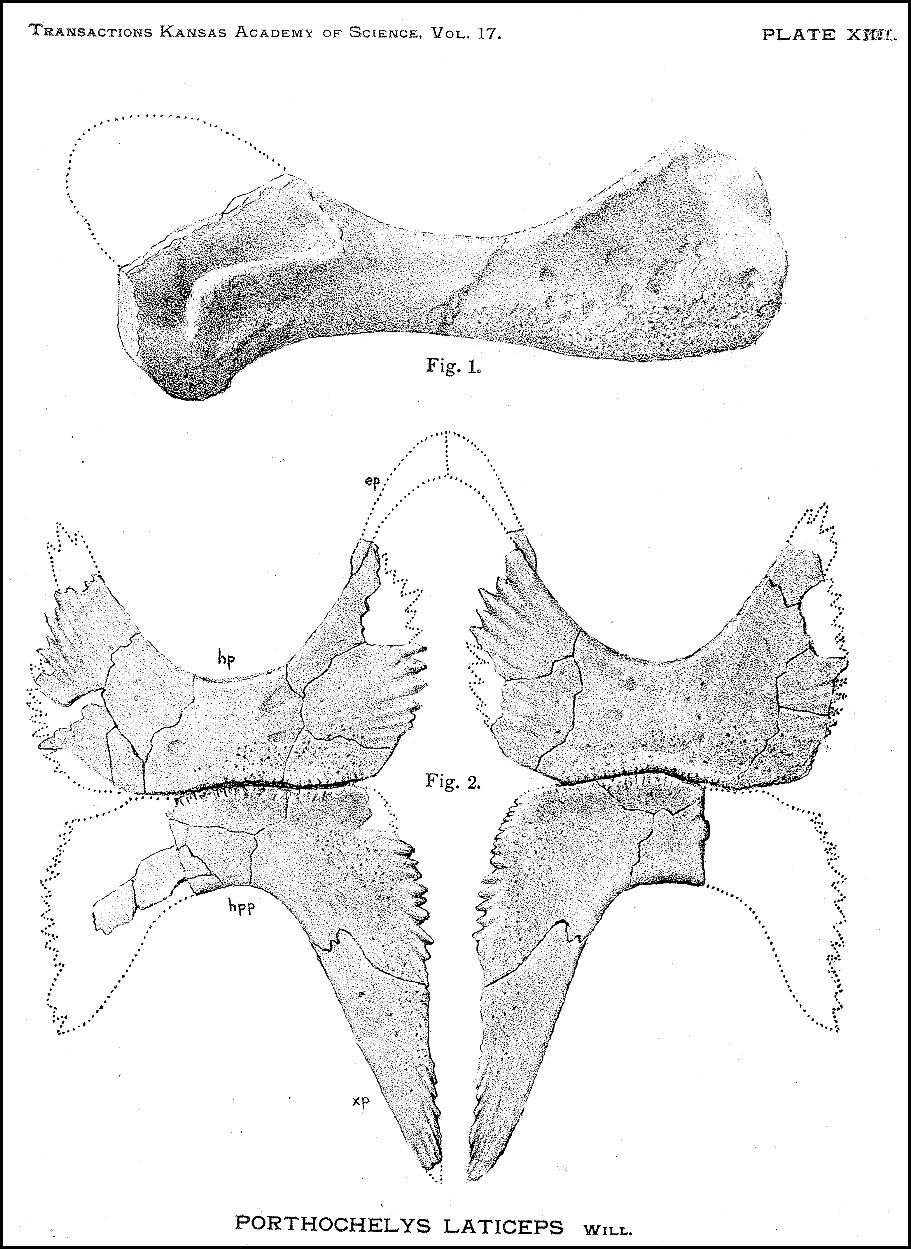
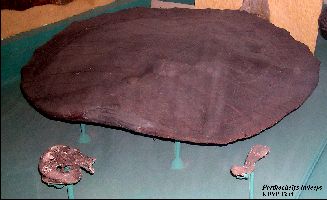
Porthochelys laticeps (KUVP 1204) is a one-of-a-kind specimen...
the only one collected so far.
LEFT: The reconstructed carapace, skull and right
humerus of the holotype specimen of Porthochelys laticeps (KUVP 1204). The
specimen was collected by E. H. Sellards and J. T. Shearer from the Smoky Hill Chalk near
the Saline River in Trego County, KS. The shell is about 60% complete and is 30 in.
long by 29 in wide. It is unusual for a Late Cretaceous marine turtle because of its solid
construction (most modern marine turtles, however, have solid shells). The specimen was
described and named by Williston in 1900 and is on exhibit at the University of Kansas
Museum of Natural History.
RIGHT: A left oblique view of Porthochelys laticeps (KUVP 1204).
Small bone at lower right is the right humerus, in ventral view. |
 |
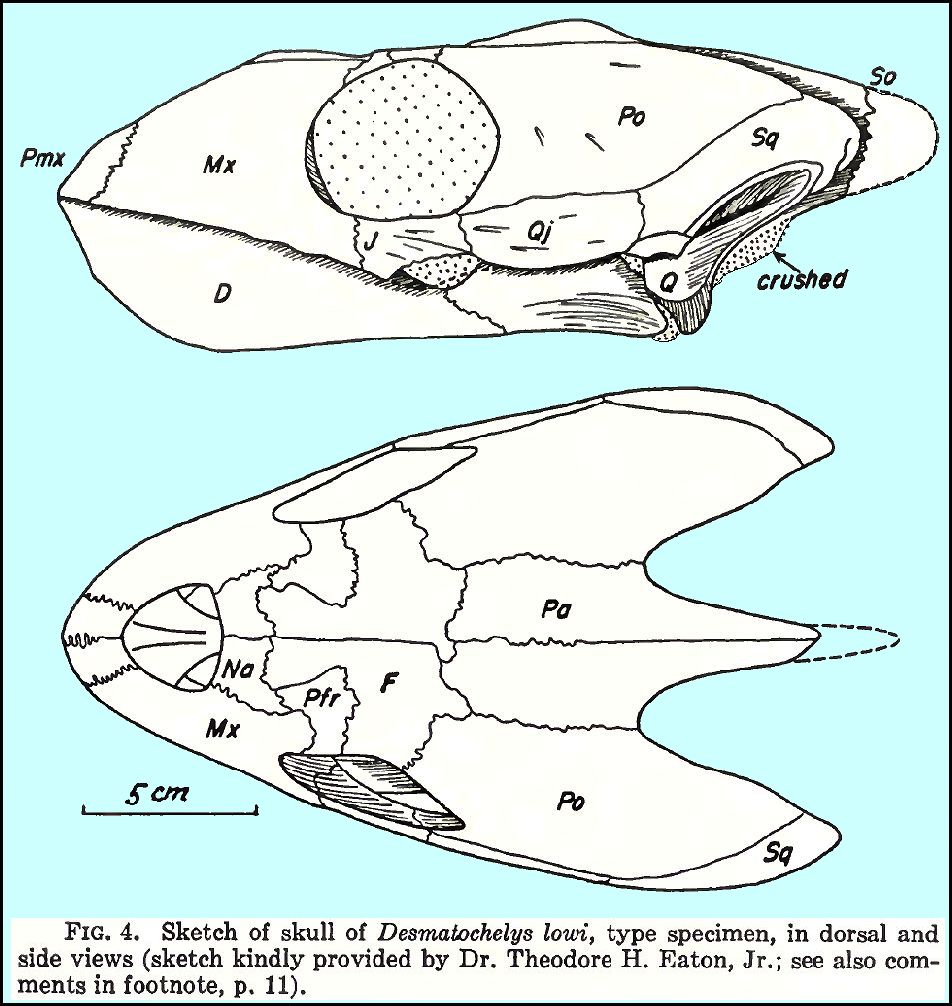
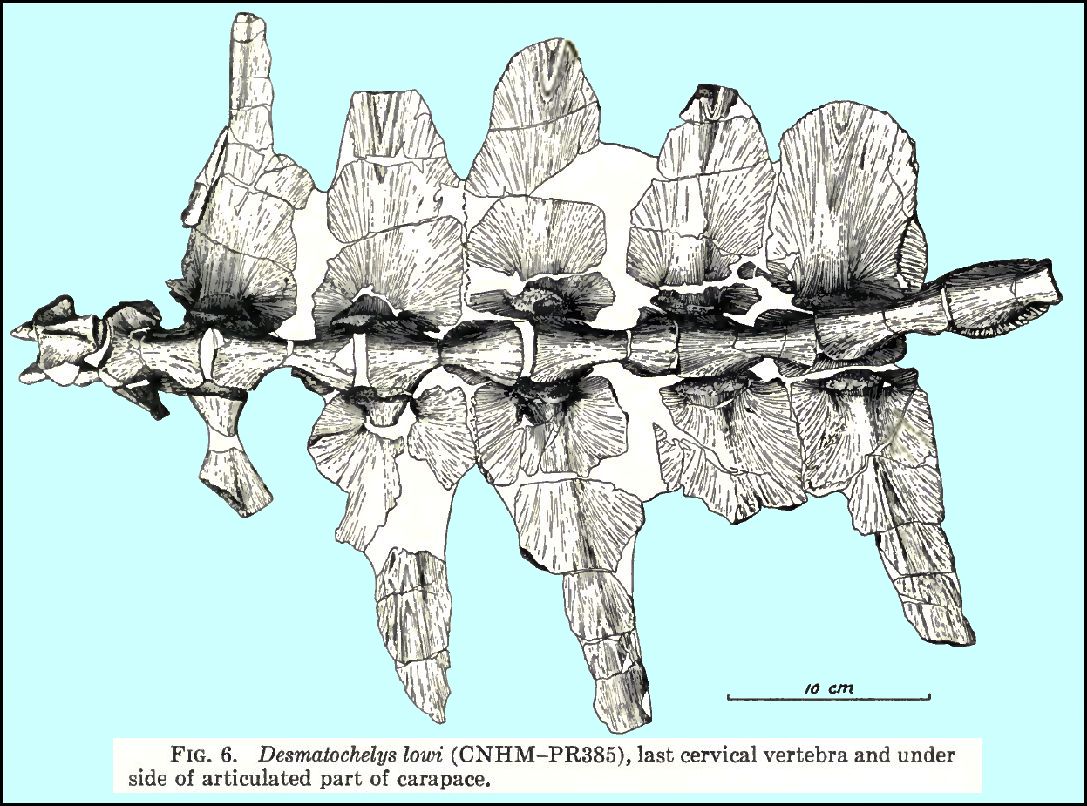
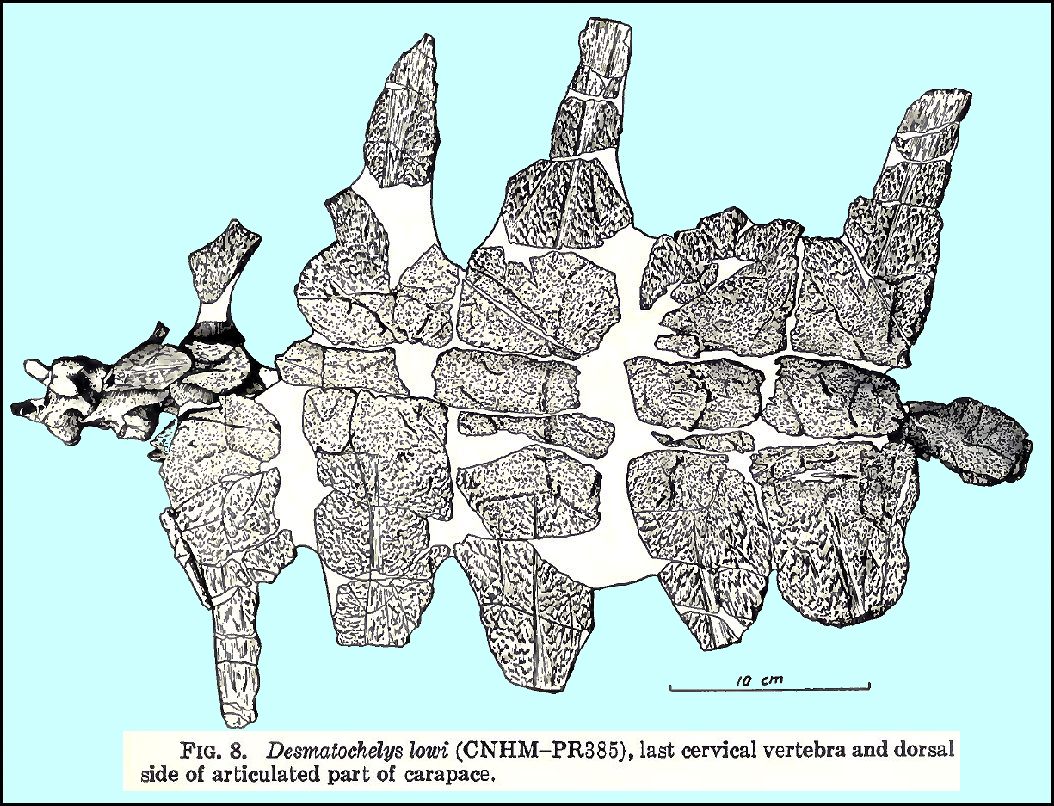
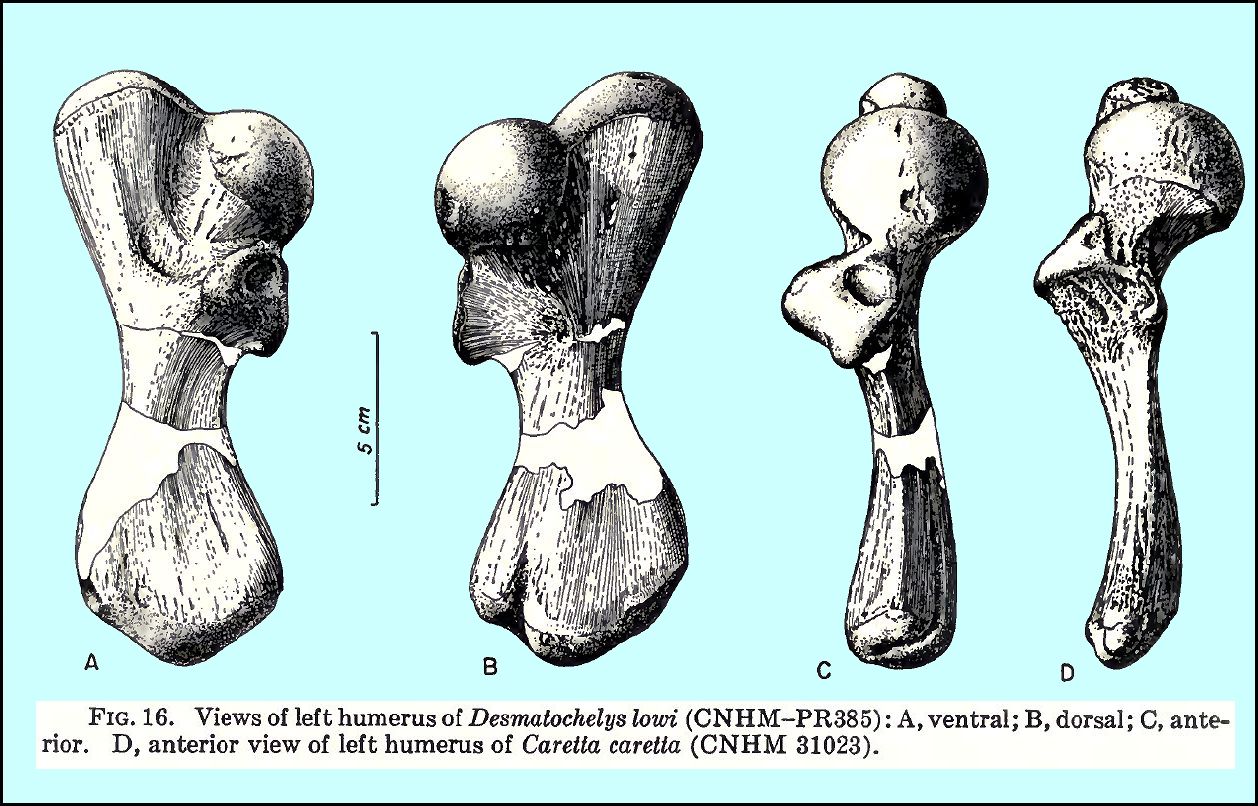
Desmatochelys lowi Williston 1894
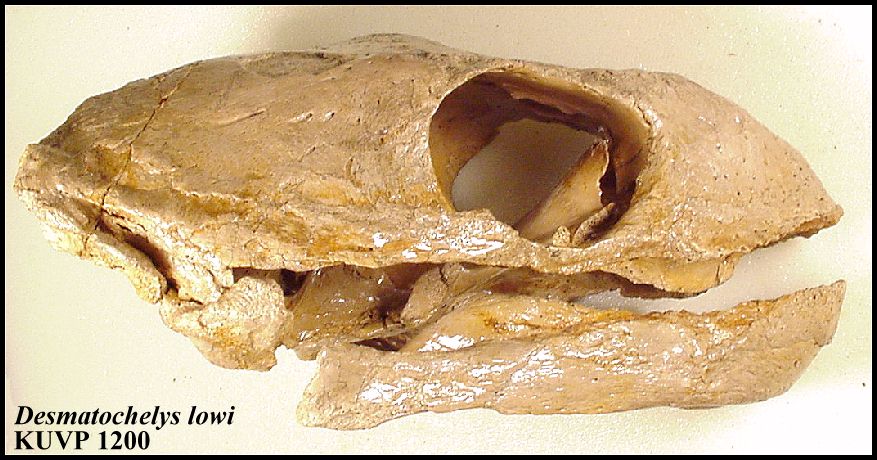
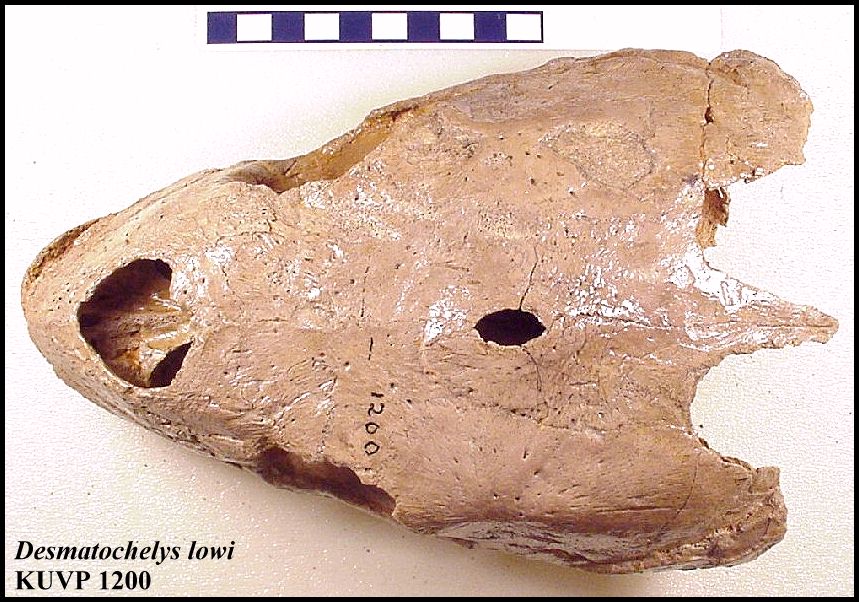
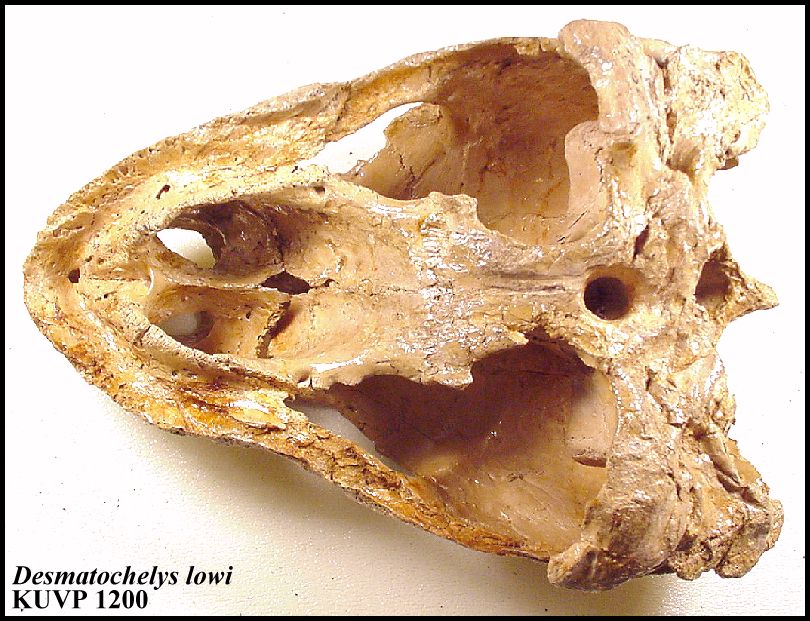
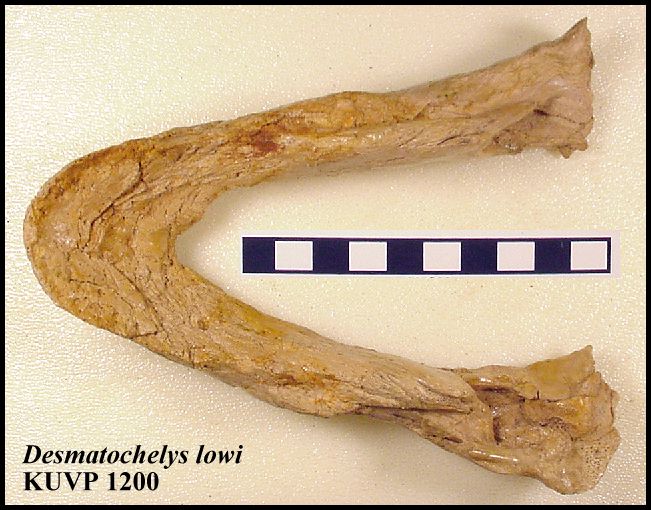
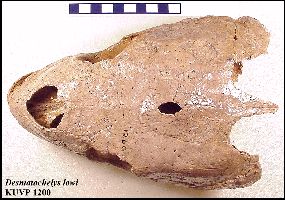
Desmatochelys lowi Williston 1894 (KUVP 1200)
is probably the oldest marine turtle yet described from the Midwest. Fragmentary turtle
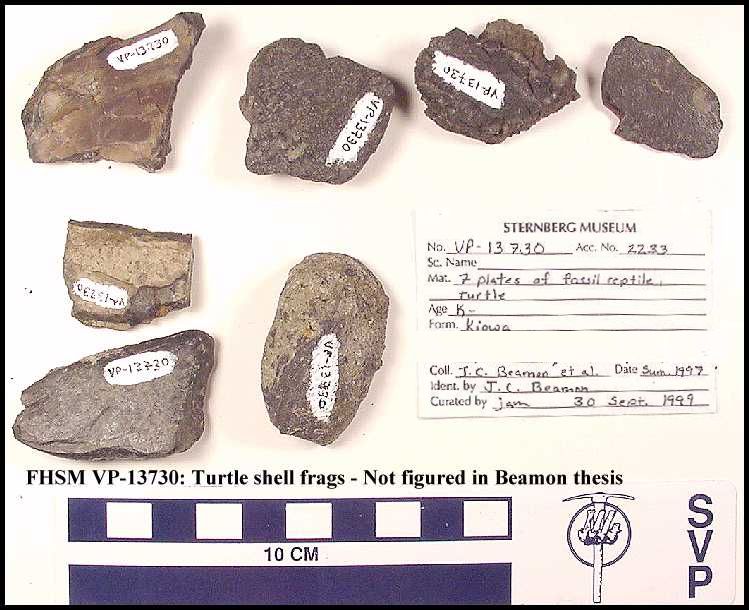
remains have been reported by Beamon, 1999, from the Kiowa Shale (Early Cretaceous,
Albian) of McPherson County, KS, but they are otherwise unidentifiable. The fairly
complete specimen of Desmatochelys lowi was collected from the "Benton
Cretaceous" near the town of Fairbury in Jefferson County, Nebraska in 1893. This
locality is just north of the Kansas-Nebraska state line and other remains (KUVP 32401 and
32405) of this species have been found in Kansas. From the excellent, 3-dimensional
preservation of the skull (below), it is likely the remains came from the Fairport Chalk
Member of the Carlile Shale and are Middle Turonian in age. Right lateral, dorsal
and ventral views of the skull of the type specimen (KUVP 1200) are shown below. A
photograph of the lower jaw is HERE. The photographs
were taken in January, 2004.
NEW - See the dig of the first Desmatochelysskull found in Kansas.... September, 2008
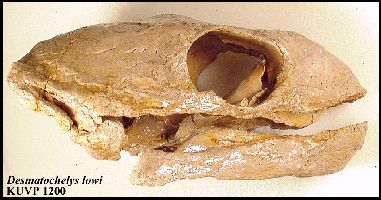 |
LEFT: A right lateral view of the skull of Desmatochelys
lowii.
RIGHT: A dorsal view of the skull of Desmatochelys
lowii |
 |
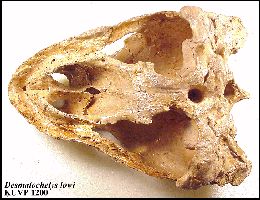 |
LEFT: A ventral view of the skull of Desmatochelys lowii. Note
that the round hole visible at the back of the palate was drilled there for mounting
purposes when it was originally on exhibit.
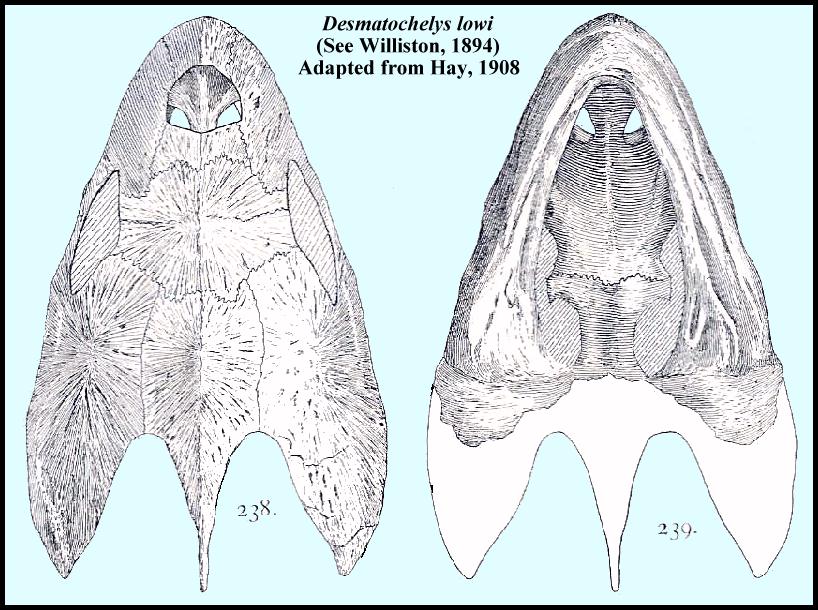
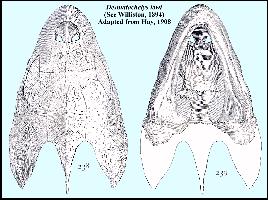
RIGHT: Drawings of the
skull of Desmatochelys lowii adapted from Hay, 1908.
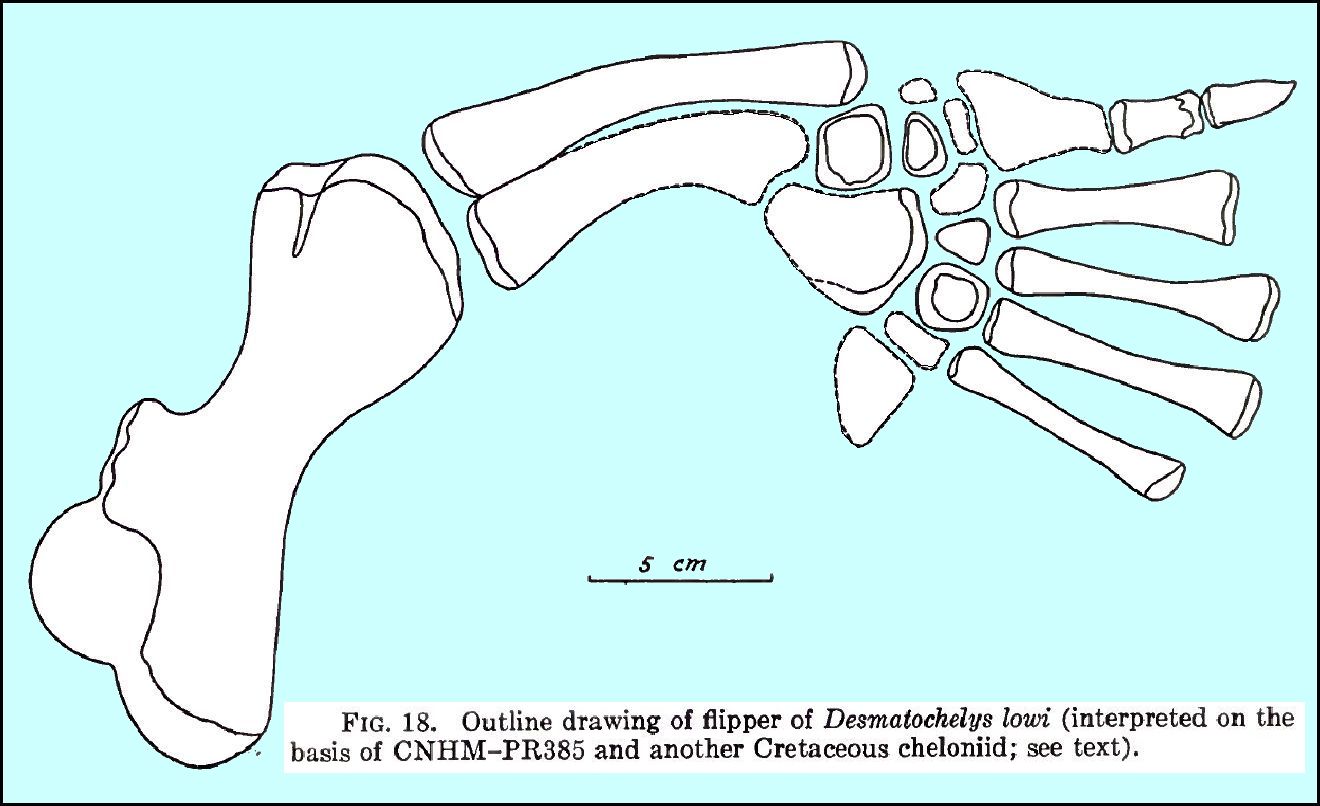
ALSO, see a drawing of the skull, carapace (ventral, dorsal), humerus and limb bones of a South Dakota
specimen from Zangerl and Sloan (1960) |
 |
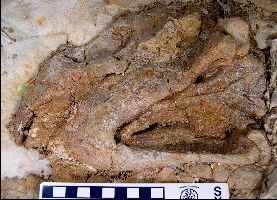 |
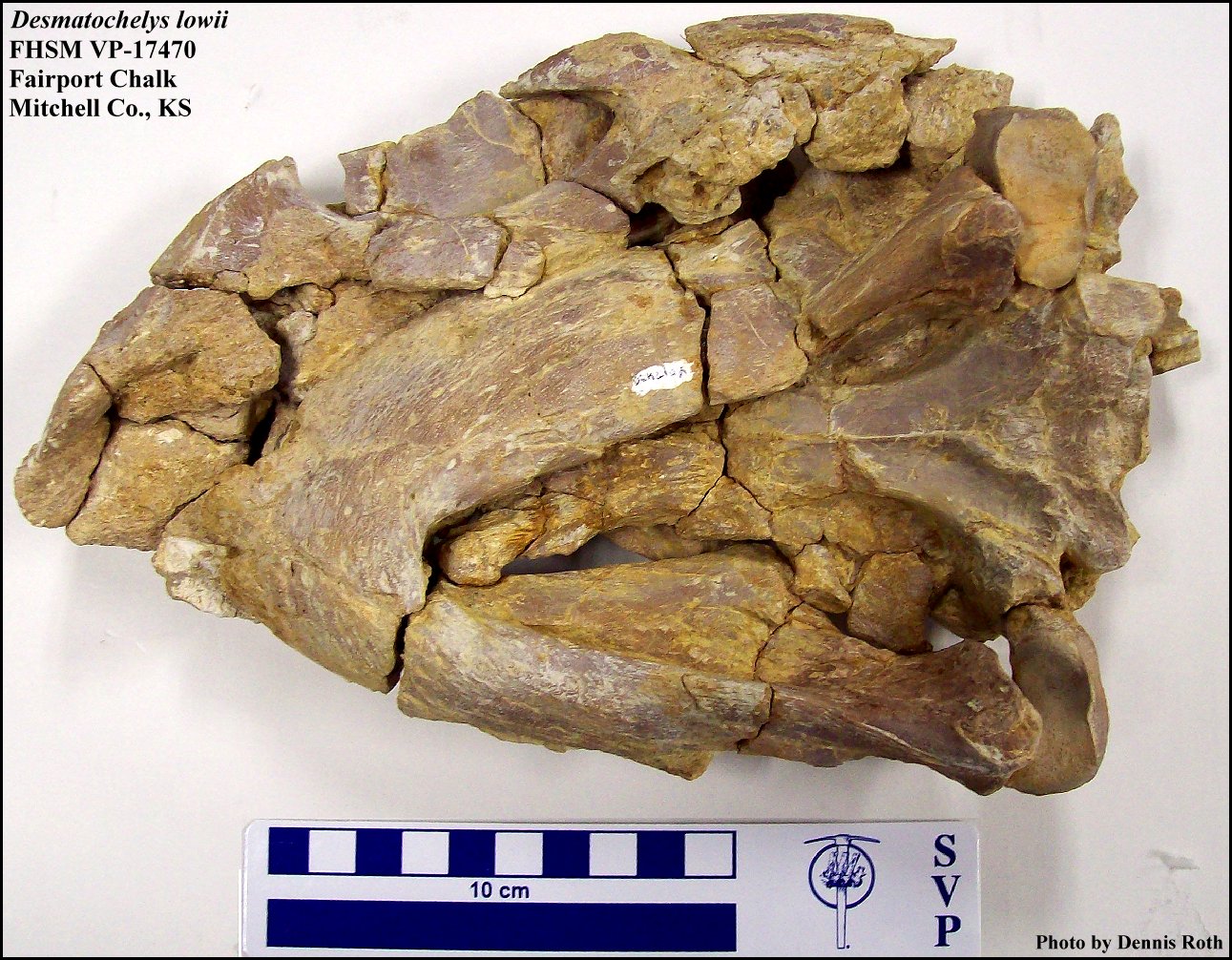
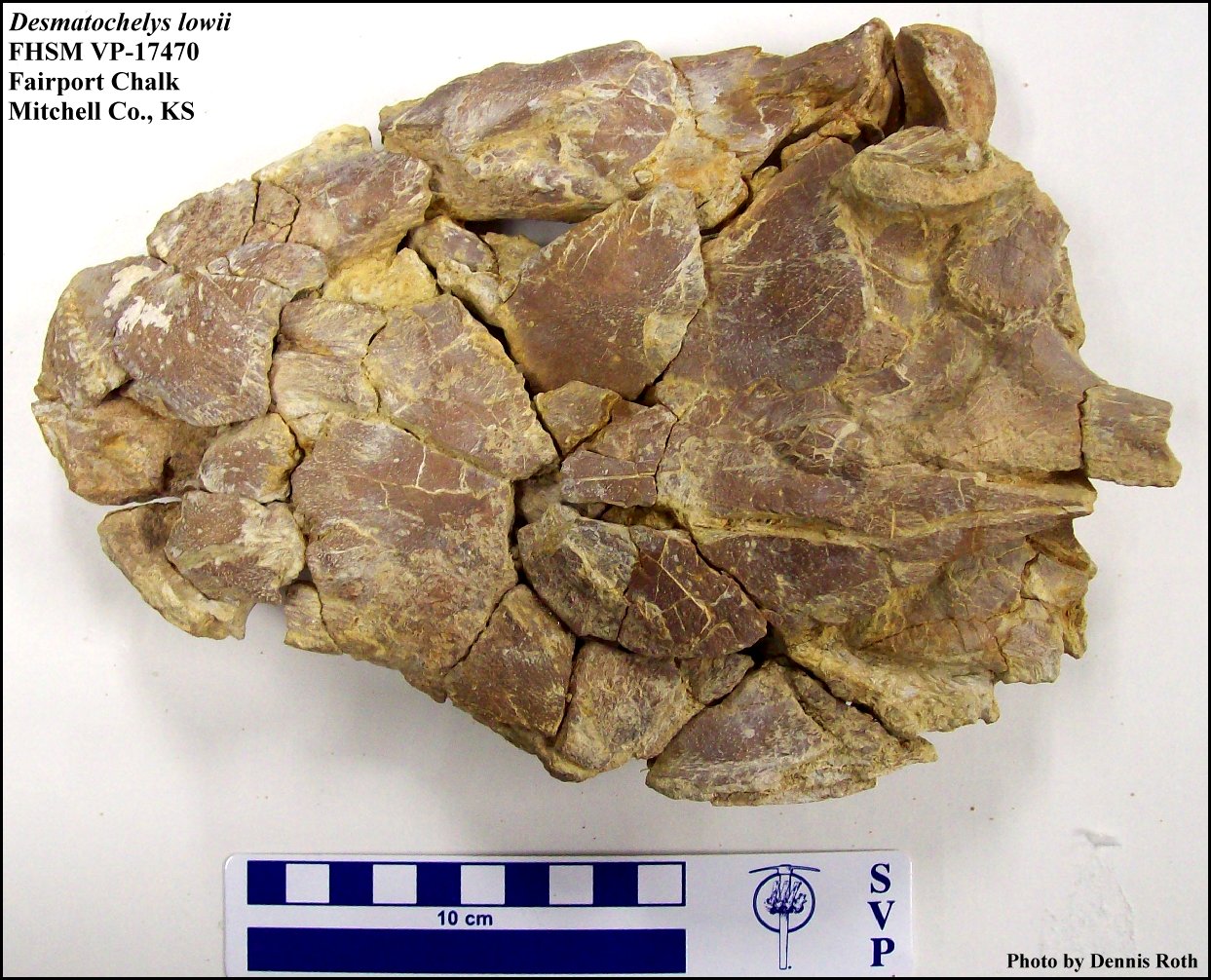
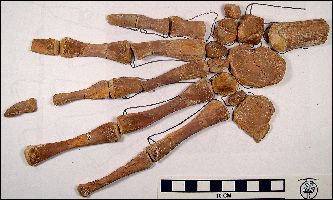
LEFT: A new specimen of Desmatochelys lowii
(FHSM VP-17470) from the
Smoky Hill Chalk of Mitchell County, KS. The specimen was
discovered in 2008 by Gail Pearson.
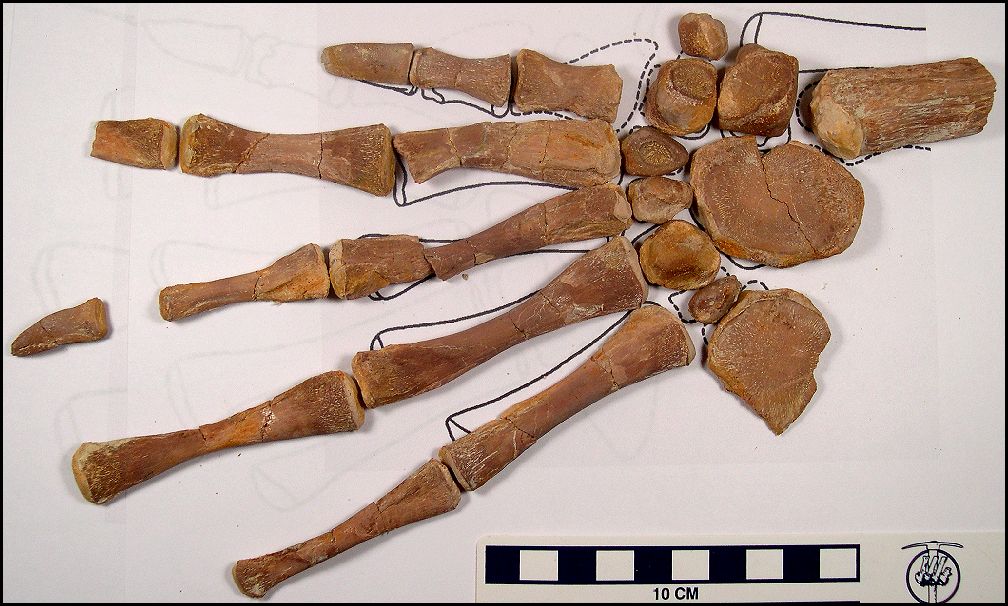
RIGHT: The left front paddle of
the new turtle specimen. |
 |
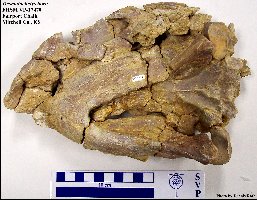 |
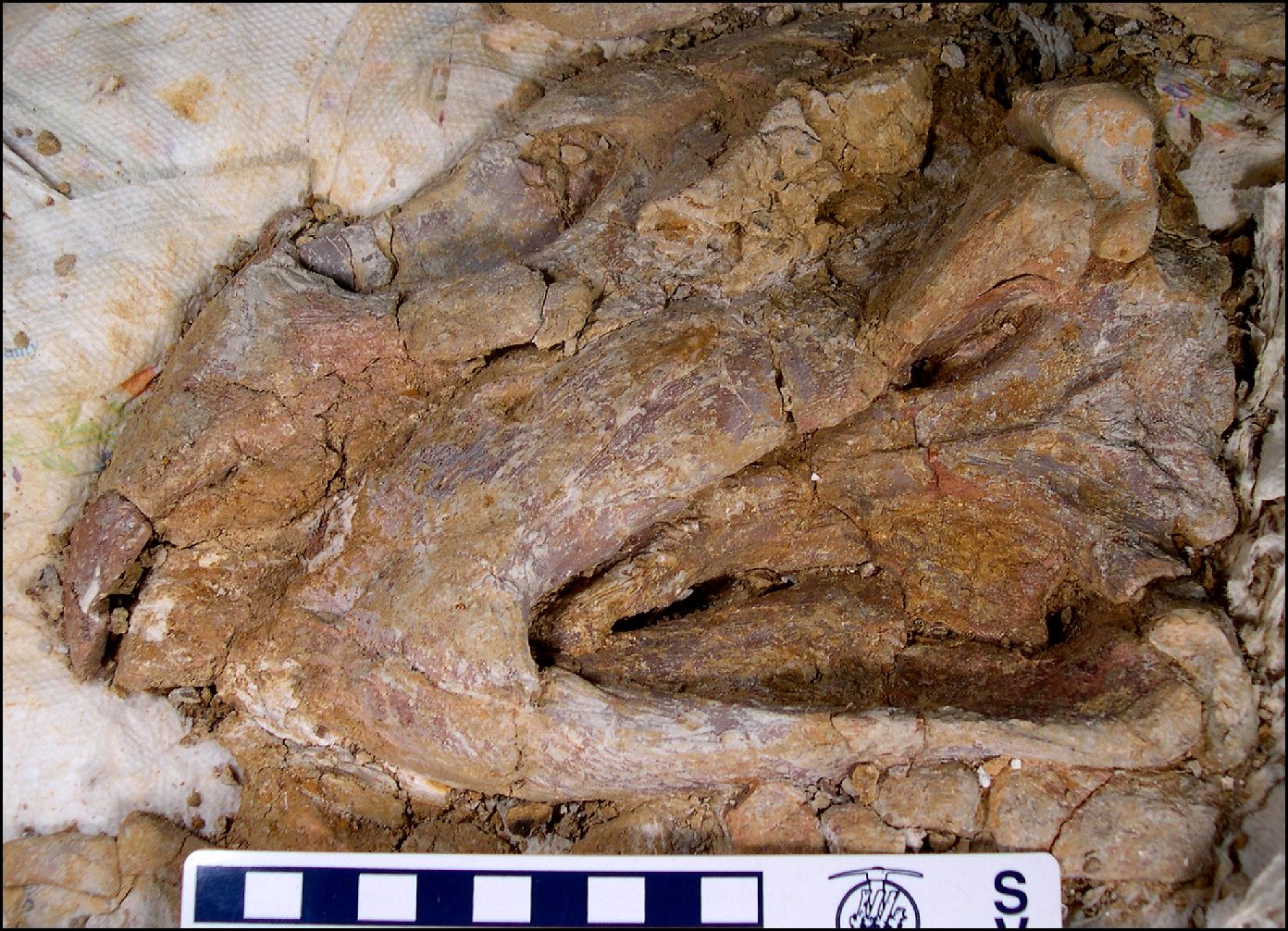
LEFT: (May, 2010) - Here is the ventral side of the
skull and lower jaws after additional preparation and cleaning by Dennis
Roth at the Sternberg Museum of Natural History. (Photo by Dennis
Roth) The specimen was
discovered in 2008 by Gail Pearson.
RIGHT: (May, 2010) - This is the first view of the dorsal side
of the skull (FHSM VP-17470) since we put the plaster and burlap jacket on
it in September, 2008 (Additional preparation and photograph by Dennis
Roth, Sternberg Museum of Natural History, Hays, Kansas). Note that while
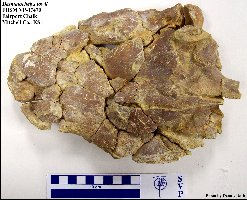
this skull is badly crushed and not as photogenic as KUVP
1200, it is more complete, and is certainly the best (and only) skull
of Desmatochelys lowii ever collected in Kansas. |
 |
The only turtle remains known from the
Greenhorn Limestone in Kansas
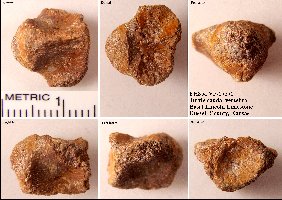 |
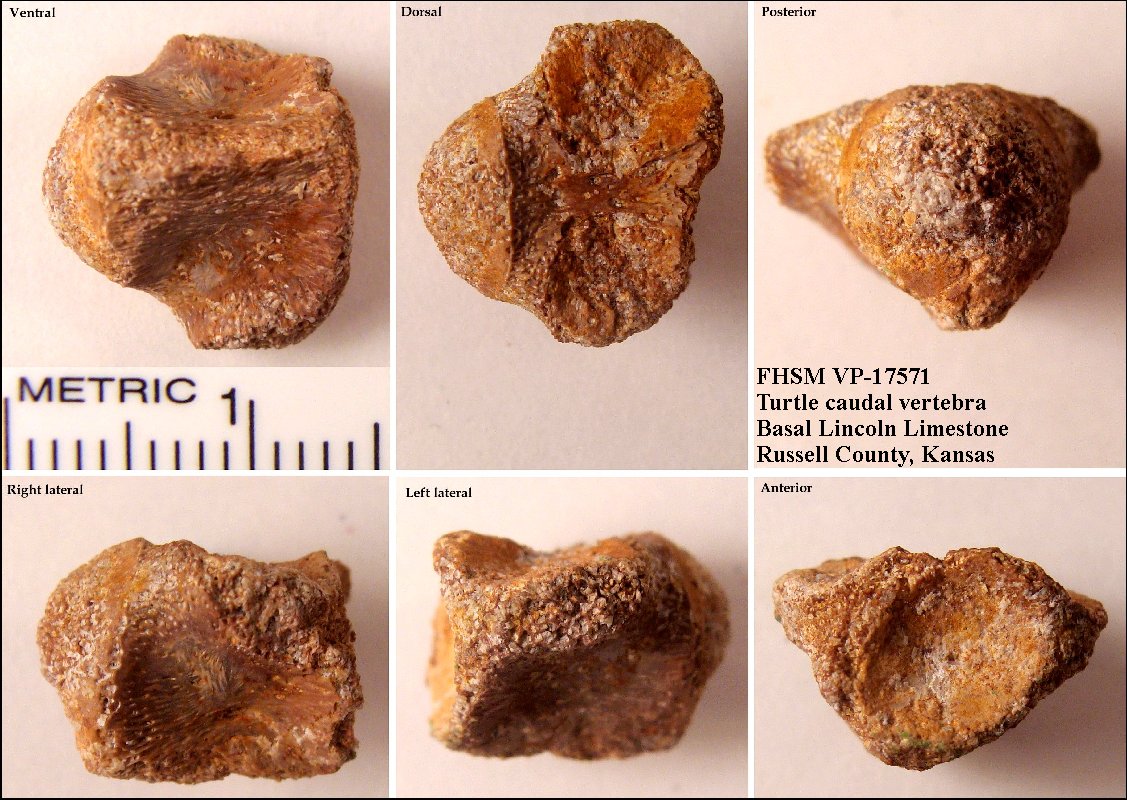
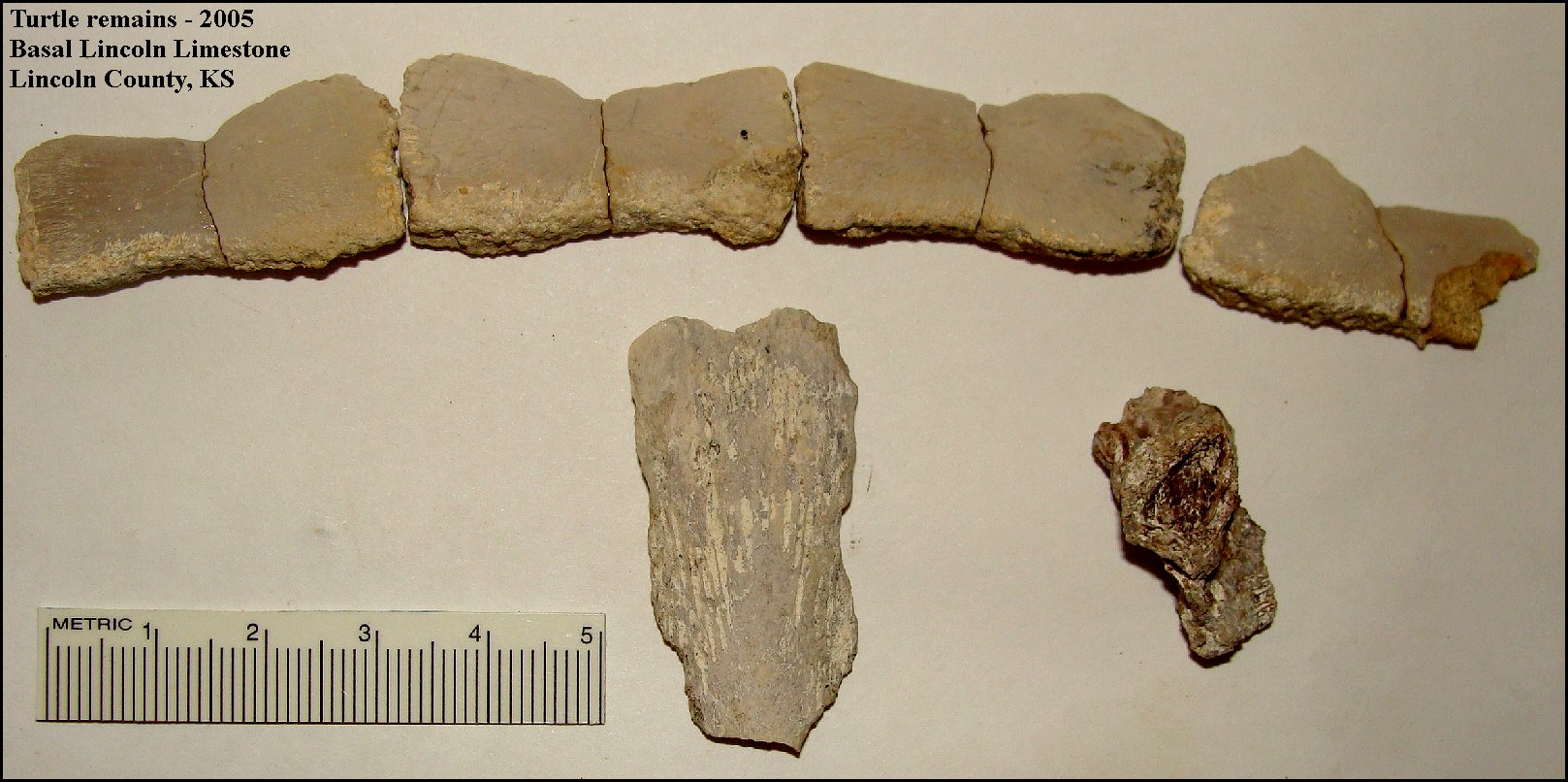
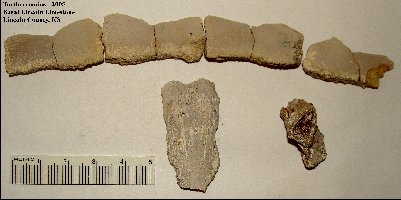
Turtle remains are very rare in the Greenhorn Formation.
LEFT: A single turtle caudal vertebra (FHSM VP-17571) from the basal
Lincoln Limestone Member of the Greenhorn Formation in Russell County,
Kansas.
RIGHT: The edge of the plastron (marginal or peripheral), the
proximal end of a rib and a part of the skull of a toxochelyid turtle from
the basal Greenhorn of Lincoln County, KS. Collected by Keith Ewell in
June, 2005. |
 |
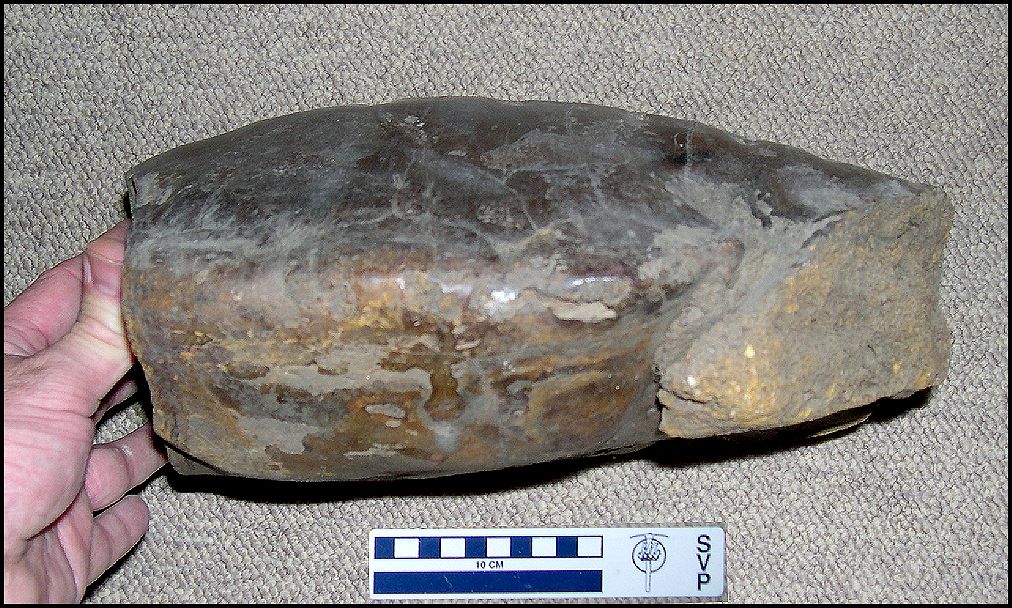
The endocast of a possible marine turtle from the
Dakota Sandstone of Republic County, Kansas
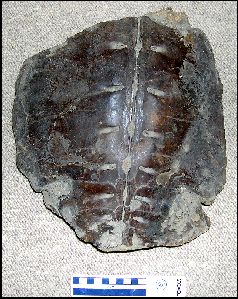 |
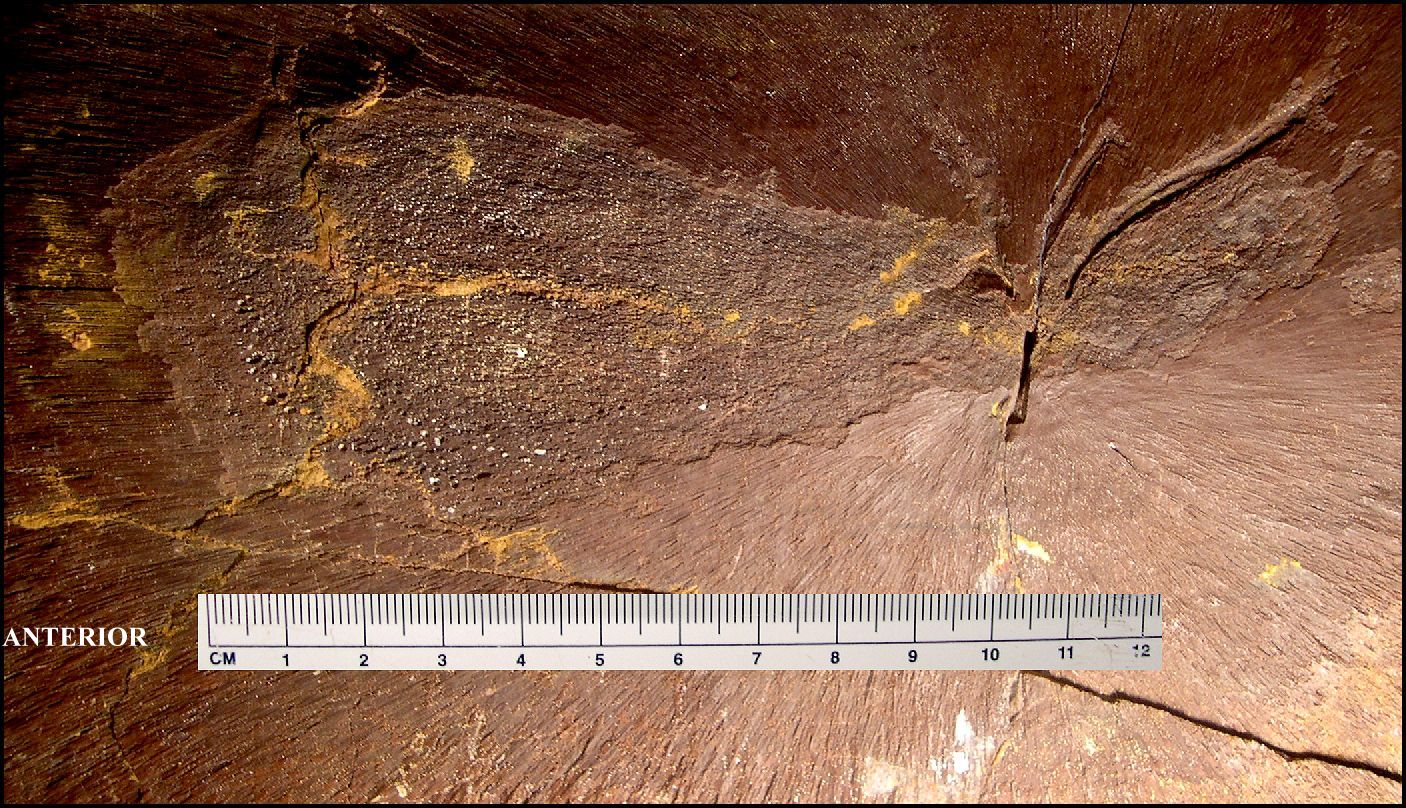
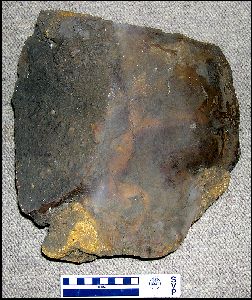
LEFT: Dorsal view of the endocast (from the inside the shell) of a
possible marine turtle from the Middle Cenomanian Dakota Sandstone of Republic County,
Kansas. The specimen is housed in the Republic County Historical Society Museum,
Belleville, KS.
RIGHT: Ventral view of the endocast (from the inside
the shell) of a possible marine turtle from the Middle Cenomanian Dakota Sandstone of
Republic County, Kansas. A side view is HERE. |
 |
A marine (?) turtle from the Kiowa Shale (Albian,
Early Cretaceous)
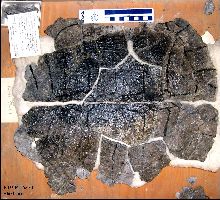 |
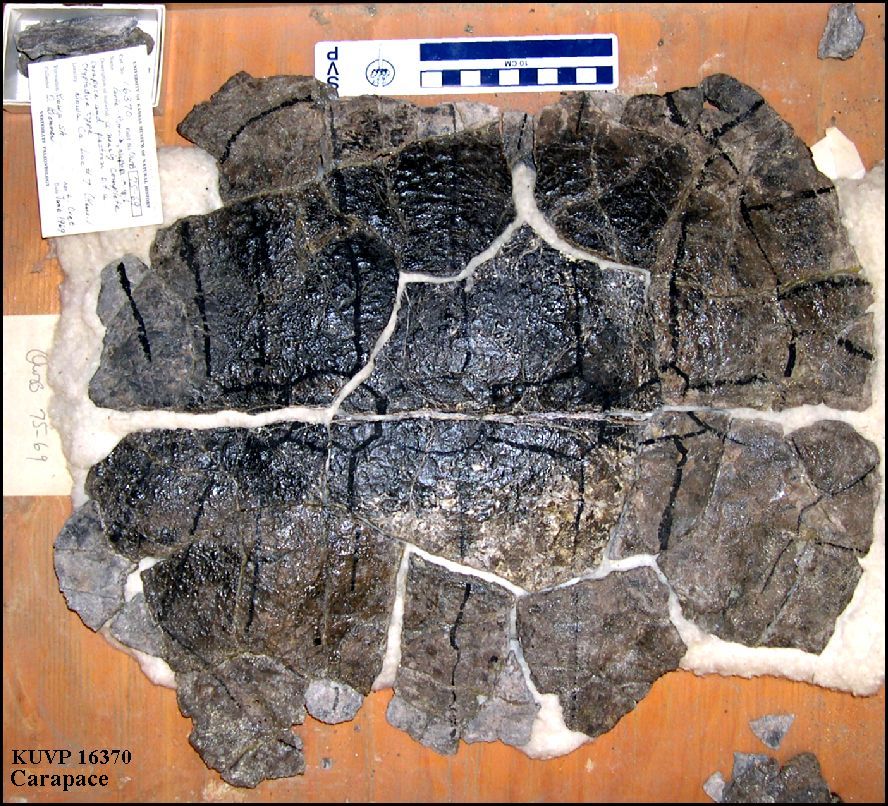
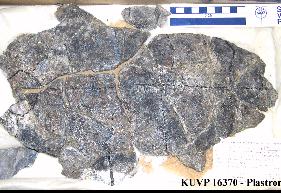
LEFT: The carapace (upper shell) of a medium sized turtle (KUVP 16370)
found in the Kiowa Shale of Kiowa County, Kansas. The specimen was discovered by
Orville Bonner in June, 1969 and was tentatively identified as Glyptops sp.
It is possible that Glyptops was not a fully marine species. However, the specimen
was found in off-shore marine sediments. Anterior is to the left.
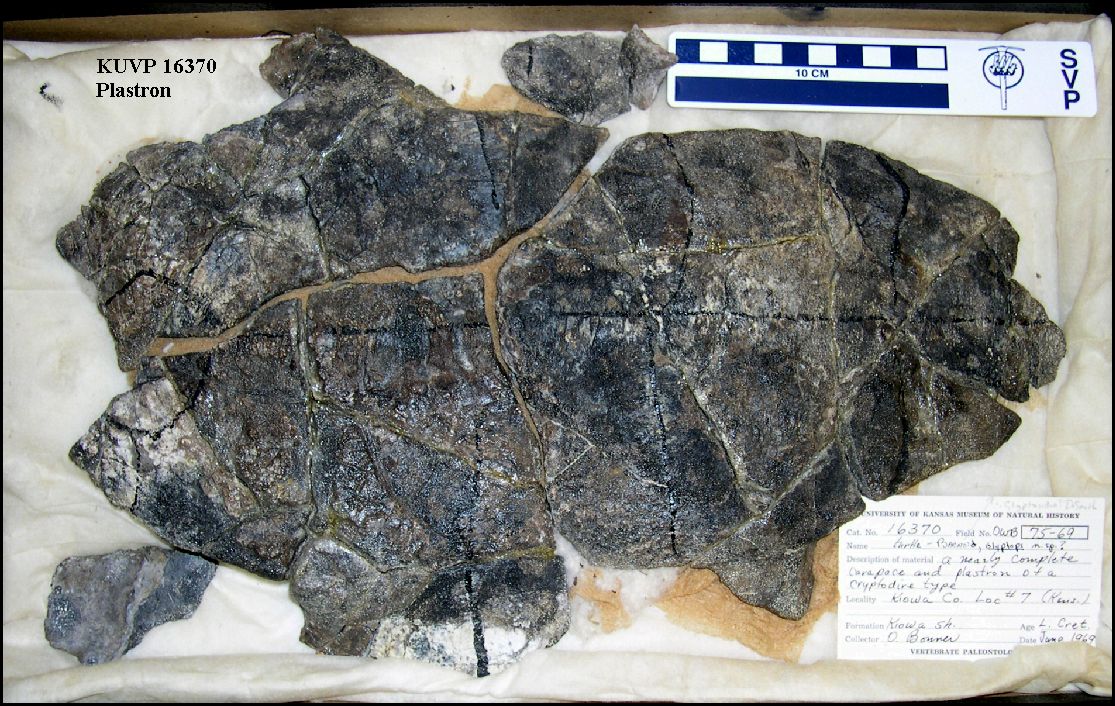
RIGHT: The
plastron (lower shell) of the same specimen. This is probably one of the oldest
turtle specimens known from Kansas, but it is as yet unreported. Anterior is to the left
in both photos. |
 |
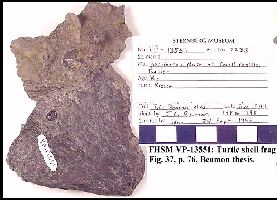 |
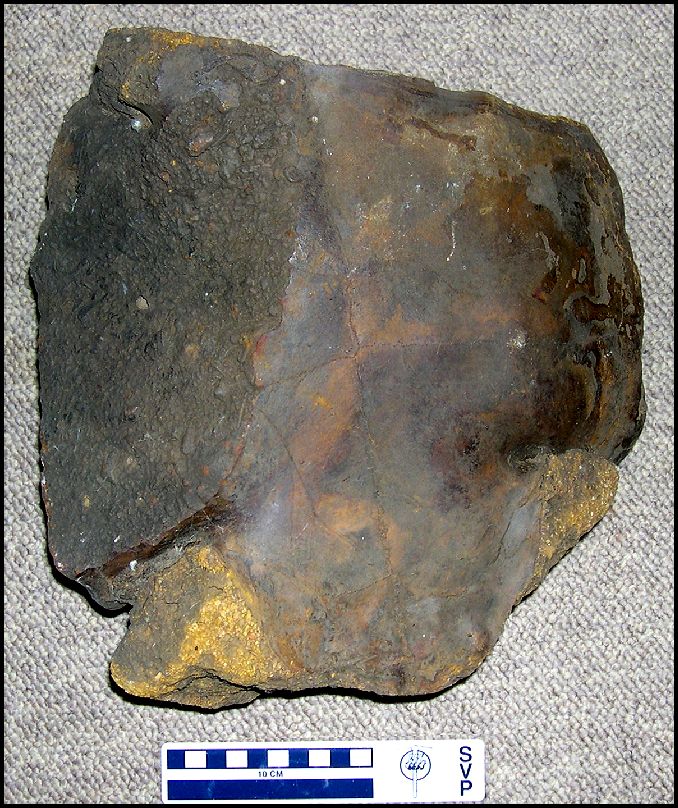
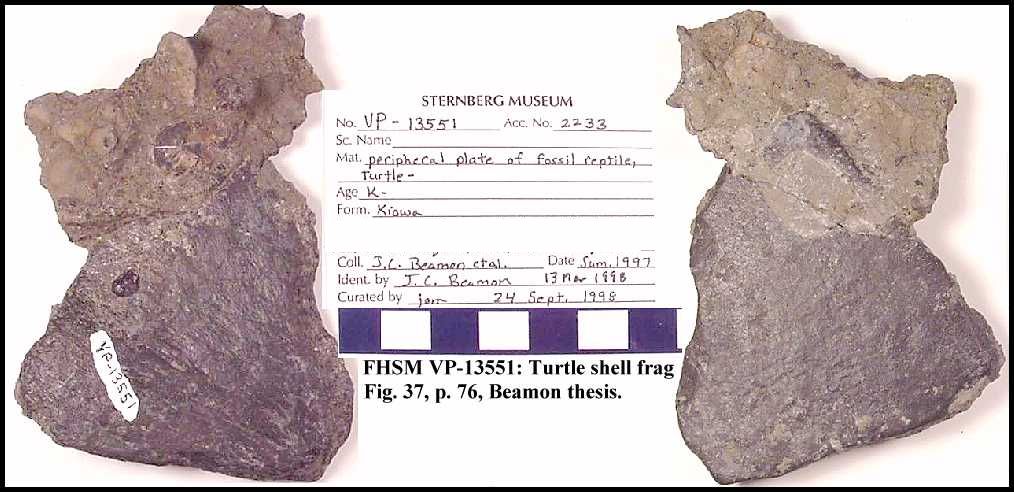
LEFT: Dorsal and ventral views of a large turtle shell fragment
(FHSM VP-13551) from the Kiowa Shale (Albian, Early Cretaceous) of
McPherson County, KS. The same deposit also includes crocodile remains and it is possible
that these crocodiles fed upon the turtles, and/or that their shells were simply battered
apart by waves in the high-energy, near shore environment.
RIGHT: A
collection of turtle shell fragments from large, early Cretaceous turtles in the Kiowa
Shale of McPherson County, KS. |
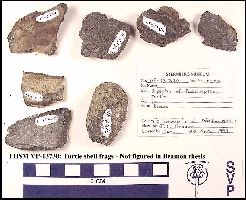 |
Protostega gigas and Archelon
ischyros were giant (Volkswagen-sized!) sea turtles that are found in Cretaceous
deposits.
Note that the first known Protostega specimen (YPM
1408) was collected on July 4 by the 1871 Yale College Scientific Expedition,
eight miles east of Fort Wallace, almost 5 months before Cope
arrived in Kansas. However, it has never been described.
 |
E. D. Cope found and collected the type specimen of Protostega
gigas during his only trip to the Kansas chalk in 1871. He wrote about his
experiences, including the discovery of Protostega, in a
letter dated October 9, 1871 to Professor Lesley of the American Philosophical
Society:
"On another occasion, we detected
unusually attenuated bones projecting from the side of a low bluff of yellow chalk, and
some pains were taken to uncover them. They were found to belong to a singular reptile, of
affinities probably to the Testudinata, this point remaining uncertain. Instead of being
expanded into a carapace, the ribs are slender and flat. The tubercular portion is
expanded into a transverse shield to beyond the capitular articulation, which thus
projects as it were in the midst of a flat plate. These plates have radiating lines of
growth to the circumference, which is dentate. Above each rib was a large flat
ossification of much tenuity, and digitate on the margins, which appears to represent the
dermo-ossification of the Tortoises. Two of these bones were recovered, each two feet
across. The femur resembles in some measure that ascribed by Leidy to Platecarpus
tympaniticus, while the phalanges are of great size. Those of one series measured
eight inches and a half in length, and are very stout, indicating a length of limb of
seven feet at least. The whole expanse would thus be twenty feet if estimated on a
Chelonian basis. The proper reference of this species cannot now be made, but both it and
the genus are clearly new to science, and its affinities not very near to those known. Not
the least of its peculiarities is the great tenuity of all the bones. It may be called Protostega
gigas."
E. D. Cope, 1871
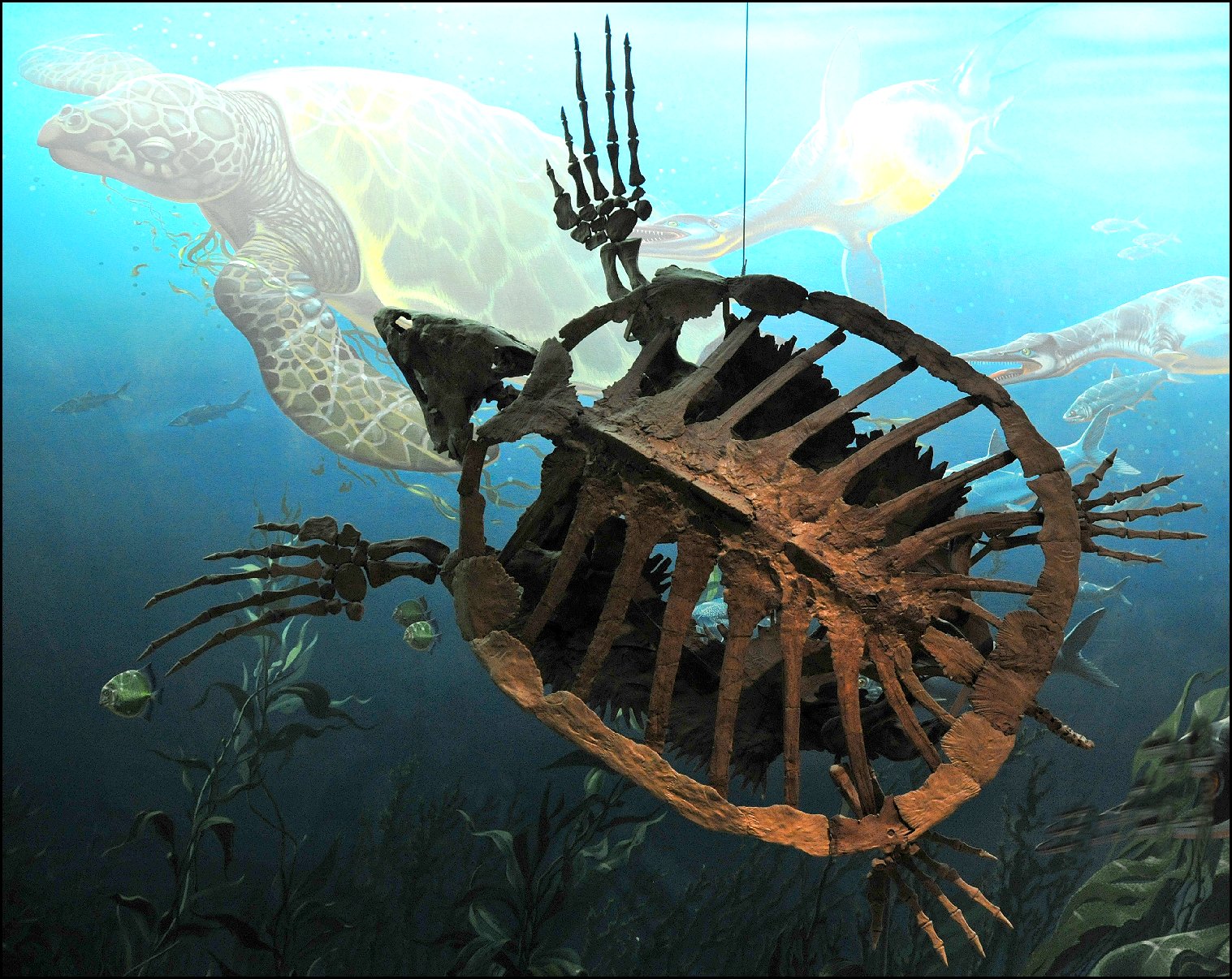
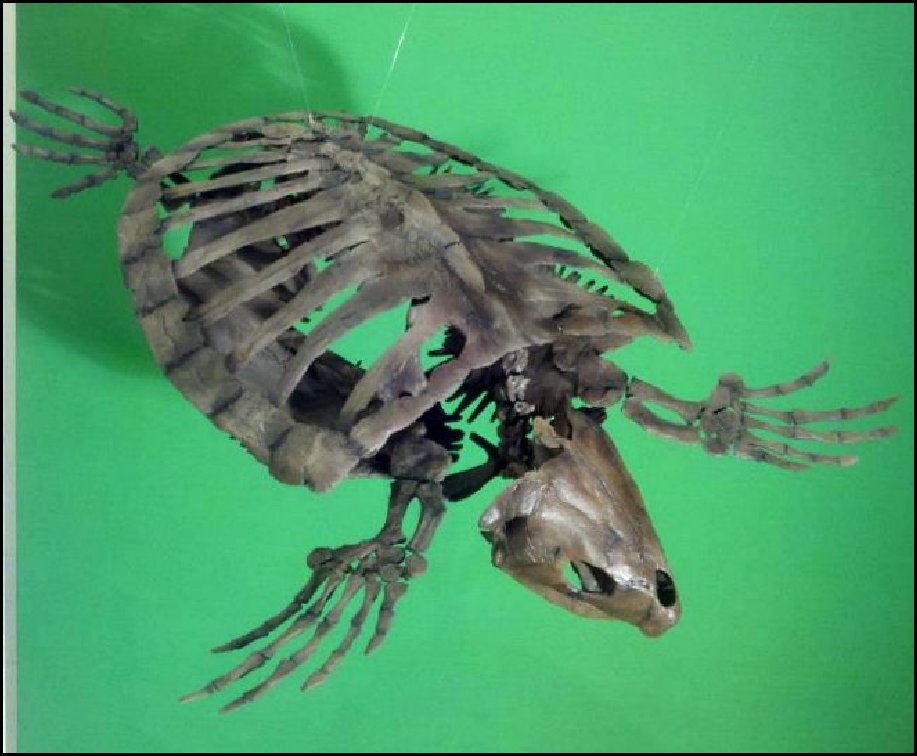
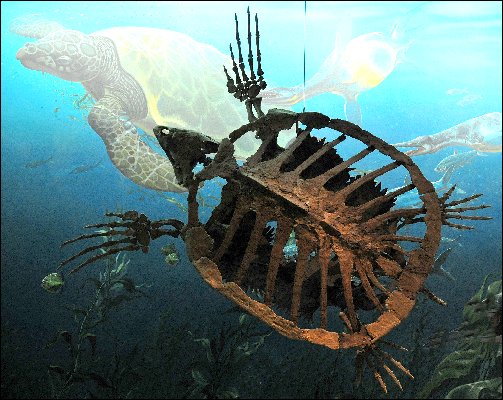
LEFT: A reconstruction of the skeleton of Protostega
gigas (USNM 11651) in the exhibit at the Smithsonian Institution, Washington, D.C. This
reconstruction is based on a specimen purchased from G.F. Sternberg. |
 |
Cope
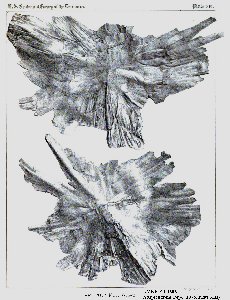
(1872, p. 433) described the discovery and recovery of the type specimen: Distribution.
This fossil was found near Ft. Wallace, W. Kansas. It was entirely
recovered by excavating. The edges of one of the large bony shields were
seen projecting from a bluff near Butte Creek, and was followed into the
chalk rock with pick-axe and shovel with the result already indicated. The
large bones were exposed in an entire condition, but were much fractured
in the attempt to lift them from their bed. Though carefully packed, the
transport of 1500 miles still further injured them, and the portions
described were reconstructed of over 800 pieces by myself. One of the bony
plates was broken into 108 pieces, the ribs into 183, the marginals into
146, etc.
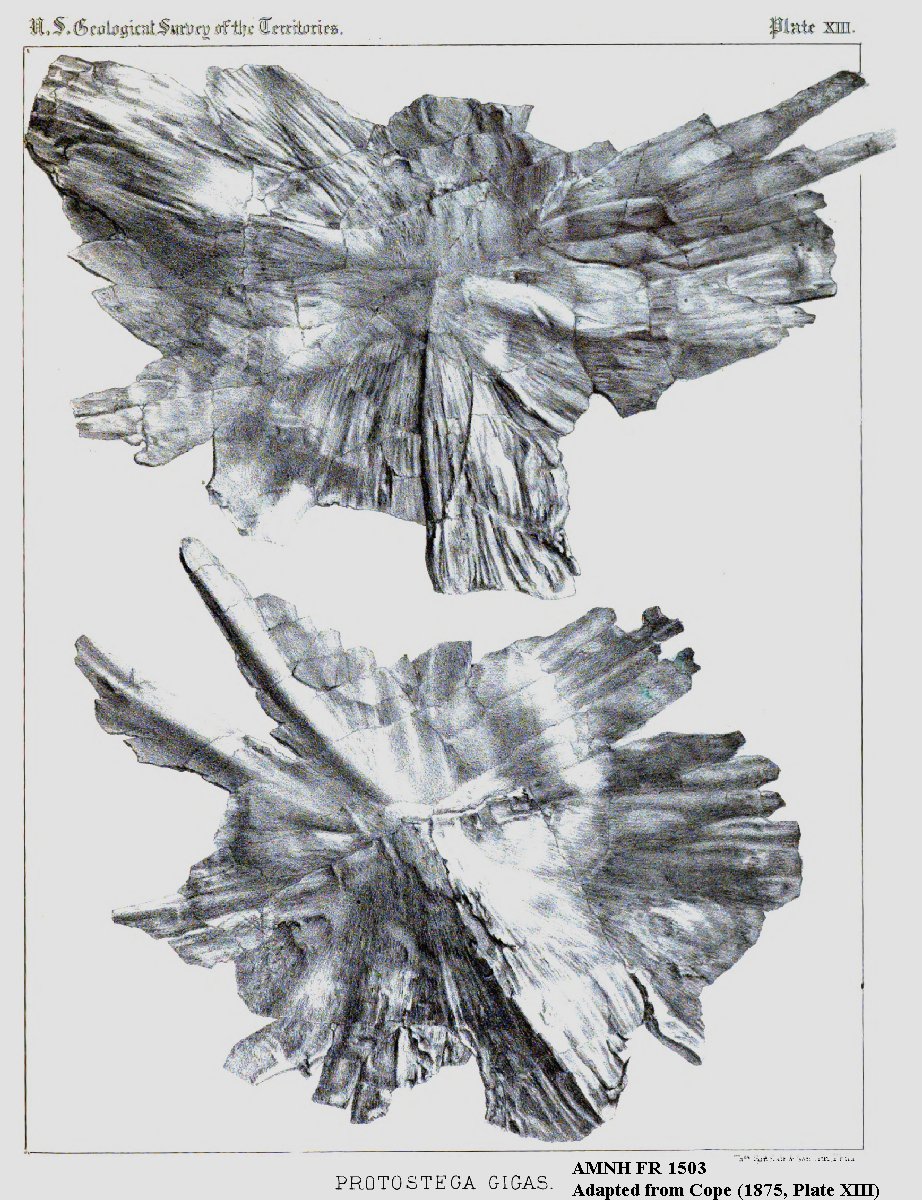
LEFT: Cope (1875, Plate
XIII) – “Two dermal bones of Protostega
gigas” - Portions of the plastron of the type specimen of Protostega
gigas (AMNH FR 1503) mis-identified by Cope as part of the carapace.
They were later correctly identified by Baur (1886) and Hay (1895). Baur (1886, p. 688) wrote: "Was
Cope für Platten des Carapace hält, gehört zum Plastron,"
which translated means: "What Cope considers as plates of
the carapace, belong to the plastron."
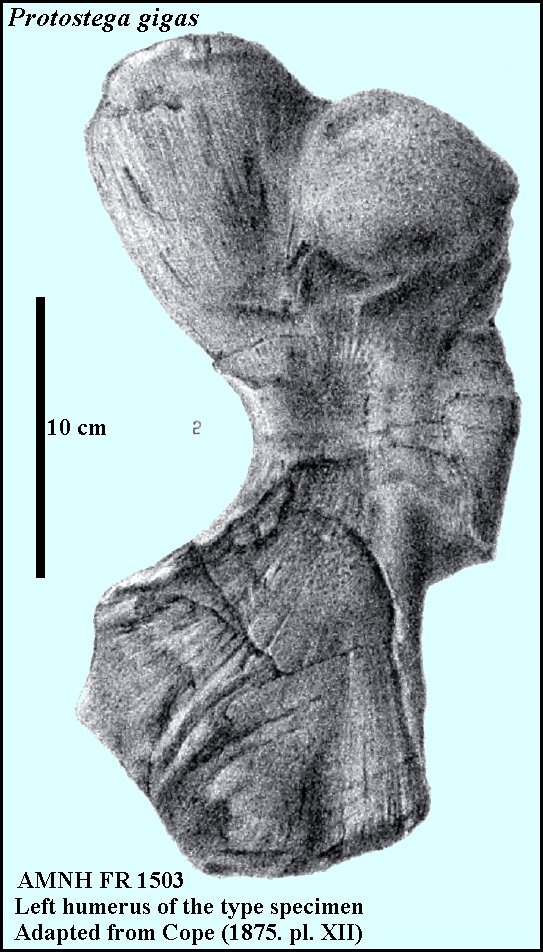
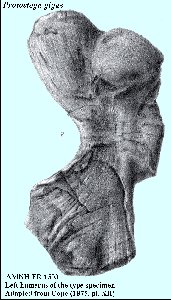
RIGHT: The left humerus of the type specimen of Protostega gigas (Cope, 1875, Plate XII). Cope (1872) noted that it was one foot (0.3 m) in
length.
Cope (1872) estimated the head to tail length of the animal at 12.8
feet; Hay (1895) disagreed with Cope's assumptions, but arrived at the
same overall length:-3.9 m |
 |
Hay (1908, p. 191) wrote: "The specimen of this species which
Cope originally described was found by him in 1871, in Niobrara deposits,
near Butte Creek, south of Wallace, Kansas. This is now in the American Museum
of Natural History and has the number 1503. At the time of its discovery the bones were much
distorted and comprest [sic]; and most of them were much fractured in collecting them. Cope states that the portions described by him were reconstructed out of
over 800 pieces. One of the large bony plates, described as overlying the ribs,
had been broken into 108 pieces. Most of the bones are yet in the condition in
which Cope left them; the large plates are, to a great extent, again broken up.
As
stated by Cope, the remains preserved include many parts of the skull; 5 vertebræ, more or less incomplete; the scapular arches of both sides, with the
coracoids; both humeri perfect, and some phalanges; 10 ribs; 1 doubtful neural
bone; 10 peripherals; parts of 4 large plates, described as overlying the ribs;
and some undetermined bones.
From
his study of his materials Cope arrived at the conclusion that Protostegawas a large marine-turtle closely allied to Dermochelys,
and had a total length of about 12 feet. The first author who added to the
knowledge of the species was Dr. George Baur, who (Zool. Anzeiger, IX, 1886, p.
688), regarding the genus as Atlantochelys, stated that the plates assigned by Cope to the dorsal
region were really portions of the plastron. This determination was undoubtedly
made from the bones collected by Cope. Hay, as cited, gave, in 1897, a
description, with figures, of the hyoplastra and hypoplastra of a specimen that
had been collected for him near Butte Creek, Kansas. Case (1897, as cited) described portions of the skull and a more complete plastron than had previously been secured, materials
now in the University
of Kansas; and made correction of Hay's restoration of the xiphiplastra. More recently
Wieland has described excellent materials which belong to the Carnegie
Museum, at Pittsburg."
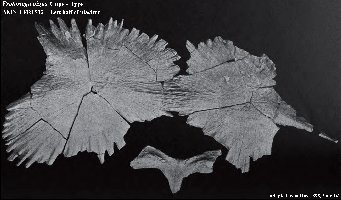 |
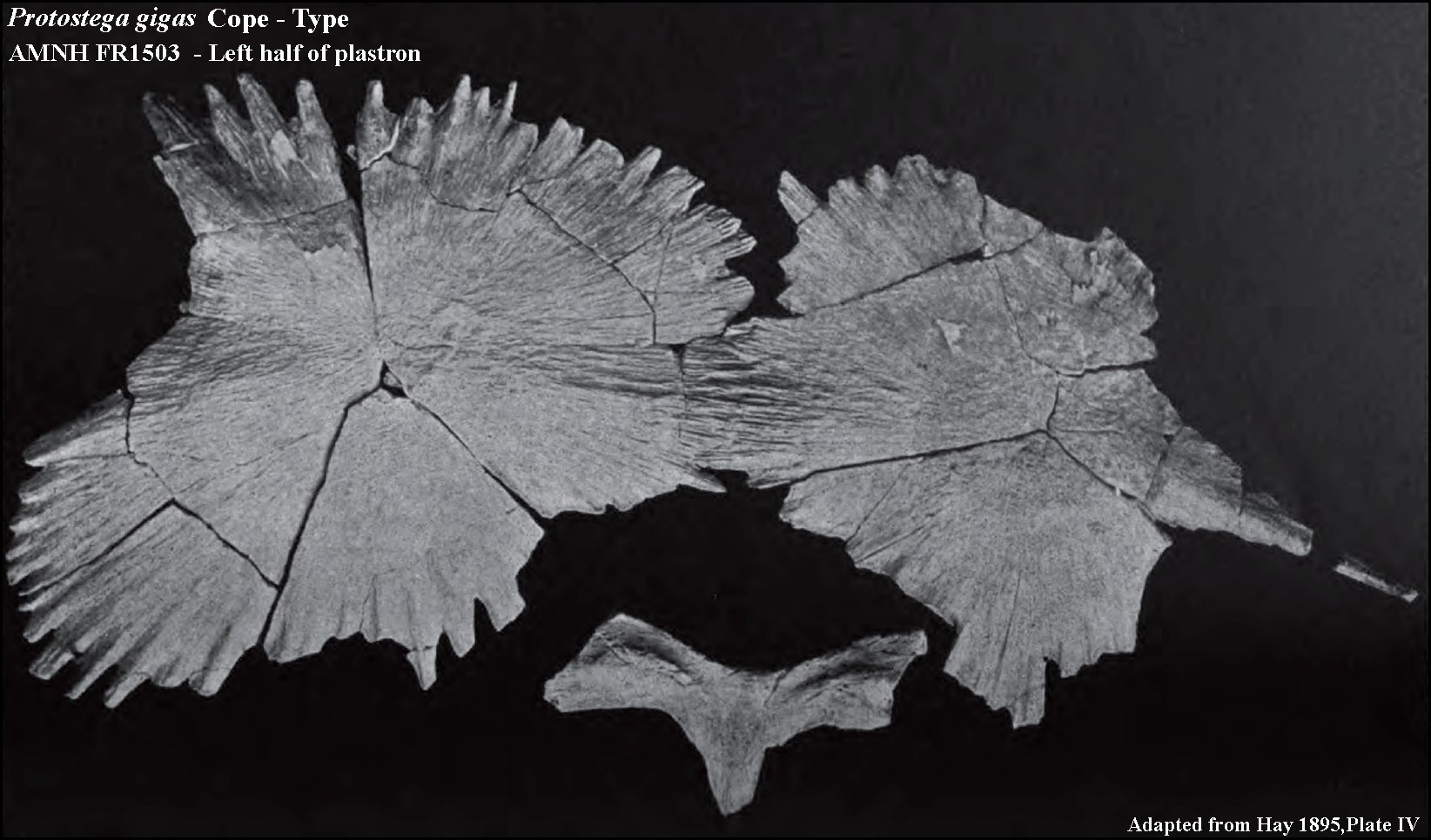
LEFT: The left plastron from the type specimen of Protostega
gigas Cope 1872 as published on Plate IV by Hay, 1895. It measures 1.2 m (almost 4 ft)
from left to right and came from a turtle that measured about 3.0 m (10 ft) long (from
nose the end of the tail). The specimen is curated in the American Museum of Natural History as
FR 1503. (Anterior to the left). "This plate represents the hyoplastron
and hypoplastron of the left side of Protostega gigas seen from below. A view is
also given of the nuchal bone." (Hay, 1895). Hay stated that the
combined length of the hyoplastron and hypoplastron (at left) was 1.2 m (4
ft)
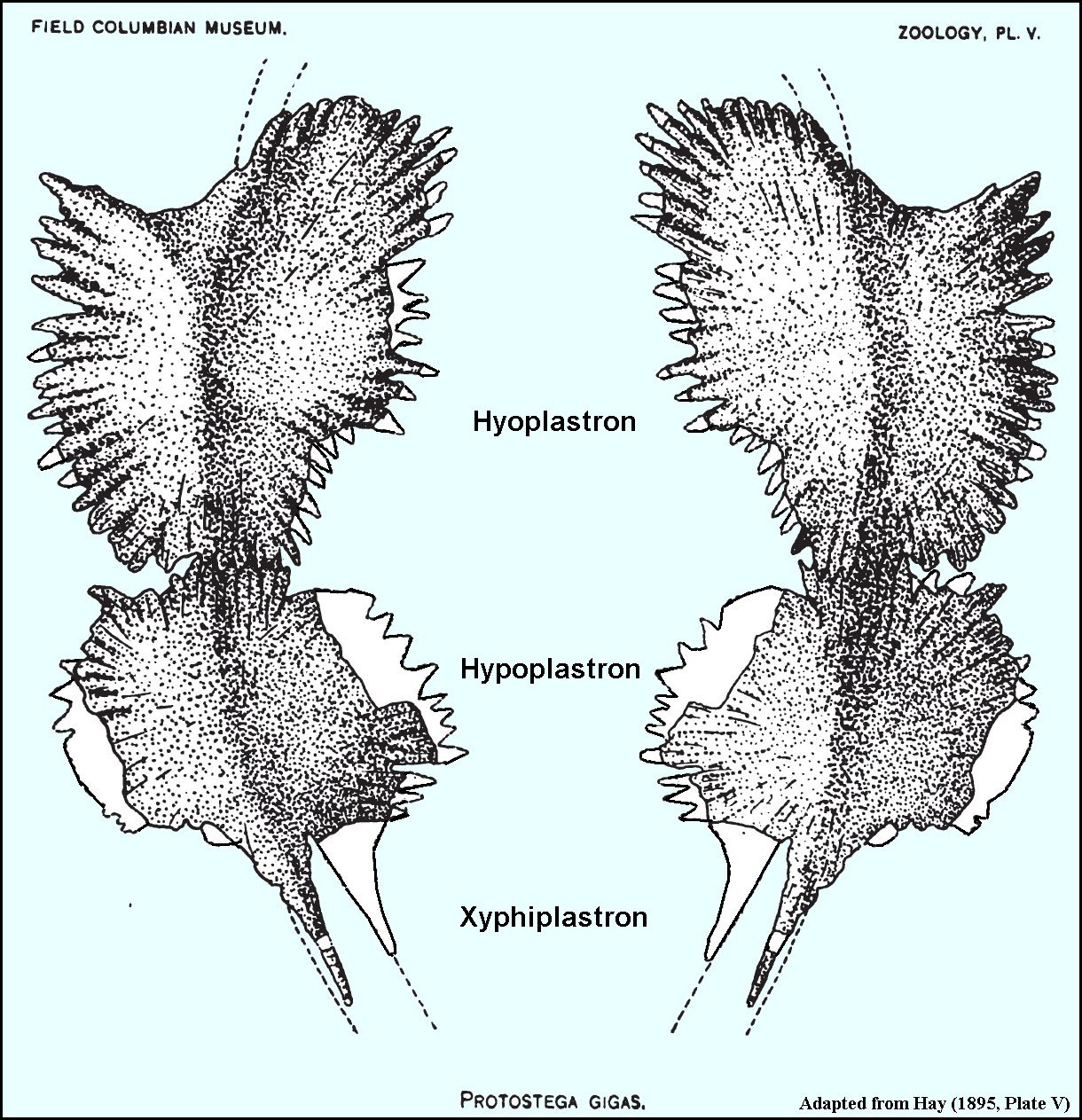
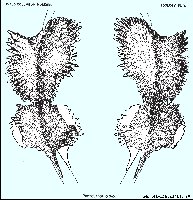
RIGHT: Plate V from Hay 1895: “A
partial restoration of the plastron of Protostega,
to show the relative positions of the bones and the size of the fontanelle.
Only the bases of the epiplastra and of the xiphiplastra are shown.” |
 |
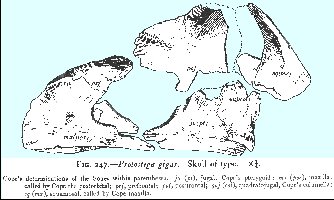 |
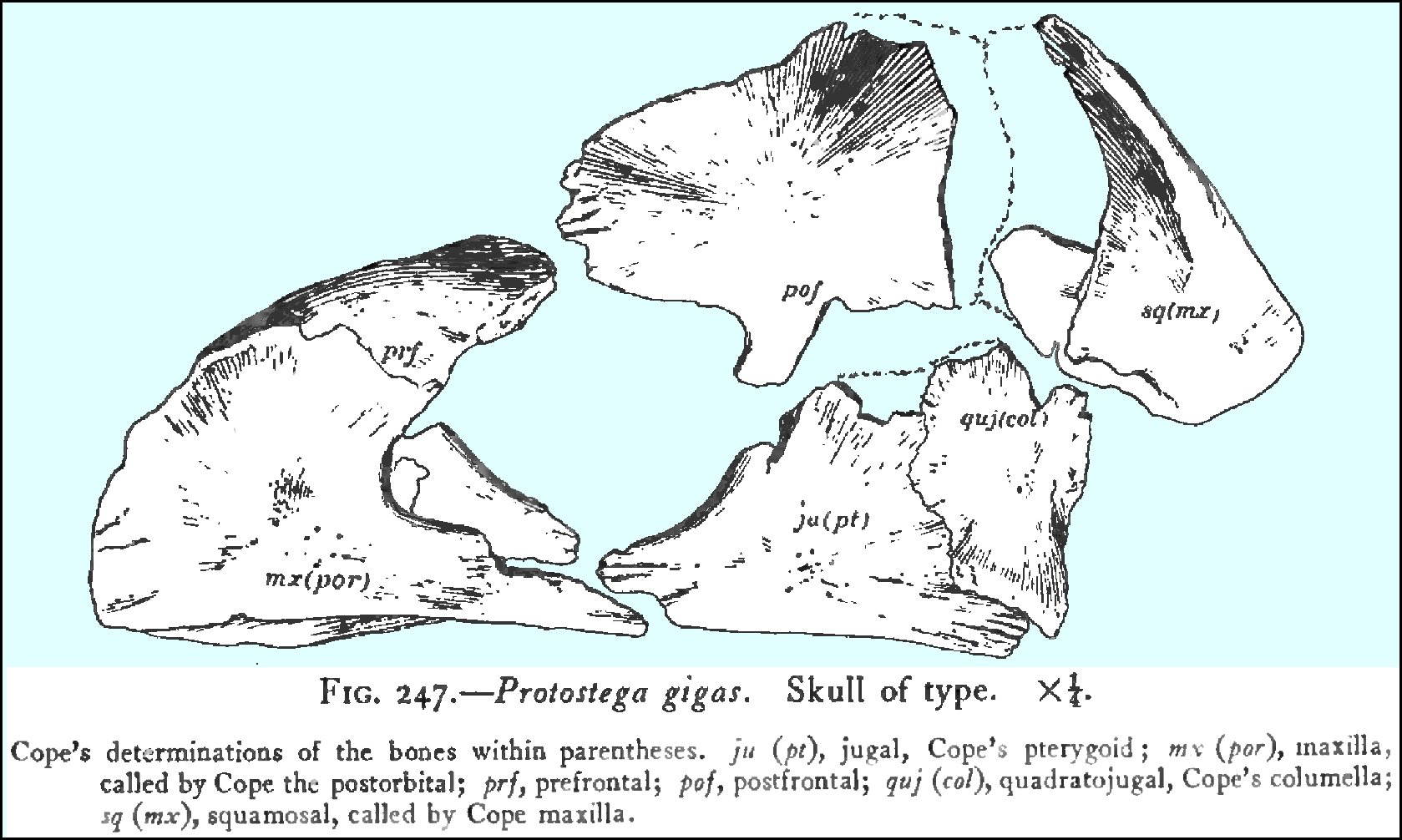
LEFT: The skull of the type specimen of Protostega
gigas (AMNH 1503) in left lateral view from Hay, 1908, fig. 247. Hay
(1908) noted that : "Cope
had considerable portions of the skull and most of these he figured. The
writer has studied these bones and has found that in most cases Cope's
determinations were incorrect. Baur had also examined these cranial bones
and accepted Cope's determinations (American Naturalist, xxiv, 1890, p.
532). Fig.
247 represents these bones, each having its name indicated. Cope's
determinations are indicated in parentheses."
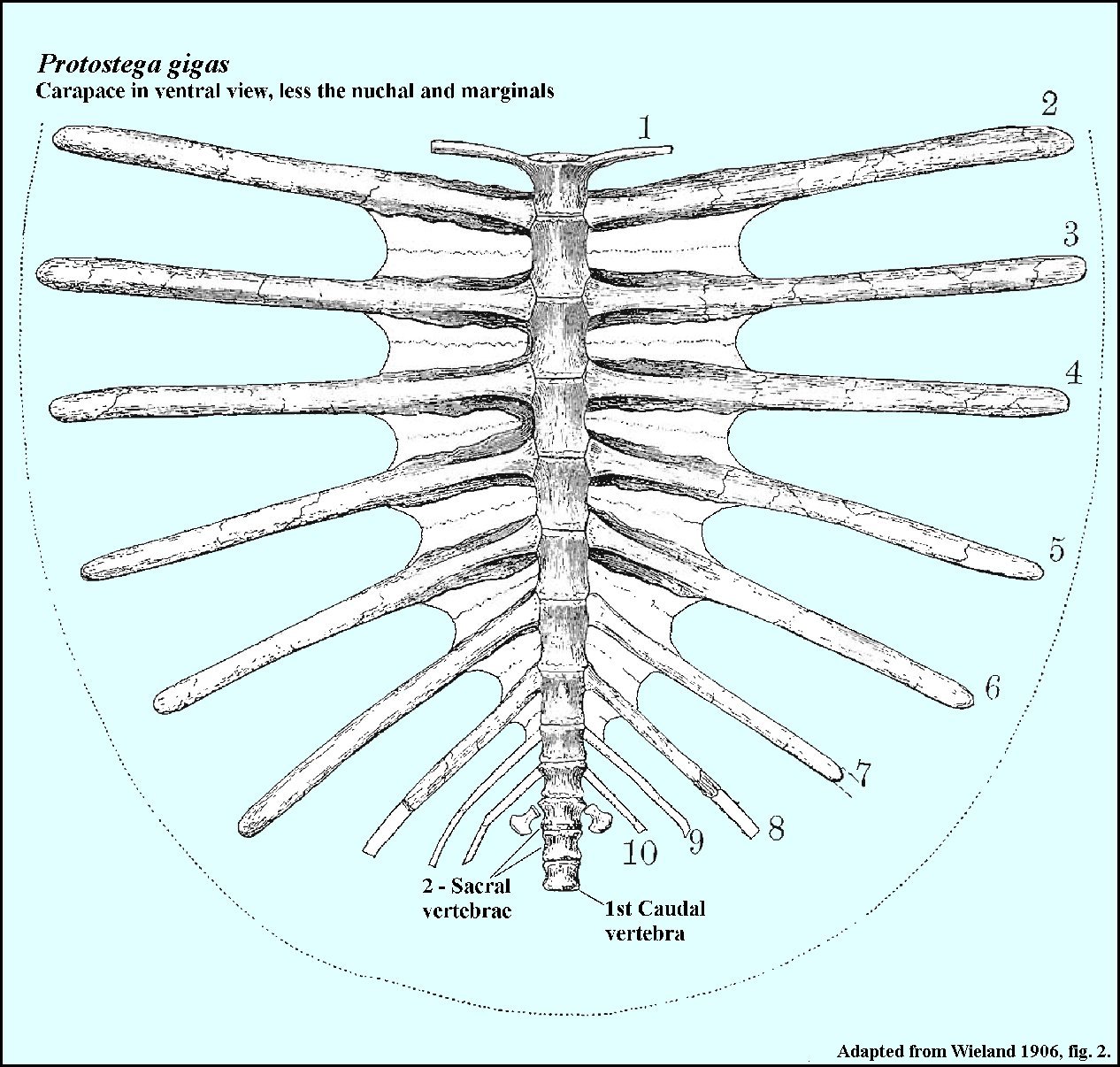
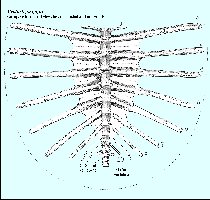
RIGHT: The carapace of CMNH 1421 in ventral view from Wieland (1906, fig. 2),
showing the dorsal vertebrae and the very limited extent of the costal
plates (less than 1/3 the length of the ribs). |
 |
 |
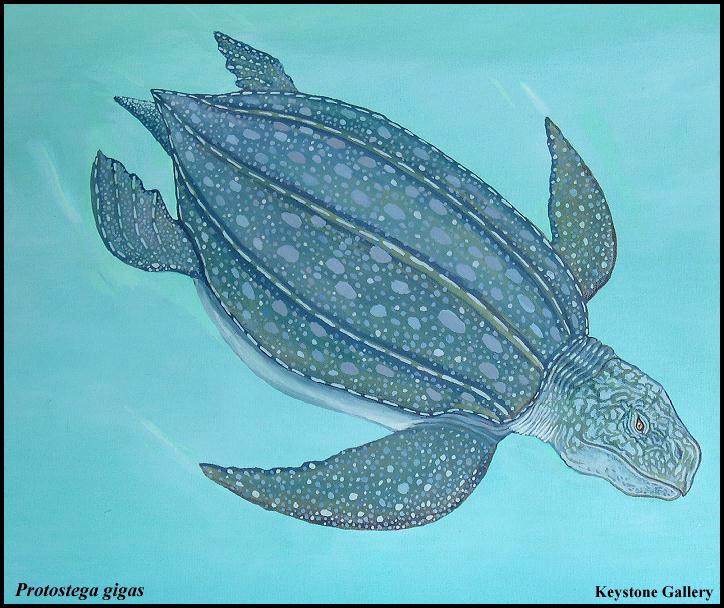
LEFT: Protostega gigas - a detail from a mural
painted by Charles Bonner in the Keystone Gallery (© Charles Bonner, Keystone
Gallery)
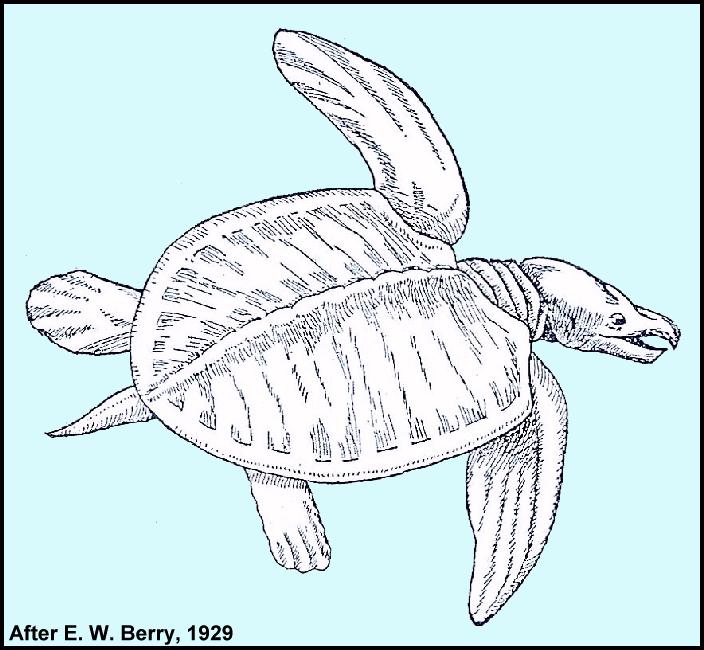
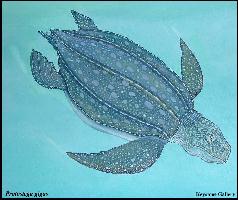
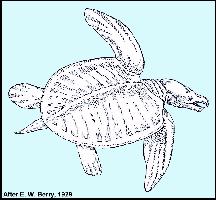
RIGHT: Archelon ischyros (adapted from Berry, 1929). Of the two, only Protostega is found in the chalk and generally only in the upper chalk. Somewhat like modern leather
back sea turtles in overall appearance, they still retain a portion of their original bony
shell. The Protostegids may have migrated in and out of the Western Interior Sea.
Fossilized remains are relatively rare, but nearly complete skeletons from the Kansas
chalk are found in many museums. |
 |
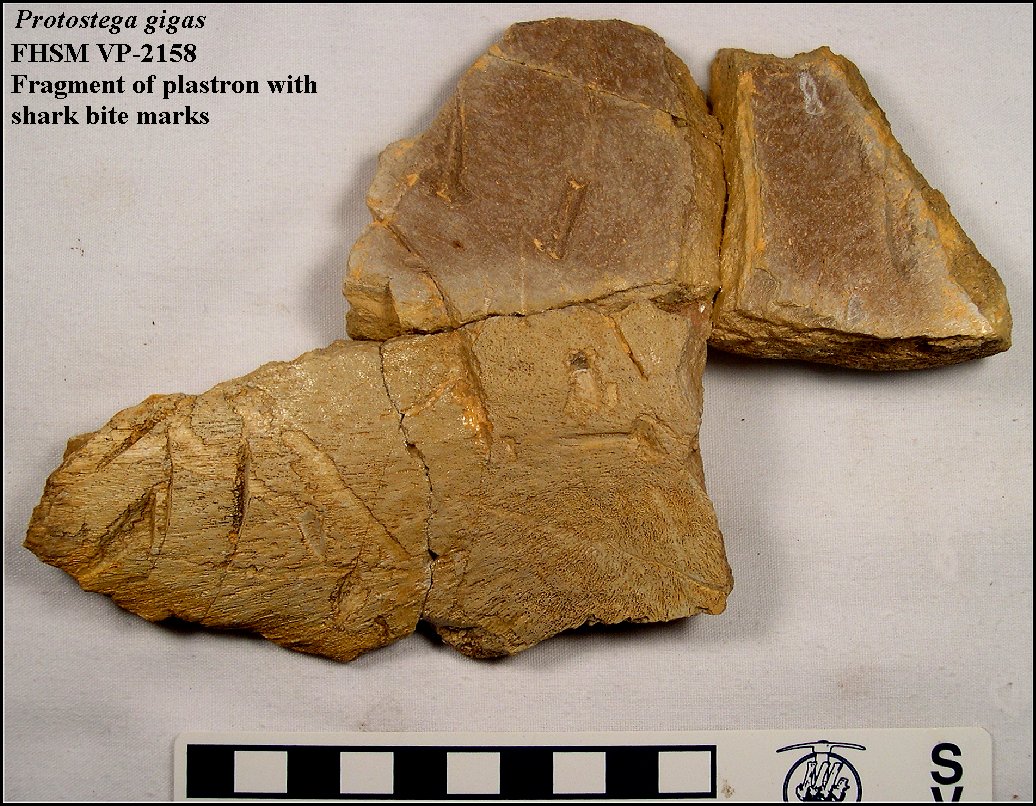
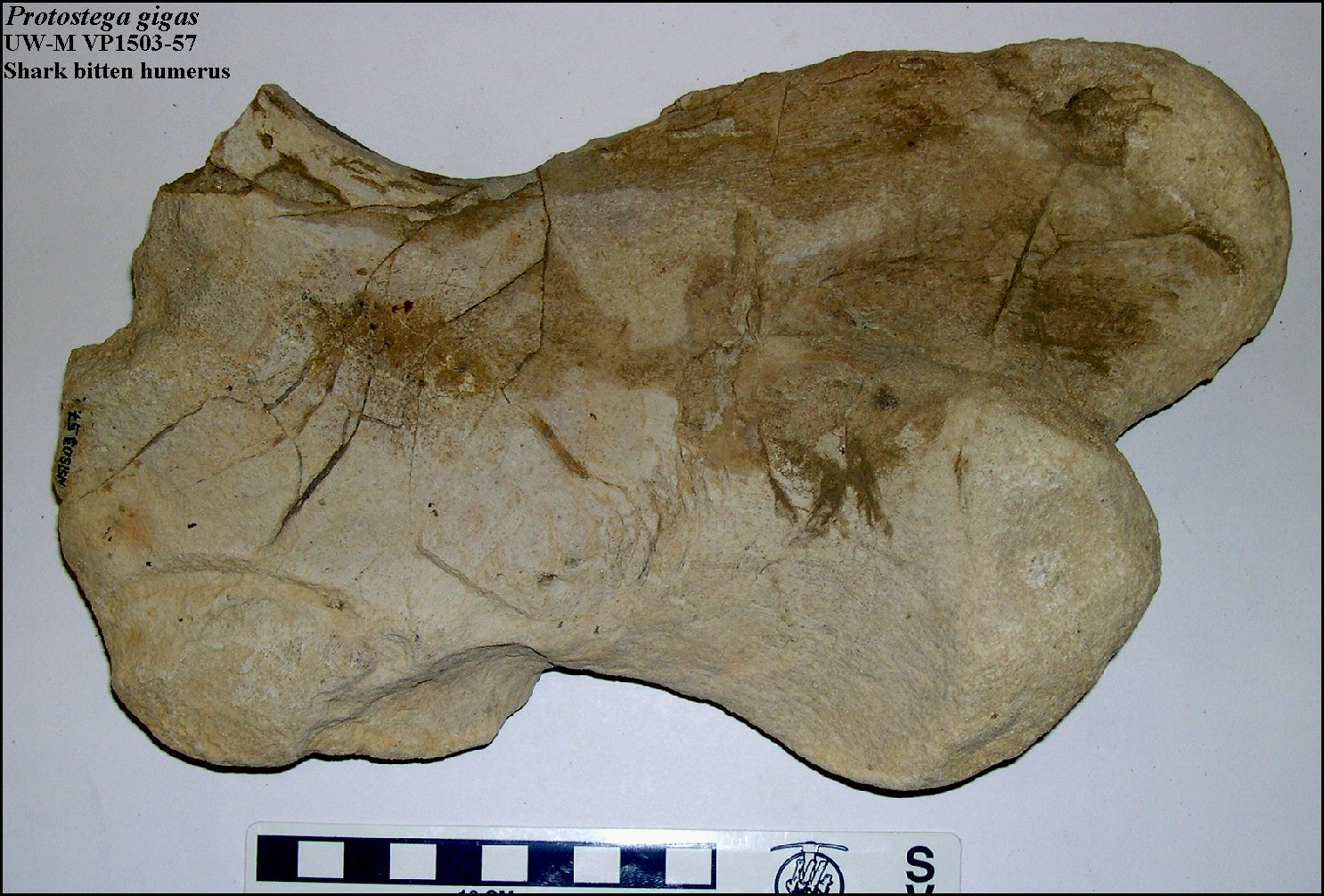
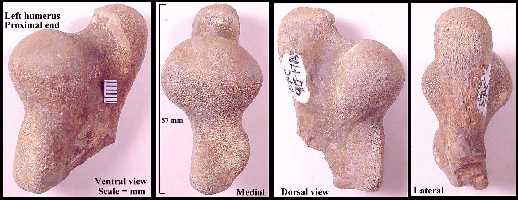 |
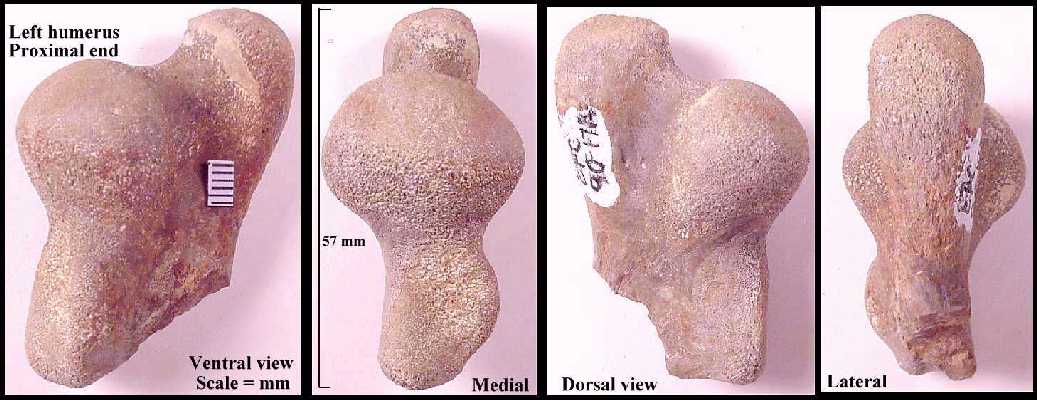
LEFT: Four views of the upper (proximal) end of a small
protostegid humerus, probably severed and partially digested by a large shark, found in
the Late Coniacian chalk of Gove County by Pam Everhart in 1990. This may be an unusually
early occurrence of this genus. (FHSM VP-17557)
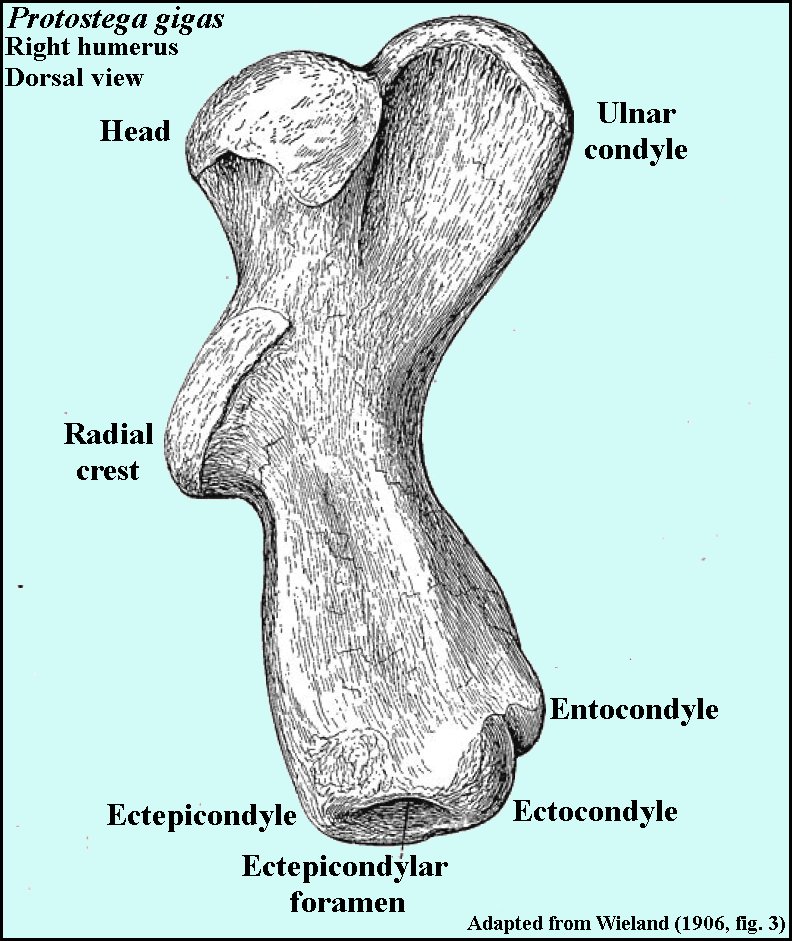
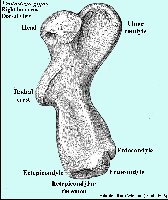
RIGHT: Figure 3 from Wieland (1906) showing the right humerus
of Protostega gigas (CMNH 1421) in dorsal view. The bone is 34 cm
(13.4 in) long. |
 |
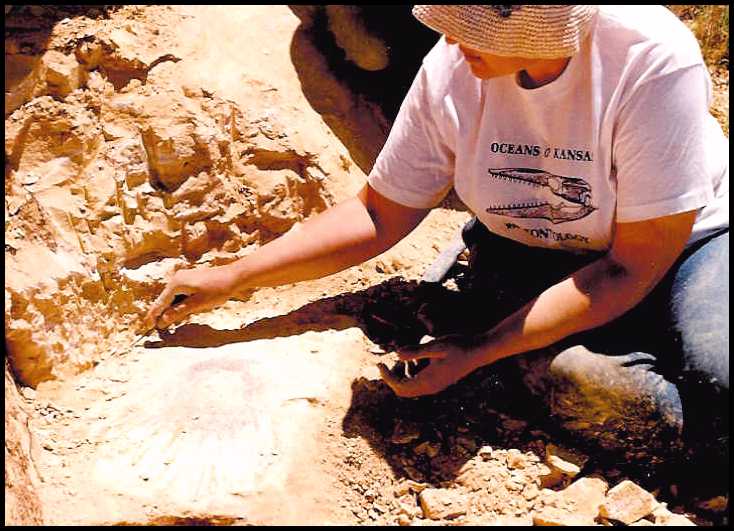
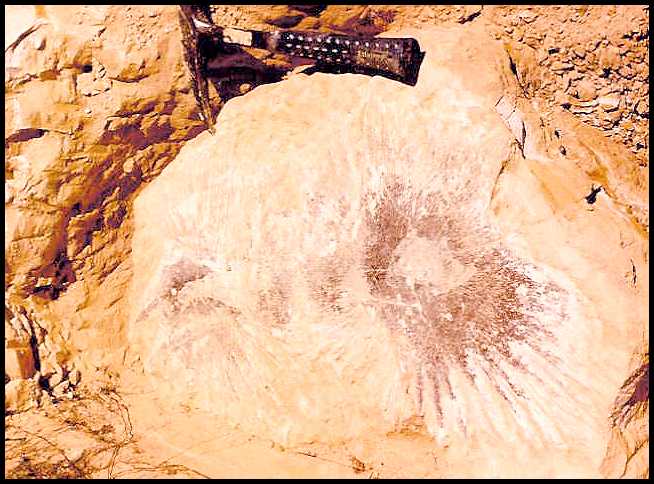
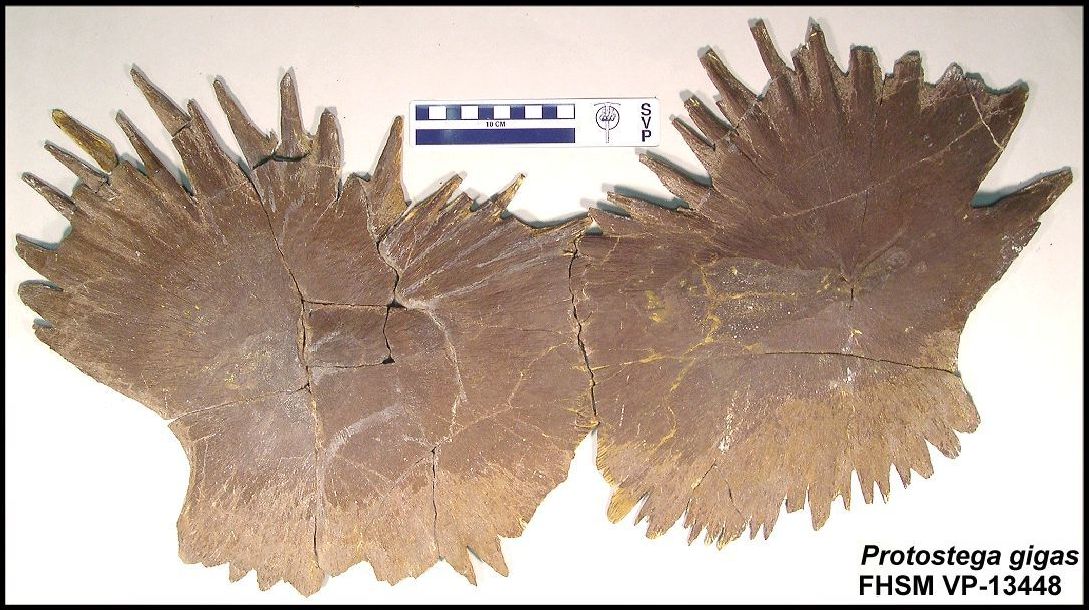
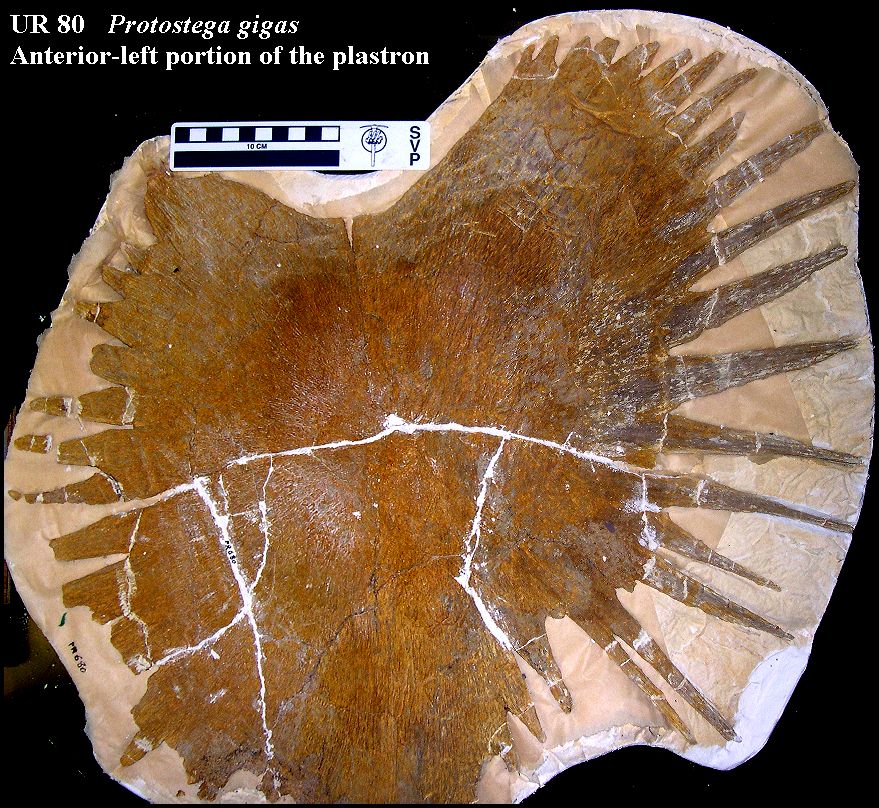
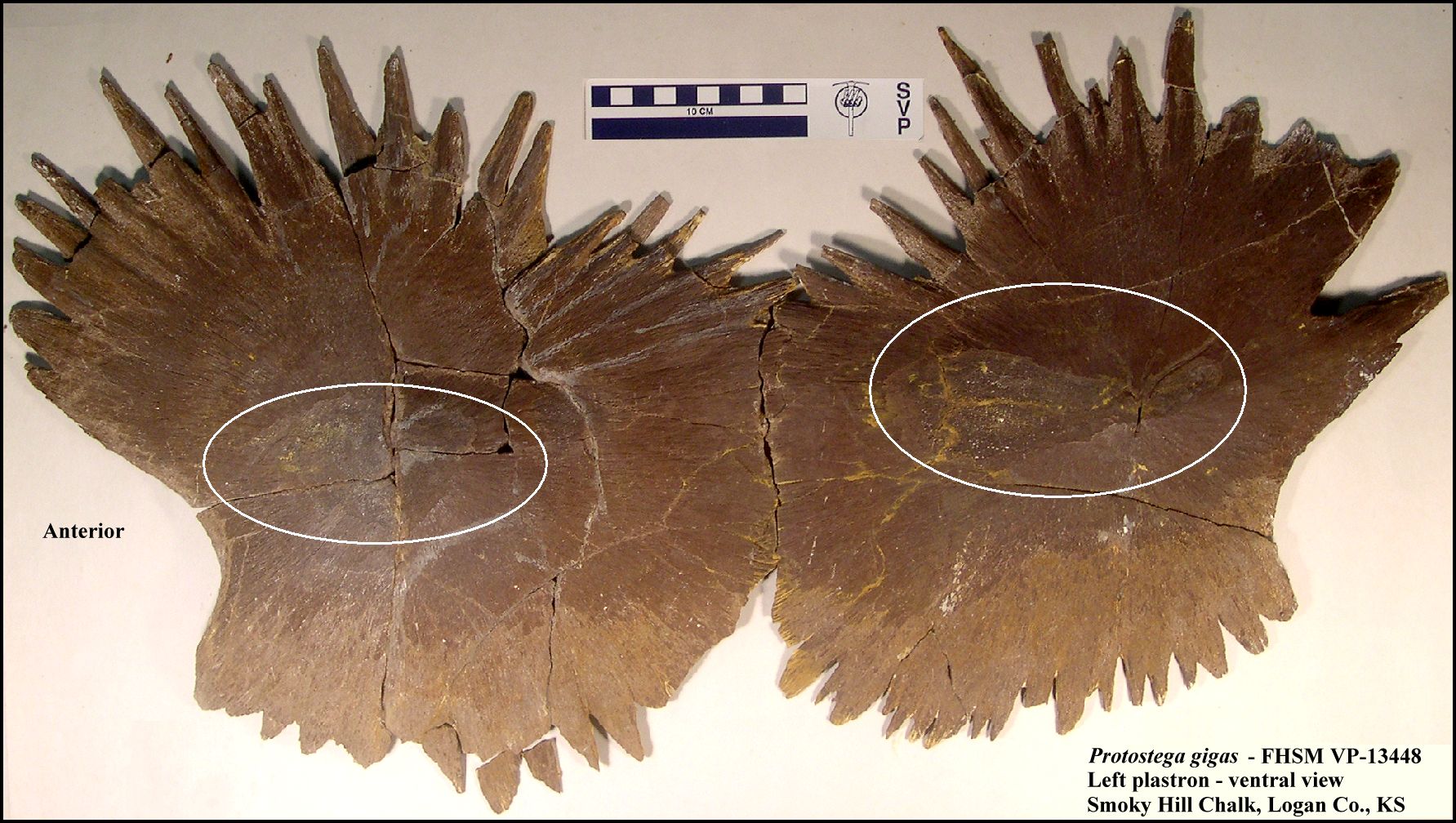
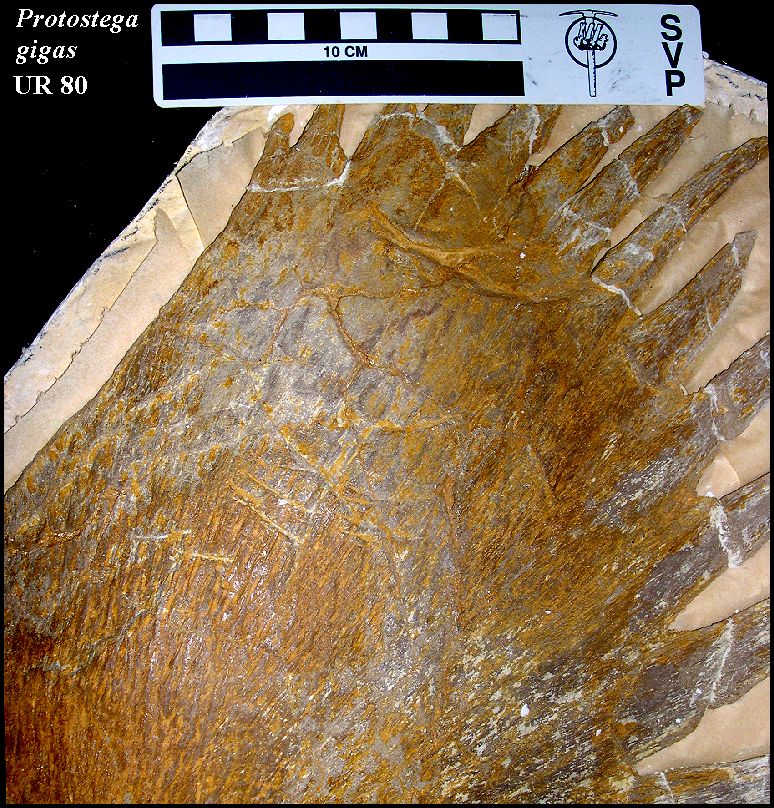
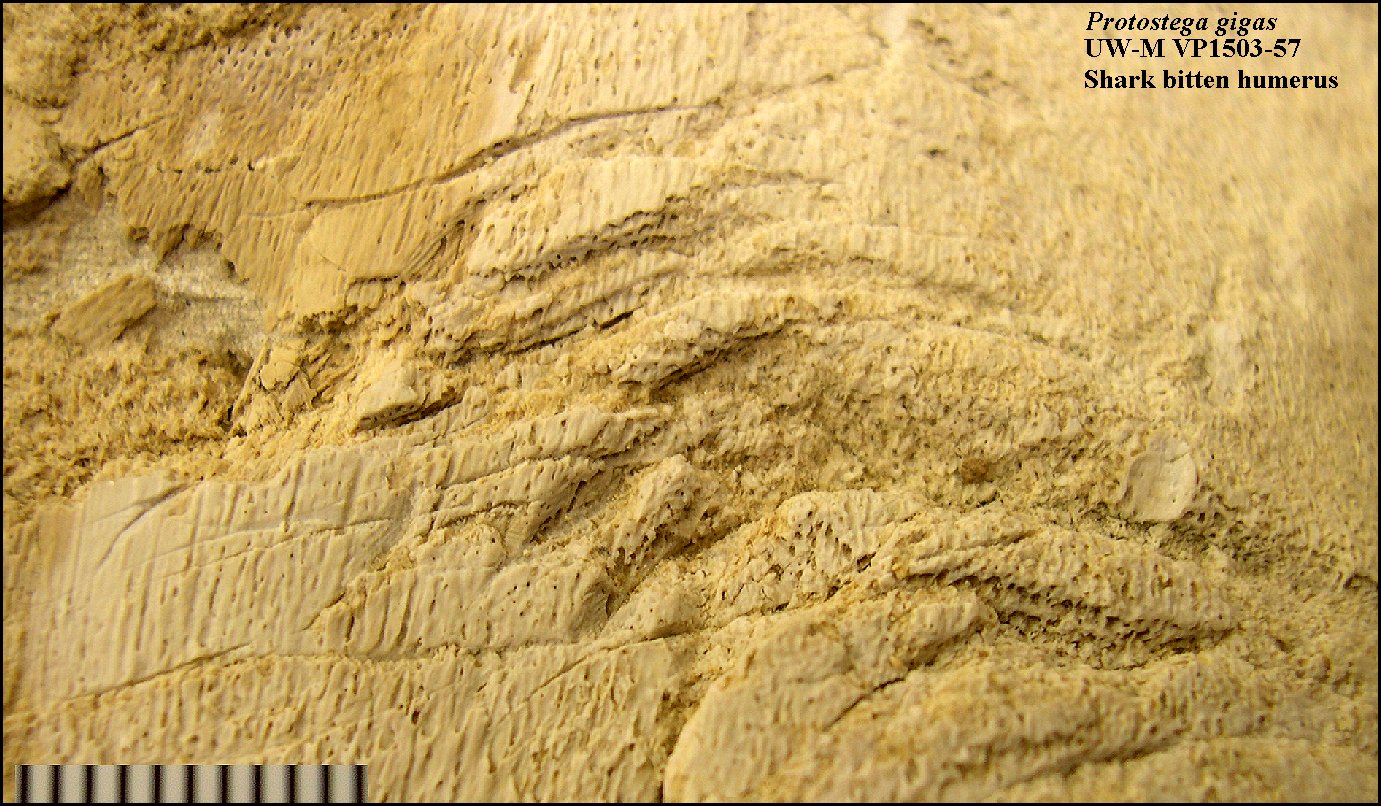
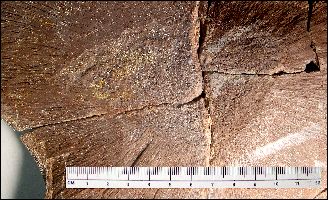
| BELOW: Left: Pam Everhart works on the partial remains of a Protostega
gigas that she discovered in July, 1994 in Logan County, Kansas. Center - Most of the
left half of the turtle's plastron (lower shell) is exposed here in dorsal view.
Right: Removed from the chalk, the 'spiky' look of the plastron (ventral view) is very
apparent. We donated this specimen to the Sternberg Museum in 1997 where it is
curated as FHSM VP-13448 (Our EPC 1994-42). About 30 inches in maximum length,
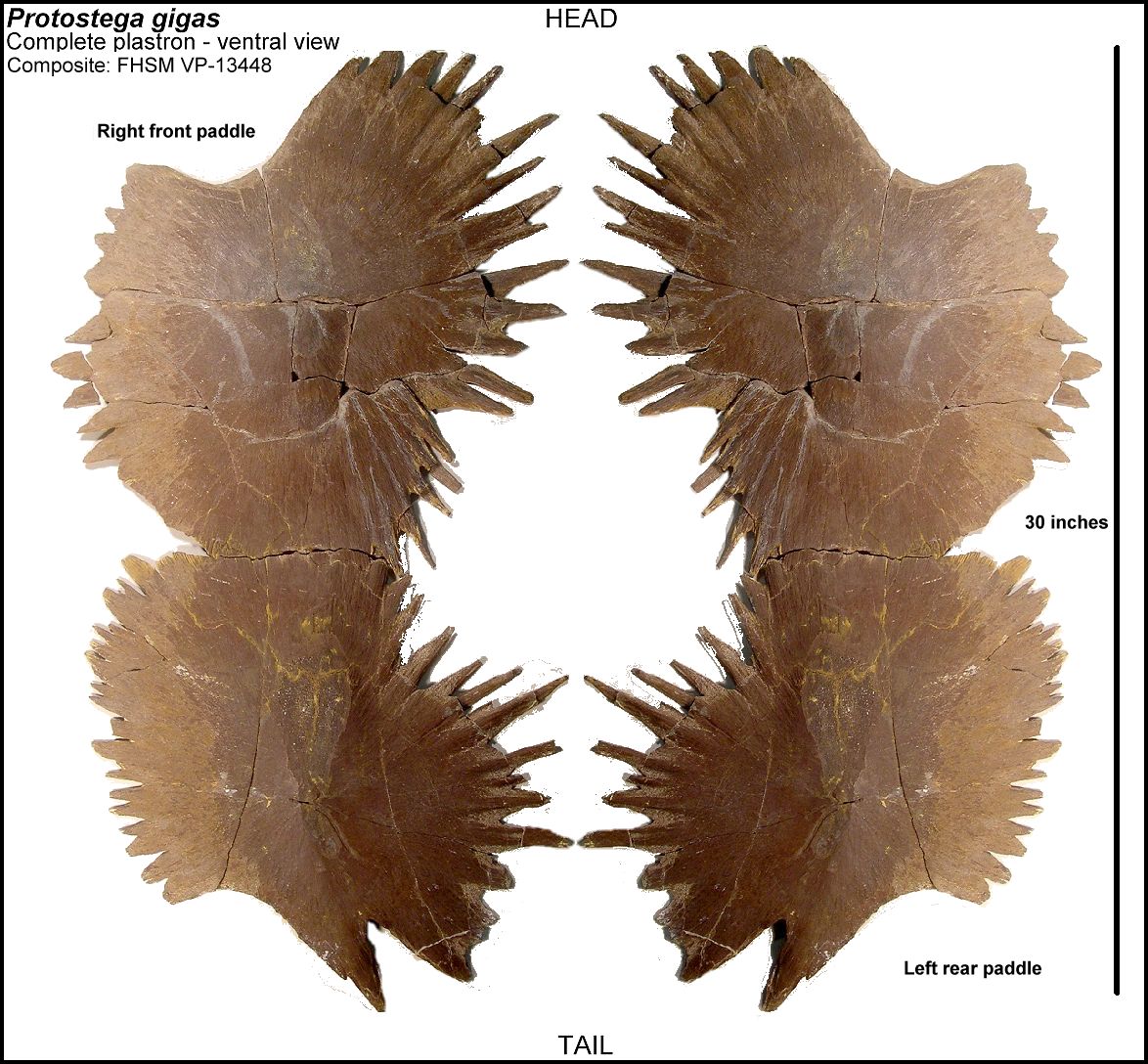
anterior to the left. See a photo of a composite Protostega plastron here. |
 |
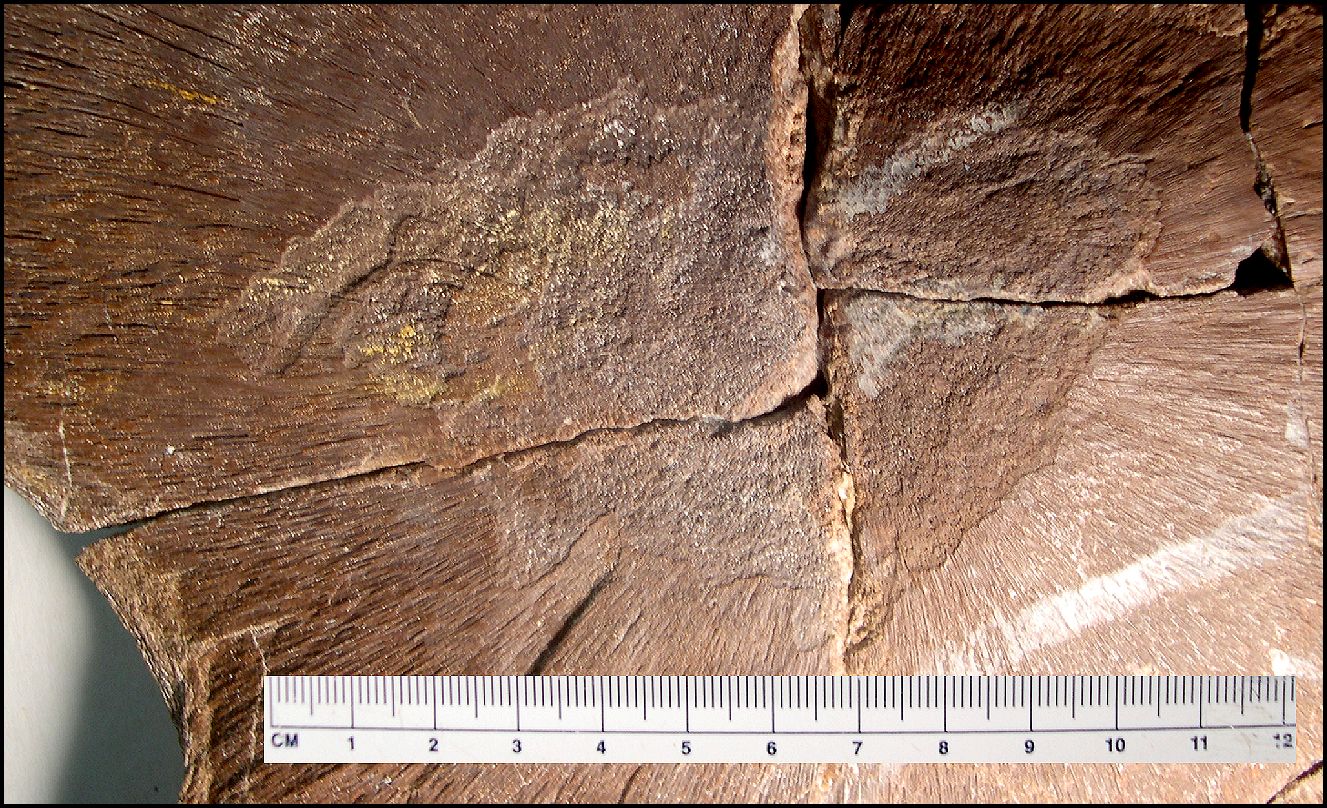
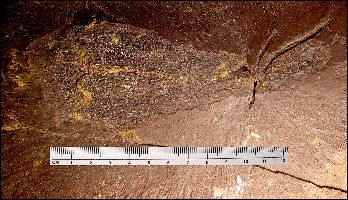
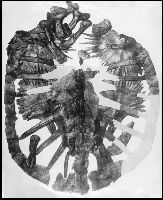
LEFT and RIGHT: Close up views of damaged areas that are
visible on the anterior and posterior lobes of this plastron (More recent photo here) in ventral view. These
appear to abrasions that might have resulted as a large, heavy female turtle dragged
herself across a sand beach to lay her eggs. (added October 28, 2006) |
 |
 |
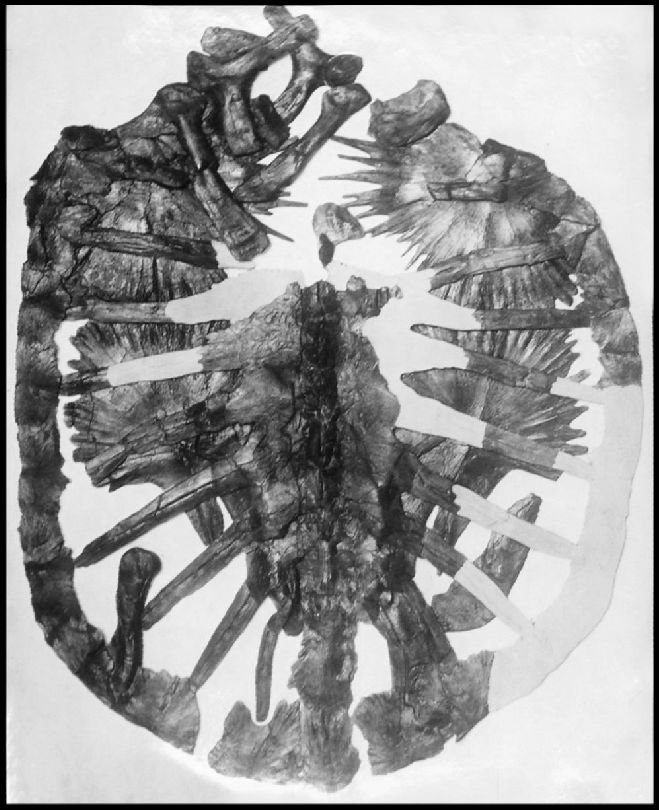
LEFT: The partial carapace and plastron on a large Protostega
gigas collected and prepared by George F. Sternberg (4886-A) and later acquired by
the United States National Museum (Smithsonian). Sternberg noted that the specimen
was found without limbs or skull. It is likely that this specimen served as the basis for
the reconstruction above.
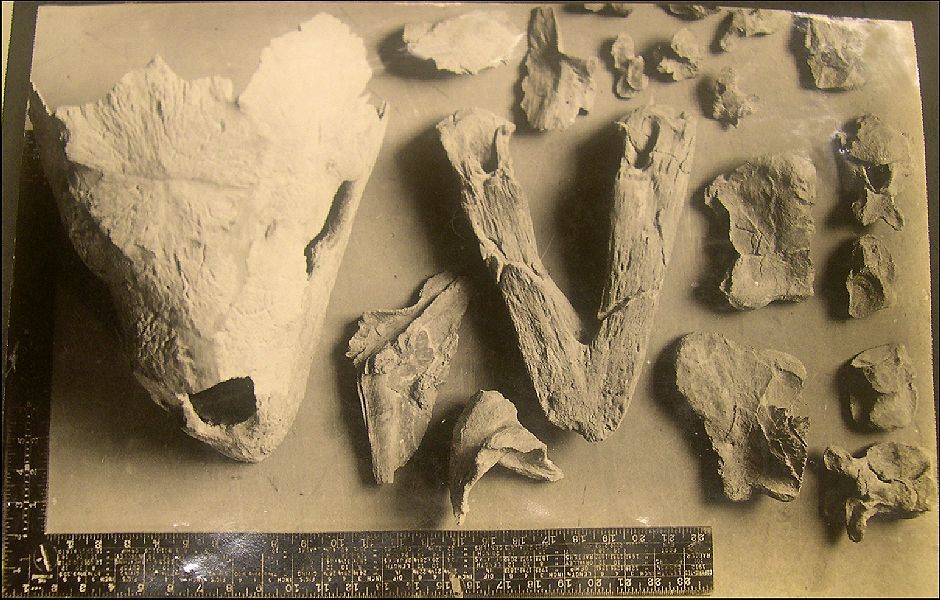
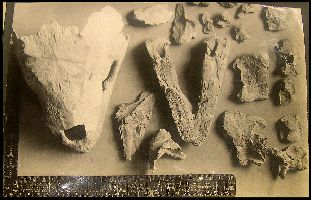
RIGHT: The skull, lower jaw and other
fragments from another Protostega specimen that was collected by George Sternberg
in the 1920s and sent to the University of Nebraska State Museum. It is probably the same
specimen as shown below. Both photos from Sternberg archives, Forsyth Library, Fort Hays
State University. |
 |
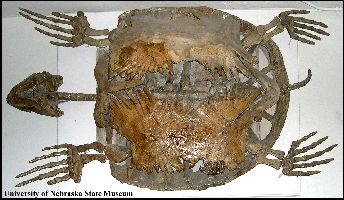 |
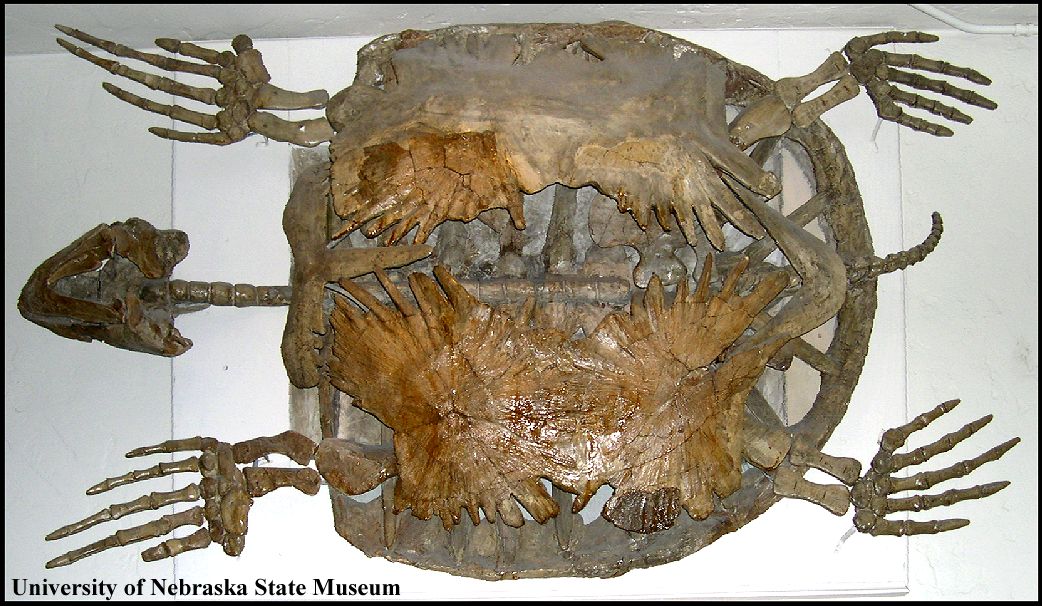
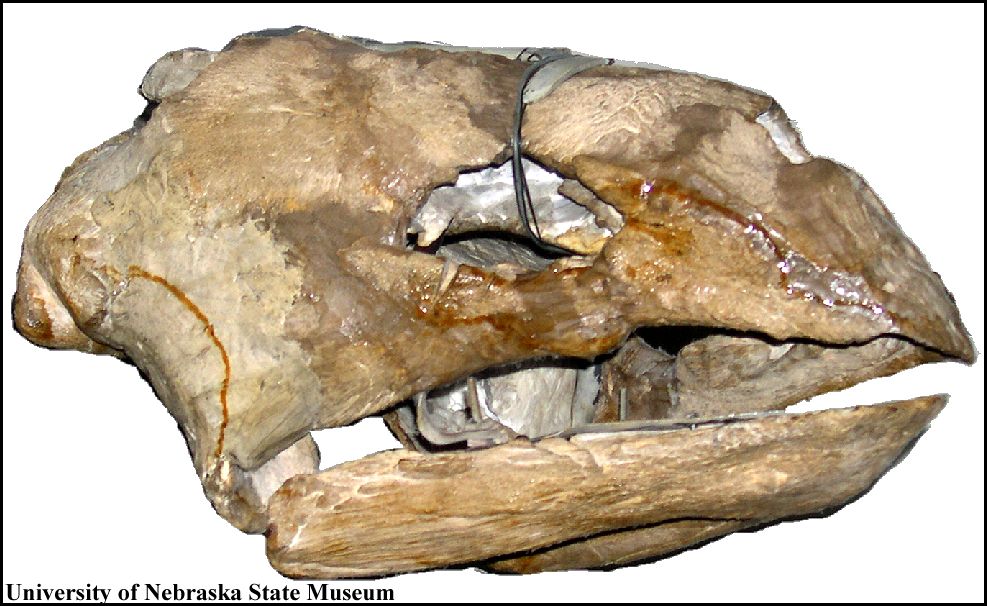
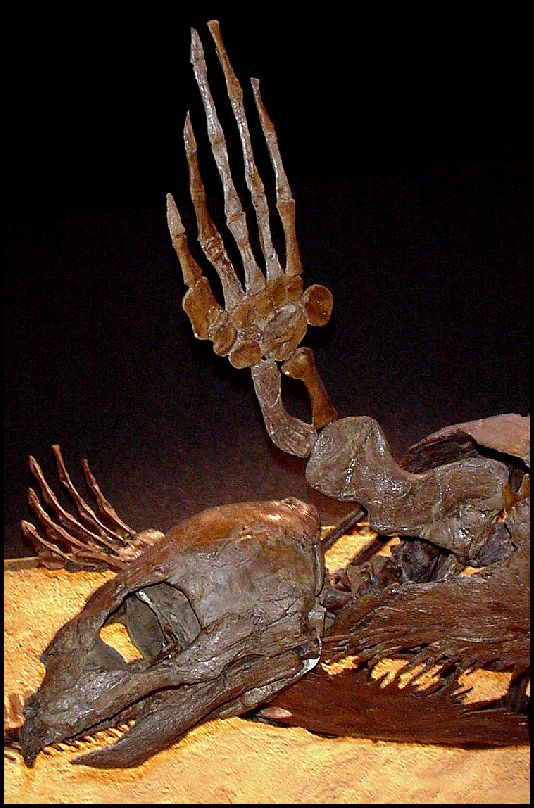
LEFT: A wall-mounted reconstruction of the partial remains of a Protostega gigas turtle in ventral view at the University of Nebraska State Museum.
Collected by George F. Sternberg (GFS 103-31)
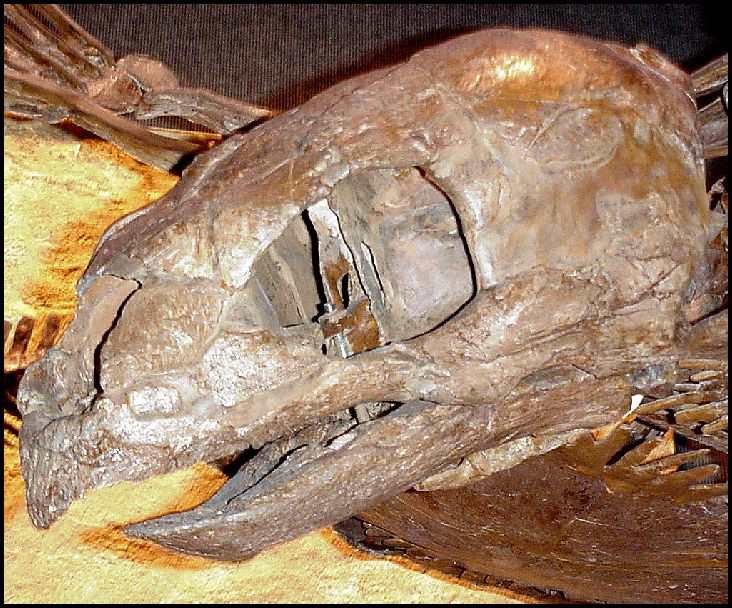
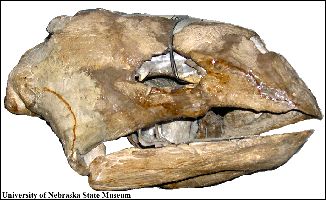
RIGHT: The skull of the turtle shown
at left in right lateral view. Note that Protostega lacks the large bony
extension of the beak (premaxilla) found in Archelon. |
 |
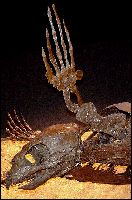 |
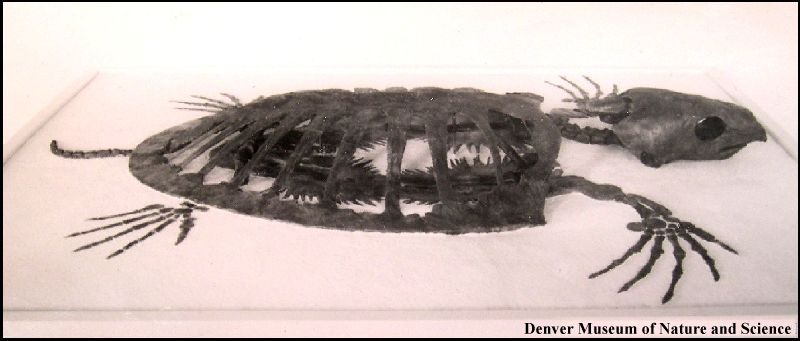
LEFT: The exhibit specimen of Protostega gigas in the
Denver Museum of Nature and Science. This specimen was collected by George F. Sternberg in
late 1945 (GFS 10145) from Logan County.
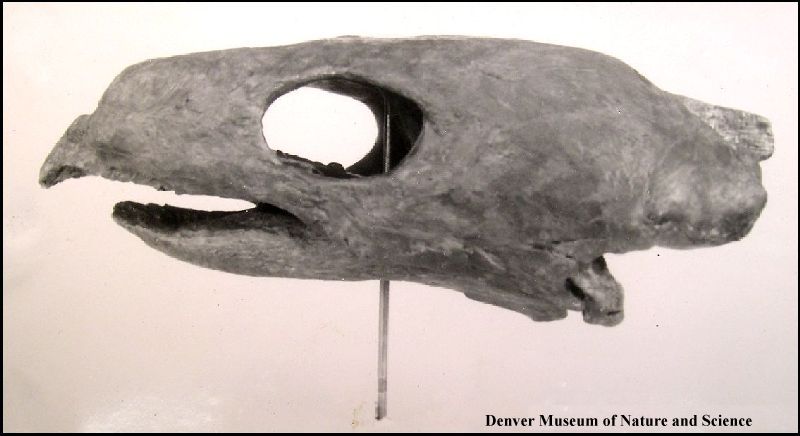
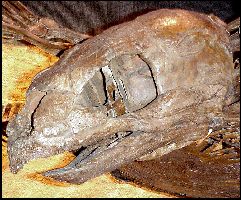
RIGHT: Left lateral view of the skull of the exhibit
specimen in the Denver Museum of Science and Nature. Click
here for an original photo of the skull. |
 |
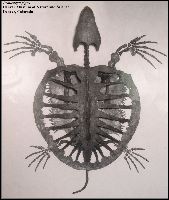 |
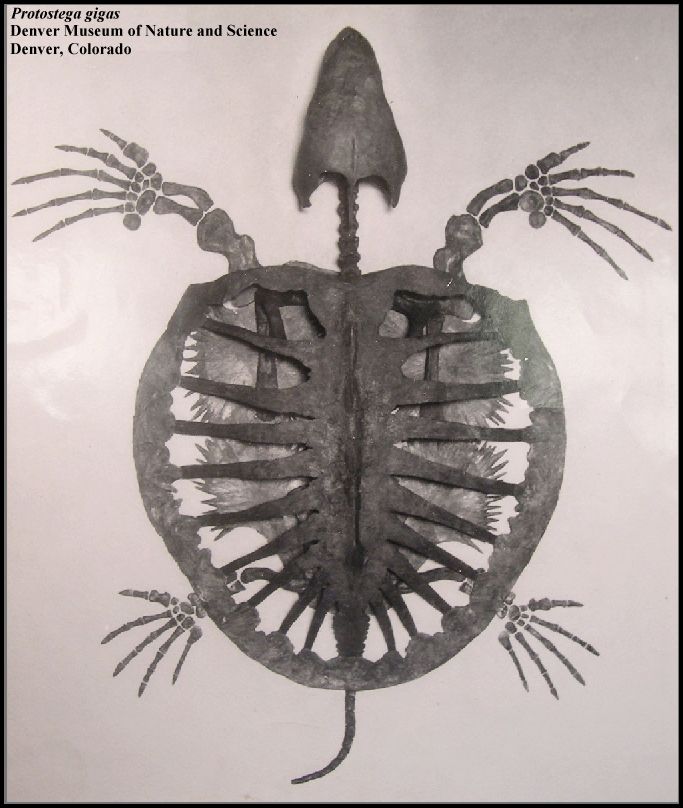
LEFT: Photograph (circa 1945) by George F. Sternberg of the above
Denver Museum Protostega gigas in dorsal view. As described by Sternberg, this
was probably a juvenile turtle with a shell that is about 3'8" wide... and a length
of about 5 feet from tip of beak to the back edge of the carapace
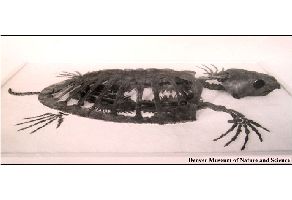
RIGHT:
Right lateral view of the same specimen as prepared and photographed by G.F.
Sternberg about 1945. Sternberg's field number on this specimen was 10145 (the 101st
specimen he collected in 1945). The specimen is about 5 feet in length, with a maximum
shell width of 44 inches. Sternberg also noted that the skull was 16 inches long. |
 |
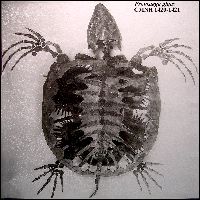 |
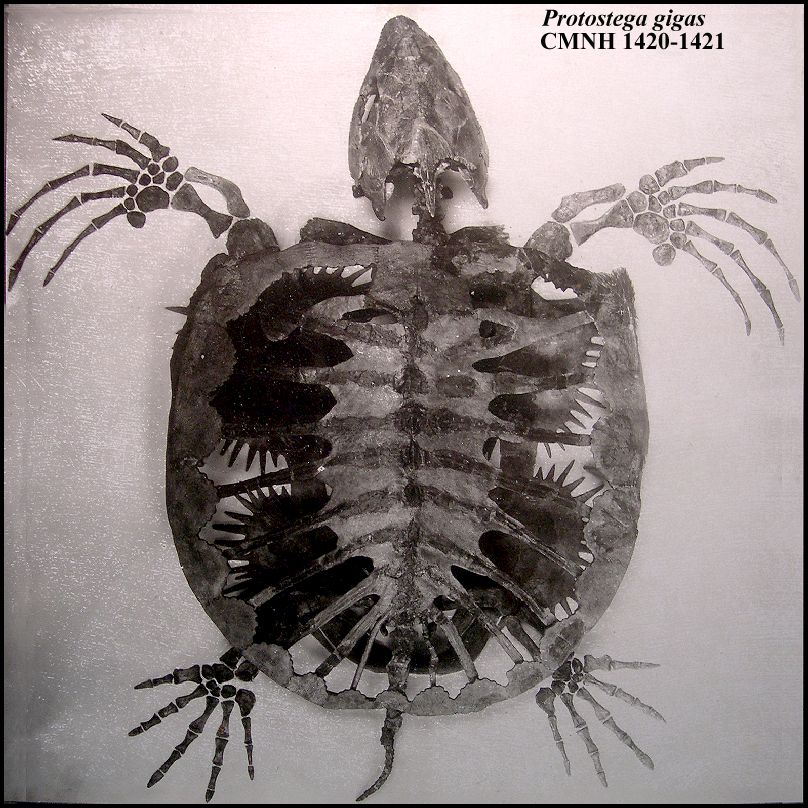
LEFT: An early photo by C.H. Sternberg of Protostega gigas from the chalk of western Kansas. The specimen is actually a composite of two
specimens (CMNH #1420 and #1421), both discovered by Sternberg about "three miles
northwest of Monument Rock" in western Gove County in 1903 and acquired by the Carnegie Museum of Natural
History in Pittsburgh, PA in 1904. Sternberg (1906) noted that this specimen
measured 10 feet (3 m) across the front paddles. A more recent picture is HERE.
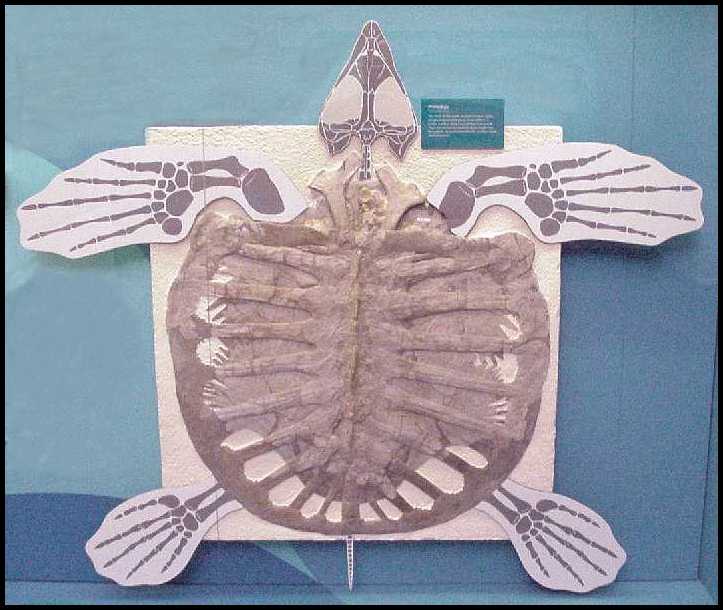
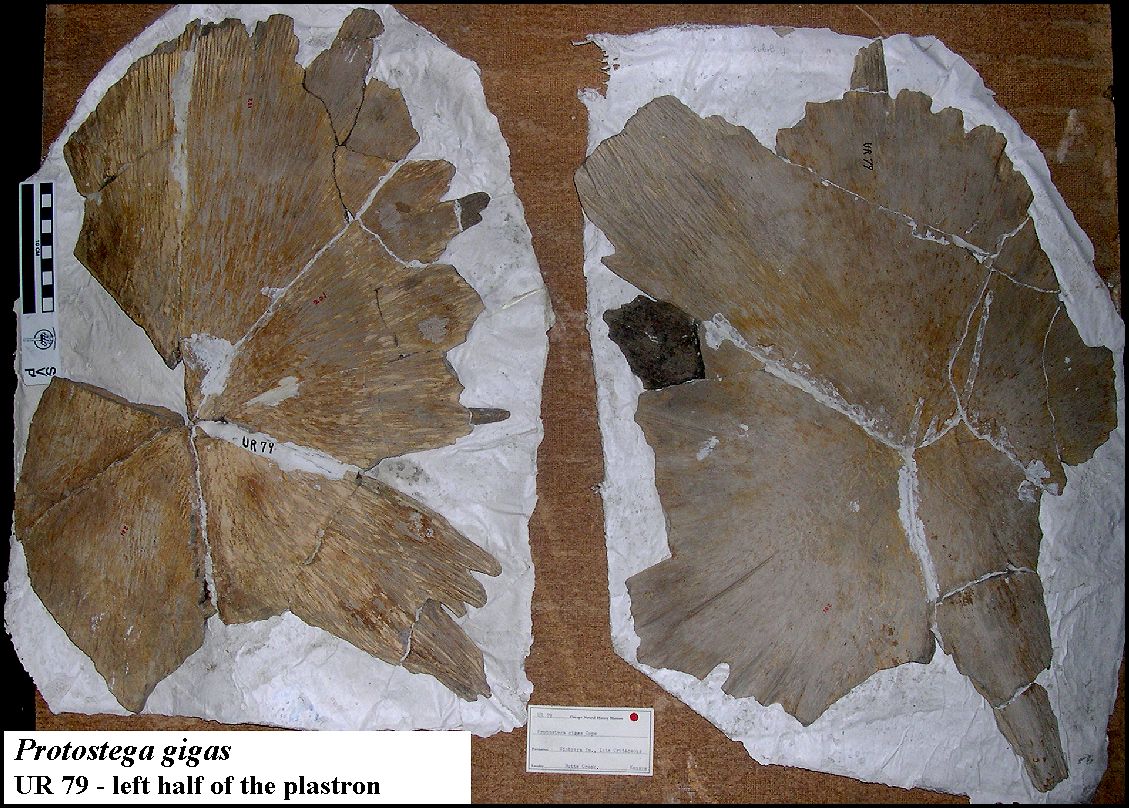
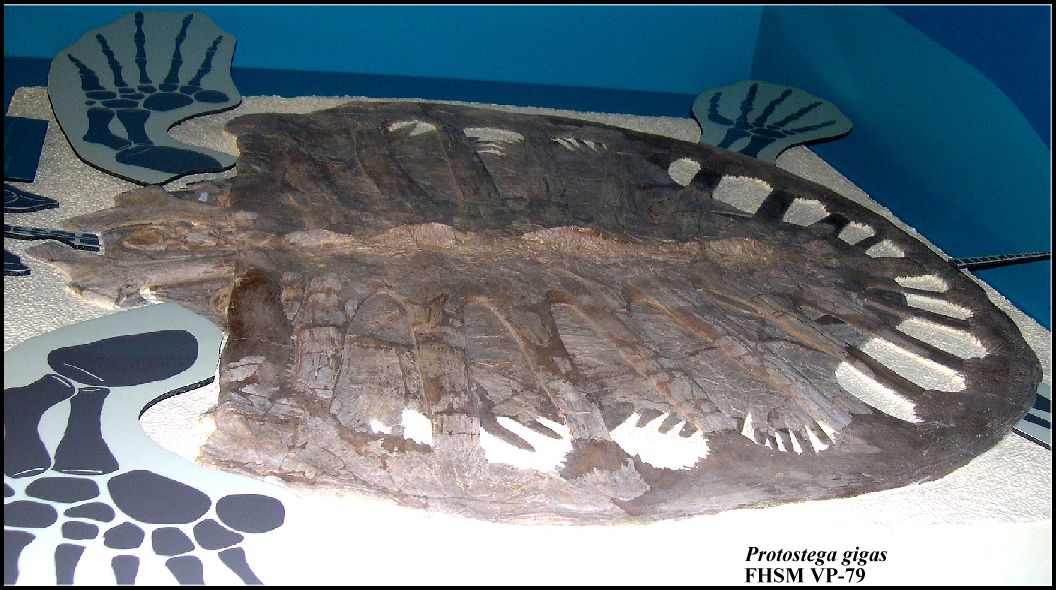
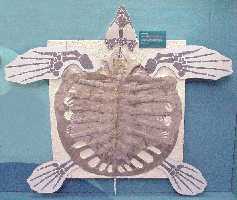
RIGHT: A dorsal view of a Protostega
gigas (FHSM VP-79) carapace and plastron on exhibit at the Sternberg Museum of Natural
History. This specimen was collected by George Sternberg. (about 4 ft x 4 ft).
Side view |
|
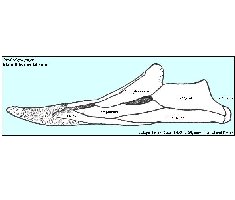 |
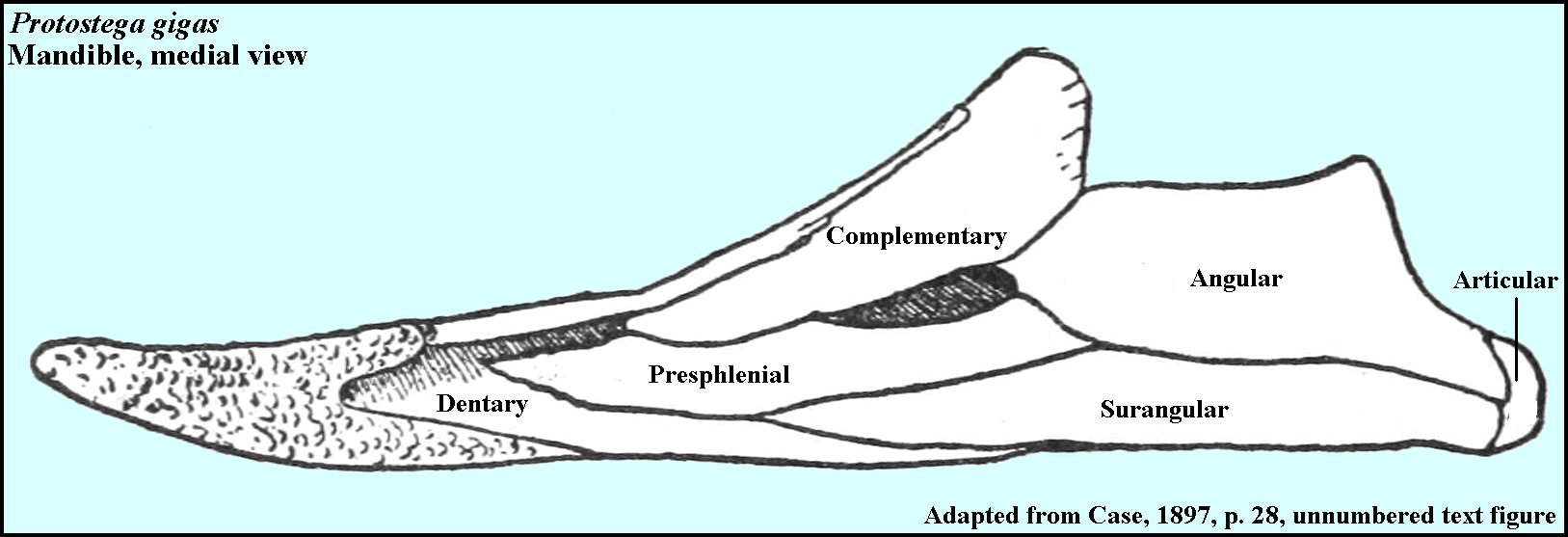
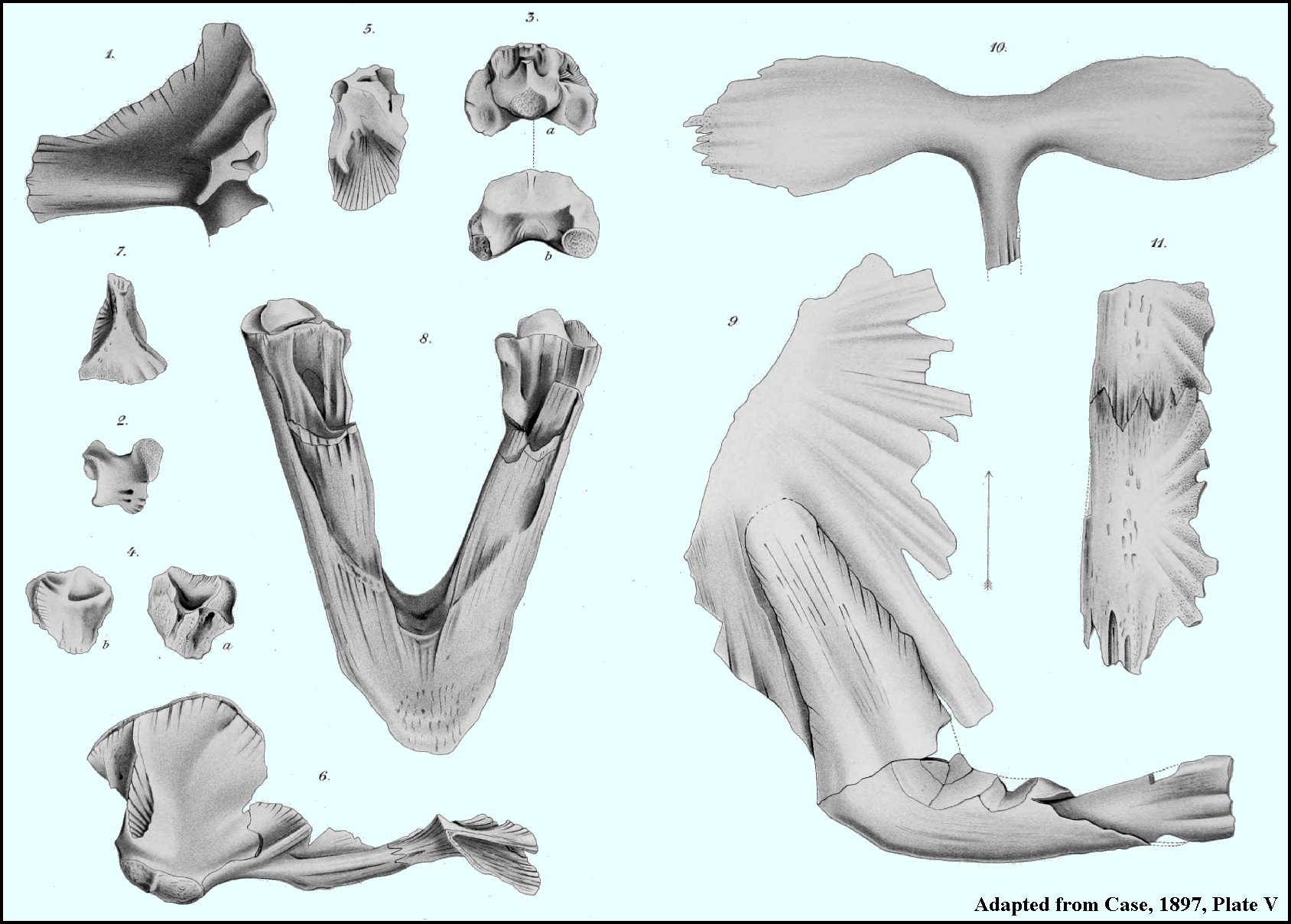
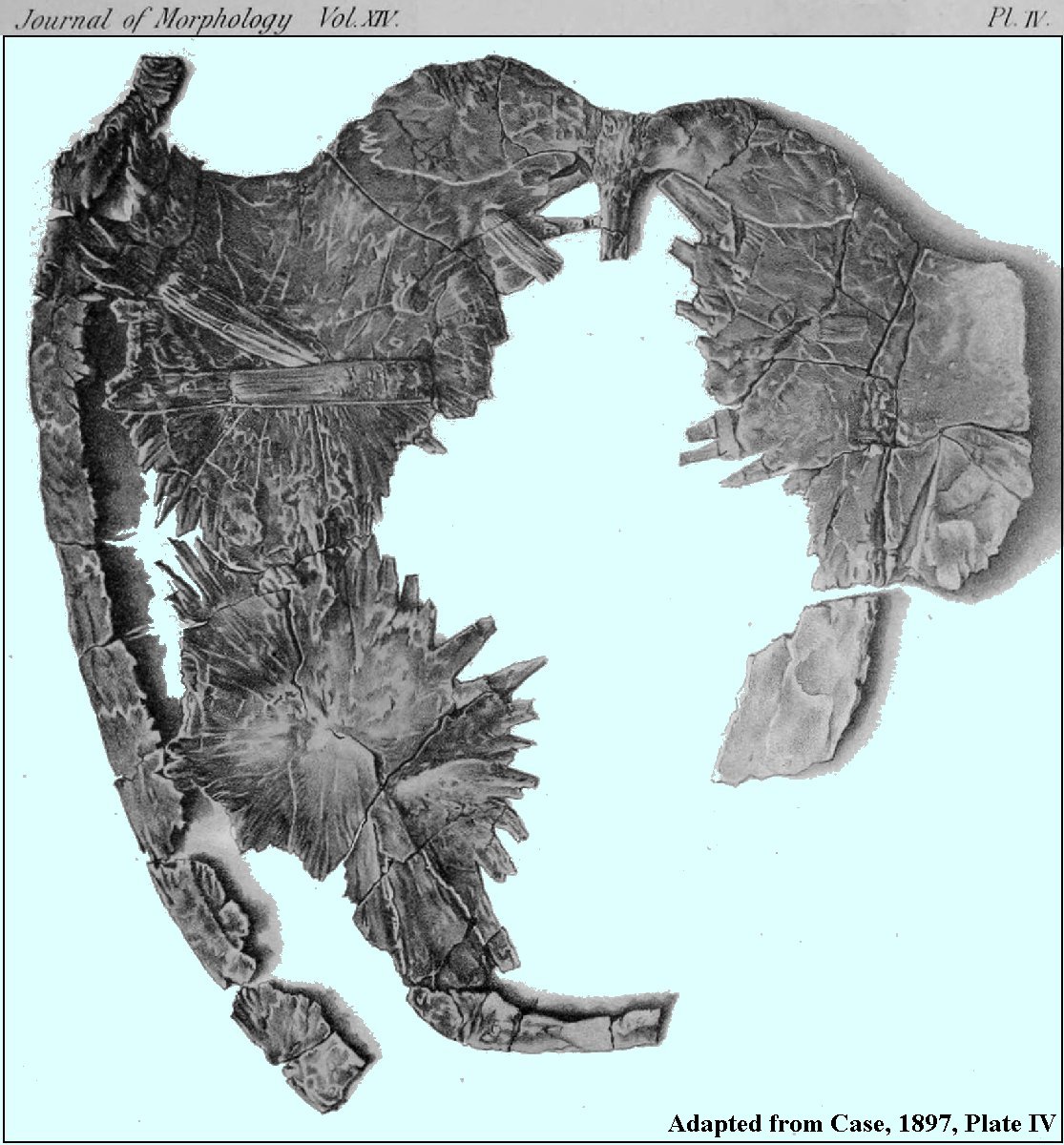
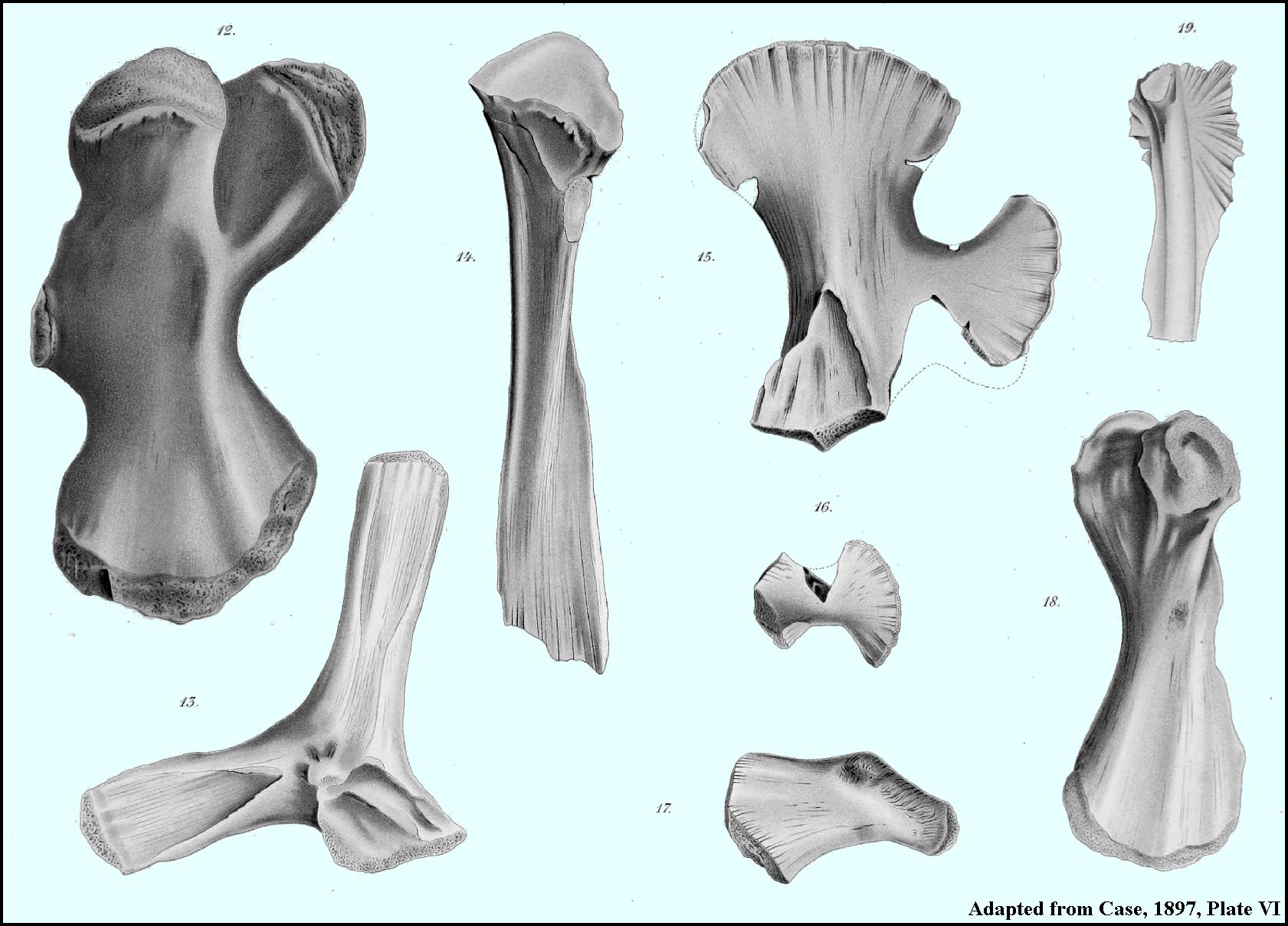
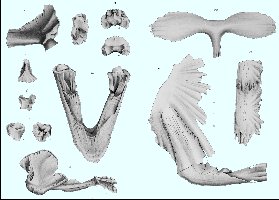
In 1897, E.C. Case described two Protostega specimens in an article in the Journal of Morphology. Although Case does
not identify the specimens by number, it is likely they were in the
collection of the Field Museum in Chicago, IL.
LEFT: A medial view of the mandible of Protostega gigas.
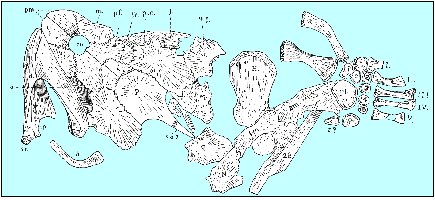
RIGHT: Plate V from Case, 1897: Fig. 1. Supraoccipital. The badly crushed petrosal and paroccipital
are not shown; Fig. 2. Exoccipital. Right side; Fig. 3. Basioccipital.
a, from above; b, from below; Fig. 4. Petrosal. a,
from within; b, from without; Fig. 5. Paroccipital. Right side; Fig. 6.
Quadrate, pterygoid, and palatine. Right side; Fig. 7. Quadrate-jugal.
Right side; Fig. 8. Lower jaw. [Dorsal
view]; Fig. 9. Xiphiplastron. Left side, showing attachment with
hypoplastron and xiphiplastron of right side; Fig. 10. Nuchal plate; Fig.
11. Fifth and sixth peripherals. Left side. |
 |
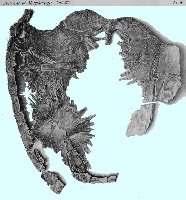 |
LEFT: Plate IV from Case, 1897. Photograph
of plastron with nuchal plate and peripherals. (Dorsal view)
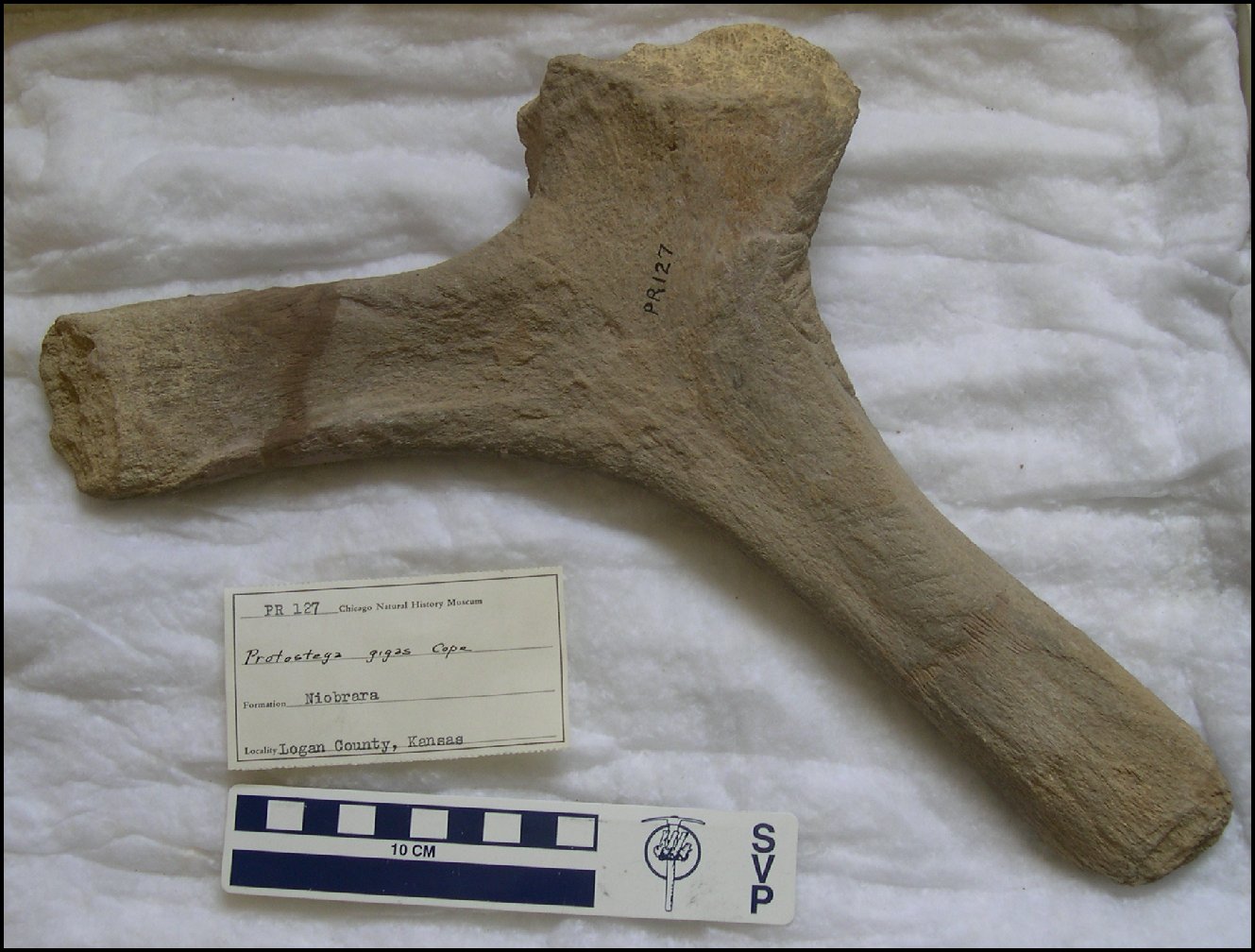
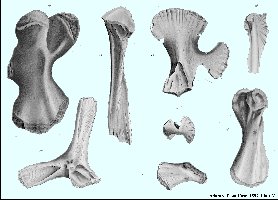
RIGHT: Plate VI from Case 181917. Fig.
12. Humerus. Right side; Fig. 13. Scapula. (See
PR127); Right side; Fig.
14. Coracoid. Right side. Fig.
15. Pubis. Right side; Fig. 16. Ischium. Right side; Fig. 17. Ilium. Right
side (taken from smaller specimen); Fig. 18. Femur. Left side; Fig. 19.
Rib head. (Taken from smaller specimen). |
 |
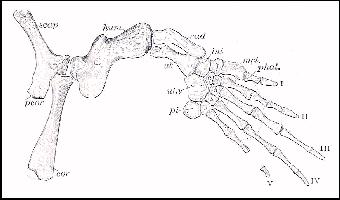 |
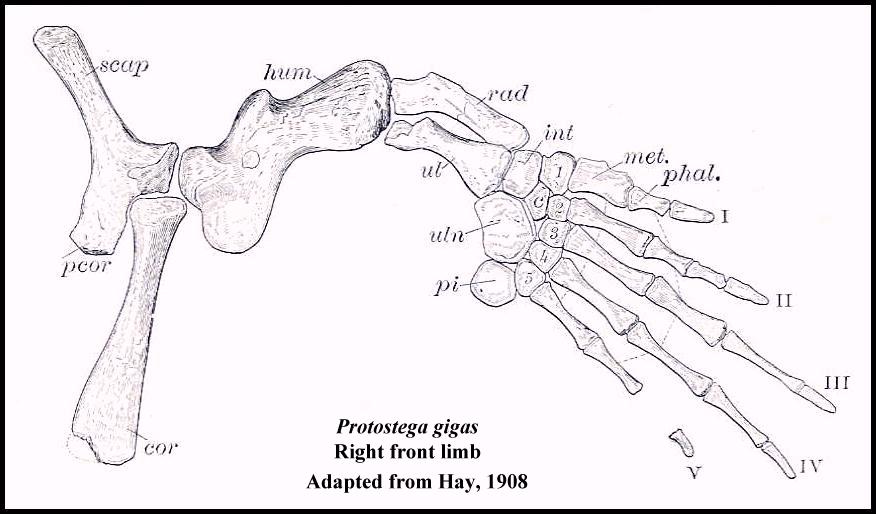
LEFT: The right front limb and shoulder of Protostega gigas,
adapted from Hay (1908).
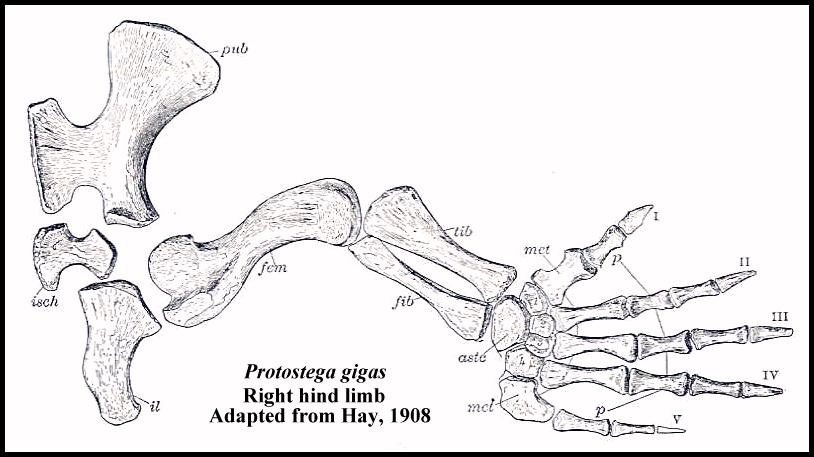
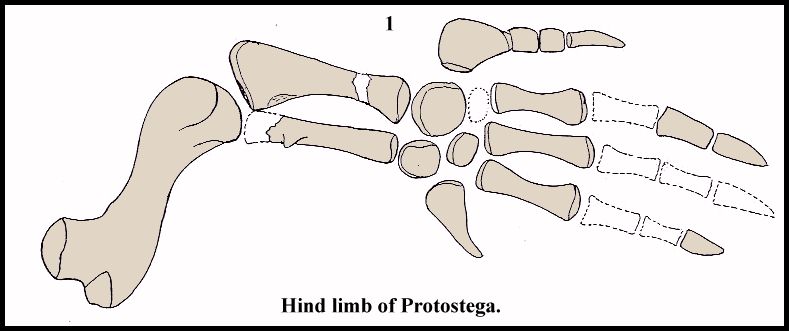
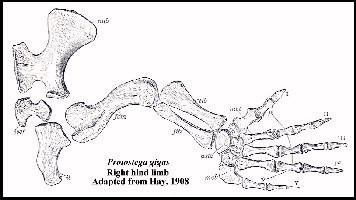
RIGHT: The right half of the pelvis and right
hind limb of Protostega gigas, adapted from Hay (1908). |
 |
 |
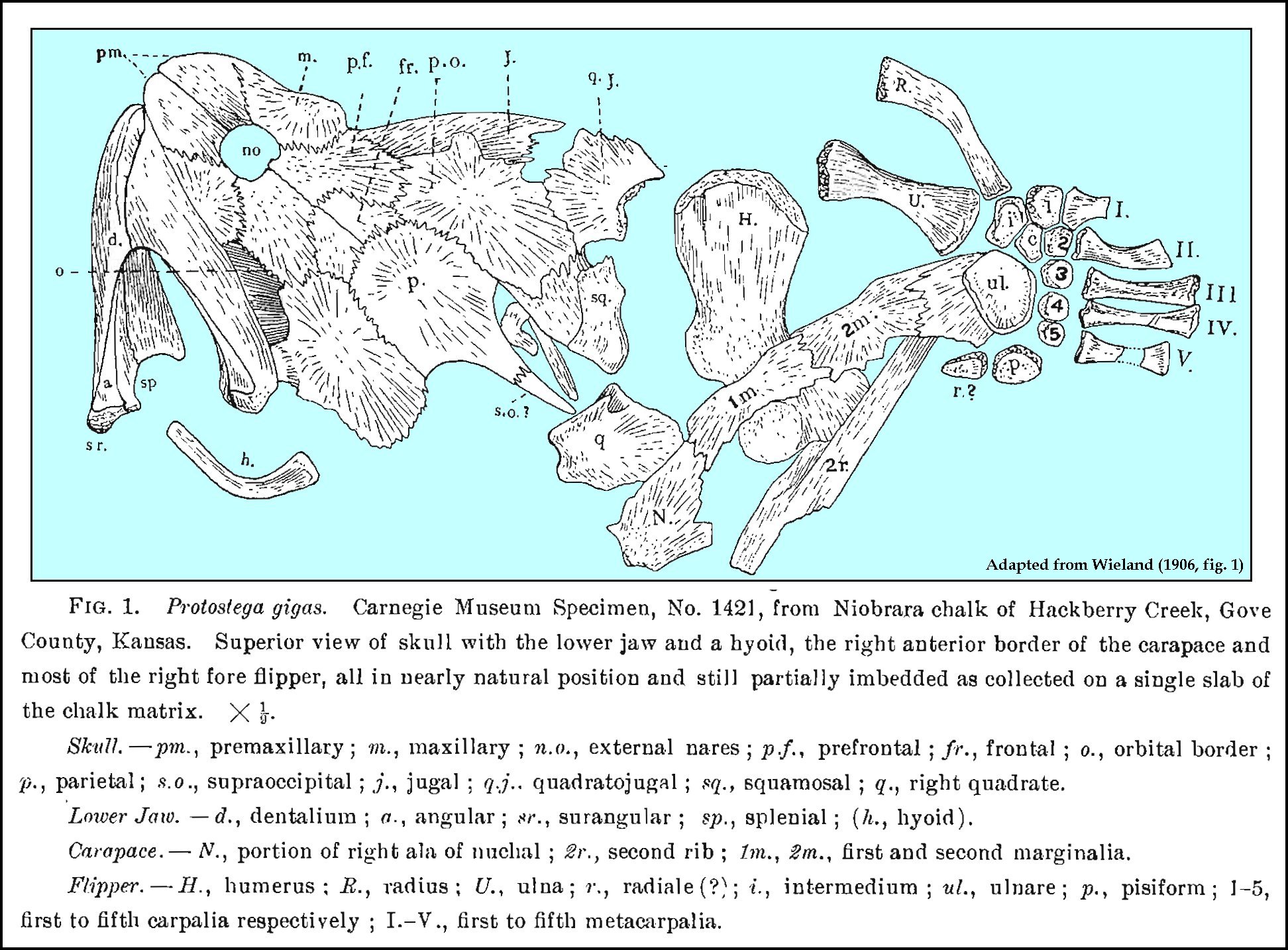
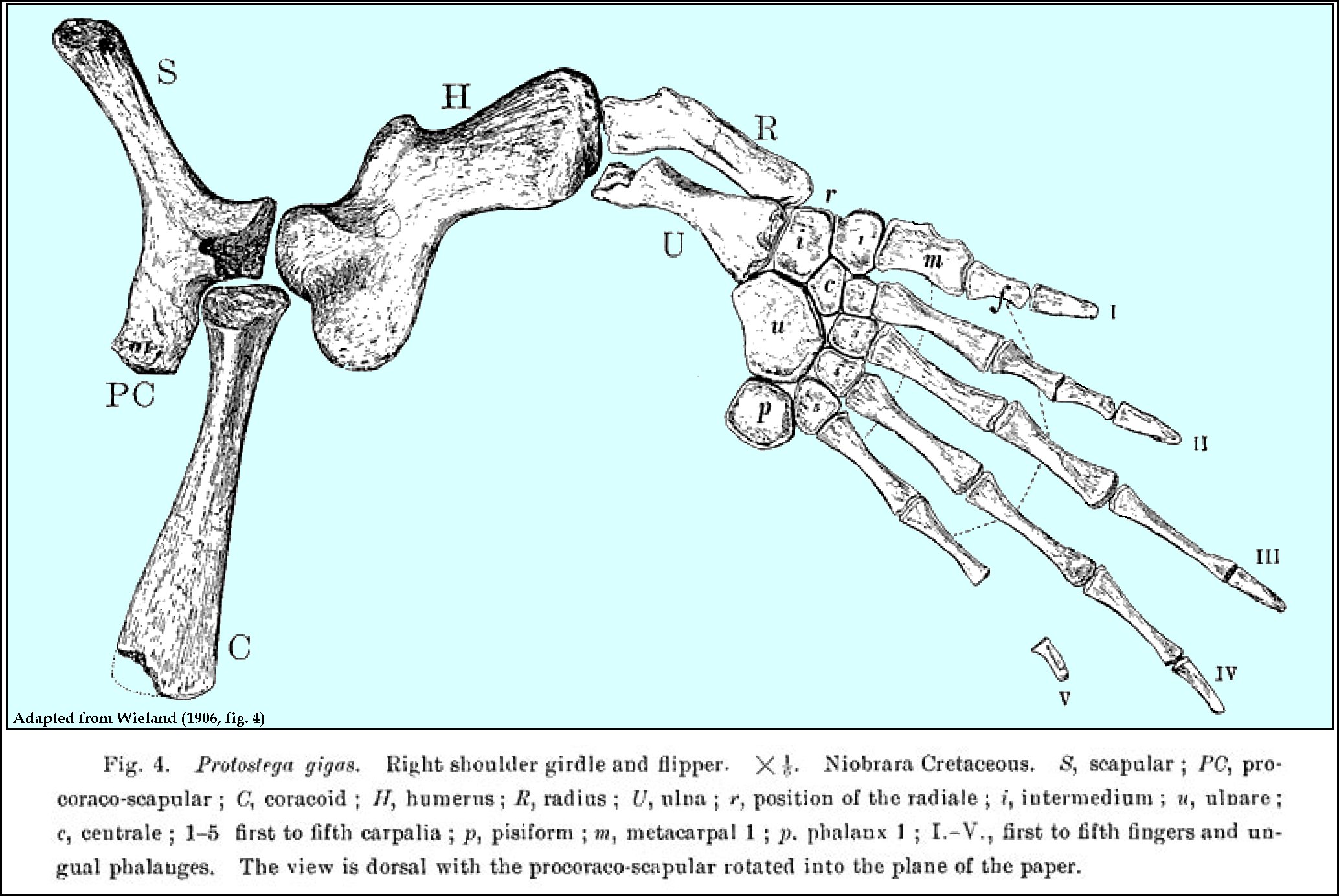
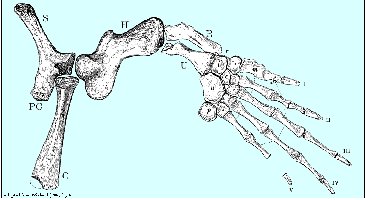
LEFT: The skull and right front limb of the
Carnegie Museum No. 1421 Protostega gigas, collected by Charles H.
Sternberg from the Smoky Hill Chalk along Hackberry Creek in Gove County,
Kansas (Adapted from Wieland 1906, Figure 1).
RIGHT: The right front limb of No. 1421 reconstructed by Wieland
(1906, fig. 4) |
 |
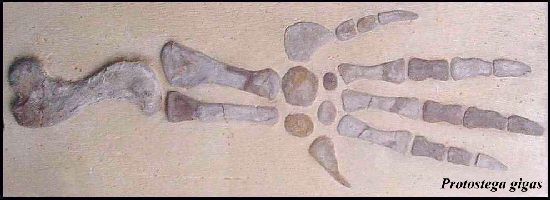 |
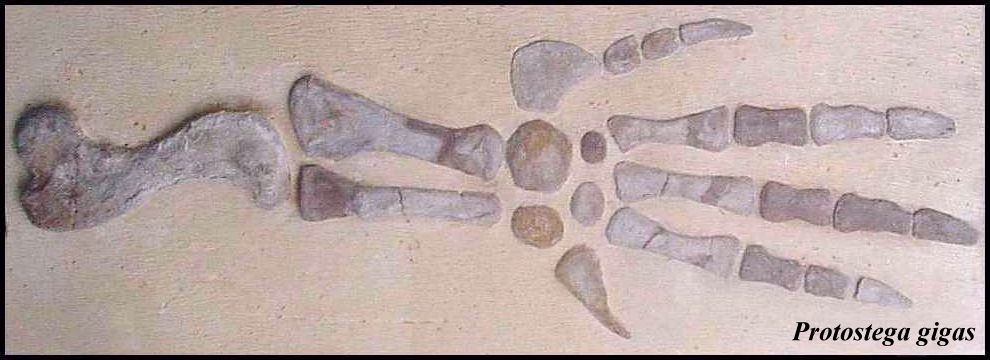
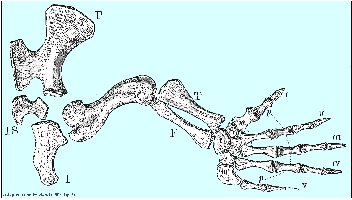
LEFT: The right hind limb of a large Protostega gigas turtle
(KUVP 1201) in the University of Kansas Museum of Natural History. It was collected by
Charles Sternberg in 1900 somewhere west of Russell Springs in Logan County. This specimen
was one of the first examples of the rear limb of this giant turtle ever found, and was
the subject of a paper by S. W. Williston in 1902. See a
colorized version of his Text-Figure 1 here. The femur (upper leg bone) is
36
cm (14 in) long. The entire limb would have been about 4 feet long.
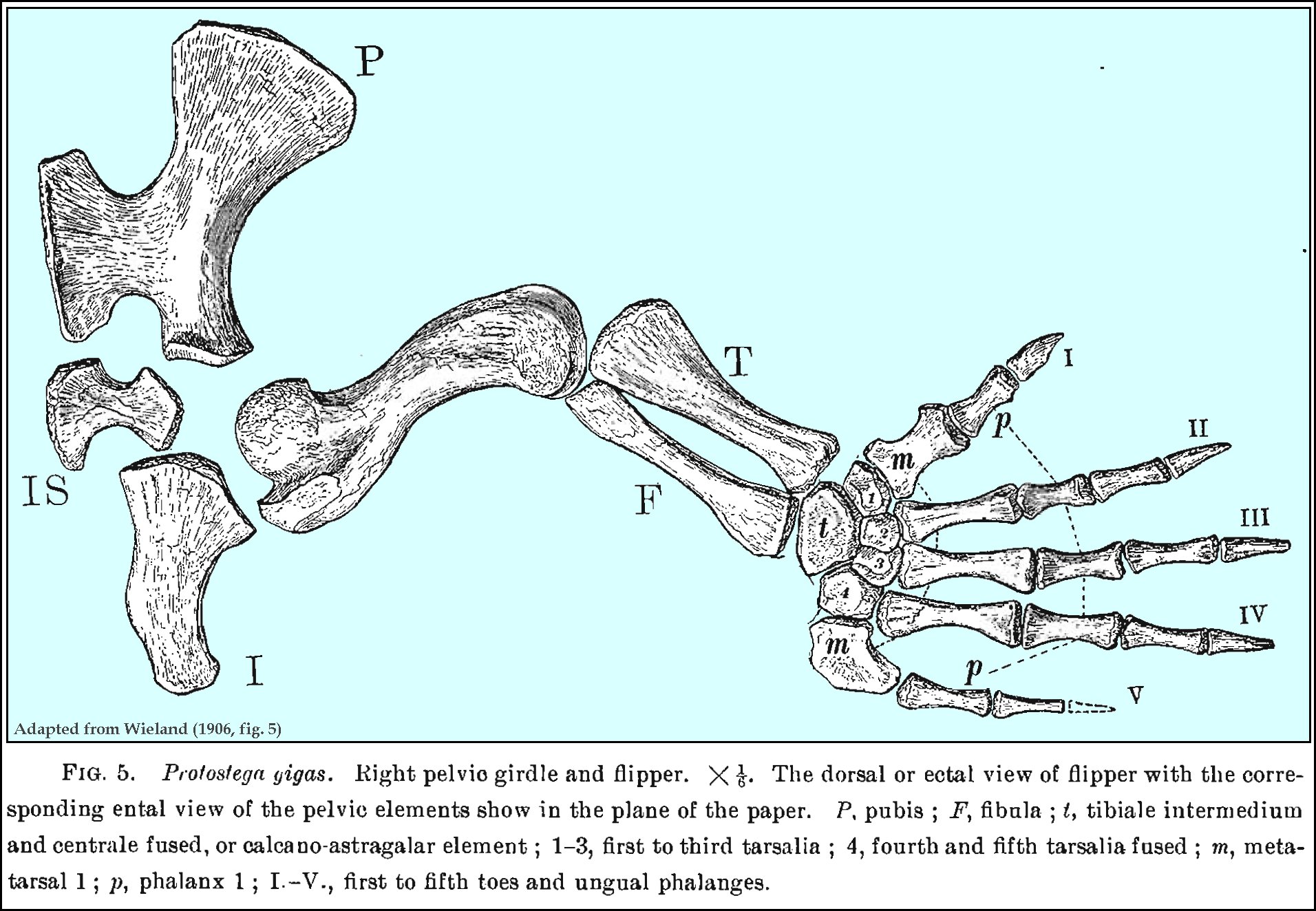
RIGHT: The right hind limb of Protostega gigas as reconstructed by
Wieland (1906, fig.5). |
 |
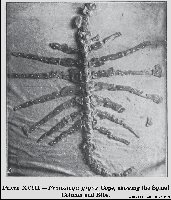 |
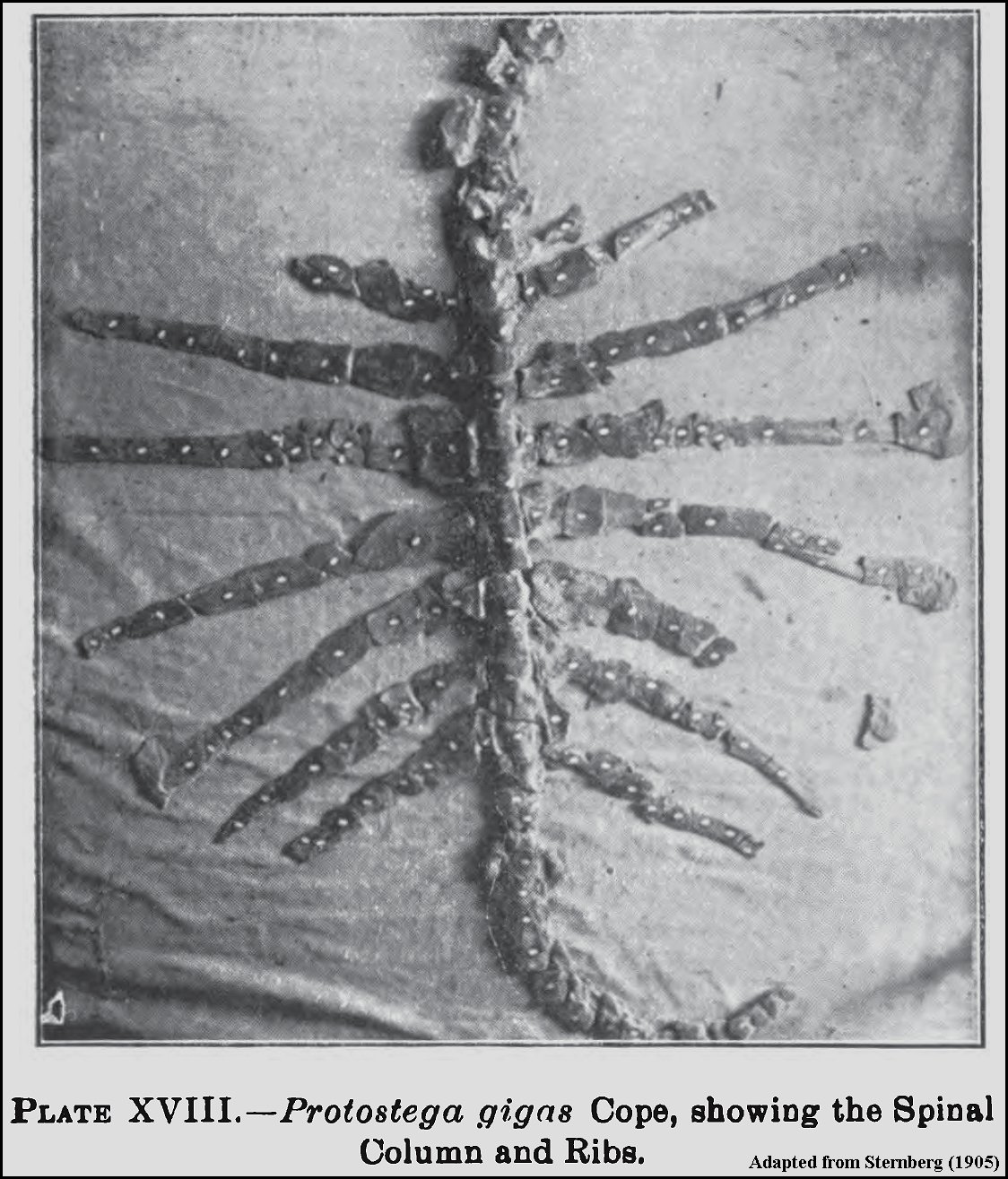
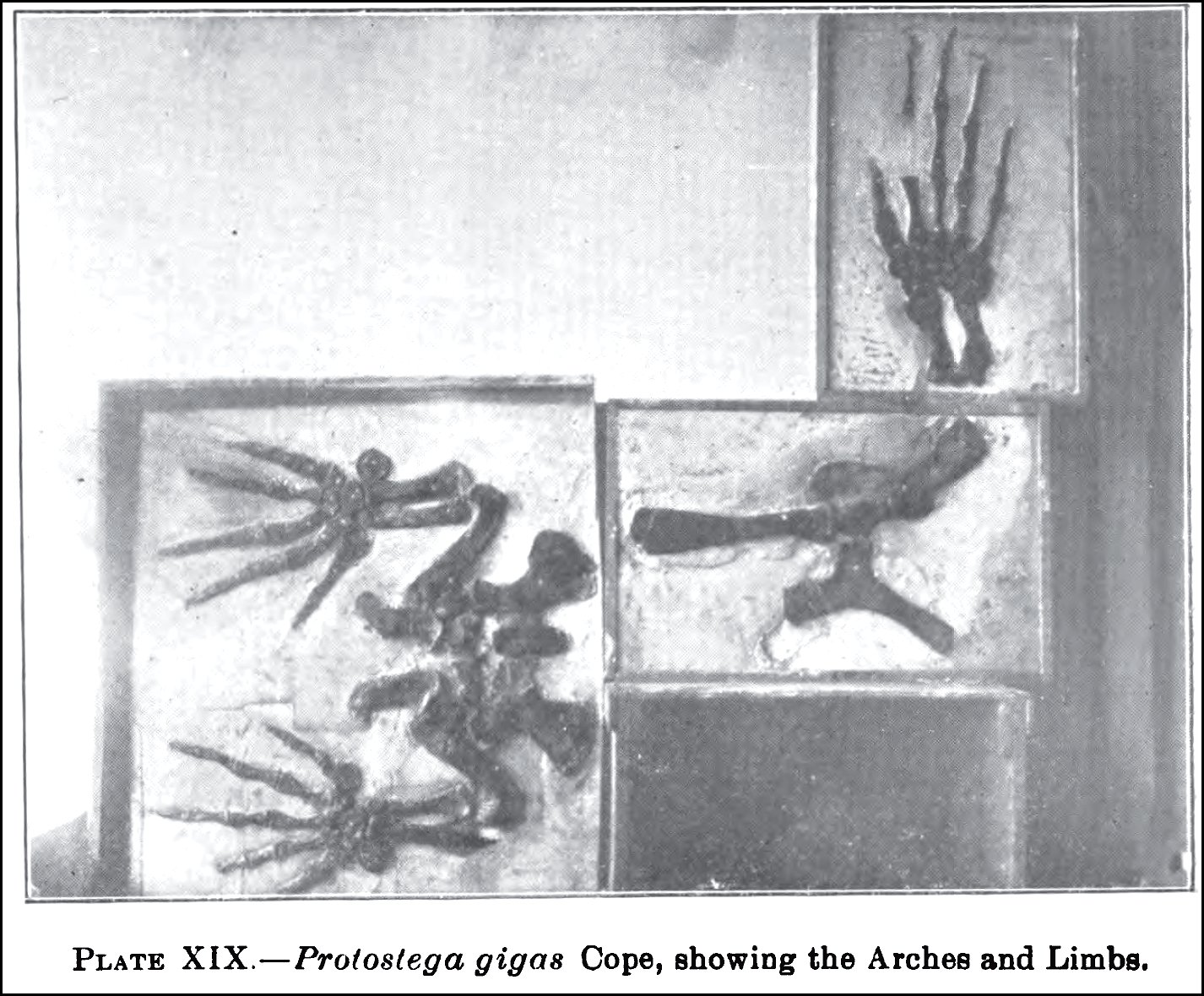
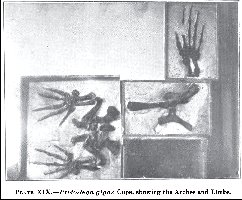
In the summer of 1903, Charles Sternberg collected a
fairly complete specimen of a turtle that he identified as Protostega
gigas. Later that year he noted that it would take another year to
finish the preparation of this remains. His oral report at the annual
meeting of the Kansas Academy of Science wasn't published until 1905. The
paper included two photographs of the specimen during preparation. The
specimen was sold to the Carnegie Museum of Natural History and is
designated as #1420.
Sternberg, C. H. 1905. Protostega gigas and other
Cretaceous reptiles and fishes from the Kansas chalk. Kansas Academy Science, Transactions
19:123-128.
LEFT: Plate XVIII shows the vertebral column from neck to tail,
including the ribs.
RIGHT: Plate XIX shows the pelvis and hind limb, part of the
shoulder and one front limb. |
 |
 |
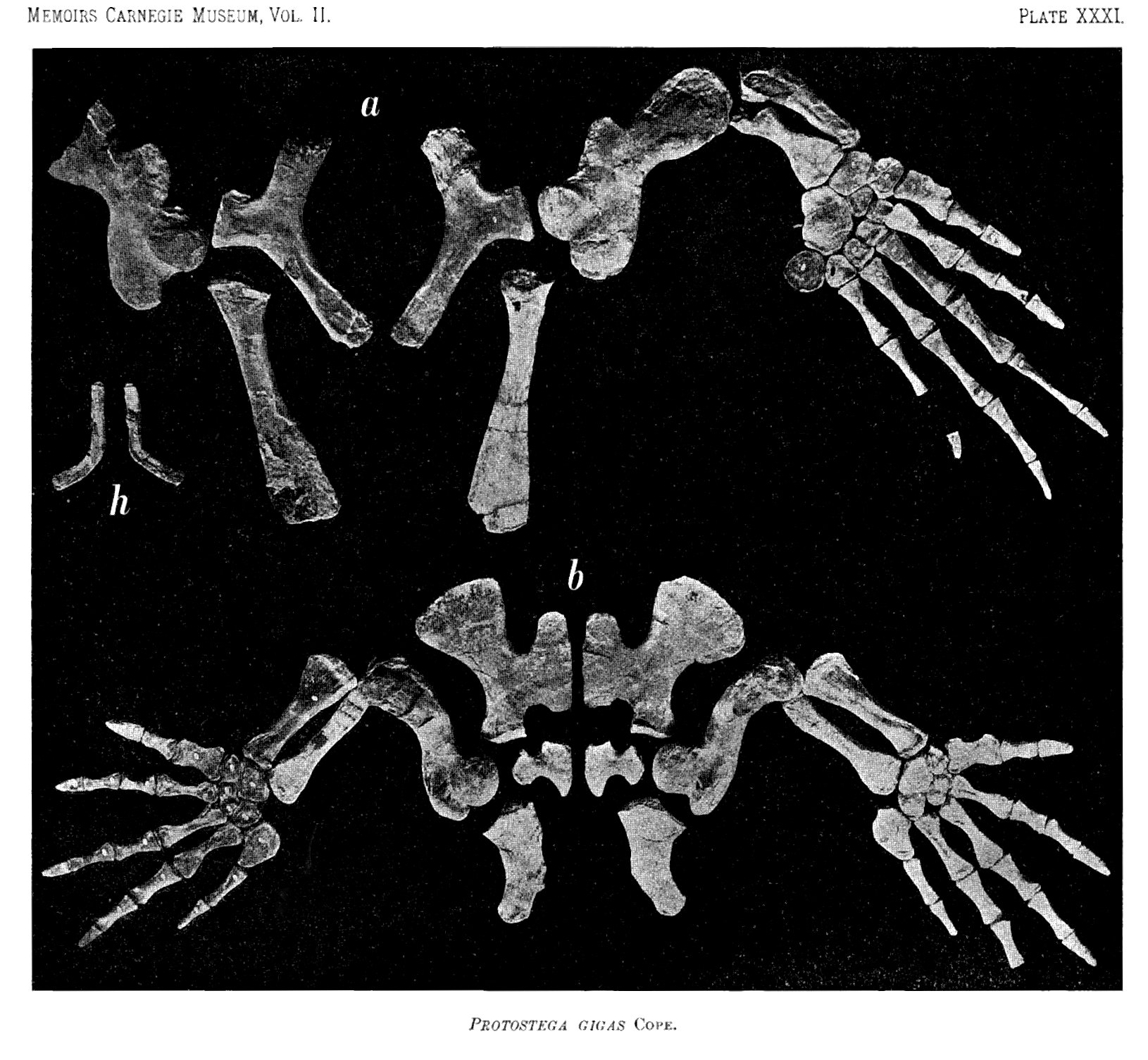
As described by H.F. Osborn (1904) in Science:
"The [#1420]
skeleton lay on its dorsal surface with the fore limbs stretched out at
right angles to the median line of the carapace, measuring six feet
between the ungual phalanges; the hind limbs were parallel with the neural
arch, and stretched out behind.
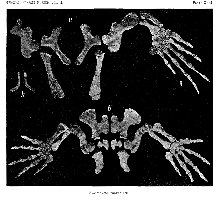
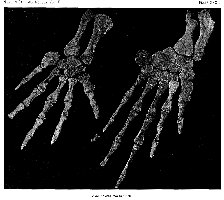
LEFT: Plate 31 from Wieland (1906): a)
Right and left shoulder girdles, with right front flipper and the proximal
half of the left humerus; b) Pelvic girdle with both hind flippers; c) The
accompanying hyoids.
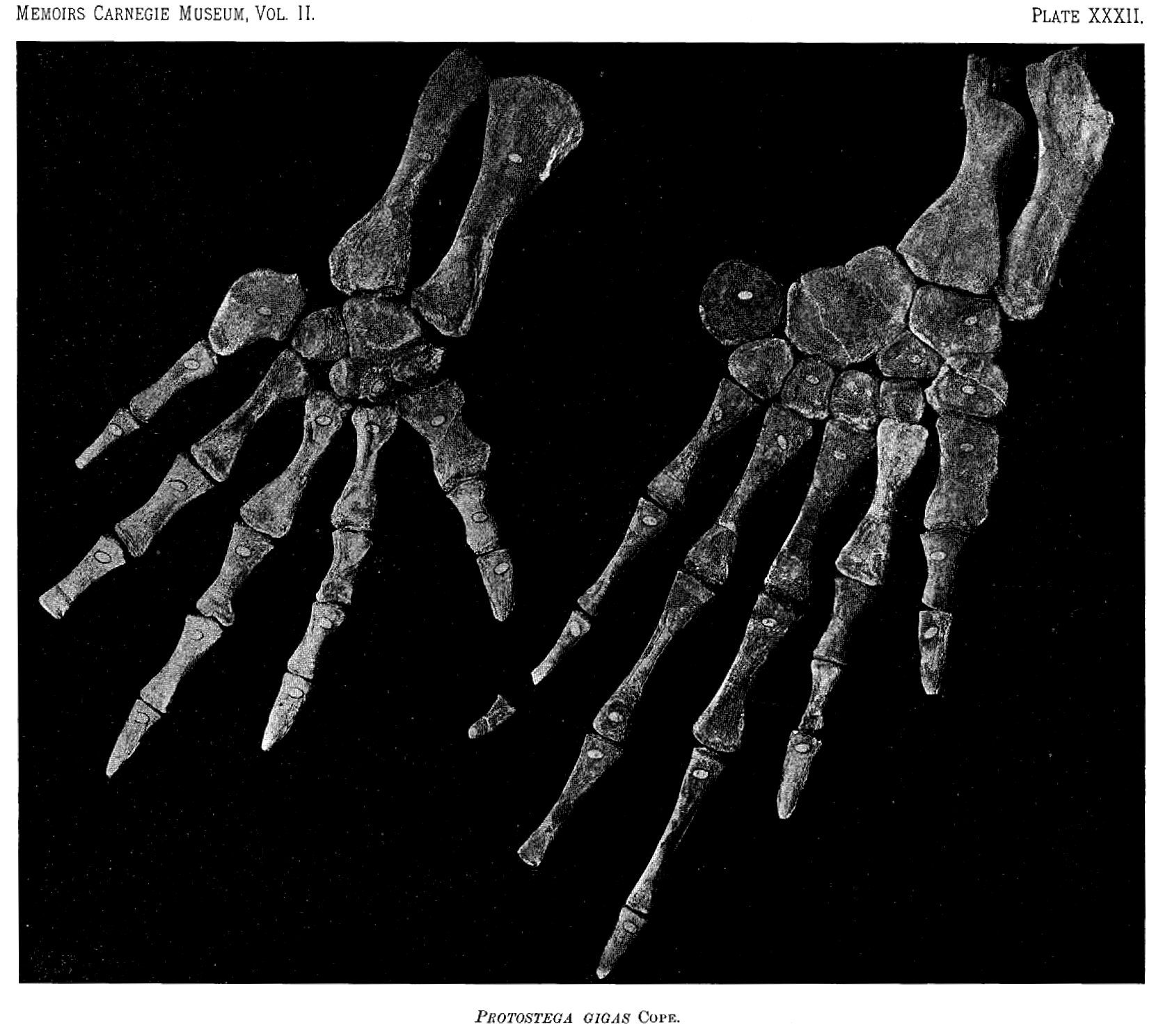
RIGHT: Plate 32 from Wieland (1906): Enlarged views of the
forearm and hand (right photograph) and the foot (left photograph). |
 |
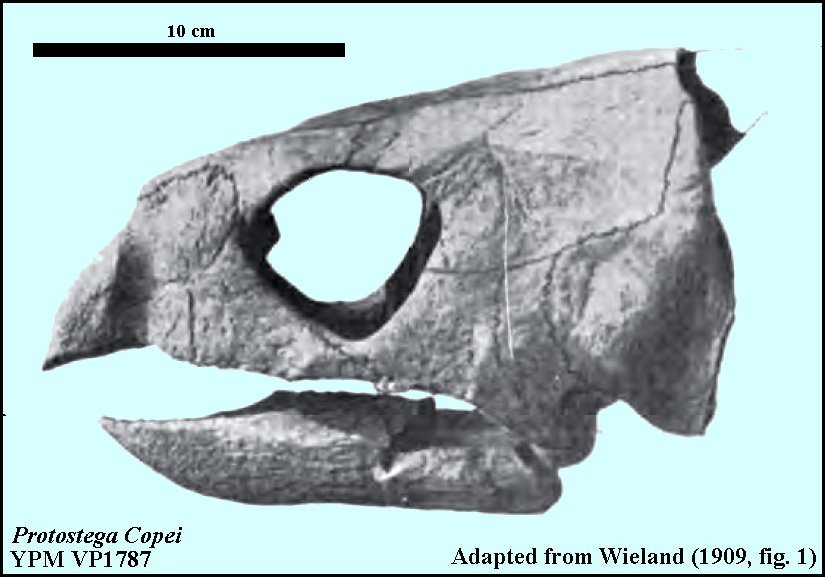
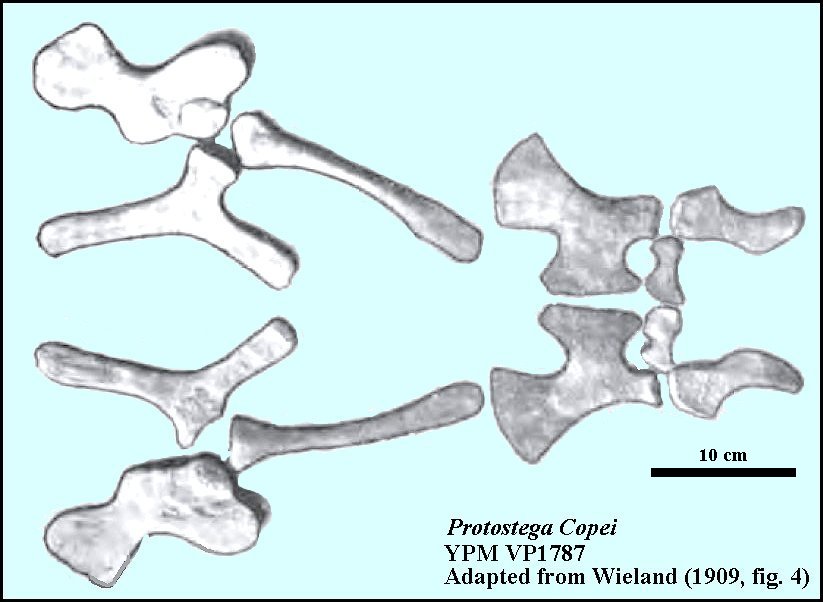
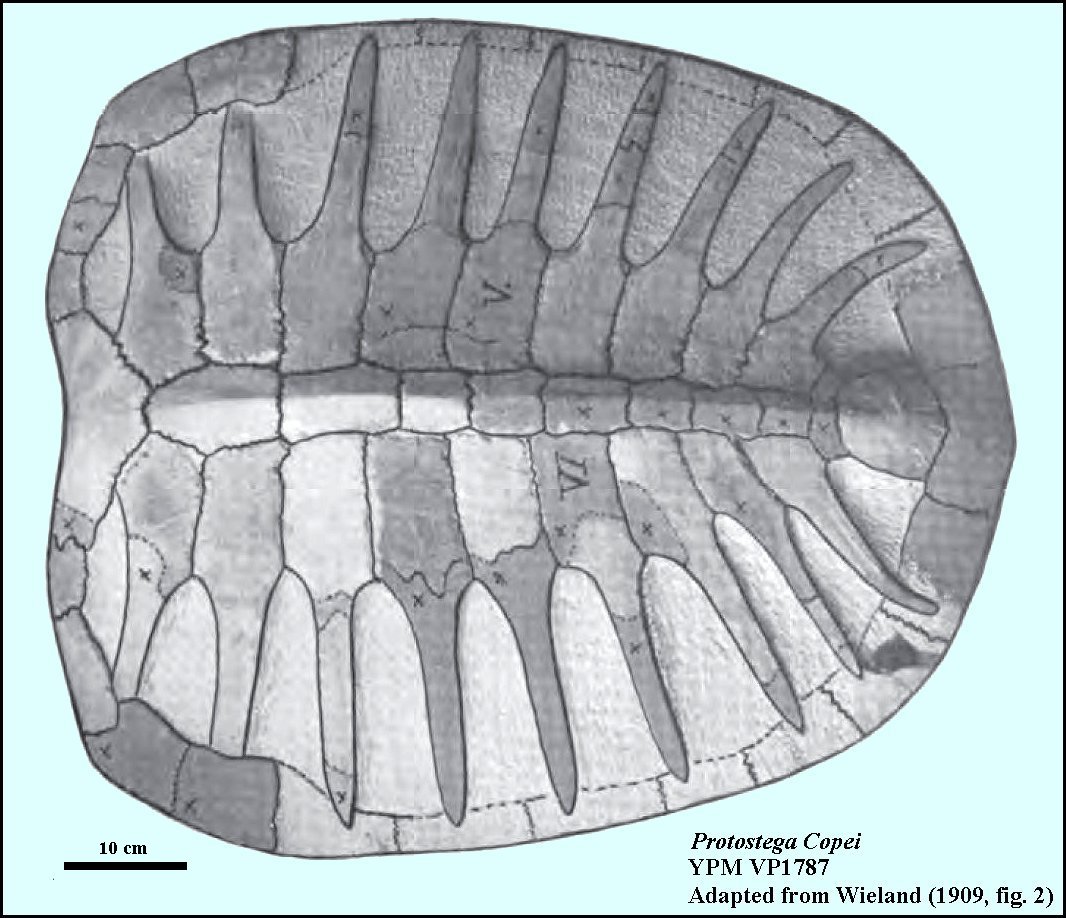
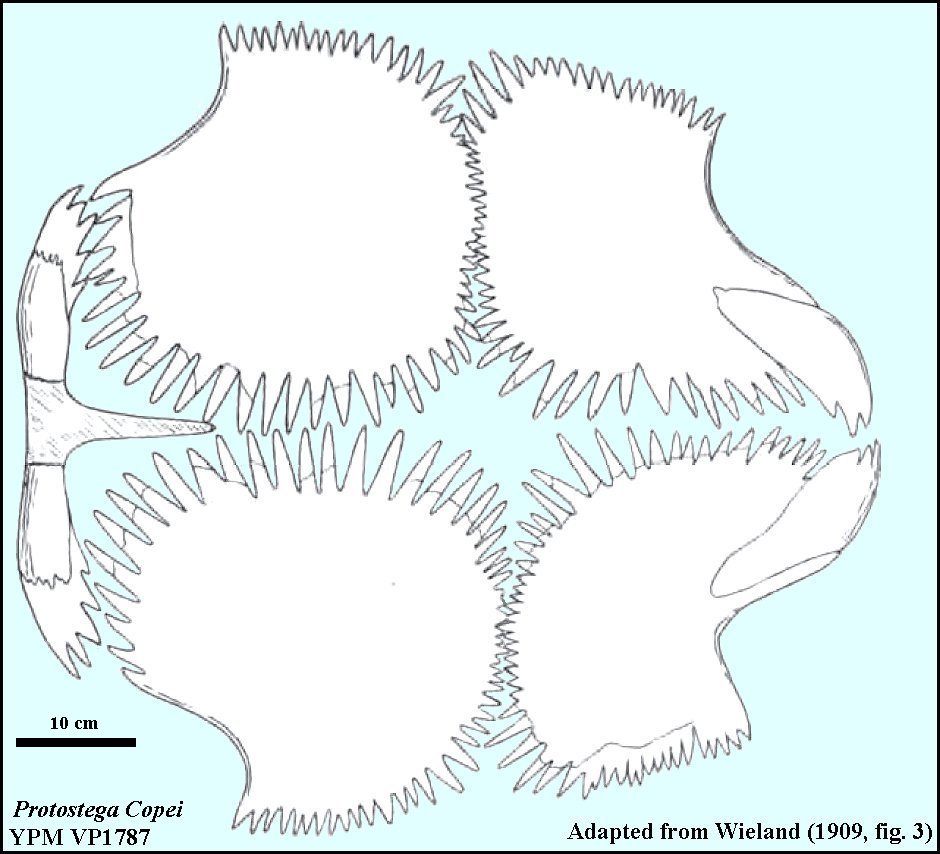
Microstega (Protostega) Copei - The
type specimen of Protostega copei (YPM VP 1787) was collected by Charles
Sternberg from along Hackberry Creek in Gove County, Kansas. It was named and
first described by Wieland in 1909. Later, Zangerl (1953) changed the
genus name to Archelon, and Hooks (1998) redescribed it again as Microstega.
The following information was provided by Dr. Kraig Derstler of the University
of New Orleans. Kraig is one of the few people currently studying protostegid turtles.
"Very little is written about Protostegids, other than the descriptive
stuff by Wieland and his colleagues in the 1890's and earliest 1900's. Protostegais a huge-headed sea turtle. The species are pretty poorly defined at present. Specimens
come from the Niobrara of Kansas, the Pierre of Kansas, Colorado, Wyoming, and South
Dakota, the Mooreville, Demopolis, and Eutaw formations of Alabama and Mississippi, and
the Campanian - Santonian marls of Texas. Possible scraps also come from other
Santonian-lowermost Maastrichtian deposits around the world. Other Protostegids (Calcarichelys,Chelosphargis, and a couple of unnamed things) range from the Albian through the
latest Maastrichtian worldwide.
Archelon ischyros has a normal-sized skull,
proportionally much smaller than Protostega. However, it has that distinctive
hooked snout. It is so far confirmed only from the upper half Pierre in South Dakota.
(Reports from Colorado and elsewhere are pretty unbelievable.)
I've never seen any Niobrara Protostega material from an animal that
was more than about 2-2.5 m long. Niobrara giants may have existed, but I haven't seen any
evidence. And, I've never seen any signs of Archelon in the Niobrara. However, there are
lots of small to medium-size Chelosphargis specimens and possibly some pieces of
the "thorny Protostegid" Calcarichelys". ( Dr. Kraig
Derstler )
 |
Concerning
size, the largest Protostega is a 3.4 m beast in the Dallas Museum of Natural
History. I was consultant for this exhibit and I'm pretty confident of the identification
as well as the size. The Yale Archelon is 3.0-3.1 m, but another I've studied is
4.6 m long! It is virtually perfect and articulated. As a result, the size and the
identification are both solid.
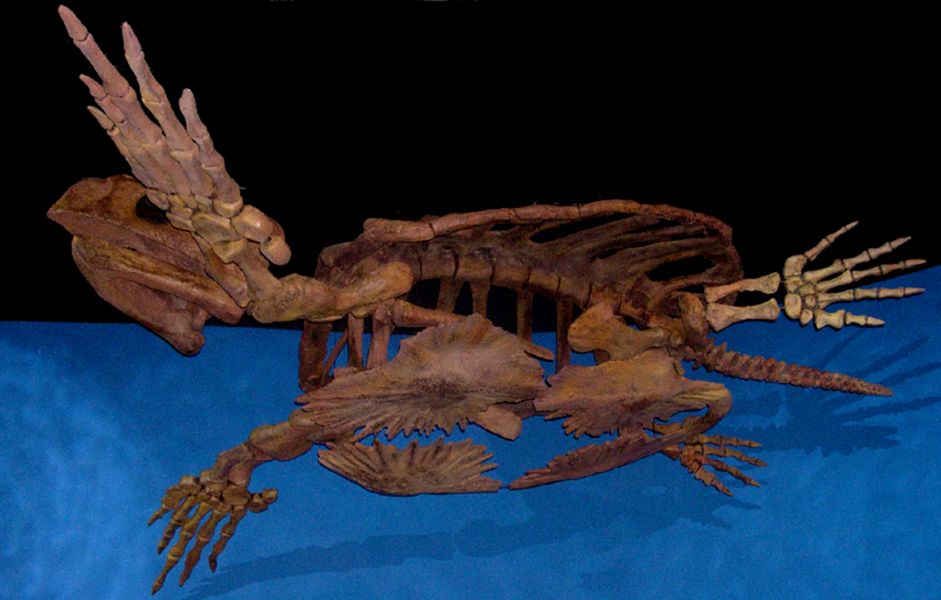
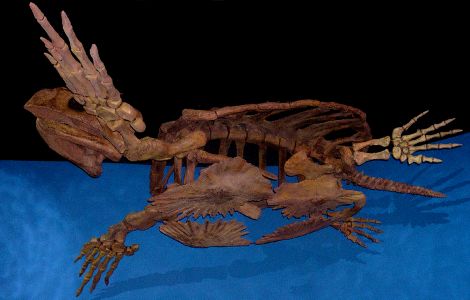
LEFT: A cast of the Dallas Protostega gigas in the McWane Center, Birmingham, AL.
(Cast by Triebold Paleontology). A view of the underside of the skull is HERE
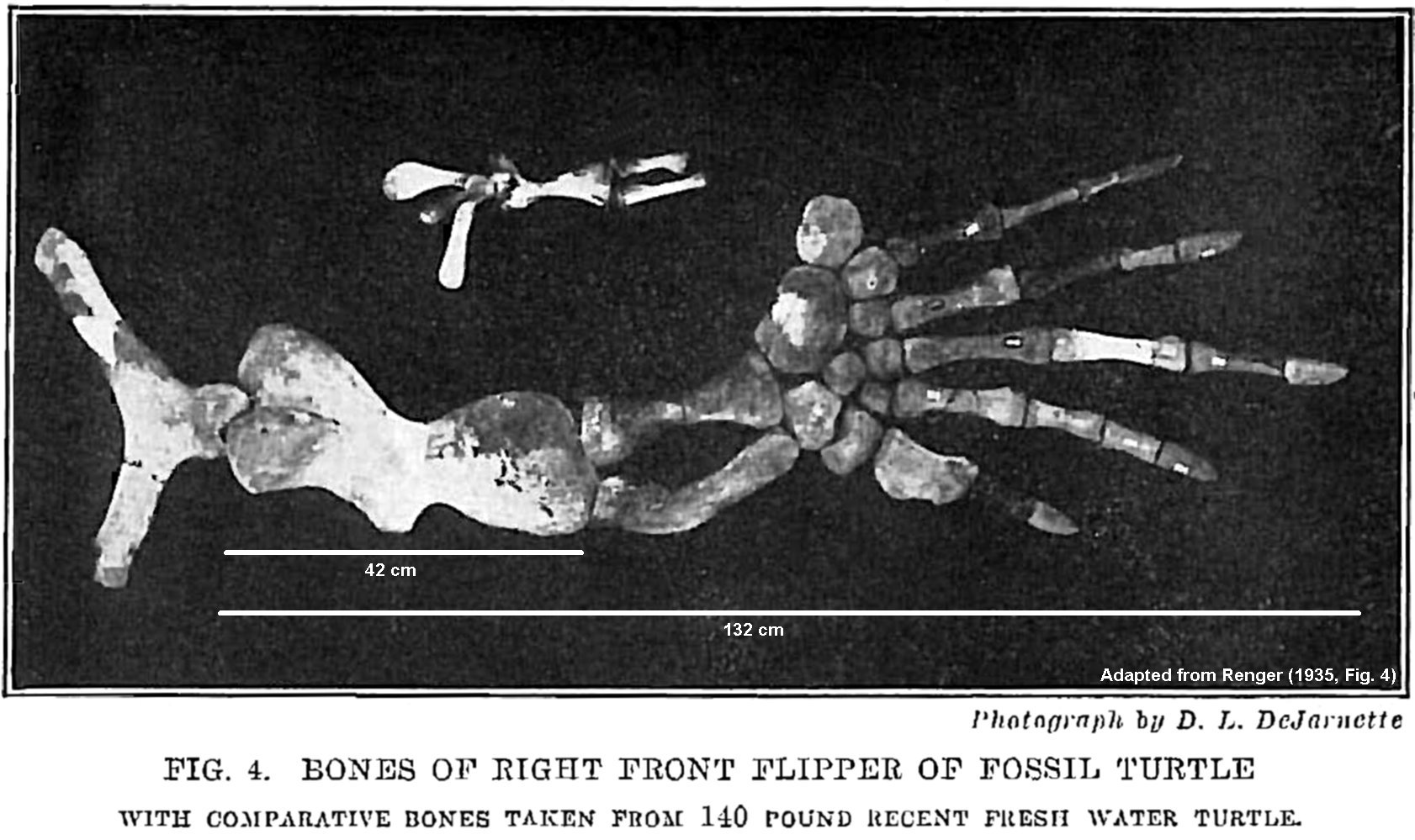
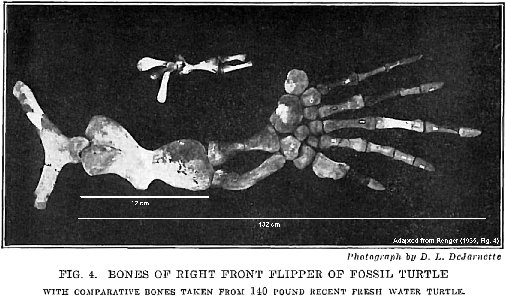
RIGHT: The right
front limb of a Protostega gigas turtle discovered in the
Cretaceous of Greene County, Alabama in 1933 (from Renger 1935). The
humerus is 42 cm long and came from an animal with a shell length of 150
cm (5 ft). Renger estimated that the animal when alive would have weighed
2.5 to 3 tons. |
 |
Archelon ischyros (Go here
for another website about Archelon)
| Williston
made an interesting comment regarding the stratigraphic occurrence of various Late
Cretaceous genera that is worth repeating here. He (1902, p. 270) noted that “the
characters separating Archelon Wieland from Protostega Cope, while not very
important, would seem sufficient. Nevertheless, one can derive little justification
from the different geological horizons in which the forms are found. The relations
between the Niobrara and Fort Pierre vertebrates are for the most part very close. I have
recognized in both horizons Tylosaurus, Platecarpus and Mosasaurus (Clidastes),
as well as Pteranodon and Hesperornis, all very typical of the Niobrara
deposits, and the existence of Claosaurus [Marsh’s dinosaur discovery in
Kansas] has been recently affirmed in the Fort Pierre. On lithological grounds, there is
nothing separating the two groups of deposits and I protest against the names Colorado and
Montana, as perpetuating a wrong impression. On paleontological and lithological
grounds, there would be much better reasons for uniting the Niobrara with the Fort Pierre
than with the Fort Benton.” |
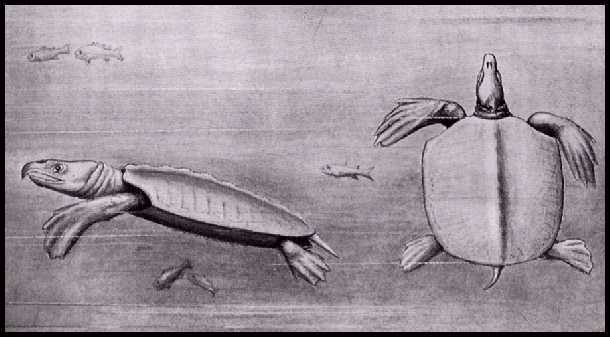 |
LEFT: Two views of "Archelon
ischyros, a gigantic sea-turtle from the Upper Cretaceous of South Dakota" by S.
W. Williston, 1914 (Fig. 126). |
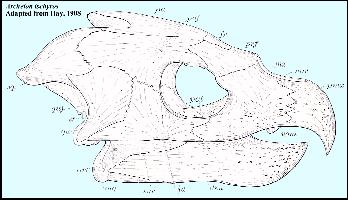 |
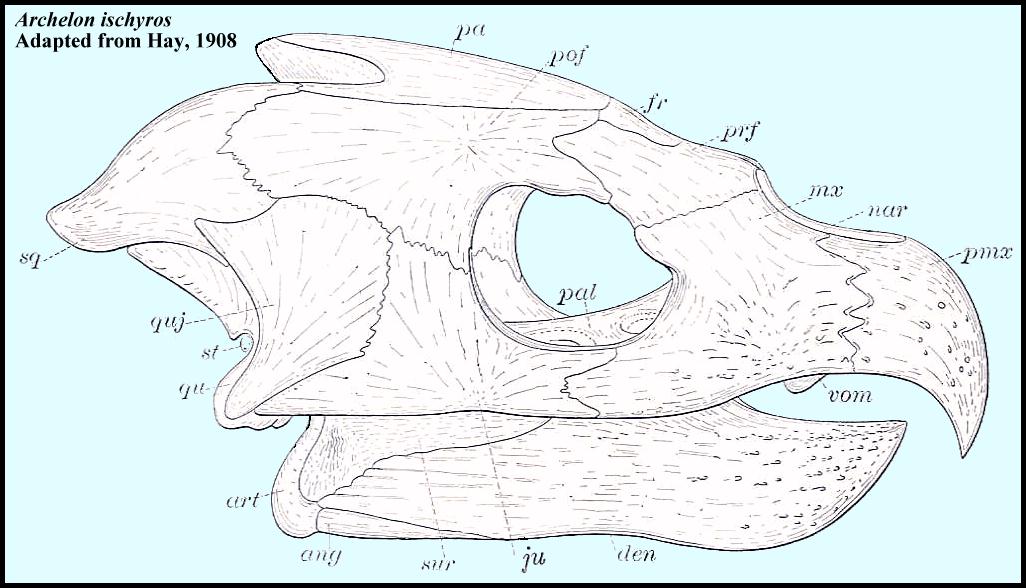
LEFT: A right lateral view of the skull of Archelon ischyros,
adapted from Hay (1908) from the original in Wieland (1900). Note the distinctive hooked
premaxilla which was covered with a horny beak in life, similar to what is seen in modern
snapping turtles.
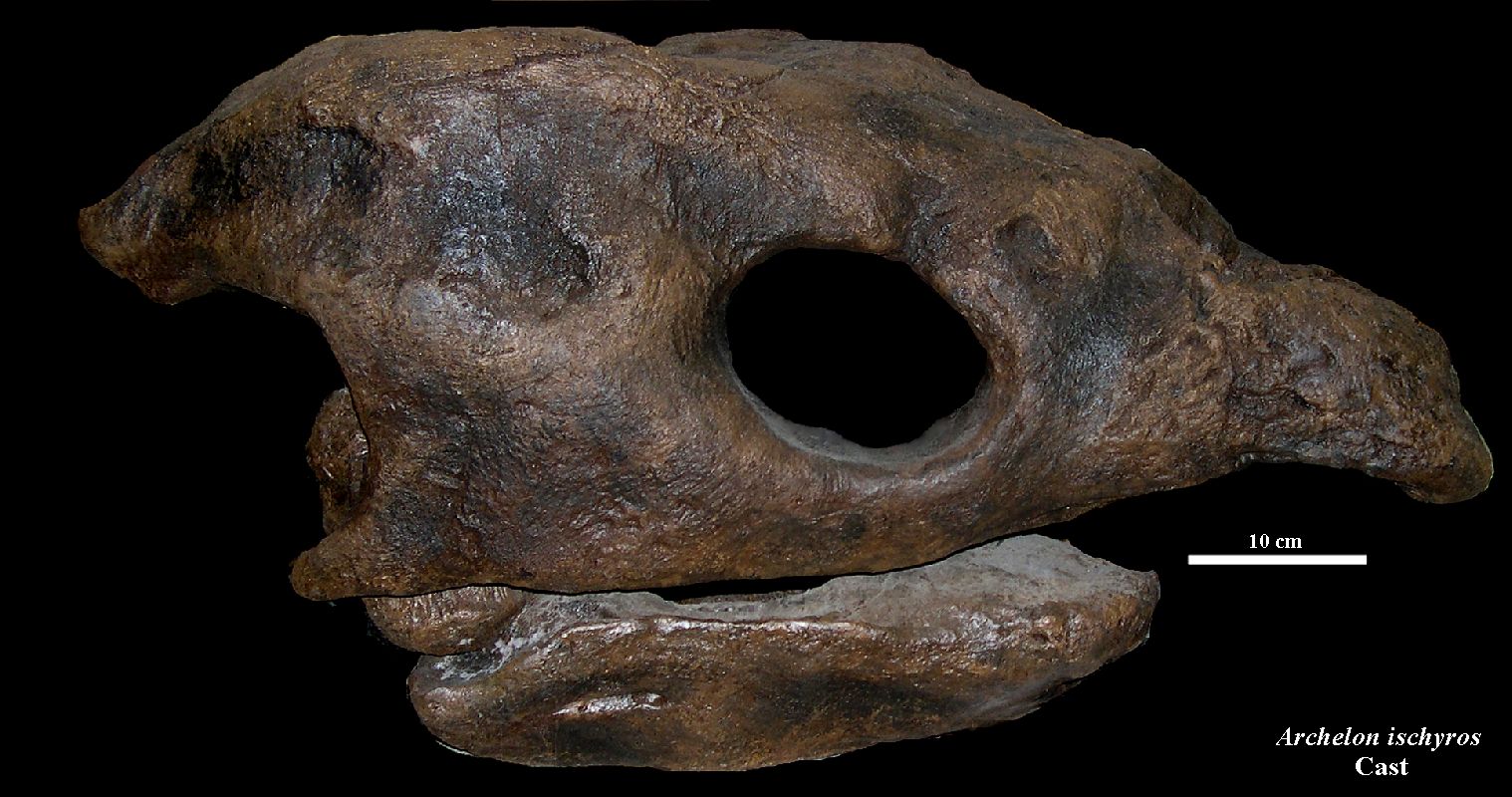
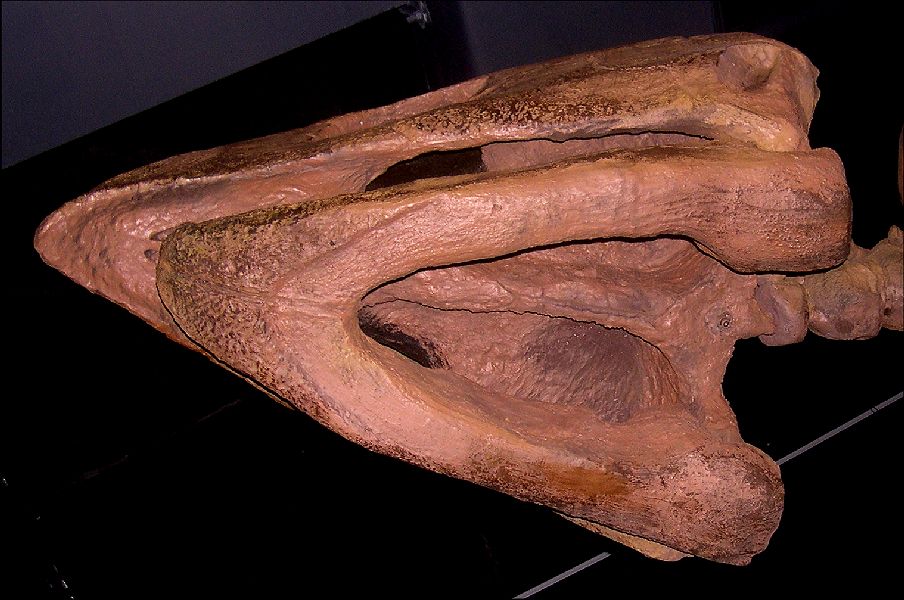
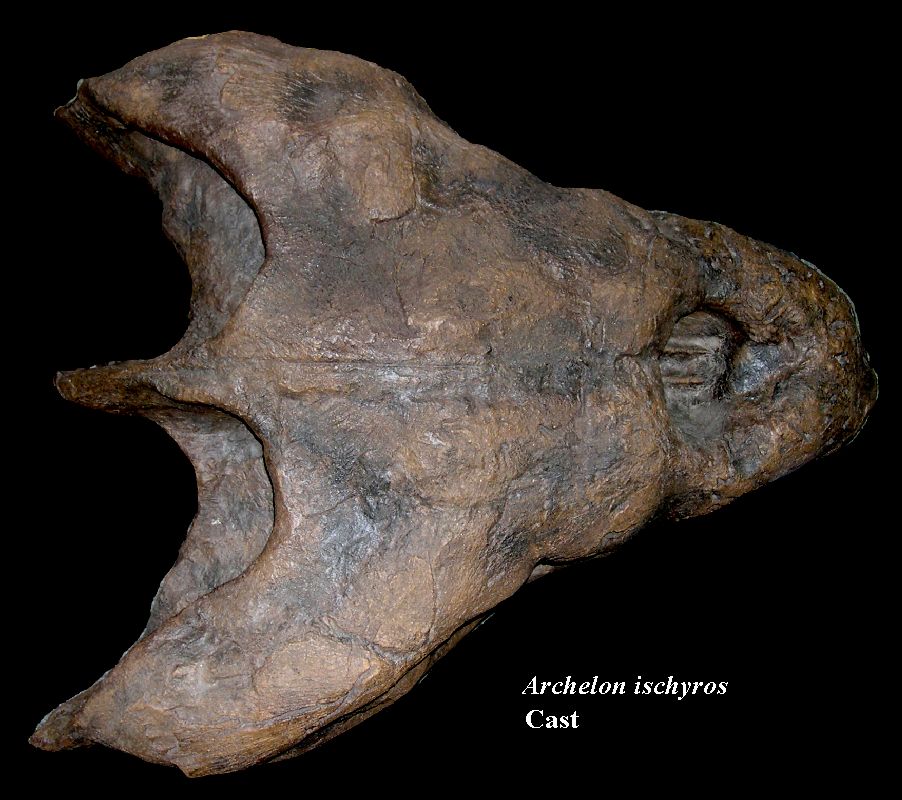
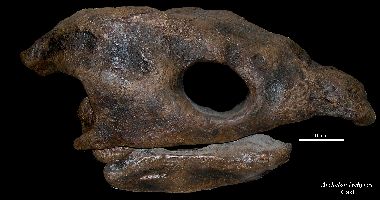
RIGHT: The cast of a very large Archelon ischyros skull from South Dakota (Vienna specimen- below). Scale is 10 cm (about 4 inches). A
dorsal view of the skull is HERE |
 |
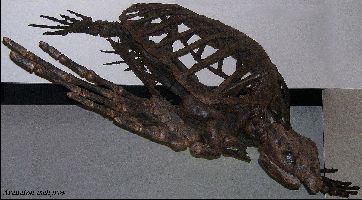 |
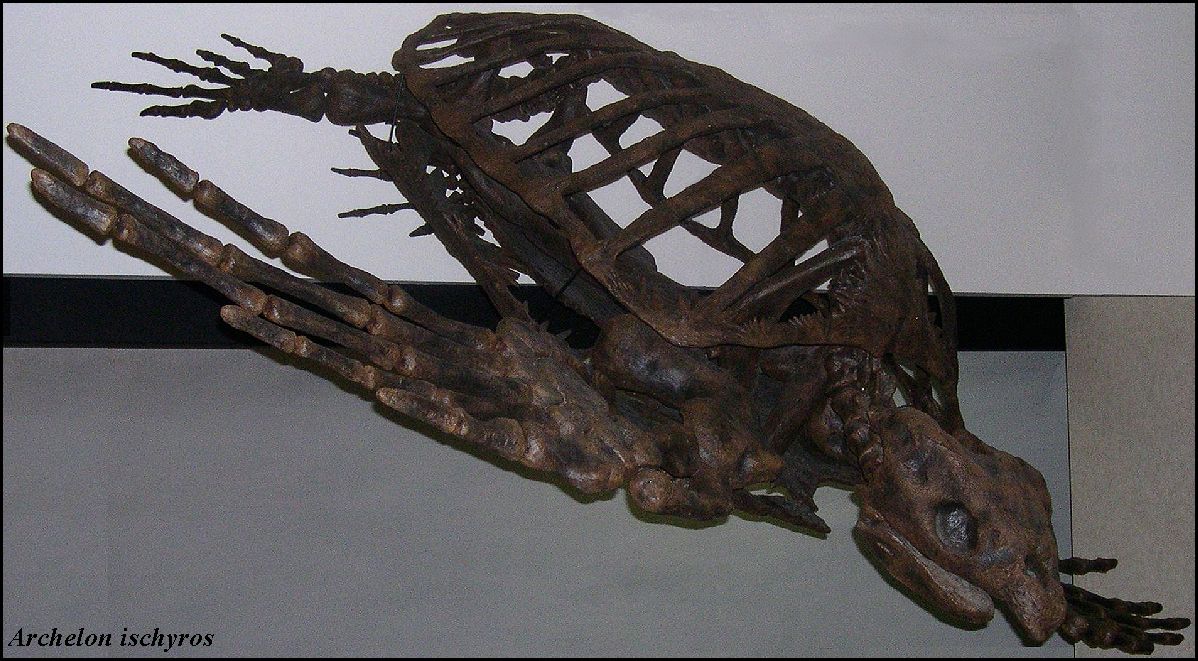
LEFT: A cast of the "Vienna Archelon"
recently on display at the Sternberg Museum of Natural History, Hays, KS. The original
specimen was found in 1976 in the upper Pierre Shale of South Dakota and is on exhibit in
the National Natural History Museum in Vienna, Austria. It measures about 15 feet from the
tip of the beak to the tip of the tail... and about 16.5 feet across the outstretched
front paddles. More information
HERE. |
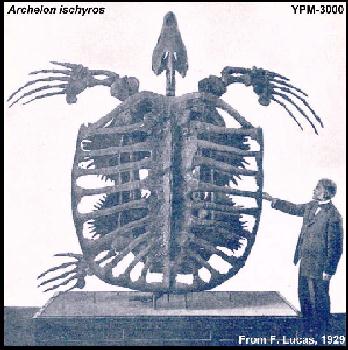 |
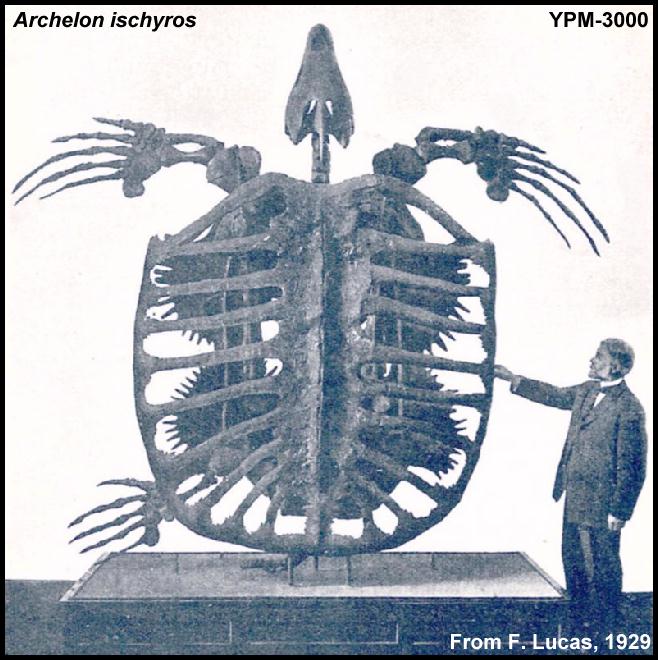
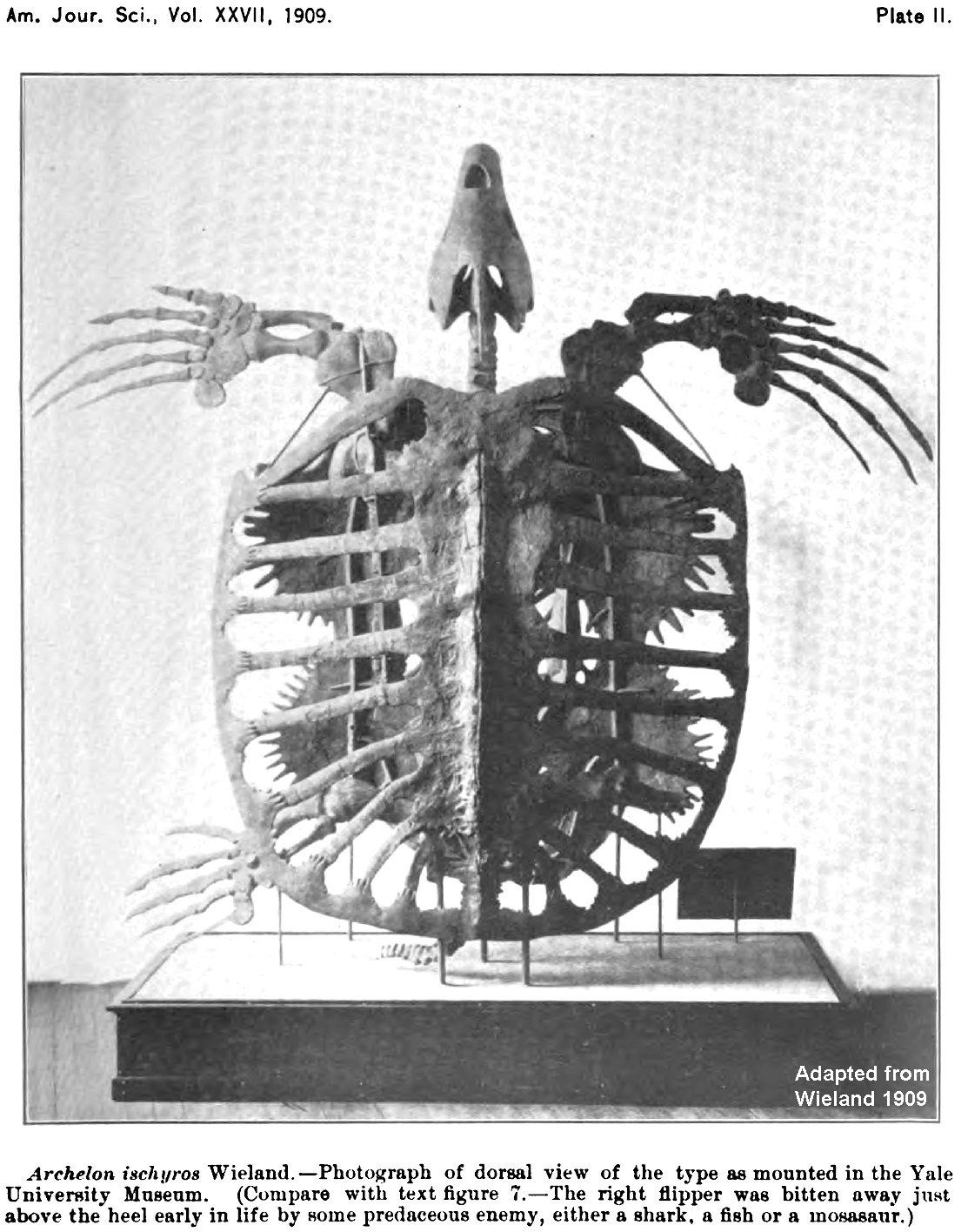
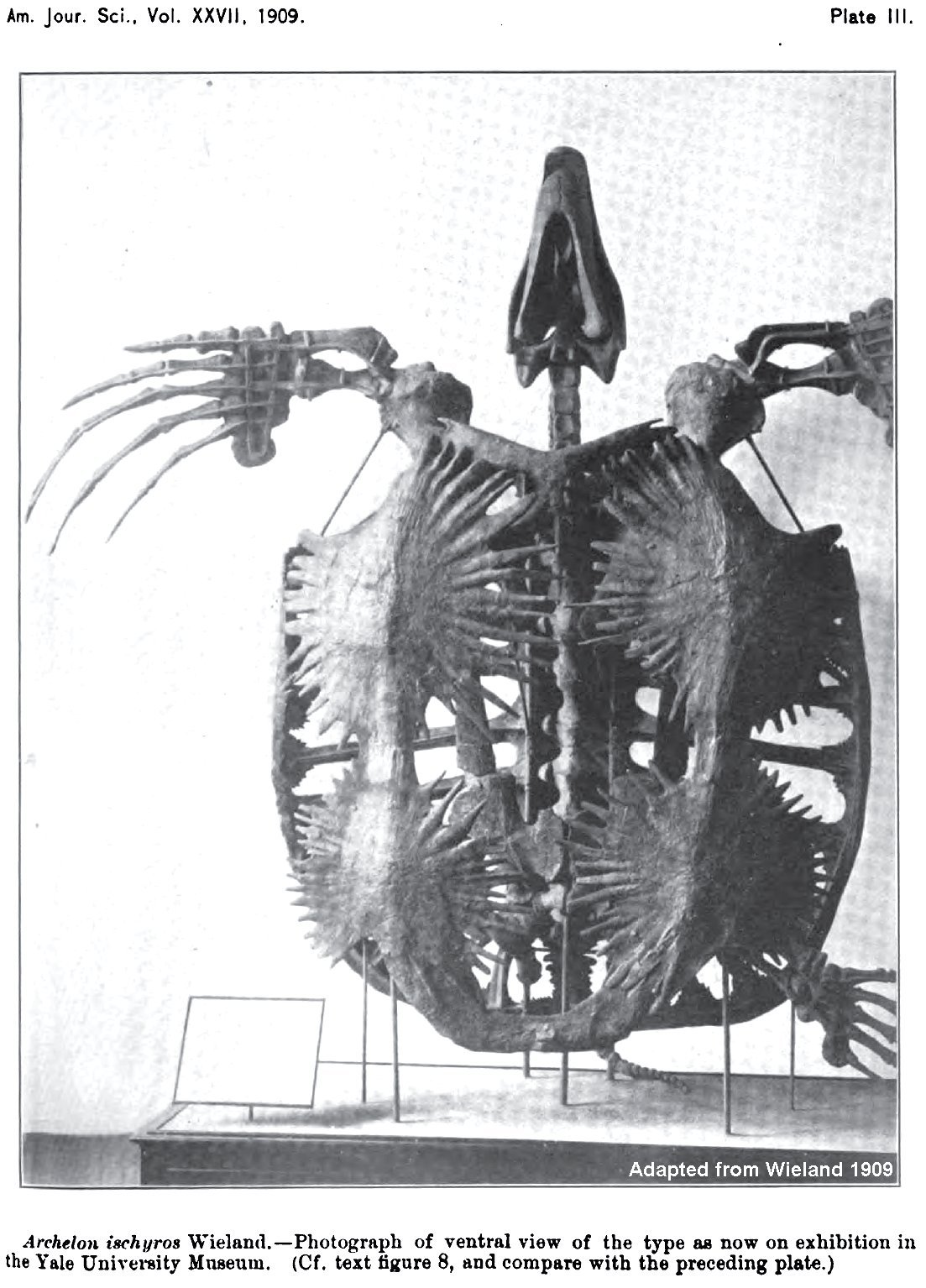
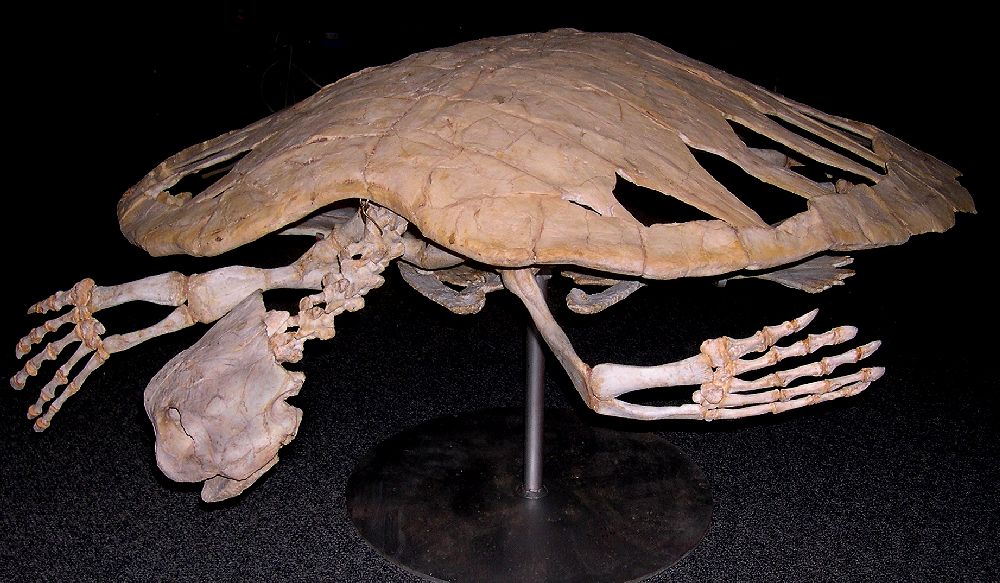
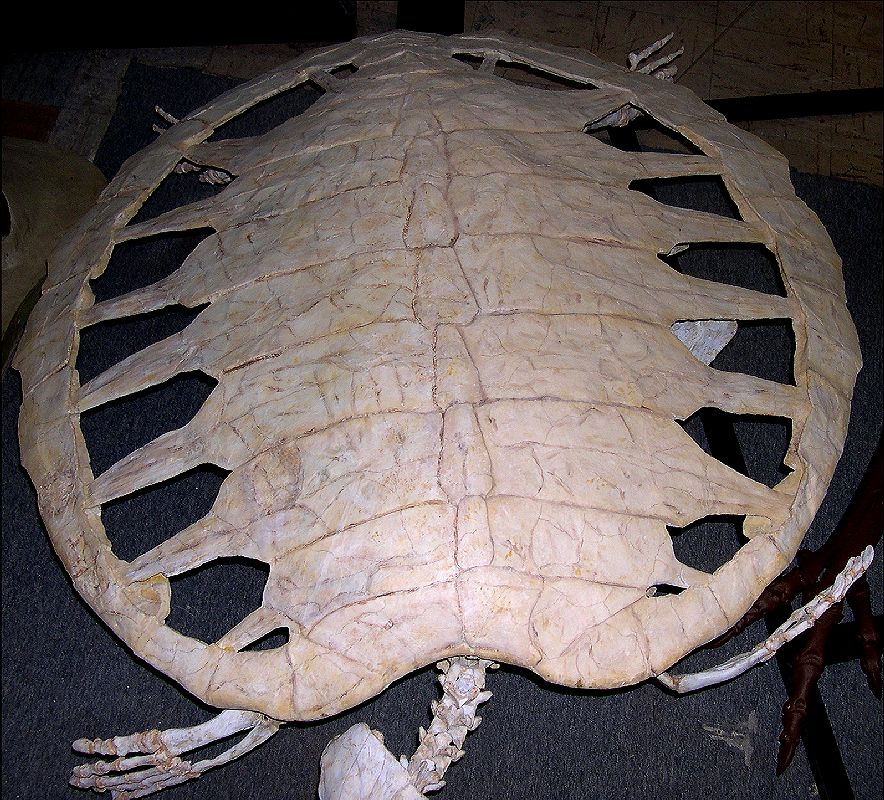
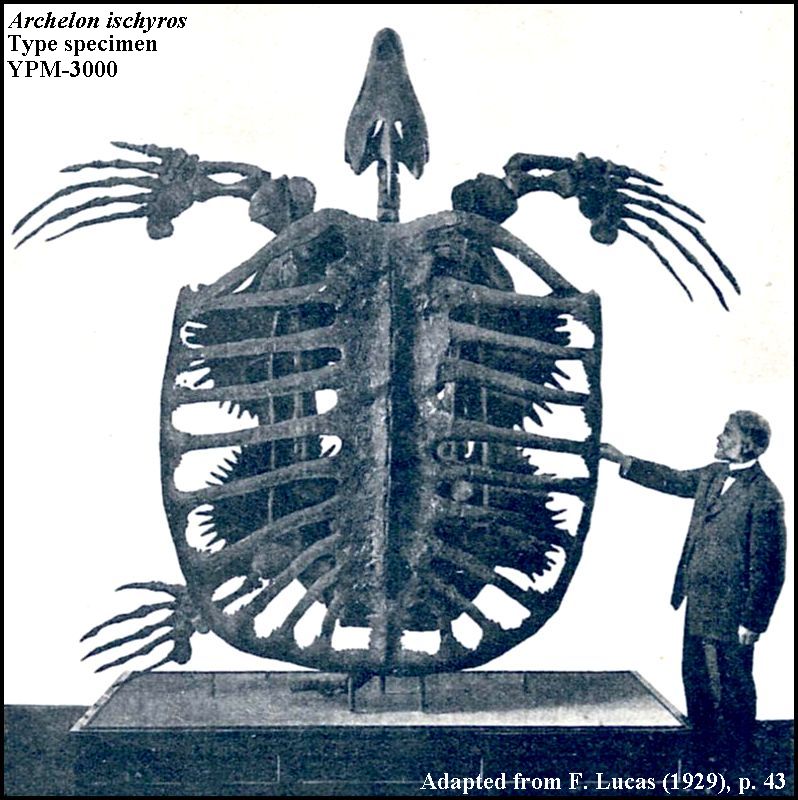
LEFT (Dorsal) AND RIGHT (Ventral): Old pictures
of the type specimen of the protostegid Archelon ischyros (YPM-3000) in the
Yale Peabody Museum. It was collected from the upper Pierre Formation of South Dakota in
1895 by Dr. G. R. Wieland, and described by him in 1896. While very similar to Protostega,
it is much larger and lived several million years after the Smoky Hill Chalk species.
(Click on LEFT photo to enlarge) .... A larger view is HERE
|
 |
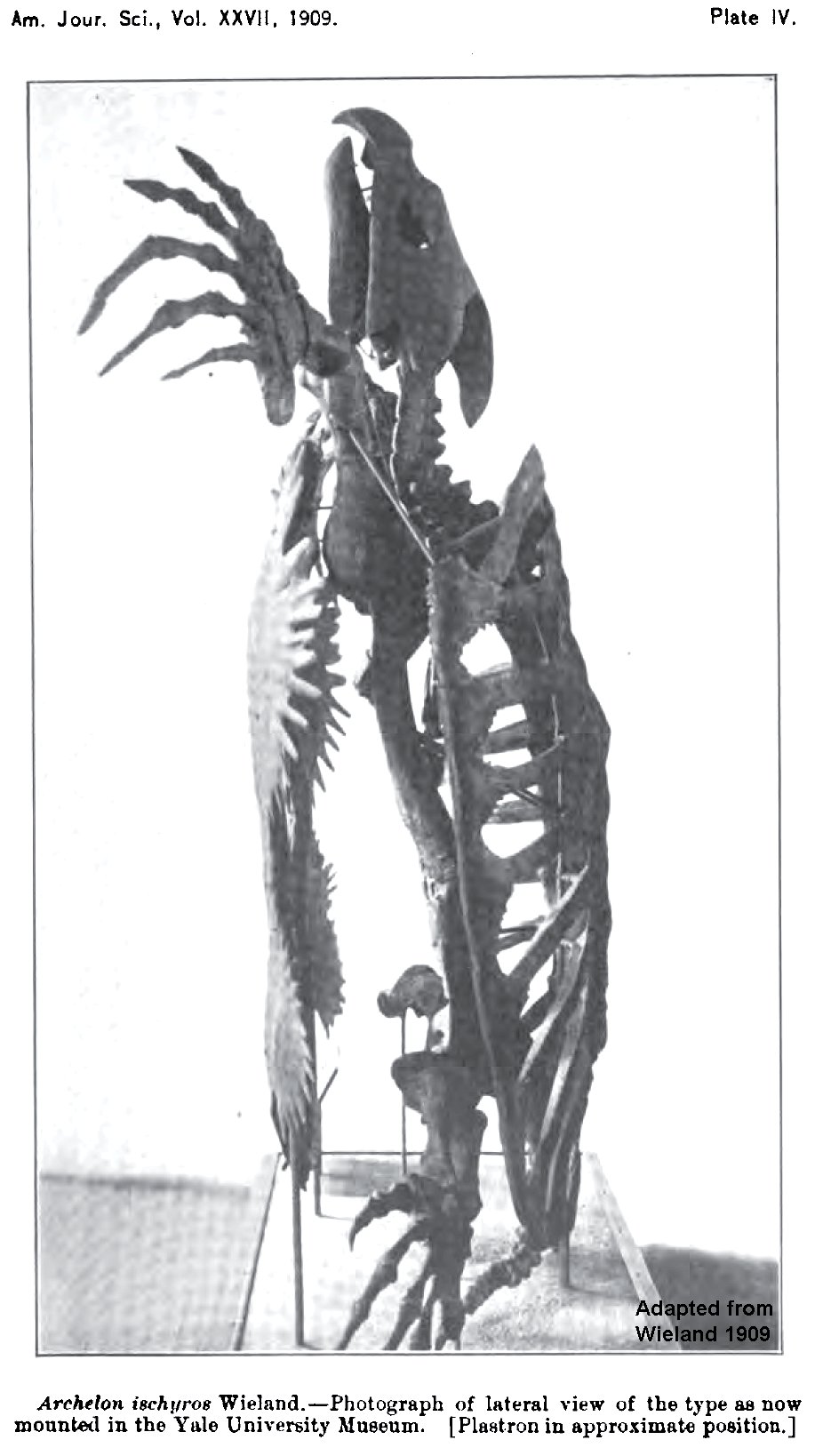
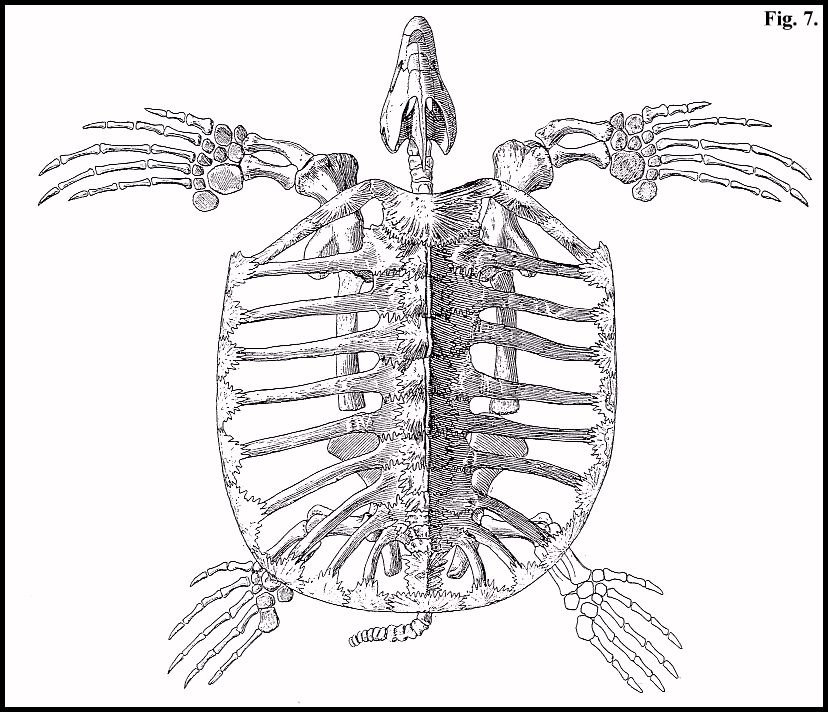
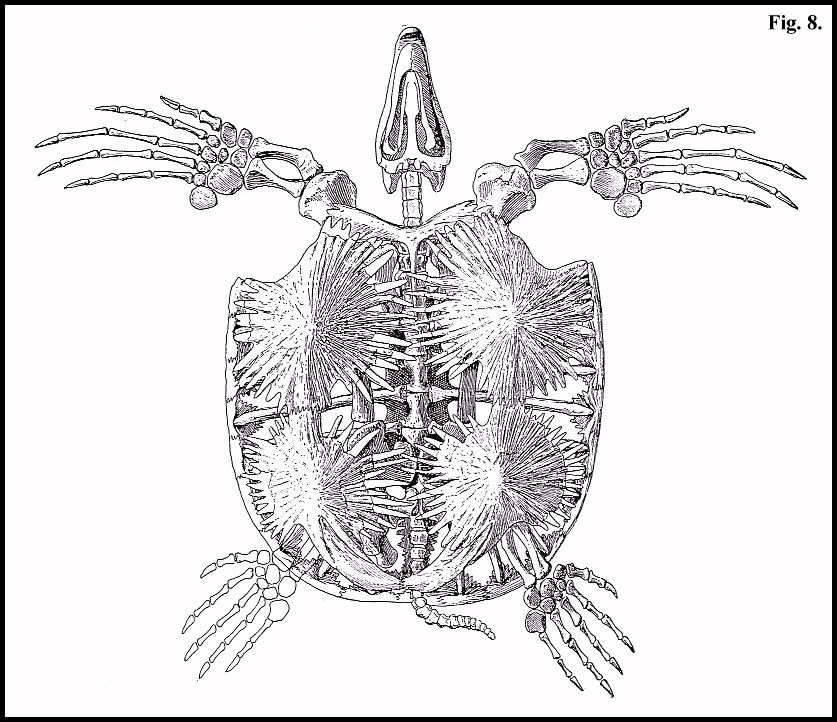
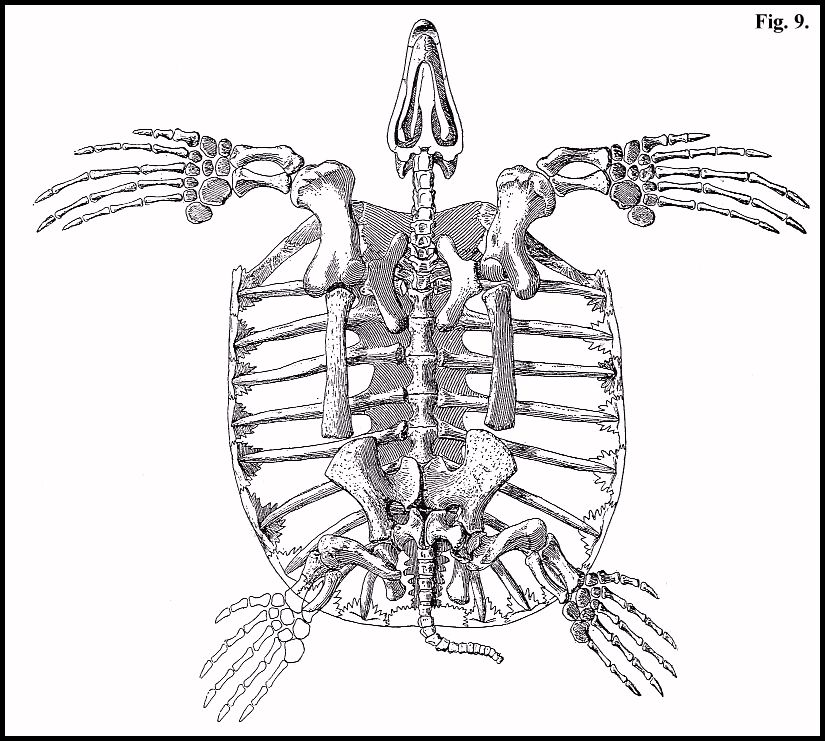
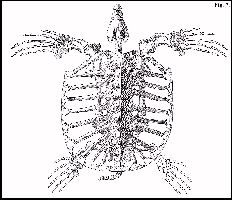
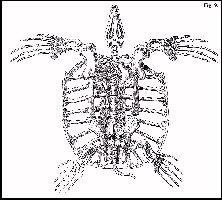
| BELOW, left to right -- Drawings from Wieland (1909) of the
same skeleton of Archelon: 1) From above; 2) From below without plastron; and, 3)
From below, with plastron. Note the missing right rear limb. Wieland (1909)
explained that the right tibia and fibula had been "cleanly
severed" at sometime before the turtle died. The right femur is
intact. |
 |
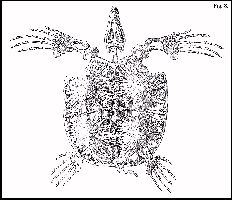 |
Archelon ischyros, adapted from Wieland, 1909. (CLICK TO
ENLARGE)
FAR LEFT: Dorsal view
LEFT: Ventral view
RIGHT: Ventral view, plastron removed. |
 |
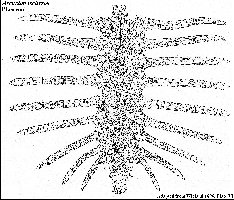 |
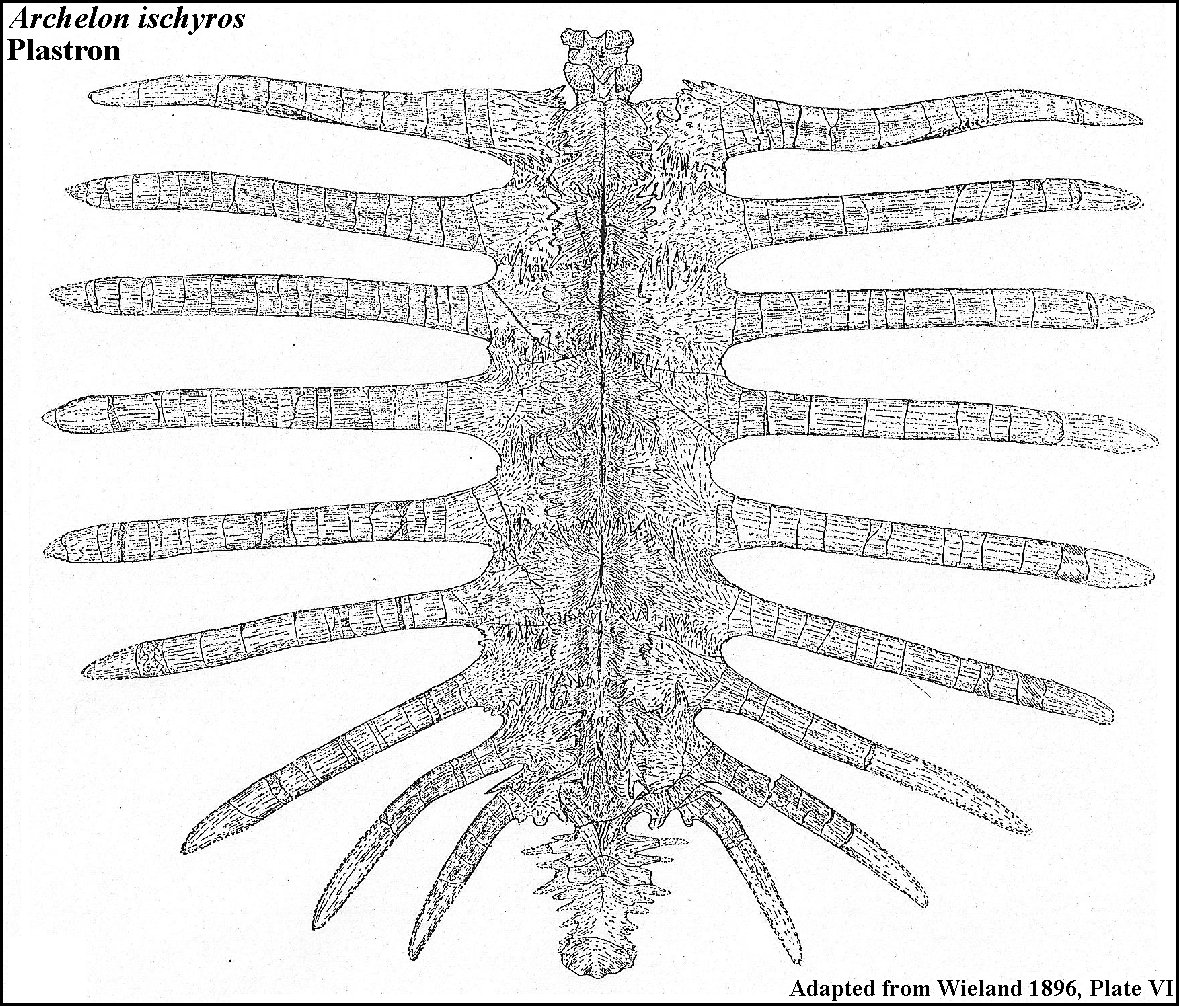
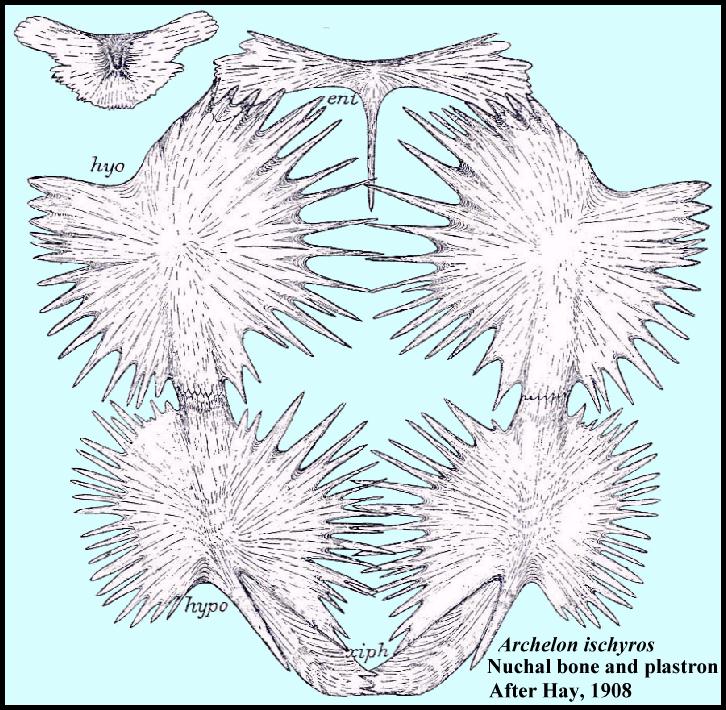
LEFT: The carapace and ribs of Archelon ischyros (adapted
from Wieland, 1896)
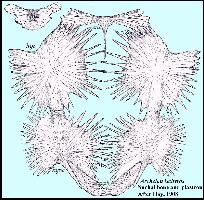
RIGHT: The plastron (lower shell) of Archelon ischyros (adapted from Hay (1908), originally from Wieland (1898)). Note that Wieland was unsure
that Archelon was a separate genus in the Protostegidae, and briefly renamed his A.
ischyros as Protostega ischyra in order to include it within that genus. The
revision was brief and was not accepted. (head is to the top) |
 |
LARGE MARINE TURTLES FROM EUROPE - THE NETHERLANDS (Maastrichtian Age)
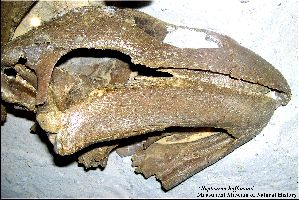 |
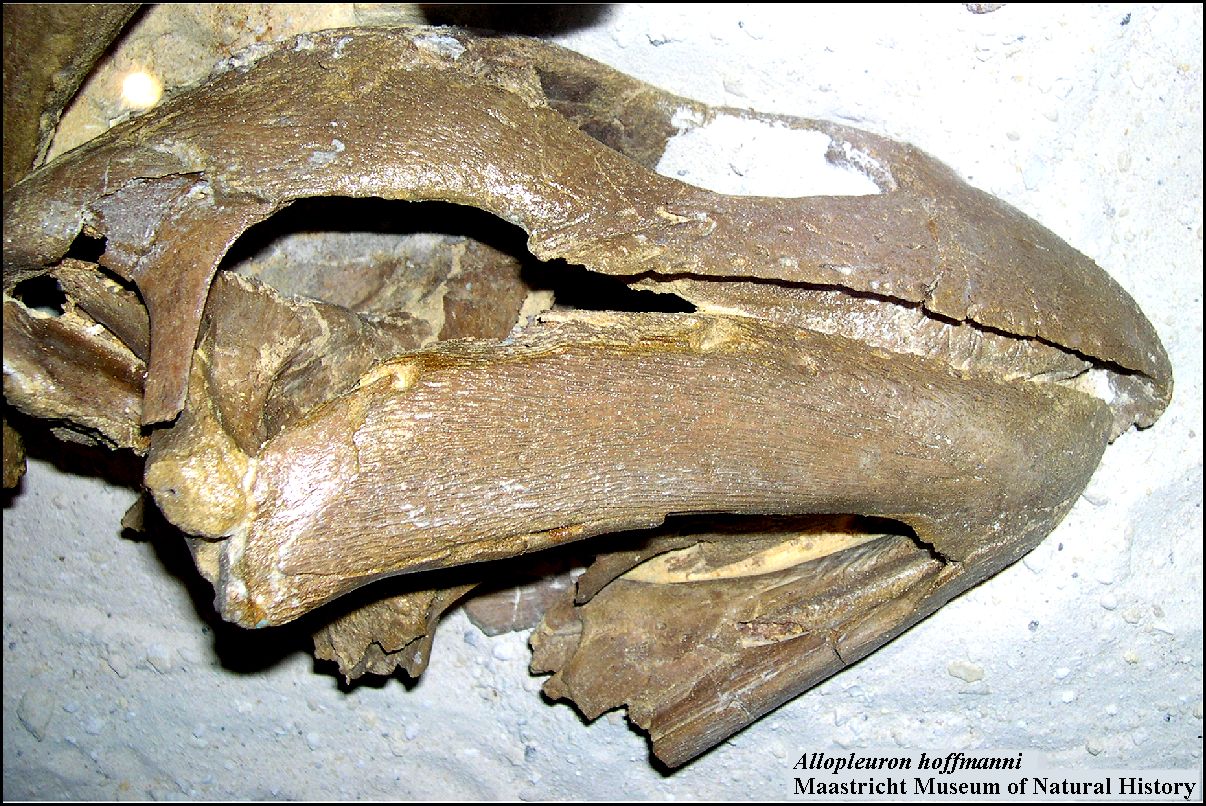
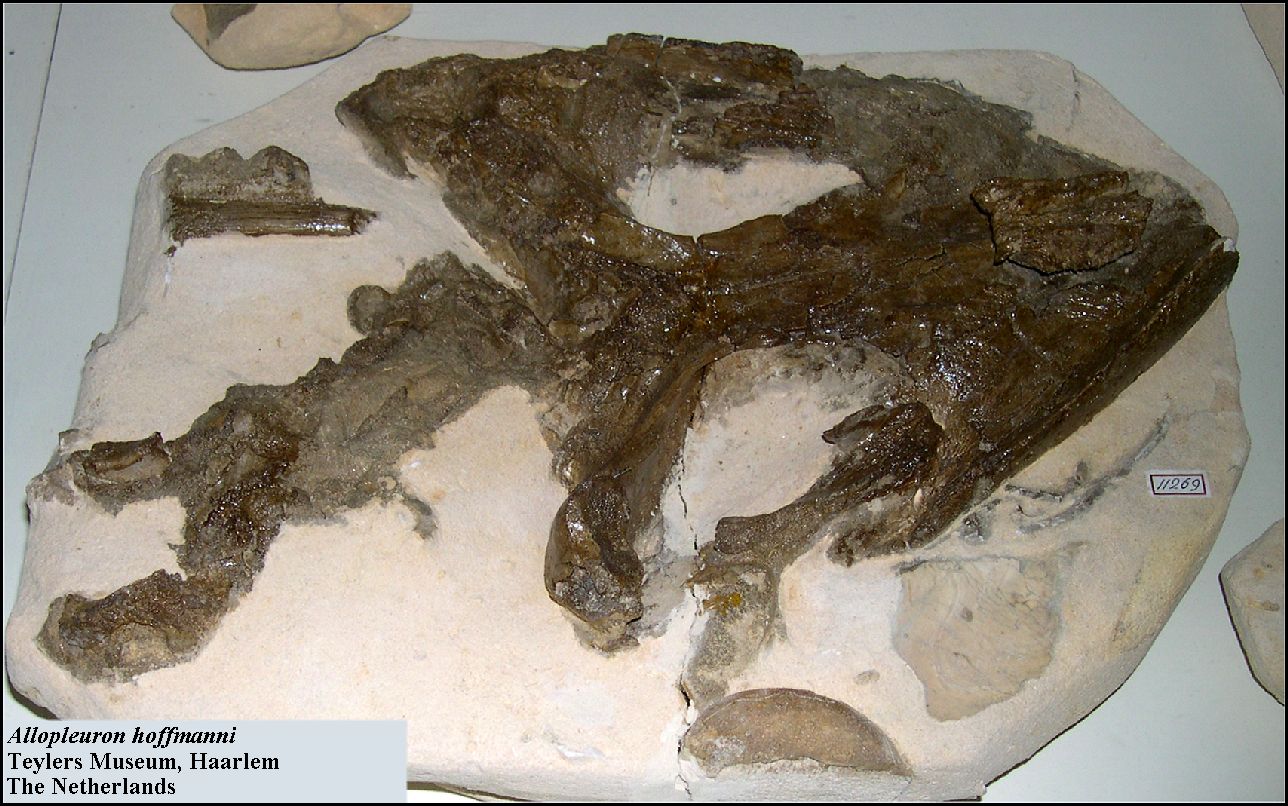
LEFT: The very well preserved skull of Allopleuron hoffmanni,
associated with a large part of the skeleton in exhibits of the Maastricht Museum of
Natural History, Maastricht, The Netherlands.
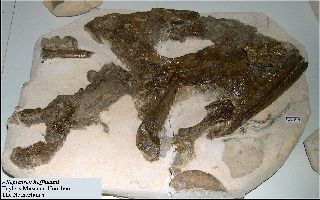
RIGHT: The crushed skull
of Allopleuron hoffmanni in the exhibits of the Teylers Museum, Haarlem, The
Netherlands. |
 |
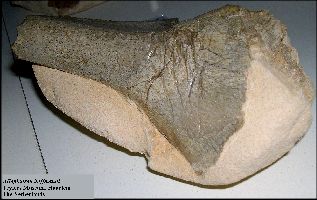 |
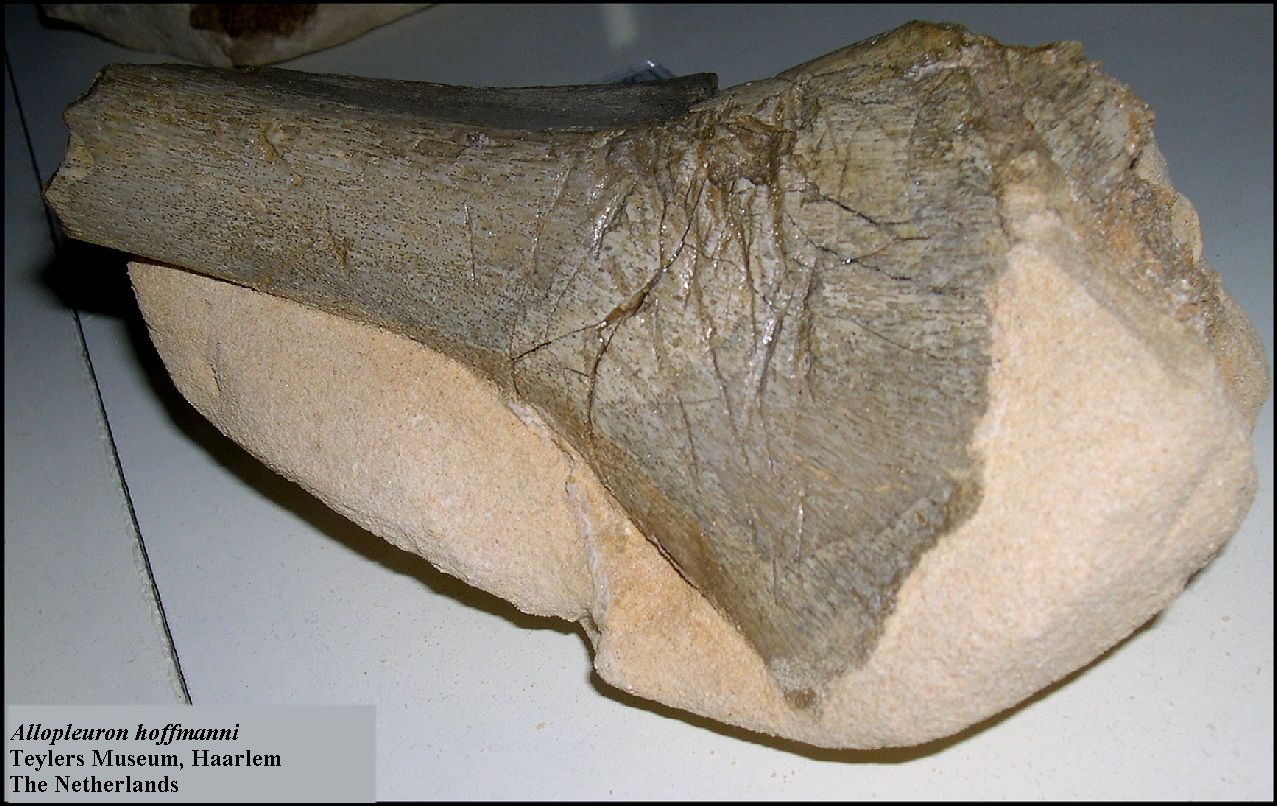
LEFT: A fragment of turtle bone showing bite marks in the exhibits
of the Teylers Museum, Haarlem, The Netherlands.
RIGHT: A fragment of a
turtle carapace showing the results of a crushing bite by a large mosasaur, probably Prognathodon,
in the exhibits of the Teylers Museum, Haarlem, The Netherlands. |
 |
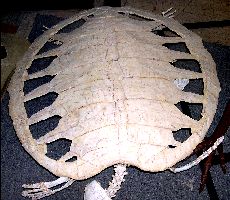
LARGE MARINE TURTLE FROM MOROCCO (Upper Campanian - Maastrichtian AGE)
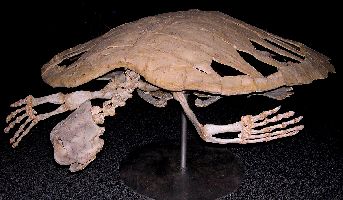 |
LEFT: A large marine turtle from the phosphates of Morocco
(Currently undescribed).
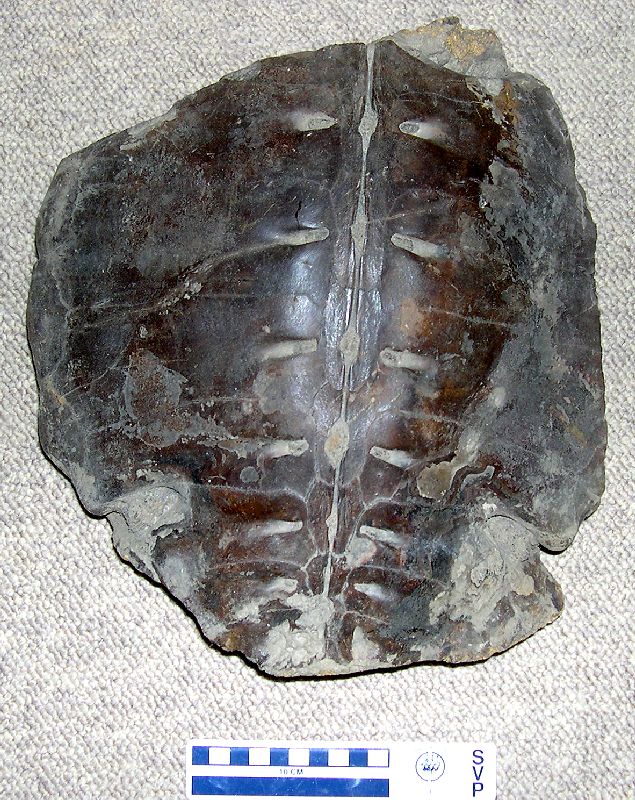
RIGHT: A dorsal view of the shell of a large
marine turtle from the phosphates of Morocco. |
 |
| This Oceans of Kansas Paleontology web page has been selected as a
resource by the Encyclopedia Britannica (October 2006). Click here to search for more
information on prehistoric and modern marine turtles: |
 |
Suggested references:
Agassiz, L. 1849.
[Remarks on crocodiles of the Green sand of New Jersey and on Atlantochelys].
Proceedings of the Academy of Natural Sciences of Philadelphia. 4:169.
Baird,
D. 1978. Pneumatoarthrus Cope, 1870, not a dinosaur but a sea-turtle.
Proceedings of the Academy of Natural Sciences of Philadelphia 129(4):71-81.
Baird,
D. 1984. Evidence of giant protostegid sea-turtles in the Cretaceous of New
Jersey. The Mosasaur 2:135-140.
Baur, G. 1886. Osteologische Notizen uber Reptilien.
Zoologischer Anzeiger 9:685-690, 733-743.
Baur,
G. 1889. Die systematische Stellung von DermochelysBlainv. Biologisches
Zentralblatt, 9:149–153,
180-191, 618-619.
Baur, G. 1896. Ueber die Morphologie des Unterkiefers der
Reptilien. Anatomischer Anzeiger 11:410-415.
Baur,
G. 1896. Bemerkungen über die Phylogenie der Schildkröten. Anatomischer
Anzeiger 12:561-570.
Beamon, J.C. 1999. Depositional environment and fossil biota
of a thin clastic unit of the Kiowa Formation, Lower Cretaceous (Albian), McPherson
County, Kansas. Unpublished MS Thesis, Fort Hays State University, Hays, KS, 97 p. (oldest
reported Cretaceous turtle remains in Kansas)
Brinkman,
D., Hart, M., Jamniczky, H., and Colbert, M. 2006. Nicholisemys baieri gen.
et sp. nov, a primitive chelonioid turtle from the late Campanian of North
America. Paludicola 5(4):111-124.
Carrino,
M.H. 2007. Taxonomic comparison and stratigraphic distribution of Toxochelys(Testudines: Cheloniidae) of South Dakota. pp. 111-132 in Martin, J.E. and Parris D.C.
(eds.), The Geology and Paleontology of the Late Cretaceous Marine Deposits of
the Dakotas. Geological Society of America, Special Paper 427.
Case, E.C. 1897. On the osteology and
relationship of Protostega. Journal of Morphology 14:21-60, pl. 4-6.
Case, E.C. 1898. Toxochelys. The University
Geological Survey of Kansas, Part IV. 4:370-385. pls. 79-84.
Cope, E.D. 1870. Observations on the Reptilia of the
Triassic formations of the Atlantic regions of the United States. Proceedings of the
American Philosophical Society 11(84):444-446. (includes the description of Pneumatoarthrus
peloreus, senior synonym of Archelon, Wieland 1896)
Cope, E.D. 1872. [Sketch of an expedition in the valley of
the Smoky Hill River in Kansas]. Proceedings of the American Philosophical Society
12(87):174-176. (meeting of October 20, 1871)
Cope, E.D. 1872. On a new Testudinate from the chalk of
Kansas. Proceedings of the American Philosophical Society 12(88):308-310. (Cyanocercus
incisus )
Cope, E.D. 1872. A description of the genus Protostega,
a form of extinct Testudinata. Proceedings of the American Philosophical Society
12(88):422-433. (March 1, 1872)
Cope, E.D. 1872. On the geology and paleontology of the
Cretaceous strata of Kansas. Annual Report of the U. S. Geological Survey of the
Territories 5:318-349 (Report for 1871).
Cope,
E.D. 1872. [On a species of Clidastes and Plesiosaurus guloCope]. Proceedings of the Academy of Natural Sciences of Philadelphia 29:127-124
Cope, E.D. 1873. [On Toxochelys latiremis].
Proceedings of the Academy of Natural Sciences of Philadelphia 25:10.
Cope, E.D. 1875. The Vertebrata of the Cretaceous formations
of the West. Report, U. S. Geological Survey Territories (Hayden). 2:302 p, 57 pls.
Cope, E.D. 1877. On some new or little known reptiles and
fishes of the Cretaceous of Kansas. Proceedings of the American Philosophical Society
17(100):176-181. (Toxochelys latiremis Cope: issue of May-Dec., 1877, printed Nov.
20, 1877)
Derstler,
K. 1994. Evolutionary history of sea turtles. Journal of Vertebrate Paleontology
15(suppl. to no. 3):23A.
Derstler,
K., A. D. Leitch, P. L. Larson, C. Finsley and L. Hill, 1993. The world's
largest turtles - The Vienna Archelon (4.6 m) and the Dallas Protostega(4.2 m), upper Cretaceous of South Dakota and Texas. Journal of Vertebrate
Paleont. 13(suppl. to no. 3):33A.
Dollo, L. 1887. Le hainosaure et les nouveaux vertébrés
fossiles du Musée de Bruxelles. Revue des Questions Scienfiques XXI 504-539.
(April 1887)
Dollo, L. 1887. Le hainosaure et les nouveaux vertébrés fossiles du Musée de
Bruxelles. Revue des Questions Scienfiques XXII 70-112. (July 1887)
Druckenmiller, P.S., Daun, A.J., Skulan,
J.L. and Pladziewicz, J.C. 1993. Stomach contents in the upper Cretaceous shark Squalicorax falcatus.
Journal of Vertebrate Paleontology. 13(supplement. to no. 3):33A.
Elliott,
D.K., Irby, G.V. and Hutchinson, J.H. 1997. Desmatochelys lowi, a marine
turtle from the Upper Cretaceous. pp. 243-258 in Callaway, J.M. and Nicholls,
E.L. (eds.). Ancient Marine Reptiles, Academic Press, San Diego.
Everhart, M.J. and Pearson, G. 2008. First report on a
marine turtle from the Fairport Chalk Member of the Carlile Shale of Mitchell County,
Kansas. Kansas Academy of Science,
Transactions 112(1-2):138-139
(Abstract).
Gudger,
E.W. 1949. Natural history notes on tiger sharks, Galeocerdo tigrinis, caught
in Key West, Florida with emphasis on food and feeding habits. Copeia 1949: 39-47, pl.
1-2.
Hay, O.P. 1895. On certain portions of the skeleton of Protostega gigasCope. Publications of the Field Columbian Museum, Zoological Series (later Fieldiana:
Zoology) 1(2):57-62, pls.
4 & 5.
Hay, O.P. 1896. On the skeleton of Toxochelys latiremis.Publ. Field Columbian Museum, Zoological Ser. (later Fieldiana: Zoology), 1(5):101-106,
pls. 14 &15.
Hay, O.P. 1905. A revision of the species of the family
of the fossil turtles called Toxochelyidae with descriptions of two new species
of Toxochelys and a new species of Porthochelys. American
Museum
of Natural History Bulletin 21(10):177-185.
Hay, O.P. 1908. The fossil turtles of North America.
Carnegie Institution of Washington, Publication No. 75, 568 pp, 113 pl.
Hirayama, R. 1994. Phylogenetic
systematics of chelonioid sea turtles. The Island Arc 3:270-284.
Hirayama, R.
1997. Distribution and diversity of Cretaceous cheloniids. pp. 225-241 in
Callaway, J.M. and Nicholls, E.L. (eds.), Ancient
Marine Reptiles, Academic Press, San Diego.
Holder, C.F. 1885.
Monster sea-turtle found in Kansas. Kansas City Review of Science and Industry
9(5):333-334.
Hooks, G.E., III. 1998. Systematic revision of the
Protostegidae, with a redescription of Carcarichelys gemma Zangerl, 1957. Journal
of Vertebrate Paleontology, 18(1):85-98.
Kear, B.P. 2006.
First gut contents in a Cretaceous sea turtle. Biological Letters 2:113-115.
Konuki, R. 2008.
Biostratigraphy of sea turtles and possible bite marks on a Toxochelys (Testudine,
Chelonioidea) from the Niobrara Formation (Late Santonian), Logan County, Kansas and paleoecological implications for predator-prey relationships among large
marine vertebrates. Unpublished Masters thesis, Fort Hays State University, Hays, Kansas , 141 pp, Appen. I-VI.
Lane, H.H. 1946, A survey of the fossil vertebrates of
Kansas, Part III, The Reptiles, Kansas Academy Science, Transactions 49(3):289-332, 7
figs.
Lehman, T.M. and Tomlinson, S.L. 2004. Terlinguachelys
fischbecki, a new species of sea turtle (Chelonioidea: Protostegidae) from
the Upper Cretaceous of Texas. Journal of Paleontology 78(6):1163-178.
Leidy, J. 1865. Cretaceous reptiles of the United
States. Smithsonian Contributions to Knowledge 14(192):1-135, pls. 1-20.
Manning, E.M. 1994. Dr. William Spillman (1806-1886),
pioneer paleontologist of Mississippi. Mississippi Geology. 15(4):64-69.
Matzke, A.T. 2007. An almost complete juvenile
specimen of the cheloniid turtle Ctenochelys stenoporus (Hay, 1905) from
the Upper Cretaceous Niobrara Formation of Kansas, USA. Palaeontology 50(3):669-691.
Matzke,
A.T. 2008. A juvenile Toxochelys latiremis (Testudines, Cheloniidae) from the Upper
Cretaceous Niobrara Formation of Kansas, USA . Neues Jahrbuch für Geologie und Paläontologie. Abhandlungen 249(3):371-380.
Matzke, A.T. 2009. Osteology of the skull
of Toxochelys (Testudines,
Chelonioidea) (with 25 text-figures). Palaeontographica Abteilung A
288(4):93-150.
Moodie,
R.L. 1908, The relationship of the turtles and plesiosaurs, Kansas University
Science Bulletin, 4(15):319-32.
Mulder, E.W.A. 2003. On latest Cretaceous tetrapods from the Maastrichtian type
area. Publicaties van het Natuurhistorisch Genootshap in Limburg, Reeks XLIV, aflevering
1.Stichting Natuurpublicaties Limburg, Maastricht.
Nicholls, E.L. 1988. New material of Toxochelys latiremisCope, and a revision of the genus Toxochelys (Testudines, Chelonoidea). Journal of
Vertebrate Paleontology, 8(2):181-187.
Nicholls, E.L.
1992. Note on the occurrence of the marine turtle Desmatochelys (Reptilia:
Chelonioidea) from the Upper Cretaceous of Vancouver Island. Canadian
Journal of Earth Sciences 29:377-380.
Nicholls, E.L., Tokaryk, T.T. and Hills, L.V. 1990. Cretaceous
marine turtles from the Western Interior Seaway of Canada. Canadian Journal
Earth Sciences 27:1288-1298.
Osborn,
H.F. 1904. Field expeditions during the past season. Science N.S. 19(470):35-36.
Parmenter,
C.S. 1899. Fossil
turtle cast from the Dakota epoch. Kansas Academy of Science, Transactions
16:67.
Parris,
D.C., DeTample, C. and Benton, R.C. 1986. Osteological notes on the fossil
turtle ?Dollochelys atlantica (Zangerl). The Mosasaur 3:97-108.
Renger, J.J. 1935. Excavation of Cretaceous
reptiles in Alabama. Science Monthly 41:560-565.
Roth, D.D. and Everhart, M.J. 2012. Preparation of
a protostegid turtle from the Fairport Chalk (Carlile Formation, Late
Cretaceous). Kansas Academy of Science, Transactions 115(1-2):71-72.
Rothschild,
B.M. 1987. Decompression syndrome in fossil marine turtles. Annals of Carnegie
Museum 56(15):253-258.
Russell, D.A. 1993. Vertebrates in
the Western Interior Sea. Pages 665-680 in Caldwell, W. G. E. and E. G. Kaufmann,
eds., Evolution of the Western Interior Basin, Geological Association of Canada. Special
Paper 39.
Schmidt, K.P. 1940. A new turtle of the genus Podocnemis from the Cretaceous of
Arkansas. Field Museum of Natural History, Geoloogical Series 8(1):1-12, 5
figs.
Schmidt, K.P. 1944. Two new thalassemyd turtles from the
Cretaceous of Arkansas. Field Museum of Natural History, Geological Series 8(11):63-74.
Shimada, K., Everhart, M.J. and Hooks, G.E. 2002.
Ichthyodectid fish and protostegid turtle bitten by the Late Cretaceous lamniform shark, Cretoxyrhina
mantelli. Journal of Vertebrate Paleontology 22(supplement. to
3):106A. (Abstract)
Sternberg, C.H. 1884. Directions for collecting vertebrate
fossils. Kansas City Review of Science and Industry 8(4):219-221.
Sternberg, C.H. 1899. The
first great roof. Popular Science News 33:126-127, 1 fig.
Sternberg, C.H. 1905. Protostega gigas and other
Cretaceous reptiles and fishes from the Kansas chalk. Kansas Academy Science, Transactions
19:123-128.
Sternberg, C.H. 1906. Some animals
discovered in the fossil beds of Kansas. Kansas Academy of Science, Transactions
20:122-124.
Sternberg, C.H. 1907. My
expedition to the Kansas Chalk for 1907. Kansas Academy of Science, Transactions
21:111-114.
Stewart, J.D. 1978. Earliest record of the Toxochelyidae.
Kansas Academy of Science, Transactions 81(2):178 (abstract).
Stewart, J.D. 1990. Niobrara
Formation vertebrate stratigraphy, pages 19-30, In Bennett, S. C. (ed.), Niobrara
Chalk Excursion Guidebook, The University of Kansas Museum of Natural History and the
Kansas Geological Survey.
Wagner, G. 1898. On some turtle remains from the Fort Pierre.
Kansas University Quarterly 7(4):201-203.
Wieland, G.R. 1896. Archelon ischyros: a new gigantic
cryptodire testudinate from the Fort Pierre Cretaceous of South Dakota. American Journal
of Science, 4th Series 2(12):399-412, pl. v.
Wieland, G.R. 1900. Some observations on certain well-marked
stages in the evolution of the testudinate humerus. American Journal of Science, 4thSeries, 9(54):413-424, with 23 text fig.
Wieland, G.R. 1902. Notes on the Cretaceous turtles, Toxochelysand Archelon, with a classification of the marine Testudinata. American
Journal of Science, Series 4, 14:95-108, 2 text-figs.
Wieland, G.R. 1903. Notes on the marine turtle Archelon. I. On the structure of the carapace, II. Associated fossils.
American Journal of Science 15:211-216.Wieland, G.R. 1905. A new Niobrara Toxochelys.
American Journal of Science 20(119):325-343, pl. X, 8 text-figs.
Wieland, G.R. 1906. The osteology of Protostega,
Memoirs of the Carnegie Museum, 2(7):279-305.
Wieland, G.R. 1909. Revision of the Protostegidae.
American Journal of Science, Series 4. 27(158):101-130, pls. II-IV, 12 text-figs.
Williston, S.W. 1894. A new turtle from the Benton Cretaceous. Kansas.
University Quarterly 3(1):5-18, with pl. II-VI.
Williston, S. W. 1898. Turtles. The University
Geological Survey of Kansas, Part VI. 4:349-369. pls. 73-78.
Williston, S.W. 1901. A new turtle from the Kansas
Cretaceous. Kansas Academy Science, Transactions 17:195-199.
Williston, S.W. 1902. On the hind limb of Protostega. American Journal
of Science, Series 4, 13(76):276-278, 1 fig.
Williston, S.W. 1914. Water reptiles of the past and present. Chicago
University Press. 251 pp.
Zangerl, R. 1953. The
vertebrate fauna of the Selma formation of Alabama, Part IV, the turtles of the family
Toxochelyidae. Fieldiana (Geology Memoirs): 3(4): 137 - 277.
Zangerl, R. 1980. Patterns of phylogenic
differentiation in the toxochelyid and chelonid sea turtles.
American Zoologist 20:585-596.
Zangerl, R. and R.E. Sloan. 1960. A new description of Desmatochelys
lowi (Williston). A primitive cheloniid sea turtle from the Cretaceous of South
Dakota. Fieldiana, Geology Memoirs 14:7-40.