PALEONTOLOGY ABSTRACTS
Copyright © by Mike Everhart: 2000-2013
Last updated 02/25/2013
|
PALEONTOLOGY ABSTRACTSCopyright © by Mike Everhart: 2000-2013Last updated 02/25/2013
|
"The ravines of the Niobrara exhibit many features in common with the cañons of the bad lands of Dakota and Nebraska, but on a diminutive scale. When a firm layer of chalky limestone overlies others of a softer texture, a narrow groove will be cut through the top, and then the wear goes on rapidly down to the level of the lower grounds. Frequently such cañons will be 100 feet long, 15 or 20 feet deep, and but 2 feet across the top, being wider below than above. These occur near each other, and then the ravines become quite labyrinthine; an intricate place for hunters or their enemies to hide. When these partitions between the cañons become detached from the hillsides and divided into sections, they stand as isolated. columns. Such are the well known Monument Rocks of the Smoky Hill Valley, in Wallace [now Logan] County, and Castle Rocks, of Ellis County. .The former stand as detached pillars, 20 to 40 feet high, in the valley, at quite a distance from the nearest parent bluffs. In the latter example, at the extreme western angle, a pillar like a detached bastion stands 200 yards from the Castle, 60 or 70 feet high, and only 20 feet through the base. The top is limestone, then chalk, while the base is firm blue shale. The valley around is perfectly level. At the eastern end of the Castle several smaller pillars seem to stand as sentinels in that direction. The top of the Castle, overlooking all, is covered by 10 feet of Pliocene sandstone. The writer regrets that these fanciful rocks have not been photographed, so that twenty years later other photographs might show the rate of abrasion. Rain, frost, and the hands of ruthless men are destroying many of these unique pinnacles. B. F. Mudge, 1877. |
The following is a listing of abstracts of papers, presentations or posters I have done or been a part of over the last several years (1991-2004). They are arranged in numerical order beginning in 1991. The blue-highlighted titles indicate clickable links for more information or the paper itself.
1991 Society of Vertebrate Paleontology Meeting - San Diego, CA
Stewart, J. D., P. A. Everhart and M. J. Everhart. 1991. Small coelacanths from upper Cretaceous rocks of Kansas. Journal of Vertebrate Paleontology 11(Supplement to 3):56A.
The first published record of Cretaceous coelacanths in North America comes from the Blufftown Formation (Campanian) of Alabama (Schwimmer et al., 1990). We here report the first Cretaceous coelacanths recognized from the Western Interior. The Fairport Chalk Member of the Carlile Shale Formation [mid-Turonian, zone of Collignoniceras woollgari (Mantell, 1822)] of Kansas has produced a few fragments of pterygoquadrates of a small coelacanth. Another such fragment associated with a plesiosaur skeleton assumed to be from the Smoky Hill Chalk Member of the Niobrara Chalk Formation of Kansas was the only other indication that there might be coelacanths in that formation. Cranial remains of a small coelacanth were recently collected in the zone of Spinaptychus n. sp. [= uppermost part of the zone of Volviceramus grandis (Conrad, 1875)]; late Coniacian) in the Smoky Hill Chalk Member in Gove County, Kansas. This specimen appears to be closely related to the Fairport Chalk specimens and is not Macropoma mantelli (Agassiz, 1835). It does not appear to represent M. precursor Woodward, 1909, but published accounts are insufficient to be certain. Differences in the quadrate and pterygoid distinguish the Kansas specimens from Axelrodichthys and Mawsonia.
1992 Kansas Academy of Science - Hutchinson Community College
Elongate ovoidal fossil structures composed almost entirely of broken shell fragment attributable to the epizootic oyster Pseudoperna congesta occur within a limited stratigraphic interval in the lower Smoky Hill Chalk Member, Niobrara Chalk of Western Kansas. More than seventy of these shelly structures have been examined to date. The structures average 42 mm in length by 26 mm in width and are less than 10 mm thick at the center. The stratigraphic interval containing these structures is a laminate olive gray chalk, approximately three meters in thickness which lies between Marker Units 4 and 5 in the composite section of Hattin (1982). The interval also corresponds to the lower portion of the biostratigraphic zone of Spinaptychus n. sp. proposed by Stewart (1990). Chalk in this area is of late Coniacian age and was deposited about 85 million years ago. Although these structures are similar in shape to some of the sand filled shrimp burrows that are found as fossils in the Mooreville Chalk of Alabama, there are significant differences. These shelly structures may be the coprolites from an as yet unknown predator that fed on colonies of oysters in the Western Interior Sea during the late Cretaceous. Nodules found in the Cretaceous (Turonian) of Greenland containing pieces of Inoceramid shell have been interpreted as coprolites of the shell crushing shark Ptychodus by Hoch (1991). Regardless of their origin, the stratigraphically limited occurrence of these structures is a useful marker for determining the relative age of fossils found in the lower Smoky Hill Chalk.
1993 Kansas Academy of Science - University of Missouri at Kansas City
Martinichthys is an obscure genus of plethodid fish whose remains have been found only in the Smoky Hill Member, Niobrara Chalk, of Western Kansas. The genus was originally described by C. E. McClung (1926) and was named by him in honor of H. T. Martin who had collected one of the most complete specimens in 1909. Earlier workers, including Cope (1877) and Hay (1903), had assigned the fragmentary and enigmatic remains to the genus Protosphyraena. While several of the specimens of Martinichthys collected by McClung and others do include locality data, there has been no information published on the stratigraphic interval in which these rare fossils were found. Field work by the authors between 1988 and 1992, and examination of more recent and better documented specimens in the Kansas University and Fort Hays University collections have shown that Martinichthys occurs only in the lower one third of the Smoky Hill Chalk, and more precisely, in the stratigraphic interval between Hattin's (1982) Marker Units 3 and 5. The approximate five meter interval corresponds to the upper portion of the biostratigraphic Zone of Protosphyraena pernicosa [perniciosa] proposed by Stewart (1990) and is of late Coniacian age.
1994 Kansas Academy of Science - Washburn University, Topeka, KS
Martinichthys is an obscure genus of Upper Cretaceous plethodid fish that was first described by C. E. McClung (1926). Less than 60 specimens of Martinichthys have been collected and most consist of only an elongated, bony rostrum which generally exhibits evidence of abrasion on the distal end. To date, only two complete skulls of Martinichthys have been collected and cervical vertebra are the only other bony elements associated with these skulls. Most of the skeleton apparently was cartilaginous or did not fossilize for other reasons. Field work by the authors (1993) between 1988 and 1993 has shown that the genus occurs only in the lower one third of the Smoky Hill Member, Niobrara Chalk of Western Kansas. All specimens for which locality data is available were found within a 6 meter interval between Hattin's (1982) stratigraphic Marker Units 3 and 5. This interval also corresponds to the upper part of Stewart's (1990) biostratigraphic Zone of Protosphyraena pernicosa [perniciosa] and is of Late Coniacian age. In 1993, a Martinichthys rostrum was discovered that exhibited definite evidence of predator attack. The teeth of the fish, Pachyrhizodus caninus, or a small mosasaur would have left conical indentations similar to those that are visible on the dorsal and ventral sides of the rostrum. Damage which is attributable to a crushing lateral bite was also apparent on the specimen. This is the first evidence of predation on this genus.
1995 Kansas Academy of Science - Pittsburg State University, Pittsburg, KS
Five articulated abdominal vertebrae from a marine lizard (Mosasauridae) with three embedded teeth attributed to the shark Cretoxyrhina mantelli were recovered recently from the Smoky Hill Member of the Niobrara Chalk (Upper Cretaceous) in Gove County, Kansas. The specimen occurred below stratigraphic Marker Unit 4 (Hattin, 1982) and within the zone of Protosphyraena pernicosa [perniciosa] (Stewart, 1990). Whether the mosasaur was attacked or scavenged, both the anterior and posterior vertebra of the series appear to have been severed and eroded prior to fossilization, indicating the partial digestion and subsequent regurgitation by a large carnivore. Comparison with other mosasaur vertebrae suggests that the mosasaur was about 6 m in total body length. Shimada (unpub. M.S. thesis, 1994) reported that specimens of C. mantelli from the Smoky Hill Chalk reached lengths of 4.5 to 5.5 m and fed upon bony fish, mosasaurs, and possibly other marine reptiles. Although it is difficult to estimate the length of the shark from the fragmentary teeth in these remains, it is apparent that the shark was a relatively large individual. This new specimen is important because it provides additional information regarding the paleoecology of the Niobrara seas.
1995 Kansas Academy of Science - Pittsburg State University, Pittsburg, KS
Everhart, M. J., P. A. Everhart, and J. D. Stewart. 1995. Notes on the biostratigraphy of a small coelacanth from the Smoky Hill Chalk Member of the Niobrara Chalk (upper Cretaceous) of western Kansas. Kansas Academy of Science, Transactions 14(Abstracts):20.
Coelacanths were first reported from the Western Interior by Stewart et al. (1991), from cranial remains (LACM 131958) found by the authors in the Smoky Hill member of the Niobrara Chalk (Upper Cretaceous), Gove County, Kansas. The undescribed specimen does not appear to represent either Macropoma mantelli (Agassiz, 1835) or M. precursor (Woodard, 1909). Differences in both the quadrate and pterygoid also distinguish these remains from Axelrodichthys and Mawsonia. The specimen was found 5.8 m. above Marker Unit 5 (Hattin, 1982) and about 44 m. above the contact with the Fort Hays Limestone. Biostratigraphically, the remains are within the Zone of Spinaptychus n.sp. (Stewart, 1990) and are considered to be of late Coniacian age. Three sets of fragmentary Spinaptychus n. sp. remains were recovered from the same locality, two of which were located 0.7 m above and one of which was 1.9 m below the Coelacanth remains. This specimen further documents the biological diversity of the Western Interior Sea during the deposition of the Smoky Hill member.
1996 Kansas Academy of Science - Emporia State Teachers College, Emporia KS
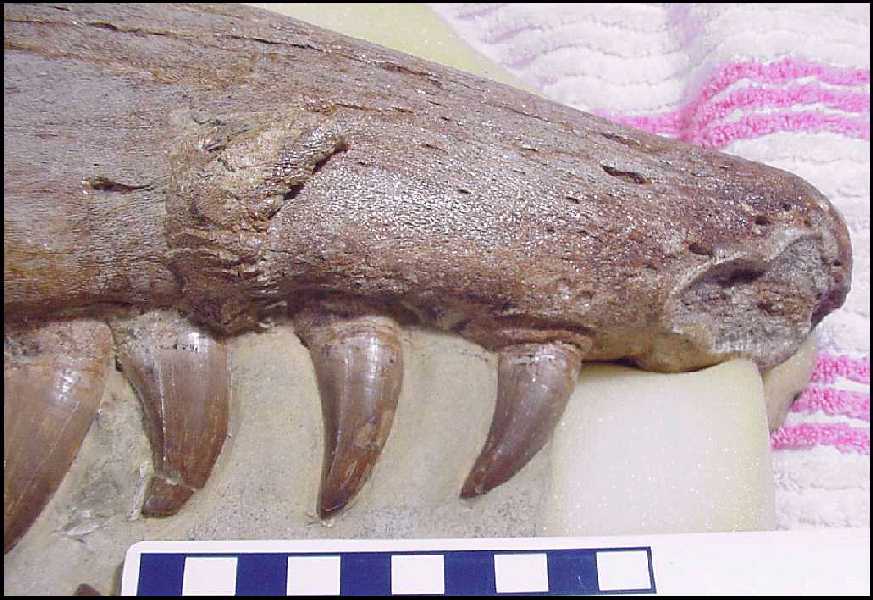
The right dentary of a marine lizard (Mosasauridae) bearing unusual, bulbous teeth was recovered from the Pierre Shale of Logan County, Kansas, by Pete Bussen of Wallace, Kansas in 1995. Stratigraphically, the specimen was located about 3 m. below the contact of the Weskan and Sharon Springs members (Campanian) of the Pierre Shale and 95 cm. below the lower of two layers of phosphate nodules. The dentary is 35 cm in length and has alveoli for 14 teeth. It was identified as Globidens sp. on the basis of the unique tooth morphology from the descriptions provided by Gilmore (1912) and Russell (1975). Ten teeth were recovered with the specimen, the largest of which is 3 cm in diameter. Although the Kansas specimen is contemporaneous with Globidens dakotensis, it cannot be reliably assigned to that species or G. alabamaensis because neither of the type specimens included the dentarys. J. Martin (personal communication, 1995) has indicated that the lower jaws of an undescribed specimen of Globidens sp. from South Dakota appeared to be more robust than this specimen. According to D. Parris (personal communication, 1995), additional material attributable to Globidens sp. has been found in Texas. This new Kansas specimen provides additional data regarding the range of this genera in the Western Interior Sea.
1997 Kansas Academy of Science - Fort Hays State University, Hays, KS (1 of 2)
The skull and seven articulated vertebrae of a large (9 m) mosasaur were collected from the Smoky Hill Chalk Member of the Niobrara Formation (Upper Cretaceous) of Gove County, Kansas, in 1996. Stratigraphically, the remains were found 2.7 m. below the base of Marker Unit 10 as described by Hattin (1982) and were in the upper portion of the biostratigraphic zone of Clioscaphites vermiformis (Stewart, 1990). The site is of early Santonian age and is dated at approximately 82 mya. The specimen was identified as Tylosaurus proriger on the basis of the following characters; the large infrastapedial process of the quadrate, the location of the parietal foramen and the lateral overlap of the prefrontal by the postorbitalfrontal. The overall size of the skull (1.2 m) is also a key identifying factor since no other mosasaur of this time was this large. Schumacher (unpub. Masters thesis, 1993) stated that Tylosaurus proriger had not been previously reported from Gove County or from lower than Marker Unit 15. This specimen extends the temporal range of the species in the Smoky Hill Chalk by at least one million years and further defines the ecological diversity of the Western Interior Sea during the Late Cretaceous.
1997 Kansas Academy of Science - Fort Hays State University, Hays, KS (2 of 2)
In 1995, the complete skull and 18 articulated cervical and thoracic vertebrae of a marine reptile, Clidastes liodontus, were collected by the authors from the lower 1/3 of the Smoky Hill Chalk member of the Niobrara formation (Upper Cretaceous) of Gove County, Kansas. Stratigraphically, the remains were found below the base of Marker Unit 4, as described by Hattin (1982), and were in the biostratigraphic zone of Protosphyraena panics [perniciosa] (Stewart, 1990). The specimen is of late Coniacian age and is dated at approximately 81 mya. The remains were identified as Clidastes liodontus on the basis of the narrow frontal and the number of teeth in the dentary. Additional Clidastes material found by the authors in the same area further supports this new record. Schumacher (unpub. Masters thesis, 1993) indicated that Clidastes liodontus had not been previously reported from Gove County, or from lower than Marker Unit 8. Bell (personal communication, 1997) indicated that an unreported specimen may have been found from as low in the chalk as Marker Unit 6. This specimen extends the temporal range of this species in the Smoky Hill Chalk and further defines the diversity of life in the Western Interior Sea during the Late Cretaceous.
1997 Society of Vertebrate Paleontology, Chicago, IL
In 1996, the articulated skull and seven cervical vertebrae of a large (10 m) mosasaur were collected from the middle of the Smoky Hill Chalk member of the Niobrara Chalk (Upper Cretaceous) in Kansas. Stratigraphically, the remains were found 2.7 m. below the base of Marker Unit 10 and within the upper portion of the biostratigraphic zone of Clioscaphites vermiformis. The site is middle Santonian age and is dated at about 85 mya. The specimen was identified as Tylosaurus proriger on the basis of the following characters: the lateral overlap of the prefrontal by the postorbitalfrontal, the large infrastapedial process of the quadrate and the location of the parietal foramen. The length of the skull (1.2 m) was also a key identifying factor since no other mosasaur of this time was as large. The slightly more anterior location of the nares, compared to other specimens of T. proriger, is a condition that is probably transitional from T. nepaeolicus. T. proriger has not been previously reported from lower than Marker Unit 15. This new specimen extends the temporal range of this species in the Western Interior Sea by at least 1.5 million years and further defines the ecological diversity of the seaway during the deposition of the Smoky Hill Chalk.
1998 Kansas Academy of Science, Kansas Newman College, Wichita, KS
In 1992, a series of 22 articulated and associated vertebrae from a marine lizard (Mosasauridae) were recovered in situ from the Smoky Hill member of the Niobrara Chalk (Upper Cretaceous) in Gove County, Kansas. The specimen was found below stratigraphic Marker Unit 5 (Hattin, 1982), near the upper limit of the biostratigraphic zone of Protosphyraena pernicosa [perniciosa] (Stewart, 1990), and is of late Coniacian age. The remains consisted of a continuous series of vertebrae from the last cervical to the next to the last dorsal vertebra, and several ribs. There was no cranial, limb or caudal material found. The single cervical vertebra was separated from the vertebral column and one lower dorsal vertebra appeared to have been fractured prior to burial. Examination of the vertebrae during preparation revealed a series of bite marks and one embedded tooth tip attributed to the extinct lamniform shark, Cretoxyrhina mantelli Agassiz. The damage was located on the right side of four dorsal vertebrae and is interpreted as a single bite to the right shoulder of the mosasaur. The distance between adjacent tooth marks on these vertebrae averaged 3 cm and suggests the actual spacing between the teeth in the upper jaw of the shark. On the basis of this data and the size of the embedded tooth, it is probable that the length of the shark feeding on these remains approximated the 5.5 meter maximum suggested by Shimada (1995). In addition to the bite marks on the vertebrae, many of the remaining ribs were scarred or severed by cuts from C. mantelli teeth, and with the distinctive, serrated tooth marks of another lamniform shark, Squalicorax falcatus. This specimen, and other recent evidence (Shimada, 1997, Everhart et al., 1995), firmly establishes that Cretoxyrhina mantelli was feeding on large mosasaurs during late Coniacian time and adds to the available information on the paleoecology of the Western Interior Sea.
1999 Kansas Academy of Science, Kansas State University, Manhattan, KS
Everhart, M. J. and Everhart, P. 1999. An early occurrence of Pteranodon sternbergi from the Smoky Hill Member (late Cretaceous) of the Niobrara Chalk in western Kansas. Kansas Academy of Science, Transactions 18(Abstracts):27.Pteranodon is the most commonly found of all pterosaurs and is represented by more than 1100 specimens in museum collections. All of these specimens were collected from mid-ocean sediments deposited in the Western Interior Seaway from the late Coniacian through the early Campanian. According to Bennett (1992), the vast majority of Pteranodon specimens do not include the skull and stratigraphic information. In 1996, the skull, cervical vertebrae and wing elements of a large Pteranodon sternbergi were recovered from the lower third of the Smoky Hill member of the Niobrara Chalk in Gove County, Kansas. The remains were found within Stewart's (1990) biostratigraphic zone of Cladoceramus undulatoplicatus and are of early Santonian age (86 mya). While this specimen does not represent the earliest occurrence of the species (Bennett, pers. comm., 1998), it is important because it includes a complete skull. From the measurement of wing bones, the wingspan of this individual would have been about 5.6 meters (18.3 feet). The remains were determined to be those of a sub-adult male on the basis of the lack of a cranial crest, and the overall size of the skull and wing bones. This specimen provides additional information regarding the occurrence of Pteranodon sternbergi and the ecology of the Western Interior Seaway.
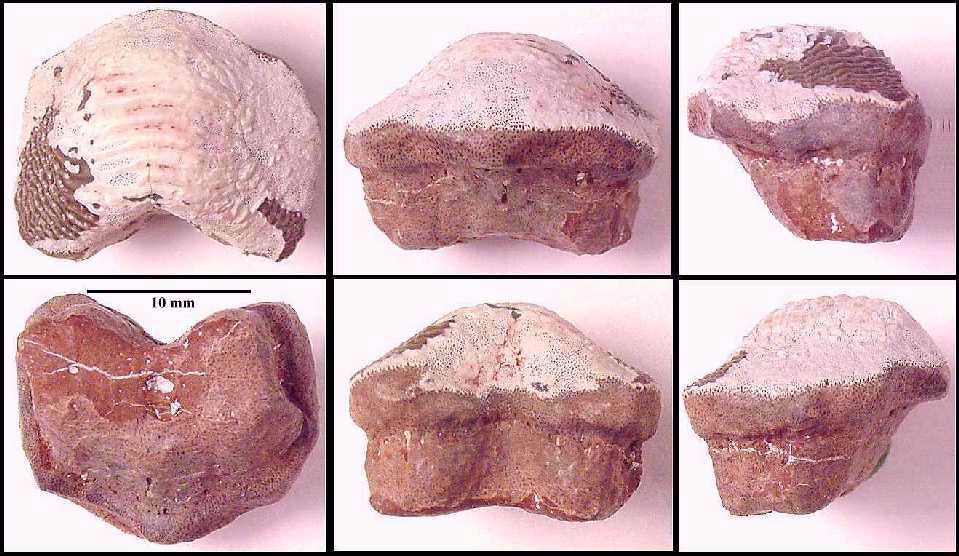
In August of 1998, a specimen consisting of 170 teeth of a rare ptychodontid shark were recovered from the Smoky Hill Member of the Niobrara Formation ( Upper Cretaceous) in Gove County, Kansas. The teeth were identified as Ptychodus martini, based on comparisons with the type specimen located in the Kansas University of Natural History. The teeth of P. martini are unique among the ptychodontids as they have very low crowns, 8 -9 nearly parallel transverse ridges that are nearly equal with the marginal area. This species was first described by Williston (1898) and was listed by Stewart (1990) as one of three ptychodontids occurring in the Smoky Hill Chalk. Other than the type specimen in the University of Kansas collection, this is the only other complete jaw plate known. The remains were found below Hattin’s (1982) Marker Unit 4 (late Coniacian) and were from Stewart’s biostratigraphic zone of Protosphyraena pernicosa
[perniciosa]. This specimen provides further information regarding the diversity of the fauna of the Western Interior Seaway.1999 Tate '99 Conference, Tate Geological Museum, Casper, WY.
The Smoky Hill member of the Niobrara Chalk was deposited in the Western Interior Seaway over a span of about five million years from the late Coniacian through the early Campanian. Coincidentally, this period also encompasses much of the early evolution and radiation of the family Mosasauridae. Thousands of mosasaur specimens have been collected from the Smoky Hill Chalk of western Kansas since the first Yale College scientific expedition in 1870. Early workers viewed the entire Smoky Hill Chalk as the "Pteranodon beds" and were not able to provide accurate stratigraphic information. Even though mosasaurs were represented by numerous complete and well preserved specimens, the ranges of the various species could not be further defined without better stratigraphic data. Williston (1898) first described the general distribution of mosasaurs within the Rudistes and Hesperornis beds of the Smoky Hill Chalk. Stewart (1990) incorporated Hattin's (1982) stratigraphic data into his biostratigraphic zones and refined the information on the occurrences of mosasaur species to a much higher level than had been done previously. Schumacher (1993) and Sheldon (1996) reviewed existing collections and provided further definition to mosasaur biostratigraphy. New specimens of Tylosaurus proriger and Clidastes liodontus with accurate stratigraphic information reported by Everhart (1997) have further expanded and refined the temporal distribution of these species within the Smoky Hill Chalk.
1999 Society of Vertebrate Paleontology Annual Meeting, Denver, CO
Incomplete skeletal remains of marine lizards (Mosasauridae) with feeding traces attributed to the extinct lamniform shark, Cretoxyrhina mantelli, are known from the Late Cretaceous Niobrara Chalk of western Kansas. These specimens were collected from the lower one-fourth of the Smoky Hill Member (Late Coniacian) in the biostratigraphic zone of Protosphyraena pernicosa [perniciosa]. The most common mosasaurs in the Western Interior Seaway at that time were Tylosaurus nepaeolicus, Tylosaurus nov. sp., Platecarpus tympaniticus and Clidastes liodontus, with the larger tylosaurs reaching lengths of 10 m. Cretoxyrhina mantelli was a large shark with a world wide distribution. The fossil record suggests the species reached a length of about 6 m at this biostratigraphic horizon.
Evidence of feeding on mosasaurs by C. mantelli includes; 1) mosasaur bones with bite marks and/or embedded Cretoxyrhina teeth; 2) partially digested bones; 3) severed bones; and 4) combinations of the above. Mosasaur vertebrae have also been found as preserved stomach contents in C. mantelli remains. On the basis of this evidence, no other known marine predator, including other mosasaurs, could have been responsible for these feeding traces. Most of these specimens can either represent a fatal attack or scavenging on a dead mosasaur by C. mantelli. There are specimens, however, that show not all such bites were fatal. For example, the caudal vertebrae in some remains show fusion due to an apparent infection following a shark bite.
During the period from which evidence of this feeding behavior was observed, mosasaurs were becoming more diverse and widespread. By the early Campanian, Cretoxyrhina mantelli had apparently become extinct and mosasaurs were the dominant large marine predators in the Earth's oceans.
2000 Kansas Academy of Sciences Meeting, Hutchinson Community College, Hutchinson, KS (1 of 2)
Everhart, M. J. 2000. The biostratigraphy of the Mosasauridae (Squamata) in the Smoky Hill Chalk (late Cretaceous) of Kansas. Kansas Academy of Science, Transactions 19(Abstracts):11.The Smoky Hill member of the Niobrara chalk was deposited in the Western Interior Seaway over a span of about five million years from late Coniacian through early Campanian time (87-82 mya). Coincidentally, this period also encompasses much of the early evolution and radiation of the family Mosasauridae. Thousands of mosasaur specimens have been collected from the Smoky Hill Chalk of western Kansas since the first Yale College Scientific Expedition in 1870. Early workers viewed the entire Smoky Hill Chalk as the "Pteranodon Beds" and were not able to provide accurate stratigraphic information. Williston (1898) first described the general distribution of mosasaurs within the Rudistes and Hesperornis Beds of the Smoky Hill chalk. This somewhat arbitrary placement of mosasaur species into the upper and lower units of the chalk was repeated by Russell (1967). Stewart (1990) first incorporated Hattin's (1982) stratigraphic data into his biostratigraphic zones and refined the information on the occurrences of mosasaur species to a higher level than had been done previously. Schumacher (1993) and Sheldon (1996) reviewed existing collections and provided additional data on mosasaur biostratigraphy. New specimens of Tylosaurus proriger and Clidastes sp. with accurate stratigraphic information reported by Everhart (1997) have further defined the temporal distribution of these species within the Smoky Hill Chalk.
2000 Kansas Academy of Sciences Meeting, Hutchinson Community College, Hutchinson, KS (2 of 2)
Lindgren, J. and M. J. Everhart. 2000. Remarks on two problematic mosasaur specimens from the Smoky Hill Chalk (late Cretaceous) of western Kansas. Kansas Academy of Science, Transactions 19(Abstracts):32.
The partial remains of a large mosasaur (KUVP 1024), previously referred to Mosasaurus ivoensis Persson 1963 by Russell (1967), is here excluded from the species because the marginal teeth of the Niobrara fossil exhibit a morphology distinctly different from that of "M." ivoensis (i.e. Hainosaurus ivoensis, Lindgren in prep.). Recently, Bell (1997) assigned the specimen to an Ectenosaurus composite, a determination that is contested herein. Instead, three possible explanations of the origin of KUVP 1024 are given: (1) the assemblage represents an early lineage of Mosasaurus as proposed by Russell (1967); (2) KUVP 1024 represents a hitherto unknown basal mosasaur clade, possibly within the subfamily Plioplatecarpinae; (3) KUVP 1024 is composed of elements derived from different mosasaur taxa.
The presence of a double buttressed premaxillary suture in a fairly small tylosaurine specimen (KUVP 1129) leads to a few observations regarding the utility of this condition in tylosaurine taxonomy: (1) the fossil represents the first record of Hainosaurus from the Niobrara Formation; or (2) KUVP 1129 represents the first known Tylosaurus with a double buttressed premaxillary suture. If the second assumption is accurate, a double buttressed premaxillary suture can not be used to distinguish Hainosaurus from Tylosaurus.
Field work conducted in 1991 and 1998 recovered 47 gastroliths in association with the incomplete and disarticulated remains of a large plesiosaur (KUVP 129744). The specimen was found in the upper Sharon Springs Member (late Cretaceous) of the Pierre Shale, Logan County, Kansas. The gastroliths are unusually large in size when compared to those documented from other plesiosaur remains, and larger than those associated with the giant sauropod, Seismosaurus. The shapes of the gastroliths are consistent with similar sized stones found in river gravel. This specimen provides new data in regard to the range of sizes and the occurrence of gastroliths in these extinct marine reptiles.
Everhart, M. J. and J. Bussen, 2001. First report of the mosasaur, Plioplatecarpus cf. primaevus, from the Pierre Shale (Campanian) of western Kansas. Kansas Academy of Science, Transactions 20(Abstracts):28-29.
The fragmentary skull, vertebrae, and ribs of a plioplatecarpine mosasaur were collected from the Pierre Shale in Logan County, KS, in 1995. Stratigraphically, the remains occurred about 6 m below a layer of large septarian nodules in the upper Sharon Springs Member (early Campanian) in the zone of Baculites maclearni [mclearni*]. Although most of the skull was recovered, the bones are in poor condition due to the intrusion of selenite crystals. The identity of the specimen was assumed to be Platecarpus at the time of collection and the material remained in the possession of the property owner. A re-assessment of the specimen in January 2001 identified the remains as Plioplatecarpus cf. primaevus on the basis of the large parietal foremen which invades the suture between the frontal and the parietal. Although Plioplatecarpus is well known from the Pierre Shale in South Dakota and elsewhere in the Western Interior basin during the early Campanian, this is the first documented occurrence of this genus in Kansas. Examination of another private collection from the Sharon Springs Member in Logan County revealed two additional possible examples of this genus which are much less complete. This specimen provides additional information regarding the distribution of fauna in the Western Interior Sea during Late Cretaceous time.* Postscript: the proper spelling of the species name, contrary to Cobban (1993), is mclearni; from B. mclearni Landes 1940
2001 Kansas Academy of Sciences Meeting, The University of Kansas, Lawrence, KS (2 of 2)
Everhart, M. J. 2001. Stones and bones: The function of gastroliths in plesiosaurs. Kansas Academy of Science, Transactions 20(Abstracts):29.
Recent discoveries of large gastroliths (stomach stones) associated with plesiosaur remains from the Sharon Springs Member (early Campanian) of the Pierre Shale in western Kansas raise the question of their function(s). The most common theories are that 1) they were used as an aid to digestion by macerating food items which had been swallowed whole; 2) they were used as ballast to aid in buoyancy control or to maintain proper orientation for swimming; and 3) they were ingested accidentally as the result of normal feeding activities. Two specimens (KUVP 129744 and NJSM 15435) discovered in the 1990s include the largest gastroliths ever collected from plesiosaur remains. The heaviest gastroliths from each specimen weigh 1.49 kg and 1.06 kg respectively and are substantially larger than any other documented stones. The total weight of gastroliths (13.1 kg) in the KUVP 129744 specimen is almost 50% greater than the 8.8 kg of gastroliths from a Montana plesiosaur. The larger stones are unlikely to have been mistaken for prey and there is no evidence that plesiosaurs fed on bottom-dwelling organisms. The total weight of these gastroliths represents approximately 0.5% of the estimated weight of the animal and would probably be less than the daily food intake or the buoyancy changes related to normal breathing. The most probable function of gastroliths is aiding in the mechanical breakdown of food.
Everhart, M. J., 2001. Revisions to the Biostratigraphy of the Mosasauridae (Squamata) in the Smoky Hill Chalk Member of the Niobrara Chalk (Late Cretaceous) of Kansas. Kansas Academy of Science, Transactions 104(1-2):56-75.
The Smoky Hill Chalk Member of the Niobrara Chalk was deposited in the Western Interior Sea during a span of about five million years extending from the upper Coniacian through the lower Campanian. Coincidentally, this period also encompasses much of the early evolution and radiation of the family Mosasauridae. Thousands of mosasaur specimens have been collected from the Smoky Hill Chalk Member of western Kansas since the first Yale College Scientific Expedition in 1870. Early workers viewed the entire Smoky Hill Chalk Member as the "Pteranodon beds" and were not able to provide accurate stratigraphic information. Even though mosasaurs are represented by numerous complete and well preserved specimens, the ranges of the various species could not be defined further without better stratigraphic data. In 1898, S. W. Williston first described the general distribution of mosasaurs within the Rudistes and Hesperornis beds of the Smoky Hill Chalk Member. Seventy years later, D. A. Russell grouped mosasaur species into upper and lower zones in the chalk and in 1990, J. D. Stewart incorporated D. E. Hattin's stratigraphic data into his biostratigraphic zones and refined the occurrences of mosasaur species to a higher degree than had been done previously. B. A. Schumacher in 1993, and M. A. Sheldon in 1996, reviewed existing collections and provided further definition to mosasaur biostratigraphy. New specimens of Tylosaurus proriger, and Clidastes liodontus with accurate stratigraphic information reported by M. J. Everhart and co-workers in 1997 further expanded and refined the temporal distribution of these species within the Smoky Hill Chalk Member.
2001 Society of Vertebrate Paleontology Annual Meeting, Bozeman, MT
Everhart, M. J. and Johnson, S. E., 2001. The occurrence of the mosasaur, Platecarpus planifrons, in the Smoky Hill Chalk (Upper Cretaceous) of western Kansas. Journal of Vertebrate Paleontology 21(suppl. to 3):48A. Abstract
Two recently collected specimens of Platecarpus planifrons extend the range of this uncommon mosasaur upward to the early Santonian level of the Smoky Hill Chalk Member (second quarter of the member, below Marker Unit 7, biostratigraphic zone of Cladoceramus undulatoplicatus) of the Niobrara Chalk. Early records of the species (more than a dozen specimens, including the type, collected by the Cope, Marsh, and Williston parties), although imprecise about locality and stratigraphy, appear to have been collected primarily from Trego County, Kansas, and mostly from lower chalk exposures along Hackberry Creek. These localities would place the species in the late Coniacian level of the Smoky Hill Chalk Member (lowermost quarter of the chalk, below Marker Unit 5, biostratigraphic zone of Protosphyraena pernicosa) [perniciosa].
The type specimen in the American Museum of Natural History was originally described as Clidastes planifrons. The name stood for twenty-five years until the material was re-examined and moved into the genus Platecarpus on the basis of characters observed in the frontal, parietal and vertebrae. The relative rarity of the species and a lack of well preserved, complete skeletons has contributed to a continuation of its uncertain taxonomic position. Until resurrected in 1993 as a valid species, P. planifrons was long considered a nomen vanum. It is far less common in the Smoky Hill Chalk Member than P. tympaniticus (including P. ictericus and P. coryphaeus). The early Santonian material reported here (FHSM VP-13907 and 13910) includes two partial skeletons from Gove and Lane Counties, one with a nearly complete skull. These specimens represent the latest known occurrence of this species and further document the temporal distribution and diversity of the fauna in the Western Interior Sea during the late Cretaceous.
2001 Society of Vertebrate Paleontology Annual Meeting, Bozeman, MT
Hamm, S. A. and M. J. Everhart, 2001. Notes on the occurrence of nodosaurs (Ankylosauridae) in the Smoky Hill Chalk (Upper Cretaceous) of western Kansas. Journal of Vertebrate Paleontology 21(suppl. to 3):58A. Abstract (See also Everhart and Hamm, 2005)
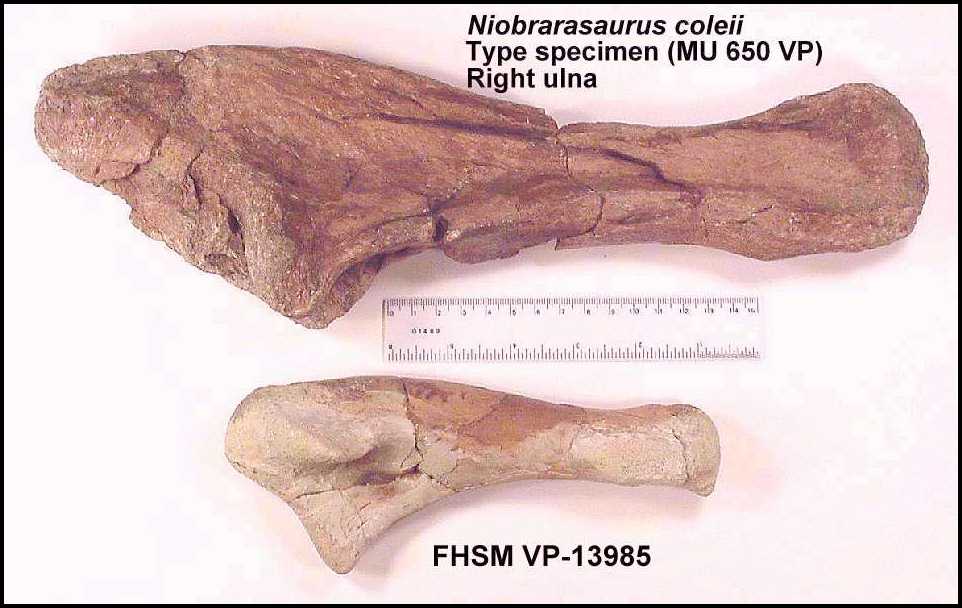
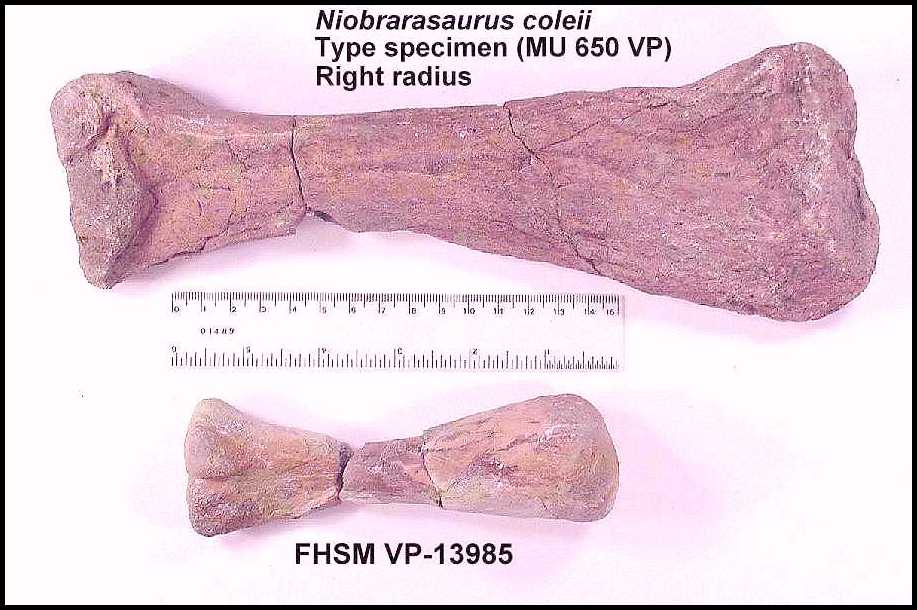
The Smoky Hill Chalk Member of the Niobrara Chalk was deposited near the middle of the Western Interior Sea, several hundred miles from the nearest land, in late Coniacian through early Campanian time. The chalk is well known for its excellent preservation of late Cretaceous fish, marine reptiles, pteranodons and toothed birds. Although terrestrial vertebrate remains are rare, the chalk has produced the best assemblage of Coniacian-Santonian nodosaur specimens presently known from North America. The occurrence of terrestrial animals in this marine unit is most likely due to a "bloat and float" scenario where the animal was washed out to sea, carried some distance by currents and then sank. Jaws, skulls, neck and tail vertebrae, and distal limb elements are the first parts of a floating carcass to fall off or be detached by scavengers. Here we report on the discovery of an isolated radius and ulna of a nodosaurid dinosaur from the Smoky Hill Chalk Member in Lane County, Kansas. The bones were found near the base of Marker Unit 8 (middle Santonian), within the biostratigraphic zone of Clioscaphites vermiformis and C. choteauensis. Bite marks and the partially digested appearance of the proximal and distal ends of the bones suggest scavenging by the lamniform shark, Cretoxyrhina mantelli. The radius and ulna are about half the length of the comparable bones of the holotype of Niobrarasaurus coleii (MU 650 VP), and indicate a juvenile animal that was about 3 m long. Besides MU 650 VP, only three other sets of nodosaur remains had been previously documented from the chalk. These include the holotype of Hierosaurus sternbergii (YPM 1847); a pair of scutes (YPM 55419); and a partial skeleton (KUVP 25150). MU 650 VP, YPM 1847, and YPM 55419 are late Coniacian in age while KUVP 25150 is middle Santonian. From a comparison with the holotype, the new specimen has been tentatively identified as Niobrarasaurus coleii.
A nearly complete skeleton of an elasmosaurid plesiosaur (NJSM 15435) from the Sharon Springs Member (Middle Campanian) of the Pierre Shale, Logan County, Kansas, is intimately associated with fragmentary fish remains and numerous gastroliths. The fish bones and gastroliths were located just behind the pectoral girdle in the abdominal region. Identifiable prey includes Enchodus and other small clupeomorph fishes. An isolated tooth of the anacoracid shark Squalicorax cf. S. pristodontus was also recovered in this area. Ninety-five gastroliths (6.8 kg) were present, with the largest stone measuring 15.1 x 8.5 x 5.7 cm (5.0 x 3.3 x 2.2 in.) and weighing 1.06 kg (2.3 lb.). Many of the gastroliths are composed of pink or gray Sioux Quartzite, which suggests that the source of these stones was over 600 km (475 mi.) to the northeast of where the elasmosaur remains were discovered. The association of fragmentary fish remains and gastroliths within the abdomen of NJSM 15435 supports the contention that the stones aided in the breakdown of food in plesiosaurs.
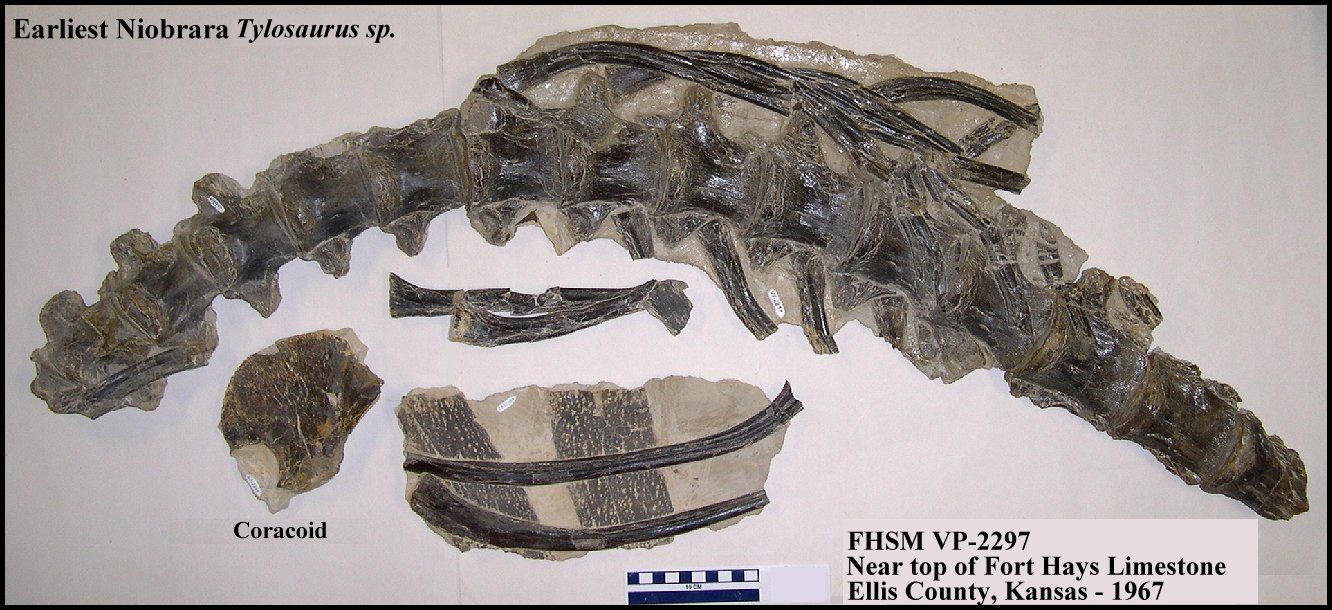
Tylosaurus nepaeolicus (Cope 1874) is one of the least well known of the five species of mosasaurs that are recognized from the lower Smoky Hill Chalk Member (upper Coniacian) of the Niobrara Formation in western Kansas. In describing the type material, Cope stated that this species was one-third or less the size of T. proriger Cope 1869, a species that appeared during the Santonian and is well represented in the middle and upper chalk. Additional data provided by Russell from a review of specimens in the American Museum of Natural History and the Yale Peabody Museum showed that most T. nepaeolicus material is somewhat larger than the type specimen, but is significantly smaller than adult T. proriger specimens. Measurements of two additional T. nepaeolicus skulls, an articulated series of Tylosaurus sp. vertebrae and other material in the Sternberg Museum of Natural History suggest that this species approached 8-9 m in size by the end of the Coniacian and was approximately the same size as a large T. proriger reported from the lower Santonian. Although time and other morphological features separate T. nepaeolicus from T. proriger, the two species are closer in size than previously reported.
2002 Kansas Academy of Sciences Meeting, Fort Hays State University, Hay, KS (1 of 2)
Everhart, M; J. 2002. New data on plesiosaur remains found as stomach contents of a Tylosaurus proriger (Squamata; Mosasauridae) from the Niobrara Formation of western Kansas, 21:27.
Although plesiosaurs and mosasaurs co-existed for about 25 million years at the
end of the Cretaceous, the fossil record was mute regarding interactions between these two
groups of marine reptiles until a discovery made in the summer of 1918. At that time,
Charles F. Sternberg uncovered the partially digested bones of a plesiosaur as stomach
contents in an adult (9 m) Tylosaurus proriger skeleton in the Smoky Hill Chalk
Member (early Campanian) of the Niobrara Formation near Twin Butte Creek in Logan County,
Kansas. The incomplete remains included parts of the scapula / coracoids, both humeri,
epipodials, vertebrae, other bone fragments and gastroliths. A comparison with the mounted
skeleton of Dolichorhynchops osborni in the Sternberg Museum of Natural History
suggests that the plesiosaur was less than 3 m in length. Sternberg reported his discovery
at the annual meeting of the Kansas Academy of Science in 1919 and indicated that the
material had
been sent to the United States National Museum (Smithsonian). Due to unusual circumstances
regarding the publication of his paper in the Transactions of the Kansas Academy of
Science, however, the association of the two specimens went largely unnoticed until last
year. The Tylosaurus skeleton (USNM 8898) is a permanent exhibit in the Ancient
Seas display at the United States National Museum and the plesiosaur remains (USNM 9468)
are in storage. Here these specimens are re-examined and discussed in light of related
information that has become available in the more than eighty years since their original
discovery.
International Conference on Morphogenesis and Pattern Formation in Biological Systems, Nagoya, Japan, September 24-27, 2002.
Everhart, M. J., 2002. Rapid ontogenetic change in Late Cretaceous mosasaurs (Reptilia; Mosasauridae) as a model of vertebrate morphogenesis. Intern. Con. Morphogenesis and Pattern Formation in Biol. Sys. Chubu Univ. Nagoya, Japan, p. 86.
Mosasaurs (Reptilia: Squamata) evolved rapidly from small, terrestrial lizards to become the dominant marine predators in the Earth’s oceans during the last 25 million years of the Cretaceous Period. Abundant remains found in chalks deposited in the middle of Western Interior Seaway, hundreds of miles from the nearest shore, suggest that they were as well adapted for life in mid-ocean as are modern marine mammals like whales and porpoises. Although varanid lizards (Komodo Dragon, etc) have long been considered to be their nearest living relative, it is likely that modern snakes (Serpentes) are the true descendents of the mosasaur lineage. Mosasaurs were the last of the great Mesozoic marine reptiles, returning to the sea as the ichthyosaurs became extinct, and then replacing the declining plesiosaurs as the top marine predator. Adaptations necessary for their successful return to the marine environment included: extensive modifications to the skull and jaws (palatal teeth and an intramandibular joint) to facilitate the ingestion of large prey; adjustments in bone density to achieve near-neutral buoyancy; changes in the body shape and skin covering (small scales) for hydrodynamic efficiency; limbs that became flippers used for steering; a long, flat tail that served to propel the animal quickly through the water; and, like ichthyosaurs, giving live birth to their young. In addition, mosasaurs grew to be very large, reaching lengths (15-17 m) that were greater than those of well-known terrestrial predators such as Tyrannosaurus rex. By Maastrichtian time, mosasaurs had diversified into at least 20 distinct genera and more than 45 species. Prior to their extinction at the end of the Cretaceous, mosasaurs dominated a variety of marine ecological niches and were encroaching on freshwater habitats traditionally occupied by crocodiles and alligators. The rapid evolution of mosasaurs can be considered as a model of vertebrate morphogenesis.
2002 Society of Vertebrate Paleontology Annual Meeting, Norman, OK
Everhart, M. J., 2002. Remains of immature mosasaurs (Squamata; Mosasauridae) from the Niobrara Chalk (Late Cretaceous) argue against nearshore nurseries. (Abstract) Journal of Vertebrate Paleontology 22(suppl. to 3):52A.
The Smoky Hill Chalk Member of the Niobrara Formation was deposited from late Coniacian through early Campanian time near the middle of the Western Interior Sea, hundreds of kilometers from the nearest shore. Many well-preserved specimens of marine vertebrates, including 10 species of mosasaurs, have been collected from the chalk since the late 1860s. Like ichthyosaurs and plesiosaurs, it is probable that mosasaurs spent most, if not all, of their lives at sea. Earlier workers reported that the remains of immature mosasaurs were never found in the chalk and proposed that these large (up to 10 m) marine reptiles either laid eggs or gave birth to their young in areas closer to shore where they would be better protected from predation. Despite problems related to the preservation of smaller individuals, a review of more recently collected material shows that immature mosasaurs (estimated body length ~ 2 m or less) are well represented throughout the chalk. The recent discoveries of fetal material associated with a mosasaur from South Dakota, and with a mosasaurid from Slovenia, provide compelling evidence that these marine reptiles bore live young. The presence of immature mosasaurs in the Smoky Hill Chalk Member of western Kansas strongly suggests that births occurred in mid-ocean and were not limited to sheltered nurseries along the shores of the Western Interior SeaNote: The poster presented was reviewed in Science News, (Oct. 26, 2002), 162(17):270.
2002 Society of Vertebrate Paleontology Annual Meeting, Norman, OK
Shimada, K., M. J. Everhart, and G. E. Hooks, 2002. Ichthyodectid fish and protostegid turtle bitten by the Late Cretaceous Lamniform shark, Cretoxyrhina mantelli. (Abstract) Journal of Vertebrate Paleontology 22(suppl. to 3):106A.
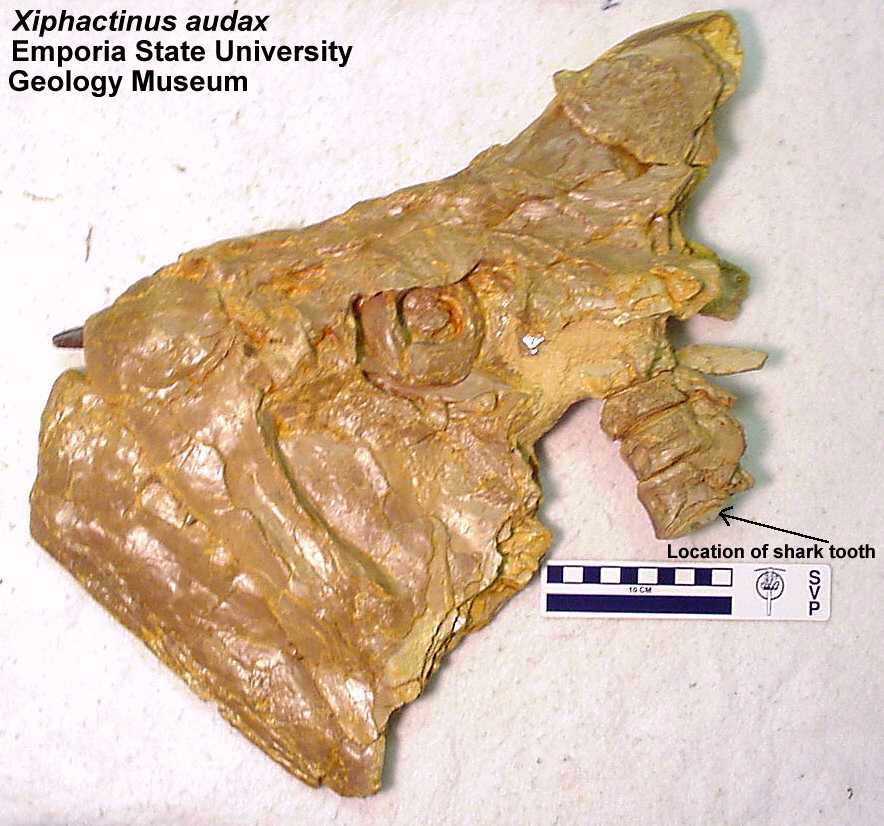
Cretoxyrhina mantelli (Agassiz) is a Late Cretaceous lamniform shark that attained 6 m in total length (TL) and may have resembled the modern great white shark, Carcharodon carcharias (Linnaeus). Ichthyodectid fish bones and presumed plesiosaur gastroliths as putative gastric residues as well as mosasaur bones with embedded Cretoxyrhina teeth (including one specimen with post-bite bone healing) have suggested that the shark was predaceous. Here, we report a specimen of Xiphactinus audax Leidy (Teleostei: Ichthyodectiformes) and a specimen of Protostega gigas Cope (Chelonia: Protostegidae), which have one or more embedded Cretoxyrhina teeth. The Xiphactinus (ESU 1047: a nearly complete skull with the six anteriormost vertebrae) is from the Niobrara Chalk (early Santonian) of Kansas and is housed in Emporia State Univ., Emporia, Kansas. A Cretoxyrhina tooth is embedded in the third vertebra. Both animals were estimated to be about 3 m TL. The Protostega (FMNH P27452: a partial skeleton) is from the Mooreville Chalk (latest Santonian / earliest Campanian) of Alabama and is housed in the Field Mus. of Nat. Hist., Chicago, Illinois. Five Cretoxyrhina tooth fragments are lodged in the left humerus, and tooth marks presumably made by the same shark are present on the exterior surface of the left hyoplastron. The turtle had a carapace length of about 1.05 m, whereas the size of the shark is uncertain. Whether Cretoxyrhina attacked or scavenged these animals cannot be ascertained from these specimens. Nevertheless, these specimens are paleoecologically important, because they suggest the coexistence of Cretoxyrhina with both Xiphactinus and Protostega, and because they further support the idea that Cretoxyrhina frequently fed on large vertebrates in the Late Cretaceous seas of North America.
2003 Kansas Academy of Science Annual Meeting, Pittsburg State University
Everhart, M. J. and P. A. Everhart, 2003. First report of the Paleozoic shark, Ctenacanthus amblyxiphias Cope 1891, from the Lower Permian of Morris County Kansas. Abstracts, Kansas Academy of Science, Transactions22:13.
In August, 2002, the remains of a small (1.6 m) Paleozoic shark (FHSM VP-15012) were discovered eroding from an exposure of the Grant Member of the Winfield Formation (Chase Group, Wolfcampian Series, Lower Permian) in the northeast corner of Morris County, Kansas. The matrix surrounding the specimen is a fine-grained, calcitic mudrock that is interpreted as a near-shore, shallow water deposit. The remains include the anterior and posterior dorsal fin spines, several pieces of calcified cartilage, including the left(?) scapulo-coracoid, placoid and ganoid scales, and placodont teeth. The nearly complete, anterior and posterior dorsal fin spines measure 25 and 18 cm in length. The fin spines are distinctively ornamented with thin rows of dentine-like material. The remains were identified as Ctenacanthus amblyxiphias by comparison with the dorsal fin spine described by Cope from the Redbeds (Permian) of Texas. Abundant shells of the brachiopod Composita subtilata, as well as silicified echinoid spines, ramose bryozoans, and crinoid fragments were associated with the remains. A crinoid calyx, provisionally identified as Delocrinus brownvillensis, was discovered nearby at the same stratigraphic level. A review of the literature and museum collections indicates that this is the first report of this shark species from Kansas.
------------------------------------------------
Everhart, M. J., T. Caggiano, and K. Shimada, 2003. Note on the occurrence of five species of Ptychodontid sharks from a single locality in the Smoky Hill Chalk (Late Cretaceous) of western Kansas. Abstracts, Kansas Academy of Science, Transactions 22:29.
The teeth of durophagous shark, Ptychodus Agassiz, are common fossils in the Late Cretaceous rocks of Kansas (Greenhorn Limestone through the middle of the Smoky Hill Chalk Member of the Niobrara Formation). The chronological range of each ptychodontid species, however, is generally limited, and it is unusual in Kansas for three or more species to occur in the same locality. We report here on the occurrence of P. anonymus Williston (AMNH 19553 and FHSM VP-14854), P. mortoni Mantell (FHSM VP-15013), P. polygyrus Agassiz (FHSM VP-15008), P. martini Williston, and P. cf. P. latissimus Agassiz (FHSM VP-14853) from a small, 15 m high exposure of the Smoky Hill Chalk in southeast Gove County, Kansas (AMNH = American Museum of Natural History; FHSM = Fort Hays State University, Sternberg Museum of Natural History). The chalk at this locality ranges lithostratigraphically from just below Hattin's Marker Unit 2 to just above Marker Unit 3 (Late Coniacian), and is in Stewart's biostratigraphic zone of Protosphyraena pernicosa [perniciosa]. These records provide additional data on the temporal distribution of Ptychodus species prior to their extinction during the Santonian, and on the faunal diversity of the Western Interior Sea during the Late Cretaceous.
------------------------------------------------
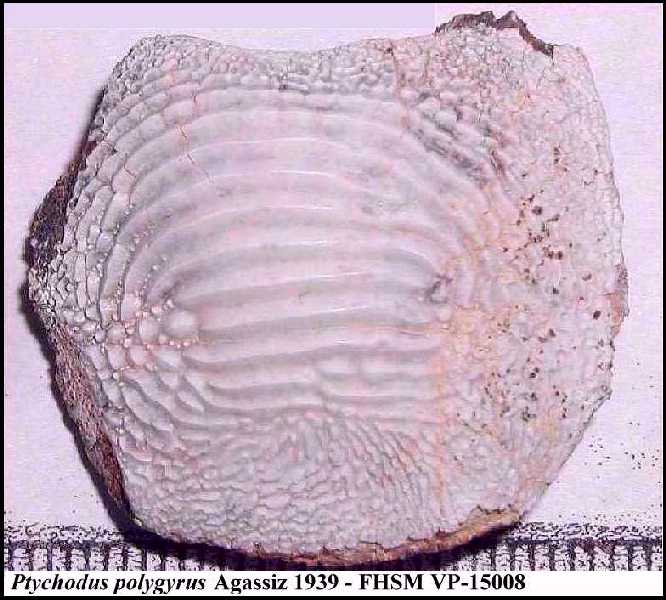
Caggiano, T. and M. J. Everhart, 2003. A rare occurrence of the Late Cretaceous Ptychodontid shark, Ptychodus polygyrus Agassiz 1839, in the Smoky Hill Chalk Member (Niobrara Formation) of western Kansas. Abstracts, Kansas Academy of Science, Transactions 22:28
A single tooth of the ptychodontid shark, Ptychodus polygyrus, was recovered from the Smoky Hill Chalk Member of the Niobrara Formation in Gove County by the authors in 1999. The tooth (FHSM VP-15008) was discovered below Hattin's marker unit 3 and is Late Coniacian in age. Individual teeth of the durophagous genus Ptychodus are common fossils in Late Cretaceous marine sediments worldwide. Although individual shed teeth are found most often, a number of articulated jaw plates, occasionally associated with calcified vertebrae and dermal / oral denticles, are also known. Ptychodus mortoni, P. anonymus and P. martini are the three species commonly found in the lower 1/3 of the Smoky Hill Chalk. The first P. polygyrus tooth from the Cretaceous of Kansas was found by Mudge in Ellis County and reported by Cope in 1874. The whereabouts of that specimen is unknown. Williston described a large, single tooth (KUVP 55237) from the "lower beds of the Niobrara Cretaceous of the Smoky Hill River" more than a century ago, but did not elaborate further on the locality or stratigraphy. FHSM VP-15008 represents the third documented occurrence of Ptychodus polygyrus in Kansas, and the first report with accurate lithostratigraphic information.
-------------------------------------------------
Hamm, S. A.. C. D. Burke, and M. Everhart, 2003. A juvenile rudistid from the Cretaceous of Kansas: Evidence for evolutionary or environmental development? Abstracts, Kansas Academy of Science, Transactions 22:16.
Extinct rudist bivalves were specialized pelecypods that occupied tropical, shallow marine environments from the Jurassic through the end of the Cretaceous. In Kansas, only one rudistid species, Durania maxima (Logan) 1898, has been recorded from Cretaceous deposits. Specimens described in the literature are adult forms with rarely associated juveniles attached to the lower valve. In October 2001, a colonial, juvenile rudistid specimen was recovered from the lower Smoky Hill Member (Late Coniacian) of the Niobrara Chalk in Gove County, Kansas. Remarkably well preserved, this juvenile consists of a major portion of the lower valve, and attachment sites for smaller rudists. Taxonomic assignment of this specimen to species level was exacerbated by the loss of the type specimen of D. maxima. As a result, the juvenile was compared to adult forms housed at FHSU Sternberg Museum. Based upon morphologic characteristics similar to both forms, the juvenile is Durania maxima. However, there are distinct differences between adults and juveniles. This divergence in morphology may be an ontogenic change representing heterochrony or an ecophenotypic response to the environment. Additional work will be needed clarify these relationships. A neotype for the lost type specimen should be recorded and stored for future taxonomic work.
--------------------------------------------------
Hamm, S. A., K. Shimada, and M. J. Everhart, 2003. Three uncommon lamniform sharks from the Smoky Hill Chalk (Upper Cretaceous) of western Kansas. Abstracts, Kansas Academy of Science, Transactions 22:31.
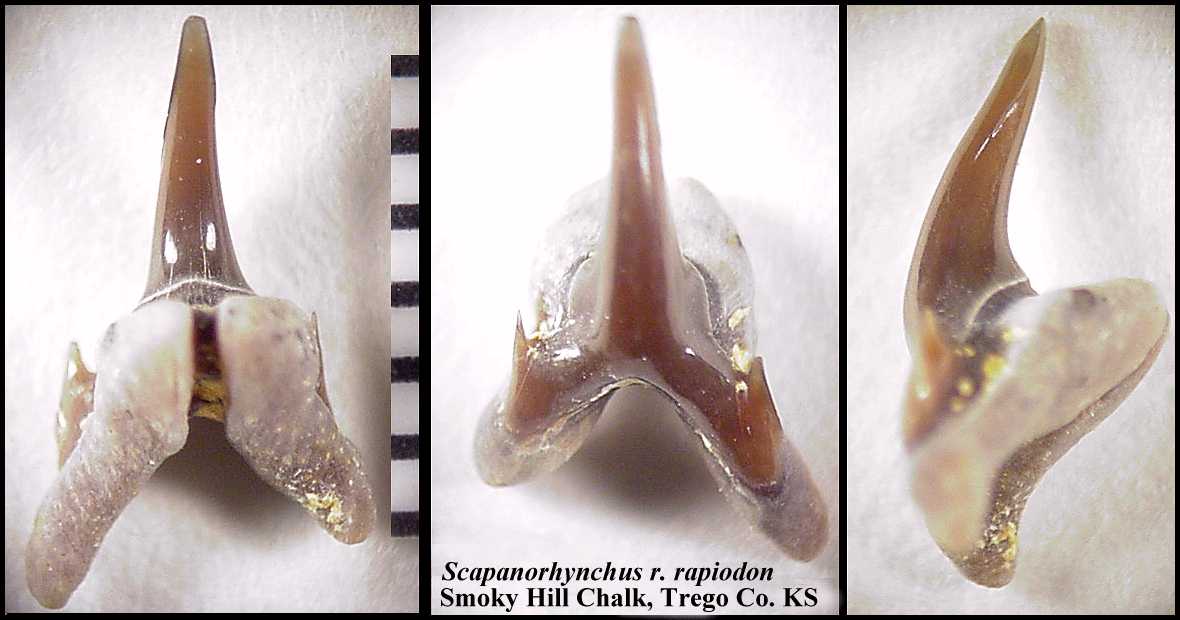
A review of the shark taxa in the Smoky Hill Member of the Niobrara Chalk (Upper Cretaceous) in Kansas suggests that only four lamniforms have been recognized from this stratigraphic member on the basis of referable specimens documented: Scapanorhynchus raphiodon (Agassiz), Cretoxyrhina mantelli (Agassiz), Squalicorax falcatus (Agassiz), and Squalicorax kaupi (Agassiz). Here, we document three additional lamniform species based on tooth specimens acquired by the Sternberg Museum of Natural History, Hays, Kansas (Vertebrate Paleontology [VP] collection). They are Cretolamna appendiculata (Agassiz), Pseudocorax laevis (Leriche), and Squalicorax pristodontus (Agassiz). All of the specimens are accompanied by stratigraphic data based on Hattin’s lithostratigraphic marker units (MU). Cretolamna appendiculata is represented by VP-14851which occurred 3 m below MU 4 in Gove County, and by VP-14852, which occurred at MU 7 in Gove County. Pseudocorax laevis is represented by VP-13960, which occurred between MU 2 and 3 in Gove County, and by VP-13959, which occurred between MU 7 and 8 in Lane County. Squalicorax pristodontus is represented by specimens from Logan County: VP-15009 from near MU 23, and VP-15010 from the uppermost part of the stratigraphic member. In summary, a total of seven lamniform species are recognized from the Smoky Hill Chalk.
2003 Society of Vertebrate Paleontology Meeting, St. Paul, MN
Everhart, M. J., P. Everhart, E. M. Manning, and D. E. Hattin. 2003. A Middle Turonian marine fish fauna from the Upper Blue Hill Shale Member, Carlile Shale, of north central Kansas. Journal of Vertebrate Paleontology, Volume 23 (Supplement to Number 3): 49A.(Abstract)
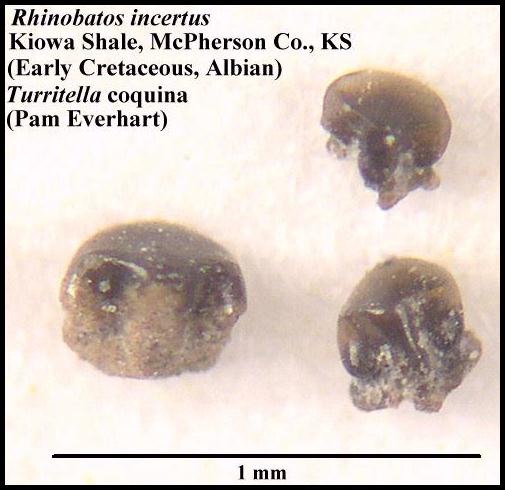
A diverse piscine fauna is reported for the first time from the Late Cretaceous Carlile Shale of Kansas. The relatively shallow (<100 m) marine assemblage derives from a thin (1-3 cm) fish-tooth conglomerate which lies 3-4 m below the top of the formation near Lovewell Reservoir in Jewell County, and accumulated during the late Middle Turonian regressive deposition in the Greenhorn Sequence. In contrast to larger material from transgressive lag faunas at the bases of sequences, the Lovewell fauna consists mostly of very small material (teeth, dermal denticles, vertebrae, and scales), suggesting winnowing by weak, intermittent currents. Due to size sorting for smaller particles, and the presence of a nearby nursery ground, teeth of juvenile individuals are unusually well represented. The fauna consists of 17 taxa (first records for Kansas are marked with an asterisk): 7 sharks (Ptychodus whipplei, *Chiloscyllium greeni, *Cantioscyllium d. decipiens, Otodus appendiculatus, Scapanorhynchus r. raphiodon, Squalicorax falcatus, and *Scyliorhinus sp.); 4 rays (*Rhinobatos incertus, *Ptychotrygon triangularis, *Ischyrhiza mira schneideri, and *Brachyrhizodus mcnultyi); and 6 bony fish (Hadrodus priscus, Pachyrhizodus minimus?, Xiphactinus a. audax, *a small unidentified albulid, Enchodus gladiolus and E. petrosus). As is found in many Late Cretaceous assemblages of marine shallow-water fishes, Scapanorhynchus is the most abundant shark and Enchodus petrosus is the most abundant of the bony fish. Both occur in far greater numbers than recorded in the younger, deeper water fauna of the Niobrara Chalk. Several elements of the fauna, however, do indicate a nearby deep-marine habitat (Ptychodus, Chiloscyllium, Otodus and Scyliorhinus). The rare albulid teeth may evince a small estuarine component, but neither freshwater nor terrestrial vertebrate remains are represented. This Kansas fish fauna closely resembles that from the Carlile of SW South Dakota, but less closely resembles that from the Carlile of NE South Dakota. The Lovewell fauna suggests a relatively shallow marine environment located far from the eastern shore of the Western Interior Sea.
Corrado, C. A., D. A. Wilhelm, K. Shimada, and M. J. Everhart. 2003. A new skeleton of the Late Cretaceous lamniform shark, Cretoxyrhina mantelli, from western Kansas. Journal of Vertebrate Paleontology, Volume 23 (Supplement to Number 3): 43A.(Abstract)
Cretoxyrhina mantelli (Agassiz) is a large Cretaceous lamniform shark that could have resembled the modern great white shark, Carcharodon carcharias (Linnaeus) in body size, body shape, and life style. In April of 2002, a new skeleton of Cretoxyrhina mantelli, was recovered from the Smoky Hill Chalk in southeastern Gove County, Kansas. The skeletal elements are mostly articulated and extended over a 5 m by 2 m area. Although the posterior portion of the vertebral column is missing due to weathering, the specimen, still largely unprepared, preserves much of the skeleton. The anterior portion of the skeleton is heavily weathered but does include parts of the skull and jaws. Much of the lower dentition is covered by cartilaginous elements, whereas the anterior half of the upper dentition is well exposed. The upper dentition exhibits a typical lamnoid tooth pattern with at least one row of symphysial teeth, two rows of anterior teeth, and several rows of post-anterior teeth including intermediate teeth. The crown height (= maximum vertical enameloid height) of the tallest tooth (one of the anterior teeth) is 43.5 mm, and the diameter of the largest vertebrae measures 95 mm. Calculations suggest that these dental and vertebral measurements are about 9% larger than those in the most complete C. mantelli skeleton known (FHSM VP-2187, which measures 5 m TL), indicating that FHSM VP-14010 probably had a TL of at least 5.4-5.5 m.
Everhart, M. J. 2003. First records of plesiosaur remains in the lower Smoky Hill Chalk Member (Upper Coniacian) of the Niobrara Formation in western Kansas. Kansas Academy of Science, Transactions 106(3-4):139-148.
Although plesiosaurs are known to occur in the Upper Cretaceous Smoky Hill Chalk Member of the Niobrara Formation, their remains are uncommon, rarely complete and unequally distributed in the unit. There are only three reasonably complete plesiosaur skeletons (all Dolichorhynchops osborni) known from the Smoky Hill Chalk in Kansas. All three specimens are from the upper one-third (Early Campanian) of the chalk. Other remains are fragmentary and, in most cases, consist of body parts that could have been readily removed by predators or scavengers. Many of these specimens have teeth marks or appear to be partially digested. In spite of observations to the contrary by Williston and others, reliable stratigraphic and locality information for museum specimens exists only for plesiosaur remains in the upper portions of the Smoky Hill Chalk (Santonian – Lower Campanian). Recent discoveries reported here suggest that plesiosaurs were present throughout the deposition of the chalk, albeit in small numbers.
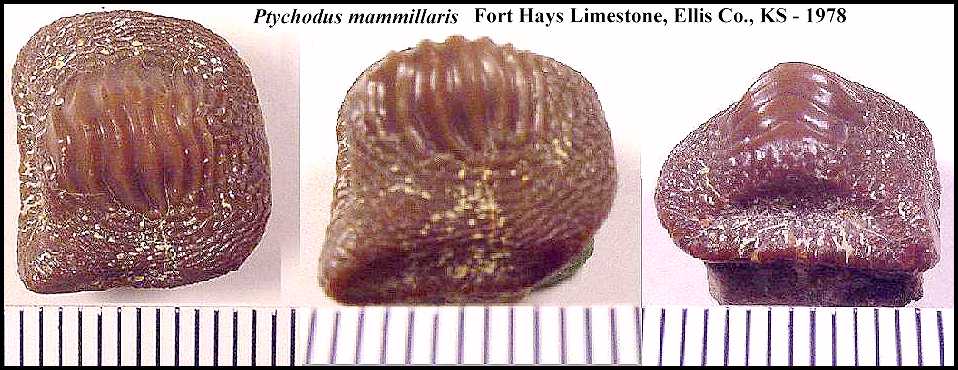
Shimada, K and M. J. Everhart. 2003. Ptychodus mammillaris (Elasmobranchii) and Enchodus cf. E. schumardi (Teleostei) from the Fort Hays Limestone Member of the Niobrara Chalk (Upper Cretaceous) in Ellis County, Kansas. Kansas Academy of Science, Transactions 106(3-4):171-176.
Vertebrate fossils are rare components of the Fort Hays Limestone Member (Uppermost Turonian - Lower Coniacian) of the Upper Cretaceous Niobrara Chalk Formation. In this paper, two fish taxa that are new to the faunal list of this stratigraphic member are described: Ptychodus mammillaris Agassiz and Enchodus cf. E. shumardi Leidy. These additions increase the total number of documented vertebrate species to 11 for the Fort Hays Limestone and provide additional insights into the paleoecology of the Western Interior Seaway during the deposition of the Fort Hays Limestone.
Everhart, M. J. 2004. New data regarding the skull of Dolichorhynchops osborni (Plesiosauroidea: Polycotylidae) from rediscovered photos of the Harvard Museum of Comparative Zoology specimen. Paludicola 4(3):74-80.
The Dolichorhynchops osborni specimen (MCZ 1064) in the Museum of Comparative Zoology, Harvard University, Cambridge, Massachusetts, was the second of only three nearly complete specimens of this species ever recovered from the Smoky Hill Chalk Member of the Niobrara Chalk Formation (Upper Cretaceous). The remains were discovered by George F. Sternberg in 1926 and later acquired by Harvard. Sternberg apparently mounted the skull in a block of plaster that obscures many important details and limits its usefulness. Recently re-discovered photos of the skull, included in correspondence sent by Sternberg to Charles W. Gilmore in 1926, provide an excellent record of the original appearance of this rare specimen. Measurements taken from these photographs are compared with those published of other specimens of this species.
Everhart, M. J. 2004. Late Cretaceous interaction between predators and prey. Evidence of feeding by two species of shark on a mosasaur. PalArch, vertebrate palaeontology series 1(1):1-7.
The fragmentary remains of a mosasaur discovered in the Smoky Hill Chalk Member (Late Coniacian) of the Niobrara Chalk of Gove County, Kansas, U.S.A., preserve a number of injuries consistent with scavenging by two species of lamnid shark. The mosasaur remains (FHSM VP-13746) were identified as cf. Ectenosaurus clidastoides and consisted of a continuous series of 21 dorsal vertebrae. No evidence was found of the anterior neck and skull, limbs or caudal vertebrae. A single cervical vertebra was located in front of the first dorsal and one posterior dorsal vertebra had been fractured prior to burial. Although still associated with the vertebral column, most of the ribs were severed or otherwise damaged. No residual of the cartilaginous sternum was found. Deep bite marks on several of the vertebrae, severed ribs and the tip of a large, embedded tooth are interpreted as evidence that the lamniform shark, Cretoxyrhina mantelli, had fed on the mosasaur remains. The spacing of the individual tooth marks (3 cm) indicate the bites were from a very large (estimated 5 m) shark. Lesser damage, including serrated bite marks and scrapes indicated that another shark species, Squalicorax falcatus, had also been involved. This specimen is important palaeoecologically because it documents a predator-prey relationship between these two species of sharks and mosasaurs, and because it provides further evidence that Cretoxyrhina and Squalicorax fed on large vertebrates in the Late Cretaceous seas of North America.
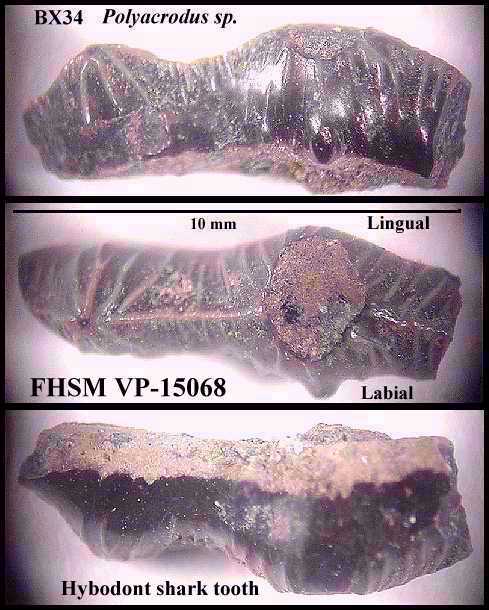
Everhart, M. J. 2004. First record of the hybodont shark genus, “Polyacrodus” sp., (Chondrichthyes; Polyacrodontidae) from the Kiowa Formation (Lower Cretaceous) of McPherson County, Kansas. Kansas Academy of Science, Transactions 107(1/2): 39-43.
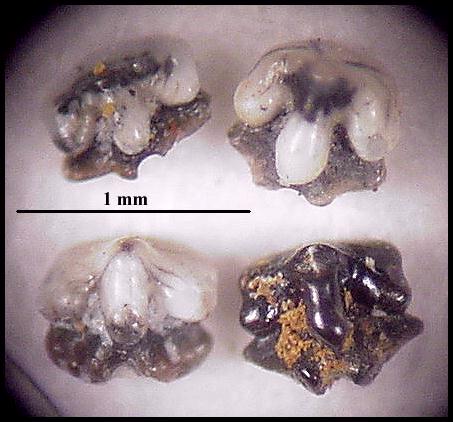
Three unassociated tooth fragments of the hybodont shark, Polyacrodus sp., were recovered from a quarry in the Kiowa Formation (Lower Cretaceous, Albian), McPherson County, Kansas, in June of 2003. The teeth of this shark represent a new record for the poorly known vertebrate marine paleofauna of the Kiowa. The fragments were discovered in association with the teeth of another hybodont, two lamniform sharks, a ray, and a pycnodont fish; a turtle vertebra; a plesiosaur tooth fragment; and bone, osteoscute, and tooth fragments of crocodilians. The teeth are the first recognized occurrence of “Polyacrodus” in Kansas, and further document the diversity of this near-shore paleofauna in the Western Interior Sea during the Early Cretaceous.
Annual meeting of the Kansas and Missouri Academies of Science, Rockhurst University, Kansas City, Missouri, April 17, 2004
Everhart, M. J., P. A. Everhart and K. Ewell. 2004. A marine ichthyofauna from the Upper Dakota Sandstone (Late Cretaceous). Abstracts of oral presentations and posters, Joint Annual Meeting of the Kansas and Missouri Academies of Science, p. 48.
The Dakota Sandstone in Kansas is composed of mudstones and channel sandstone lenses deposited at the mouth of a river flowing into the Western Interior Sea from the northeast during Middle Cenomanian time. The formation is well known for beautifully preserved impressions of deciduous leaves, but has an otherwise poor record for vertebrate remains. A marine ichthyofauna is reported here for the first time from the Upper Dakota Sandstone near Wilson Lake in eastern Russell County. The interbedded sandstones and shales exposed at this locality represent the transition from non-marine, deltaic deposits to a shallow-water, marine environment at the beginning of the Greenhorn Transgression. The micro- and macro-vertebrate faunal assemblage is derived from a two layers of poorly cemented sand within 6 m of the contact with the Graneros Shale. To date, the Wilson Lake fauna consists of 20 taxa: 7 sharks (Hybodus sp., “Polyacrodus” sp., Cretoxyrhina mantelli, Cretolamna appendiculata, Carcharias amonensis, Cretodus semiplicatus, and Squalicorax falcatus); 6 rays (Rhinobatos incertus, Pseudohypolophus mcnultyi, Chiloscyllium greeni, Onchopristis dunklei, Ptychotrygon sp., and “Cretomanta canadensis”); and 7 bony fish (“Coelodus” sp., Hadrodus sp., Pachyamia sp., Lepidotes sp., Enchodus sp., Xiphactinus audax, and Protosphyraena bentonianum). The teeth of Carcharias and Rhinobatos are the most abundant of the sharks and rays, and Enchodus sp. is the most abundant bony fish. The species represented in the Wilson Lake fauna suggest a shallow marine environment located on the edge of a river delta near the eastern shore of the Western Interior Sea.
Annual meeting of the Kansas and Missouri Academies of Science, Rockhurst University, Kansas City, Missouri, April 17, 2004
Everhart, M. J., K. Shimada and K. Ewell. 2004. First record of the lamniform shark genus, Johnlongia, from the Niobrara Chalk. Abstracts of oral presentations and posters, Joint Annual Meeting of the Kansas and Missouri Academies of Science, p. 48.
We describe the first occurrence of the extinct lamniform shark, Johnlongia sp. (Elasmobranchii: Odontaspididae), from the Smoky Hill Chalk Member of the Niobrara Chalk (Upper Cretaceous) in southwestern Trego County, Kansas. The specimen is a small isolated tooth which is morphologically unique and may represent a new taxon within the genus Johnlongia. It occurred near the base of the Smoky Hill Chalk where the stratigraphic level corresponds in age to the Late Coniacian. This record not only represents the first documented occurrence of the genus from the Niobrara Chalk, but also establishes the stratigraphically youngest Johnlongia specimen in the world. The addition of Johnlongia sp. increases the total number of lamniform species reported from the Smoky Hill Chalk to eight. The Johnlongia tooth is catalogued as VP-15545 in the collection of the Sternberg Museum of Natural History, Fort Hays State University, Hays, Kansas.
Annual meeting of the Kansas and Missouri Academies of Science, Rockhurst University, Kansas City, Missouri, April 17, 2004
Ewell, K. and M. J. Everhart. 2004. A Paleozoic shark fauna from the Council Grove Group (Lower Permian). Abstracts of oral presentations and posters, Joint Annual Meeting of the Kansas and Missouri Academies of Science, p. 48-49.
In 2003, abundant vertebrate remains consisting of unassociated shark teeth, dorsal fin spines and preserved cartilage were discovered in a narrow (2-3 cm) seam of poorly consolidated limey mud near the base of the Neva Limestone Member of the Genola Limestone Formation (Council Grove Group, Lower Permian) in southeastern Geary County, Kansas. Remains identified included the teeth of the Paleozoic sharks Cladodus occidentalis, Petalodus alleghaniensis, Agassizodus variabilis, Acrodus sp., Chomodus sp., and a chimaeroid (cf. Sandalodus sp.), dorsal fin spines of Physonemus mirabilis and a hybodont shark (cf. Lissodus sp.), and scales of Holmesella quadrata. The mud layer contains a high percentage of coarsely ground shell and bone fragments, and is interpreted as a re-deposit generated by a major storm or tsunami type event. Another nearby site produced dorsal fin spines of Ctenacanthus cf. amblyxiphias, teeth of Cladodus sp. and Petalodus sp., and preserved cartilage in association with abundant invertebrate remains, while teeth of Petalodus sp. and Chomodus sp., and an unidentified dorsal fin spine fragment were collected at a third site. Cladodus teeth were the most frequently recovered remains at Site 1, while Ctenacanthus dorsal fin spines and Petalodus teeth were the most common remains at Site 2 and Site 3 respectively. Differing conditions of deposition are indicated by the condition and abundance of vertebrate remains at each site.
Annual meeting of the Kansas and Missouri Academies of Science, Rockhurst University, Kansas City, Missouri, April 17, 2004
Schumacher, B. A. and M. J. Everhart. 2004. A new assessment of plesiosaurs from the old Fort Benton Group, Central Kansas. Abstracts of oral presentations and posters, Joint Annual Meeting of the Kansas and Missouri Academies of Science, p. 50.
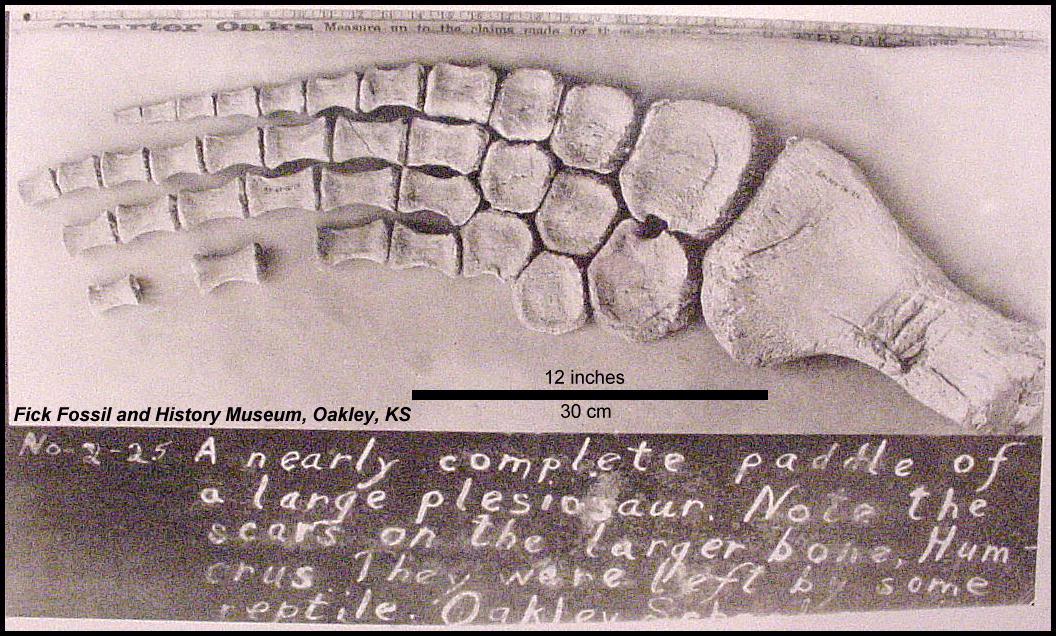
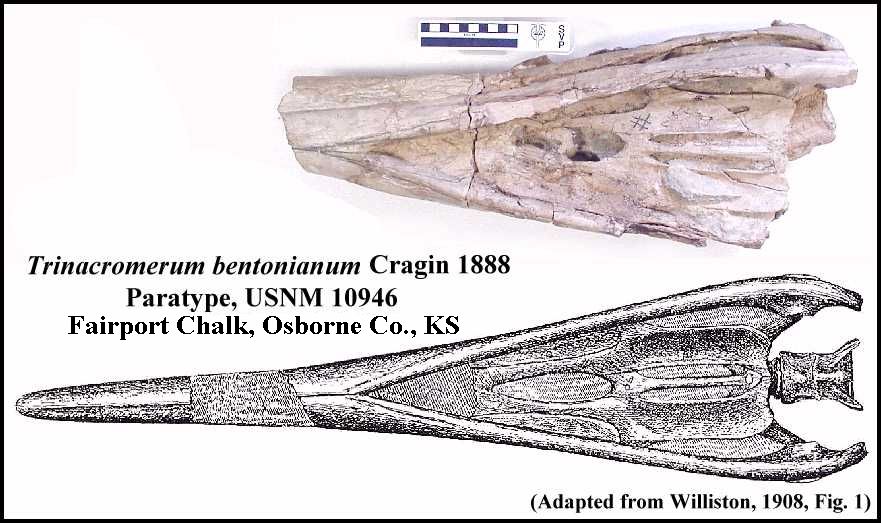
The old “Fort Benton Group” in central Kansas has produced a relatively large number of plesiosaur (pliosaurid, polycotylid and elasmosaurid) specimens. In modern terminology this stratigraphic term refers to the Graneros Shale, Greenhorn Limestone, and Carlile Shale (Middle Cenomanian to Middle Turonian) of the Western Interior. In particular, the Fairport Chalk Member, Carlile Shale, has produced an unusually high number of plesiosaur remains in light of the fact that it is characteristically poorly exposed and minimally accessible. A giant pliosaurid (Brachauchenius lucasi) is known from the basal Lincoln Limestone Member, Greenhorn Limestone (Middle Cenomanian) to the middle of the Fairport Chalk. The occurrence of pliosaur material in the Fairport Chalk (lower Middle Turonian) is at or near the last known occurrence of this group prior to their extinction. A polycotylid (Trinacromerum bentonianum) appears to be especially well represented in the upper Greenhorn Limestone and lower one-half of the Fairport Chalk (Lower and Middle Turonian), but is first documented in central Kansas from upper Hartland Shale Member, Greenhorn Limestone (middle Upper Cenomanian). Elasmosaurid remains appear to be comparatively rare throughout this interval, with the only three firmly established records from the Graneros Shale and Greenhorn Limestone (Middle Cenomanian to Lower Turonian). Since the discovery of the first plesiosaur in the “Old Fort Benton Group” by B. F. Mudge in 1873, a significantly greater number of plesiosaur specimens have been collected from this stratigraphic interval than from the overlying Niobrara Chalk.
Everhart, M. J. 2004. Tylosaurus novum sp. – An update on an unnamed species of basal tylosaurine. Abstract book and field guide of the First Mosasaur Meeting, Schulp, A. S. and John W. M. Jagt (eds.), Natuurhistorisch Museum Maastricht, the Netherlands, pp. 35-39.
Tylosaurines were among the earliest of the mosasaurs which flourished in the oceans of the earth during the last 25 million years of the Late Cretaceous. Tylosaurus (“Macrosaurus”) proriger was the first mosasaur described from the Niobrara Chalk of the Western Interior Sea by Cope in 1869. Since then, the remains of tylosaurine mosasaurs have been recovered from many localities around the world, including Europe, Japan, New Zealand and Antarctica. The remains of the earliest known tylosaurine species, T. nepaeolicus (Cope 1874), are found in the Late Coniacian in the western Kansas along with Platecarpus tympaniticus Cope 1869, and Clidastes liodontus Cope 1874. Another early species of tylosaurine, originally identified as “Tylosaurus n. sp.” by Stewart (1990), apparently co-existed with T. nepaeolicus and exhibited a number of primitive characters which place it in a basal position in the mosasaur phylogeny of Bell (1997). Differences between it and all other tylosaurs include: quadrates that lack an infrastapedial process; a shortened, more rounded premaxilla; and an anteriorly located parietal foramen that often invades the frontal-parietal suture. Except for a few fragmentary and problematic remains found in Texas, the third species of Tylosaurus is known only from the lower Smoky Hill Chalk Member of the Niobrara Chalk of western Kansas. The species apparently became extinct by the Early Santonian. Since 1990, other than brief, unpublished descriptions by Bell (1993) and Schumacher (1993), and inclusion within Bell’s (1997) phylogenetic revision of the Mosasauroidea, the new species has only been mentioned in the literature without further comment. For a variety of reasons, and somewhat without precedent, this species still does not have a formal name, even though there are a number of well preserved, articulated skulls and several reasonably complete skeletons in museum collections. The purpose of this paper is to update the information regarding this species and to begin the process of describing and naming Tylosaurus novum sp.
Everhart, M. J. 2004. Plesiosaurs as the food of mosasaurs; new data on the stomach contents of a Tylosaurus proriger (Squamata; Mosasauridae) from the Niobrara Formation of western Kansas. The Mosasaur 7:41-46.
Although plesiosaurs and mosasaurs co-existed for about 25 million years at the end of the Cretaceous, the fossil record was mute regarding interactions between these two groups of marine reptiles until a discovery was made in the summer of 1918. At that time, Charles F. Sternberg uncovered the partially digested bones of a plesiosaur as stomach contents in an adult (9 m) Tylosaurus proriger skeleton in the Smoky Hill Chalk Member (early Campanian) of the Niobrara Formation near Twin Butte Creek in Logan County, Kansas. Sternberg reported his discovery at the annual meeting of the Kansas Academy of Science in 1919 and indicated that the material had been sent to the United States National Museum. Due to unusual circumstances regarding the publication of his brief paper in the Transactions of the Kansas Academy of Science, however, the association of the two specimens went largely unnoticed until 2001. This association demonstrates conclusively that mosasaurs fed on plesiosaurs and provides additional data about the ecology of the Western Interior Sea. Here the remains are re-examined and discussed in light of related information that has become available in the more than eighty years since their original discovery.
Everhart, M. J. 2004. Notice of the transfer of the holotype specimen of Niobrarasaurus coleii (Ankylosauria; Nodosauridae) to the Sternberg Museum of Natural History. Kansas Academy of Science, Transactions 107(3-4):173-174.
Published as a note - No abstract
Everhart, M. J. and T. Caggiano. 2004. An associated dentition and calcified vertebral centra of the Late Cretaceous elasmobranch, Ptychodus anonymus Williston 1900. Paludicola 4(4), p. 125-136.
The associated remains of a ptychodontid shark, Ptychodus anonymus Williston 1900, were recovered by the authors from the Smoky Hill Chalk Member (Late Cretaceous; late Coniacian) of the Niobrara Chalk Formation of western Kansas. Preserved elements included 208 teeth, five vertebral centra, fragments of centra and calcified cartilage, and oral (pharyngeal) denticles. The presence of calcified vertebral centra indicate that Ptychodus is a neoselachian shark and not a hybodont as previously reported. Whereas individual teeth of the genus Ptychodus are relatively common fossils in Late Cretaceous marine sediments, reasonably complete dentitions and preserved soft tissues are rare, and few have been reported in the literature. Most of the Ptychodus teeth that have been documented previously from the Niobrara Chalk have not included accurate stratigraphic information. In addition to reporting the associated dentition, calcified vertebral centra and oral denticles of Ptychodus anonymus, we also review the fauna association of the specimen and the history of the genus in North America.
Everhart, M. J. and M. K. Darnell. 2004. Occurrence of Ptychodus mammillaris (Elasmobranchii) in the Fairport Chalk Member of the Carlile Shale (Upper Cretaceous) of Ellis County, Kansas. Kansas Academy of Science, Transactions 107(3-4):126-130.
Although more vertebrate species have been reported from the Fairport Chalk Member (Middle Turonian) than from the overlying Blue Hill Shale and Codell Sandstone members (upper Middle Turonian) of the Carlile Shale in Kansas, the number is relatively small compared to that from the deeper water fauna of the Smoky Hill Chalk Member (upper Coniacian to lower Campanian) of the Niobrara Chalk. Ptychodontids are poorly represented in the Fairport Chalk, both in number of specimens and species. Here we report the first occurrence of Ptychodus mammillaris from a single tooth collected in the Fairport Chalk of Ellis County. This specimen adds new data concerning the faunal diversity of the Western Interior Sea during the Middle Turonian.
Shimada, K. and M. J. Everhart. 2004. Shark-bitten Xiphactinus audax (Teleostei: Ichthyodectiformes) from the Niobrara Chalk (Upper Cretaceous) of Kansas. The Mosasaur 7, p. 35-39.
We report a specimen of the ichthyodectiform teleost, Xiphactinus audax Leidy, from the Upper Cretaceous Niobrara Chalk of western Kansas, which consists of a nearly complete, fully articulated skull and the six anteriormost vertebrae. A broken tooth of the lamniform shark, Cretoxyrhina mantelli (Agassiz), is embedded in the third vertebra of the specimen. The size of the Xiphactinus skull suggests that the teleost was approximately 3 m in total body length. The total body length of the shark is extrapolated to be no larger than 3.1 m. Whether the shark attacked or scavenged the teleost cannot be ascertained. Nevertheless, the specimen offers compelling evidence for the coexistence of these two species and further supports a previously proposed idea that C. mantelli fed on X. audax.
Shimada, K., K. Ewell and M. J. Everhart. 2004. The first record of the lamniform shark genus, Johnlongia, from the Niobrara Chalk (Upper Cretaceous, western Kansas. Kansas Academy of Science, Transactions 107(3/4):131-135.
We describe the first occurrence of the Late Cretaceous lamniform shark, Johnlongia sp. (Elasmobranchii: Odontaspididae), from the Smoky Hill Chalk Member of the Niobrara Chalk in Trego County, Kansas. The specimen is a small isolated tooth, which is morphologically unique and may represent a new taxon within the genus Johnlongia. The tooth occurred in the Upper Coniacian portion of the Smoky Hill Chalk, and it represents the stratigraphically youngest Johnlongia specimen in the world. The addition of Johnlongia sp. increases the total number of lamniform species reported from the Smoky Hill Chalk to eight.
2004 Society of Vertebrate Paleontology Meeting, Denver, CO.
Everhart, M. J. 2004. Conchoidal fractures preserved on elasmosaur gastroliths are evidence of use in processing food. Journal of Vertebrate Paleontology 24 (Supplement to 3): 56A.
The association of large numbers of gastroliths (stomach stones) with the remains of elasmosaurs (Plesiosauria: Elasmosauridae) in the Late Cretaceous marine sediments of North America was first reported in 1877. Their anterior position suggests that they were contained within the elasmosaur digestive tract. The stones are usually well rounded and polished to some degree, and occur in a wide range of sizes within the same specimen. Their presence has been explained by previous authors as accidental ingestion, ballast, and for use in a gastric mill. Gastroliths were examined from seven North American elasmosaur specimens varying in age from Cenomanian to Maastrichtian. In all specimens, at least one stone, usually composed of a microcrystalline quartz such as chert, preserved numerous arc-shaped surface markings. Examination indicates that these markings were the result of small (2-5 mm), conchoidal fractures of the chert. The fractures generally cover the surface of the stone, exhibit varying degrees of wear and often cross other fractures. Similar fractures can occur naturally due to stone on stone impacts in river or beach gravels, but do not occur on non-gastroliths in the numbers observed on the gastroliths which were examined. The more frequent occurrence of conchoidal fractures on the edges of angular shaped stones in a controlled experiment indicates that such damage is an important part of the mechanism for rounding and smoothing gastroliths. Gastroliths with arc-shaped markings were found within a recently described plesiosaur specimen in intimate association with the finely comminuted bones of small fish. These markings suggest that conchoidal fractures occurred as the stones were ground against one another by peristaltic contractions within the plesiosaur’s digestive tract. The more frequent occurrence of these markings on chert gastroliths in plesiosaurs compared to similar stones from river and shore deposits provides further evidence as to their use in processing food.
2005 Annual Meeting of the Kansas Academy of Science, Johnson County Community College, Overland Park, KS
Everhart, M.J. 2004. Tylosaurus proriger and the myth of the ram-nosed mosasaur. Kansas Academy of Science Transactions, 108(3-4): 167.
The type specimen of Tylosaurus proriger (Cope 1869) was found near Monument Rocks in 1868. As an indication of the disagreements to come between E. D. Cope and O. C. Marsh, the genus name was changed from Macrosaurus to Rhinosaurus Marsh 1872 to Rhamphosaurus Cope 1872, and finally to Tylosaurus Marsh 1872. Roughly translated, the name means “prow-bearing snout-lizard,” an obvious reference to the characteristic extension of the premaxilla and dentarys beyond the front teeth. This feature is unique to Tylosaurus and is in contrast to the muzzle of most other mosasaur genera where the anterior-most teeth are even with or project beyond the ends of the upper and lower jaws. It was suggested by Cope and others that the bony snout was used as a ram to kill prey or as a weapon against other mosasaurs. More recent studies have shown that the cranial bones of many mosasaurs were loosely connected, similar to the highly flexible skull of a snake. In addition, the rostrum was extensively innervated and may have served a sensory function for locating prey in conditions of low visibility. The badly fractured rostrum of a T. proriger specimen from the Niobrara Chalk provides dramatic evidence of a collision with a solid object. The popular idea of Tylosaurus ramming prey or foes with its relatively fragile and sensitive snout appears to be unsupported by the fossil evidence.
Everhart, M. J. and S. A. Hamm. 2005. A new nodosaur specimen (Dinosauria: Nodosauridae) from the Smoky Hill Chalk (Upper Cretaceous) of western Kansas. Kansas Academy of Science Transactions 108 (1/2): 15-21. (See also Hamm and Everhart, 2001)
The right ulna and radius of a small nodosaur were recovered from the Smoky Hill Chalk Member (Upper Santonian) of the Niobrara Formation in October, 2000. Based on the similarity of the specimen in comparison with the holotype of Niobrarasaurus coleii, and the relatively small size of the remains, the bones are considered to be those of a juvenile N. coleii. The presence of two parallel scratch marks on the distal shaft of the radius, and the partially digested appearance of the proximal and distal ends of both bones, suggest that the lower limb had been detached from the carcass as the result of scavenging, most likely by the large lamniform shark, Cretoxyrhina mantelli. Although the remains of terrestrial vertebrates are not unknown from sediments deposited in the Late Cretaceous Western Interior Sea, additional discoveries are infrequent and valuable sources of information regarding the terrestrial fauna of the time.
Everhart, M. J. 2005. Bite marks on an elasmosaur (Sauropterygia; Plesiosauria) paddle from the Niobrara Chalk (Upper Cretaceous) as probable evidence of feeding by the lamniform shark, Cretoxyrhina mantelli. PalArch, vertebrate paleontology 2(2): 14-24.
The left front paddle of an unidentified elasmosaurid in the collection of the Fick Fossil and History Museum exhibits two groups of deeply incised grooves across the dorsal and ventral sides of the humerus that suggest a series of bites by the lamniform shark, Cretoxyrhina mantelli. The remains were discovered by George F. Sternberg in 1925 in the Smoky Hill Chalk Member of the Niobrara Chalk, Logan County, Kansas, USA. Archival photographs, along with Sternberg's hand written note, document the condition of the specimen when originally collected. The specimen is significant because it preserves the first evidence of probable feeding by C. mantelli on an elasmosaurid, and because it represents the rare occurrence of an elasmosaurid in the upper Smoky Hill Chalk of western Kansas.
Everhart, M. J. 2005. Rapid evolution, diversification and distribution of mosasaurs (Reptilia; Squamata) prior to the K-T Boundary. Tate 2005 11th Annual Symposium in Paleontology and Geology, Casper, WY, p. 16-27 (not peer-reviewed).
Highly-adapted marine reptiles called mosasaurs became the apex predators of the Earth’s oceans in the last 25 million years of the Late Cretaceous. Returning to the sea during Cenomanian - Turonian time, they evolved from 1 m, shore-dwelling lizards into a variety of large (up to 17 m), fully marine carnivores. Their remains have been found in marine deposits on all continents, including Antarctica. Evidence of their rapid radiation, worldwide distribution and dominance appears to contrast sharply with that of other marine reptiles such as ichthyosaurs and plesiosaurs, the dinosaurs and even other marine predators such as sharks. Mosasaurs were highly adaptable and apparently able to fill many of the ecological niches left vacant by the extinction of the ichthyosaurs, marine crocodiles and plesiosaurs. Their rapid evolution may have also contributed to the extinction of several species of sharks, and they may have been competing with crocodilians in estuarine and freshwater environments at the end of the Cretaceous. Mosasaurs are an example of adaptive radiation prior to the K-T boundary extinction.
Schumacher, B. A. and M. J. Everhart. 2005. A stratigraphic and taxonomic review of plesiosaurs from the old “Fort Benton Group” of central Kansas: A new assessment of old records. Paludicola 5(2):33-54.
The old “Fort Benton Group” (Middle Cenomanian to Middle Turonian) in central Kansas has produced a relatively large number of plesiosaur specimens. In modern terminology, this historical stratigraphic term refers to the Graneros Shale, Greenhorn Limestone, and Carlile Shale of the Western Interior. In particular, the Fairport Chalk Member of the Carlile Shale has produced an unusually high number of partial plesiosaur skeletons in light of the fact that it is characteristically poorly exposed and minimally accessible. Polycotylids, including Trinacromerum bentonianum, are first documented in central Kansas from the upper Hartland Shale Member, Greenhorn Limestone (middle Upper Cenomanian), and appear to be especially well represented in the upper Greenhorn Limestone and lower one-half of the Fairport Chalk (Lower and Middle Turonian). Pliosaurids (including Brachauchenius lucasi) are known from the basal Lincoln Limestone Member, Greenhorn Limestone (Middle Cenomanian) to the middle of the Fairport Chalk. The occurrence of pliosaurs in the Fairport Chalk (early Middle Turonian) is at or near the last known occurrence of this group prior to their extinction. Elasmosaurid remains are rare throughout the “Fort Benton” interval, with only three firmly established records.
Everhart, M.J. 2005. Probable plesiosaur gastroliths from the basal Kiowa Shale (Early Cretaceous) of Kiowa County, Kansas. Kansas Academy of Science, Transactions 108 (3/4): 109-115.
Rounded and polished igneous or metamorphic pebbles that occur in sedimentary deposits generally are considered to be true gastroliths only when associated with the remains of vertebrate animals. In the Kansas Cretaceous, with the exception of two unusual specimens, a shark and a mosasaur, gastroliths are known to be associated only with the remains of extinct marine reptiles called plesiosaurs (Sauropterygia; Plesiosauroidea). Examples of non-associated, gastrolith-like stones are rare in the fossil record of Kansas. The recent discovery of rounded and polished stones from two localities in the basal Kiowa Shale (Albian, Early Cretaceous) coincides with the documented presence of plesiosaur remains in that formation, including one specimen associated with over 200 gastroliths. Similar sized stones collected from the underlying Cheyenne Sandstone were composed predominately of quartz and are lithologically distinct from the probable gastroliths. The rounded, polished appearance of these stones, including chert pebbles with distinctive conchoidal fractures, strongly suggests that the stones from the basal Kiowa Shale are gastroliths.
Everhart, M.J. 2005. Earliest record of the genus Tylosaurus (Squamata; Mosasauridae) from the Fort Hays Limestone (Lower Coniacian) of western Kansas. Transactions 108 (3/4): 149-155.
Fossil vertebrates are extremely rare in the Fort Hays Limestone member of the Niobrara Chalk in comparison to the rich variety of well-preserved fish, turtles, mosasaurs, pteranodons, and toothed birds collected from the over-lying Smoky Hill Chalk, and to a lesser extent, the underlying Carlile Shale. Although mosasaurs are well documented from the Smoky Hill Chalk (Upper Coniacian – Lower Campanian), and occur rarely in the Carlile Shale (Middle Turonian), they had not been previously reported from the intervening Fort Hays Limestone (Lower Coniacian). Here we report the remains of a mosasaur (FHSM VP-2297) preserving 14 articulated vertebrae, the left coracoid, ribs, and fragments of sternal cartilage collected by M. V. Walker in 1967 from Ellis County, Kansas. Serrated bite marks on several of the ribs are attributable to the anacoracid shark, Squalicorax falcatus, and suggest post-mortem scavenging of the remains. The specimen is identified as Tylosaurus sp. on the basis of the characteristic shape of the coracoid and represents the earliest documented occurrence of that genus. It is also the first record of a mosasaur in the Fort Hays Limestone and preserves the earliest evidence of scavenging on mosasaur remains by Squalicorax.
Everhart, M. J. 2005. Elasmosaurid remains from the Pierre Shale (Upper Cretaceous) of western Kansas. Possible missing elements of the type specimen of Elasmosaurus platyurus Cope 1868? PalArch 4(3): 19-32.
When E. D. Cope described the type specimen of Elasmosaurus platyurus 1868 more completely in 1869, he noted that a number of dorsal vertebrae were missing, along with the gastralia, the limbs, and most of the skull. Although additional searches were made by the military surgeon who discovered the remains, Dr. Theophilus H. Turner, the missing material was never located. Interest in the specimen eventually faded as dinosaurs were discovered further West, and portions of the specimen, including the pectoral and pelvic girdles, were mysteriously lost. More recently, three collections of associated plesiosaur material, including dorsal vertebrae, ribs, gastralia, and large gastroliths were made from a second site near the type locality of E. platyurus. The additional material is curated in the Sternberg Museum of Natural History, Hays, KS, the University of Kansas Museum of Natural History, Lawrence, KS, and the Cincinnati Museum Center, Cincinnati, OH. Examination the more recently discovered remains in these three repositories, and comparisons with the those of the type specimen at the Academy of Natural Sciences of Philadelphia, a review of the letters and other historical documents related to the discovery of E. platyurus, and on-site evaluation of the stratigraphy of the both localities suggest that the more recently collected remains were originally part of the type specimen and were separated prior to burial when the floating carcass began to fall apart.
Everhart, M.J. 2005. Tylosaurus kansasensis, a new species of tylosaurine (Squamata: Mosasauridae) from the Niobrara Chalk of western Kansas, U.S.A. Netherlands Journal of Geosciences / Geologie en Mijnbouw, 84(3), p. 231-240.
Tylosaurus kansasensis sp. nov. is described herein on the basis of thirteen specimens collected from the Smoky Hill Chalk (upper Coniacian) of western Kansas, USA. The new species, originally designated Tylosaurus n. sp., co-occurred with T. nepaeolicus and exhibits a number of primitive characters that place it in a basal position in the mosasaur phylogeny. Among the key differences separating this species from other tylosaurines are a shortened, more rounded pre-dental process of the premaxilla, a distinctive quadrate lacking an infrastapedial process, and a parietal foramen located adjacent to the frontal-parietal suture.
2005 Society of Vertebrate Paleontology Meeting, Mesa, AZ.
Everhart, M. J. 2005. New stratigraphic records (Albian-Coniacian) of the guitarfish, Rhinobatos incertus (Chondrichthyes; Rajiformes), from the Cretaceous of central and western Kansas. Journal of Vertebrate Paleontology, 25(Supplement to 3): 55A.
Guitarfish (Rhinobatidae) are a conservative group of extant rays with worldwide distribution and a fossil record that extends back to the Late Jurassic of Europe. Modern representatives of the order inhabit shallow tropical and sub-tropical waters, at depths less than 200 m, and are also found in fresh water environments. The most common fossil remains are isolated teeth (less than 2 mm) although complete specimens are known. In North America, the earliest documented Rhinobatos sp. teeth were recovered from the Early Cretaceous (Lower Albian) of Texas. Rhinobatos sp. has been reported in the western interior from the Albian-Campanian of Texas, the Turonian and Santonian of Kansas, the Cenomanian of Nebraska, the Cenomanian-Turonian of New Mexico and South Dakota, and the Coniacian of Saskatchewan, Canada. Recent discoveries of Rhinobatos incertus teeth in the Cretaceous of Kansas indicate a reasonably continuous presence of the species in a variety of marine environments within the Western Interior Sea from the Upper Albian to the Lower Campanian. New Kansas records of R. incertus teeth are: 1) Kiowa Shale (Upper Albian), McPherson County; 2) Dakota Sandstone - Graneros Shale contact (Middle Cenomanian), Russell County; 3) Basal Lincoln Limestone Member, Greenhorn Limestone (Upper Cenomanian), Russell County, and; 4) Smoky Hill Chalk (Upper Coniacian), Trego County. The only previous reports from Kansas include the Blue Hill Shale Member, Carlile Shale (Middle Turonian), Jewell County, and the Smoky Hill Chalk (Middle Santonian and Lower Campanian), Gove and Logan counties. Depositional settings varied from marginal marine sandstone to near-shore shales and deeper water (< 200 m) limestone and chalk during the Kiowa-Skull Creek, Greenhorn and Niobrara Cyclothems. The earliest (Upper Albian) and smallest (< 0.5 mm) R. incertus teeth were found in a shelly lag deposit composed predominately of Turritella belviderei. Hundreds of R. incertus teeth were collected near the top of Dakota Sandstone, and the species represented nearly one-third of about 1600 selachian teeth picked from a fish tooth conglomerate in the upper Blue Hill Shale.
2006 Kansas Academy of Science Annual Meeting, Wichita State University, Wichita, Kansas, April 9, 2006
Everhart, M.J., Sternberg Museum of Natural History, R. Decker and P. Decker, Mankato, Kansas. Earliest remains of Dolichorhynchops osborni (Plesiosauria: Polycotylidae) from the basal Fort Hays Limestone, Jewell County, Kansas.
The Fort Hays Limestone Member of the Niobrara Chalk was deposited in the Western Interior Sea during the maximum transgressive phase of the Niobrara Cyclothem (early Coniacian). The water was relatively deep, well-aerated and far enough from shore as to be beyond the influence of terrestrial sediments. The member ranges from 17-24 m in thickness and consists of several relatively resistant beds of chalky limestone separated by thin layers of chalky shale. Although rich in invertebrate remains, the Fort Hays has produced few vertebrate specimens. In 2005, polycotylid plesiosaur (Dolichorhynchops osborni) remains were collected from the basal Fort Hays in Jewell County, Kansas. The specimen (FHSM VP-16459) consists of a semi-articulated series of 24 dorsal vertebrae, pelvic and pectoral girdle fragments, ribs, and distal limb elements. Dolichorhynchops was previously known from the Campanian age Smoky Hill Chalk and Pierre Shale, although fragmentary remains of polycotylids have been reported from the upper Coniacian. The new specimen is only the second plesiosaur and the third marine reptile collected from the Fort Hays. Remains of Xiphactinus, Cimolichthys, Protosphyraena and several species of shark teeth have been collected by the authors from the same stratigraphic level. The new specimen significantly extends the temporal range of Dolichorhynchops and adds to our knowledge of the faunal diversity of the Western Interior Sea during early Coniacian time.
2006 Kansas Academy of Sciences Meeting, Wichita State University, Wichita, Kansas, April 9, 2006
Everhart, M. J. and E. M. Manning, 2002. Dr. George Miller Sternberg: The first Sternberg fossil hunter in Kansas.
Charles H. Sternberg and his sons, George F., Charles M. and Levi are recognized today as one of the 'dream teams' of paleontology for their collecting work in Kansas, and elsewhere in the United States and Canada. Few people realize that Charles H. Sternberg had an older brother who was actually one of the first fossil collectors in north central and northwestern Kansas during the late 1860s. Dr. George Miller Sternberg (1838-1915), an Army surgeon assigned to Fort Harker (1866-67) and the Indian campaign in western Kansas and the Oklahoma Territory (1868-69), collected fossil leaf imprints from the Dakota Sandstone, and shark teeth, fish, turtle and mosasaur remains from the Niobrara Chalk and Pierre Shale. He discovered the type specimen of the giant Cretaceous fish, Xiphactinus audax Leidy 1870, and more than 40 marine reptile specimens now in the United States National Museum (Smithsonian) collection. While in Kansas, Dr. Sternberg arranged for his parents and siblings to take up ranching on his land near Fort Harker, and encouraged young Charles Sternberg's interest in fossils. At the first meeting of the State Natural History Society (now the Kansas Academy of Science) in 1868, Dr. Sternberg was elected an honorary member. Later in his military career, Dr. Sternberg made important discoveries in the control of communicable diseases and was the Surgeon General of the Army from 1893-1902.
Everhart, M. J. and Ewell, K. 2006. Shark-bitten dinosaur (Hadrosauridae) vertebrae from the Niobrara Chalk (Upper Coniacian) of western Kansas. Kansas Academy of Science, Transactions, 109 (1-2):27-35.
The Niobrara Chalk in western Kansas was deposited on the eastern shelf of the Late Cretaceous Western Interior Sea during Coniacian through early Campanian time, hundreds of miles from the nearest land. As might be expected, the remains of terrestrial animals, including dinosaurs, are extremely rare in this marine environment. The first dinosaur (Claosaurus agilis) collected by Marsh from the Smoky Hill Chalk Member of the Niobrara Chalk in 1871 was also the only hadrosaur known from this formation. All other dinosaur remains collected there since 1871 have been identified as nodosaurs. Here we report the discovery of an articulated series of nine hadrosaur caudal vertebrae (FHSM VP-15824) from the Smoky Hill Chalk (upper Coniacian) of southeastern Gove County, Kansas. The presence of non-serrated bite marks on four of the vertebrae and the partially digested appearance of the proximal and distal ends of the series suggest that the vertebrae had been scavenged from the floating carcass of a dinosaur by a large shark, most likely Cretoxyrhina mantelli. The specimen represents the earliest known occurrence (Upper Coniacian) of the Hadrosauridae in the Smoky Hill Chalk, and preserves the earliest evidence of scavenging on dinosaur remains by a shark in the Western Interior Sea.
Everhart, M. J. 2006. The occurrence of elasmosaurids (Reptilia: Plesiosauria) in the Niobrara Chalk of Western Kansas. Paludicola 5(4):170-183.
The Niobrara Chalk, including the Fort Hays Limestone and Smoky Hill Chalk, was deposited during a period of high sea levels (Coniacian – lower Campanian). Although the Fort Hays Limestone is relatively devoid of vertebrate remains, the Smoky Hill Chalk has produced a rich variety of well-preserved skeletons of fish, turtles, mosasaurs, pterosaurs, toothed birds and even a few dinosaurs. In the case of mosasaurs and pterosaurs, thousands of specimens have been collected in Kansas since the late 1860s. Elasmosaurids, however, are notable for their relative scarcity, especially when compared to the number of specimens collected from the underlying and the overlying strata when the sea was shallower and the eastern shore was closer. Nine partial specimens of elasmosaurids are reported from the upper (Lower Campanian) Smoky Hill Chalk and one is known from the Fort Hays Limestone (Lower Coniacian). Although polycotylid remains are present throughout the Niobrara, they also occur more frequently in the upper Smoky Hill Chalk. The low numbers of elasmosaurid remains in the Niobrara Chalk suggests a possible preference for shallower water and a near shore environment where larger quantities of small prey were more likely to be available.
Hasiotis, S.T., Platt, B.F., Hembree, D.L. and Everhart, M.J. 2007. The Trace-Fossil Record of Vertebrates. Chapter 12, pp. 196-218 in Miller, W. III. (ed.), Trace Fossils - Concepts, Problems, Prospects. Elsevier, Amsterdam. 611 pages.
The trace-fossil record of vertebrates contains behavioral evidence of fish, amphibians, reptiles, dinosaurs, mammals, and birds in continental, transitional, and marine paleoenvironments since the Devonian. The study of vertebrate trace fossils includes tracks, trails, burrows, nests, and such feeding traces as bite marks, coprolites, gastroliths, and regurgitalites. Behaviors recorded by these traces include various kinds of (1) locomotion, (2) dwelling, (3) aestivation, (4) breeding and nesting, as well as (5) acts of feeding, which also result in (6) digestion, (7) regurgitation, and (8) defecation. These trace fossils represent the interaction between a vertebrate and a medium, which includes softgrounds, firmgrounds, hardgrounds, plants, and other animals. Humans also have a trace-fossil record, and, like other vertebrates, produce numerous trace fossils that result from different kinds of behavior.
Everhart, M. J. 2007. Remains of a pycnodont fish (Actinopterygii: Pycnodontiformes) in a coprolite; An upper record of Micropycnodon kansasensis in the Smoky Hill Chalk, western Kansas. Kansas Academy of Science, Transactions 110(1/2): 35-43.
Bone fragments, ganoid scales and the distinctive tooth crown of a pycnodont fish (FHSM VP-16583), were recovered from a coprolite (FHSM VP-16586) collected from the Smoky Hill Chalk Member (lower Santonian) of the Niobrara Chalk in northeastern Lane County, Kansas. Pycnodonts were small to medium-sized, deep-bodied bony fish with batteries of flattened, peg-like teeth on the vomer and prearticulars that are well adapted for feeding on hard-shelled prey. The tooth and a dermal bone fragment were identified as Micropycnodon kansasensis on the basis of comparison with the holotype and other specimens. Small inoceramid fragments inside the coprolite may represent gut contents of the pycnodont, or the larger, possibly durophagous, predator. The remains of pycnodonts are rare occurrences in the Smoky Hill Chalk and are generally limited to toothplates bearing their distinctive teeth. Previous specimens recovered from the Smoky Hill Chalk have been limited stratigraphically to the uppermost Coniacian. FHSM VP-16583 represents the first record of this species in the Santonian.
Everhart, M. J. 2007. Use of archival photographs to rediscover the locality of the Holyrood elasmosaur (Ellsworth County, Kansas). Kansas Academy of Science, Transactions 110(1/2): 135-143.
In 1931, an oilfield geologist working in Ellsworth County discovered large bones eroding from a limestone exposure along a creek bank about two miles west of the town of Holyrood, Kansas. He notified George F. Sternberg of the remains and later that year, Sternberg and his assistant, M.V. Walker, collected the remains of a large, headless elasmosaur from the “Lincoln Marble (Benton).” The specimen (UNSM 50136) was sold to the University of Nebraska State Museum in 1935, where it was prepared from the remaining matrix. One of the front paddles has been on display in the UNSM since that time. Sternberg was also an accomplished photographer and took several black and white photographs of the locality. The photos were used by Harold Ehler, the grandson of the person who had leased the land at the time of the discovery, and the author to confirm the locality and stratigraphic occurrence of this relatively unknown but important specimen.
Carpenter, K. and Everhart, M. J. 2007. Skull of the ankylosaur Niobrarasaurus coleii (Ankylosauria: Nodosauridae) from the Smoky Hill Chalk (Coniacian) of western Kansas. Kansas Academy of Science, Transactions, 110(1/2): 1-9
The skull of the nodosaurid Niobrarasaurus coleii (Mehl) is redescribed as the result of the discovery of additional material, including the partially crushed braincase. The bone surface shows moderate remodeling, but not to the point of sutural obliteration. The snout section suggests a long, narrow skull more similar to Pawpawsaurus than the broader Edmontonia. Nevertheless, the skull differs from other nodosaurs in the ornamentation of the bone surface and trapezoidal outline of the occipital condyle in posterior view.
Everhart, M. J. 2007. New stratigraphic records (Albian-Campanian) of the guitarfish, Rhinobatos sp. (Chondrichthyes; Rajiformes), from the Cretaceous of Kansas. Kansas Academy of Science, Transactions 110(3-4): 225-235.
Guitarfish (Rhinobatidae) are a conservative group of extant rays with worldwide distribution and a fossil record that extends as far back as the Jurassic (Toarcian). Modern representatives of the family inhabit shallow tropical and sub-tropical waters, at depths less than 200 m, as well as some fresh water environments. Although complete specimens are known, the most abundant fossil remains are small, isolated teeth (less than 2 mm, measured mesiodistally). In North America, the earliest record of Rhinobatos sp. is from Lower Cretaceous (Lower Albian) of Texas. Rhinobatos sp. has been reported from Cretaceous rocks in other areas of the U.S. Western Interior including the Albian-Campanian of Texas, the Turonian and Santonian of Kansas, Cenomanian of Nebraska, Cenomanian and Turonian of New Mexico and South Dakota, and Coniacian of Saskatchewan, Canada. Recent discoveries of Rhinobatos incertus teeth from the Upper Albian to the Lower Campanian in the Cretaceous of Kansas document a reasonably continuous presence of the species in a variety of marine environments within the Western Interior Sea. New Kansas records of R. incertus teeth are from: McPherson County, Kiowa Shale (Upper Albian); Russell County, Dakota - Graneros Shale contact (Middle Cenomanian); Jewell County, Codell Sandstone (Middle Turonian), and; Trego County, Smoky Hill Chalk (Upper Coniacian) and Logan County, Smoky Hill Chalk (Lower Campanian).
Shimada, K., Everhart, M.J., and Ewell, K. 2007. A unique reptilian (large dolichosaurid lizard?) tooth from the Upper Cretaceous Niobrara Chalk of western Kansas. Kansas Academy of Science, Transactions 110(3-4): 213-219.
We describe a unique reptilian tooth from the Smoky Hill Chalk Member of the Niobrara Chalk in Trego County, Kansas. Its taxonomic placement cannot be ascertained due to its isolated find, and it is possible that the tooth could have come from a mosasauroid in which the juvenile dentition is not known. However, except for its large size, the specimen closely resembles a right maxillary tooth of a dolichosaurid lizard, Coniasaurus crassidens, and is here referred to as cf. Coniasaurus sp. If it indeed belongs to Coniasaurus, it represents 1) the second Coniasaurus specimen from the Smoky Hill Chalk, 2) the first Coniacian record for the genus, and 3) the largest Coniasaurus tooth known to date that could have come from a 1.6 m individual.Cicimurri, D. J., D. C. Parris and M. J. Everhart. 2008. Partial dentition of a chimaeroid fish (Chondrichthyes, Holocephali) from the Upper Cretaceous Niobrara Chalk of Kansas, USA. Journal of Vertebrate Paleontology 28(1):34-40.
A specimen collected in 2006 from the Smoky Hill Chalk of central Kansas, USA, represents a rare occurrence of a chimaeroid fish from the Niobrara Chalk. The associated material includes associated right and left vomerine plates, and the right palatine plate. Comparison of the Kansas vomerines with the type of Edaphodon laqueatus, a right vomerine from Lower Campanian strata of eastern Mississippi, indicates that the remains are conspecific. However, our analysis also shows that these vomerine plates are distinct from Edaphodon, principally because of a massive, hammer-like beak, and overall modification of the oral surfaces into flat crushing plates, rather than oblique shearing surfaces as seen in Edaphodon. In addition, whereas there are three large tritors on an Edaphodonpan> palatine, the Niobrara palatine has four very small tritors, with two inner tritors, a middle tritor, and an outer tritor. Our conclusion is that the original taxonomic designation, Eumylodus laqueatus Leidy, 1873, is valid, and the geographic distribution of the taxon extended from the Mississippi embayment to the central portion of the Western Interior Seaway, U.S.A.
Everhart, M.J. 2008. Probable cause of death of the holotype specimen of Tylosaurus kansasensis (Squamata; Mosasauridae) from the Smoky Hill Chalk, western Kansas. Kansas Academy of Science, Transactions 111(1-2):170.
Mosasaurs are large marine reptiles that flourished in Earth’s oceans during the last 25 million years of the Late Cretaceous. The largest species grew to adult lengths in excess of 15 m near the end of the Maastrichtian. Aside from Great white-sized sharks such as Cretoxyrhina mantelli, there are no other marine species known from that time which could challenge the role of mosasaurs as apex predators. From the evidence of the injuries observed on the remains of mosasaurs since their discovery, however, it appears that they occasionally fought with or were attacked by other mosasaurs. Sometimes the injuries incurred in this combat were non-fatal and healed prior to the death of the mosasaur; in other specimens, the injuries were apparently fatal. The well preserved, articulated skull, lower jaws and cervical vertebrae of the holotype specimen of Tylosaurus kansasensis (FHSM VP-2295) were collected from the lower Smoky Hill Chalk (Late Coniacian) in Ellis County in 1968. The skull exhibits readily visible and non-healed gouges on the frontal and right dentary that are attributable to the powerful bite of a much larger mosasaur. The deep bite marks on the skull, as well as possible damage to the neck at the base of the skull, suggest that this individual died when its skull was bitten and crushed by another, larger mosasaur.
Everhart, M.J. 2008. Rare occurrence of a Globidens sp. (Reptilia; Mosasauridae) dentary in the Sharon Springs Member of the Pierre Shale (Middle Campanian) of Western Kansas. p. 23-29 in Farley G. H. and Choate, J.R. (eds.), Unlocking the Unknown; Papers Honoring Dr. Richard Zakrzewski, , Fort Hays Studies, Special Issue No. 2, 153 p., Fort Hays State University, Hays, KS.
The right dentary of a durophagous marine lizard (Mosasauridae), herein identified as Globidens sp., bearing unusual, globular teeth was recovered from the Pierre Shale of Logan County, Kansas, USA, in 1995. The specimen possesses a heterodont dentition consisting of large, rounded posterior teeth and relatively slender anterior teeth, justifying assignment to the genus Globidens. Stratigraphically, the specimen was located about 3 m below the contact between the Weskan and Sharon Springs members of the Pierre Shale (middle Campanian). The dentary has 13 alveoli and preserves 10 teeth, the largest of which is 2.4 cm in diameter and has a crown height of 1.6 cm. Although the Kansas specimen (FHSM VP-13828) is contemporaneous with Globidens dakotensis, it cannot be reliably assigned to that species or to G. alabamaensis because neither of these holotypes includes a dentary. This is the first specimen of Globidens documented from Kansas and provides additional data regarding the geographic range and temporal occurrence of Globidens in the Western Interior Sea.
Everhart, M.J. 2008. The mosasaurs of George F. Sternberg, paleontologist and fossil photographer. Proceedings of the Second Mosasaur Meeting, Fort Hays Studies Special Issue 3, Fort Hays State University, Hays, Kansas, pp. 37-46.
ABSTRACT: George F. Sternberg (1883-1969) is well known as a field paleontologist who collected fossils primarily from Kansas, and also from as far away as Canada and Argentina. His abilities as a photographer are not as well known but were probably developed as teenager while helping his father, Charles H. Sternberg, collect and sell fossils in the family business. Later, G. F. Sternberg used small versions of his photographs glued to typewritten pages to advertise his fossils for sale to various museums around the country. His well-composed, large format, black and white photographs represent some of the earliest visual documentation of fossil discoveries and collecting techniques. Although most of G. F. Sternberg's photographic negatives were destroyed in the basement of his home by a 1951 flood in Hays, many of his photographs are conserved in the archives of the Forsyth Library at Fort Hays State University as well as the files of the various institutions that were his customers. During his long career, he discovered, collected, and photographed many specimens of mosasaurs from the Smoky Hill Chalk of western Kansas. The photographs include a Clidastes propython skull and front paddles (date of collection unknown, but published by C. H. Sternberg, 1909); a specimen of Platecarpus ictericus collected in 1909; another Platecarpus skull collected in 1911; a complete Platecarpus skeleton sent to Wiman in Sweden along with the type specimen of Clidastes sternbergii; a complete skull of Tylosaurus kansasensis collected in 1924 and sent to Harvard; an extensive series of photographs covering the preparation a nearly complete Tylosaurus proriger (FHSM VP-3) in 1926; and a 1931 field photo of the excavation of a Tylosaurus skull and vertebral column. These and other Sternberg photographs record his field work and his preparation techniques as well as his efforts to promote fossils for use in public school and university collections.
Polcyn, M.J. and Everhart, M.J. 2008. Description and phylogenetic analysis of a new species of Selmasaurus (Mosasauridae: Plioplatecarpinae) from the Niobrara Chalk of western Kansas. Proceedings of the Second Mosasaur Meeting, Fort Hays Studies Special Issue 3, Fort Hays State University, Hays, Kansas, pp. 13-28.
Mosasaur remains discovered in 1996 include a complete but disarticulated skull, twenty-six vertebrae, and ribs, collected from the Smoky Hill Chalk (Lower Santonian) of Gove County, Kansas, and currently housed in the collections of the Sternberg Museum catalogued as FHSM VP-13910. The remains have been informally referred to as Platecarpus planifrons in abstract, journal article, popular print, and on the Internet since 1998. Subsequent comparison with the type material of P. planifrons and other plioplatecarpine mosasaurs does not support the earlier identification but instead warrants referral of FHSM VP-13910 to the genus Selmasaurus. The new material differs from the holotype of Selmasaurus russelli in a number of respects and justifies erection of a new species, Selmasaurus johnsoni n. sp. Phylogenetic analysis recovers a topology placing Selmasaurus as the sister taxon to a clade comprised of (Angolasaurus (Platecarpus + Plioplatecarpus)) and Ectenosaurus as the sister taxon of that clade. However, derived characters shared between Ectenosaurus and Selmasaurus suggest a closer relationship between those two taxa, and is our preferred phylogenetic hypothesis.
Polcyn, M.J., Bell, G.L., Jr., Shimada, K. and Everhart, M.J. 2008. The oldest North American mosasaurs (Squamata: Mosasauridae) from the Turonian (Upper Cretaceous) of Kansas and Texas with comments on the radiation of major mosasaur clades. Proceedings of the Second Mosasaur Meeting, Fort Hays Studies Special Issue 3, Fort Hays State University, Hays, Kansas, pp. 137-155.
Mosasaurs are extinct marine lizards that are commonly found in Coniacian–Maastrichtian (Late Cretaceous) deposits nearly worldwide but are rare in older rocks. Here, we describe new mosasaur specimens from the Turonian of Kansas and Texas which represent the oldest mosasaur remains in North America, and discuss the relationships of these and previous reports of pre-Coniacian mosasaurs globally. The new Kansas material includes a form phylogenetically allied with Dallasaurus turneri, a plesiopedal mosasaurine mosasaur from the Turonian of Texas. Previous reports of mosasaurine mosasaurs from the Turonian of Kansas are found to be allied with the parafamily Russellosaurina which includes the subfamilies Tylosaurinae and Plioplatecarpinae. We also report a new basal tylosaurine from the Turonian of Texas. Distribution of early mosasaurs suggests an initial radiation during the Cenomanian in the Neotethys and northern Gondwanan margins and the oceanic connection with the southern margin and interior seaway of North America and the northern margins of South America. The initial radiation was followed by a cladogenesis of russellosaurines possibly in the northern Gondwanan margin during the early Turonian. During the mid-Turonian, moderately-sized russellosaurines dispersed geographically, Tylosaurinae and Plioplatecarpinae diverged phylogenetically, and Mosasaurinae underwent speciation within the Western Interior Seaway. Subsequently, Mosasaurinae maintained endemism in its basal members until at least the Campanian.
Everhart, M.J. 2008. A bitten skull of Tylosaurus kansasensis (Squamata: Mosasauridae) and a review of mosasaur-on-mosasaur pathology in the fossil record. Kansas Academy of Science, Transactions 111(3/4):251-262
Aside from large sharks such as Cretoxyrhina mantelli, there are no other marine species known from the Late Cretaceous which could challenge the role of mosasaurs as apex predators. From the evidence of the injuries observed on mosasaur remains, however, it is likely that they occasionally fought with or were attacked by other mosasaurs. Sometimes the injuries incurred in this combat were non-fatal and show evidence of healing prior to the death of the mosasaur, while in other instances, the injuries were apparently fatal. The well-preserved skull and lower jaws of the holotype specimen of Tylosaurus kansasensis (FHSM VP-2295) in the collection of the Sternberg Museum of Natural History exhibit readily visible punctures and gouges on the frontal, left prefrontal, right dentary and right articular that are attributable to the bite of a larger mosasaur. These deep and unhealed bite marks on the skull, as well as a possible broken neck, suggest that this individual died from injuries received when its skull was bitten and possibly crushed by another mosasaur.
2009 Kansas Academy of Science Annual Meeting, Washburn University, Topeka, Kansas, March 29, 2009
Everhart, M.J., Sternberg Museum of Natural History, Fort Hays State University. NOTE ON A PLESIOSAUR SPECIMEN FROM THE KIOWA SHALE (EARLY CRETACEOUS; MIDDLE ALBIAN) OF KIOWA COUNTY, KANSAS. KANSAS. Kansas Academy of Science, Transactions 112(1-2):138.
The well-preserved, nearly complete left ischium of a small plesiosaur was collected by the author from the basal Kiowa Shale near Belvidere, Kansas in August, 2008. It occurred approximately 0.5 m below the first major bentonite in the lower Kiowa Shale (Early Cretaceous; Upper Albian; Venezoliceras kiowanum Zone), and about 4 m above the basal Champion Shell Bed. The specimen (FHSM VP-17302) represents a plesiosaur that was 3-4 m in length. Another ischium (FHSM VP-2984) is similar in size but appears to represent a different taxon. Plesiosaur remains are the most common of any of the marine tetrapods from the Kiowa Shale and have been collected from Kiowa and Clark counties since the 1890s. More recently their remains also have been discovered in McPherson County. While the remains of these early plesiosaurs are well-represented in the collections of the University of Kansas Museum of Natural History (KUVP) and the Sternberg Museum of Natural History (FHSM), few of the specimens are reported in the literature. The type specimen of Plesiosaurus mudgei; (KUVP 1305), including limb bones, vertebrae and gastroliths, is figured in a 1903 photograph by Williston. Further study of these historically collected specimens is hampered by the lack of associated stratigraphic information. The collection of future specimens with accurate field data is important to our understanding of the occurrence of marine vertebrates from the Early Cretaceous in Kansas.
2009 Kansas Academy of Science Annual Meeting, Washburn University, Topeka, Kansas, March 29, 2009
Everhart, M.J. and Pearson, G., Sternberg Museum of Natural History, Fort Hays State University. FIRST REPORT ON A MARINE TURTLE FROM THE FAIRPORT CHALK MEMBER OF THE CARLILE SHALE OF MITCHELL COUNTY, KANSAS. Kansas Academy of Science, Transactions 112(1-2):138-139.
The type specimen of the giant protostegid turtle, Protostega gigas, was collected by E.D. Cope from the Niobrara Chalk in 1871. Since that time, numerous specimens of this and other turtle species have been collected from western Kansas. Although turtle remains are known from as far back as the Early Cretaceous (Kiowa Shale) in Kansas, specimens other than those from the Niobrara are generally rare and usually fragmentary. The type specimen of another protostegid turtle, Desmatochelys lowii (KUVP 1200), was collected from the older Fairport Chalk (Late Cretaceous; Middle Turonian) near Fairbury in south central Nebraska in 1893, but in general the remains of turtles are rare and fragmentary in the entire Carlile Shale Formation. In September, 2008, the authors collected the anterior skeleton of a large marine turtle in situ from a roadside exposure of the Fairport Chalk in Mitchell County, Kansas. The remains consist of a complete skull and mandible, cervical vertebrae, a complete left front limb, elements of the right front limb, and anterior portions of the carapace, including the nuchal. The missing portion of the skeleton suggests that the turtle was bitten by a larger predator, possibly the pliosaur Brachauchenius lucasi. So far as can be determined, this specimen includes the first turtle skull collected from the Fairport Chalk in Kansas. While the specimen has been provisionally identified as Desmatochelys, there are some differences noted between the humeri of the type as figured by Williston (1894) and the new specimen.
Bell, A. and Everhart, M.J. 2009. A new specimen of Parahesperornis (Aves: Hesperornithiformes) from the Smoky Hill Chalk (Early Campanian) of western Kansas. Kansas Academy of Science, Transactions 112(1/2):7-14.
Despite the abundance of hesperornithiform fossils from the Western Interior of North America, particularly the Niobrara Chalk of Kansas, few specimens are known of Parahesperornis, a toothed, foot-propelled diving bird somewhat smaller than Hesperornis. Numerous specimens of three species of Hesperornis as well as those of Baptornis advenus are known from the Smoky Hill Chalk of western Kansas, but only two specimens of Parahesperornis have been collected to date. This paper presents a new specimen of Parahesperornis and a detailed description of the tarsometatarsus of this genus. Minor differences in morphology of the isolated tarsometatarsus presented here prevent its inclusion in Parahesperornis alexi, however these differences are not sufficient to warrant the designation of a new taxon at this time.
Shimada, K. and Everhart, M.J. 2009. First record of Anomoeodus (Osteichthyes: Pycnodontiformes) from the Upper Cretaceous Niobrara Chalk of western Kansas. Kansas Academy of Science, Transactions 112(1/2):98-102.
We describe the first occurrence of the Late Cretaceous pycnodont fish referred to Anomoeodus cf. A. barberi Hussakof, from the Smoky Hill Chalk Member of the Niobrara Chalk in western Logan County, Kansas. The specimen is an incomplete right prearticular tooth plate that was surface collected from the upper Smoky Hill Chalk (lower Campanian), and represents the second and the youngest occurrence of Anomoeodus from Kansas. The addition of this taxon to the fauna of the Smoky Hill Chalk increases the total number of pycnodont taxa to four, bony fish taxa to 56, and total fish taxa to 72.
Everhart, M.J. and Bell, A. 2009. A hesperornithiform limb bone from the basal Greenhorn Formation (Late Cretaceous; Middle Cenomanian) of north central Kansas. Journal of Vertebrate Paleontology 28(3):952-956.
No abstract
Everhart, M.J. 2009. First occurrence of marine vertebrates in the Early Cretaceous of
Fragments of a bone described here as the probable rib of a large plesiosaur were recovered from the lowest septarian concretion zone in the Blue Hill Shale Member (Middle Turonian) of the Carlile Formation in southwestern Mitchell County, Kansas. If this identification is correct, the specimen represents the first documented occurrence of plesiosaur remains in the Blue Hill Shale and adds to the poorly known vertebrate fauna from this member. The rib, however, is non-diagnostic other than its large size, and could represent either a large elasmosaur or a pliosaur such as Brachauchenius lucasi.
Everhart, M.J. 2009. Probable plesiosaur remains from the Blue Hill Shale (Carlile
Formation; Middle Turonian) of north central
The Champion Shell Bed, the lowest defined lithostratigraphic unit of the Kiowa
Formation that conformably overlies the Cheyenne Sandstone, is exposed near
Friedman, M., Shimada, K., Martin, L., Everhart, M.J., Liston, J., Maltese, A. and Triebold, M. 2010. 100-million-year dynasty of giant planktivorous bony fishes in the Mesozoic seas. Science 327:990-993.
Large-bodied suspension feeders (planktivores), which include the most massive animals
to have ever lived, are conspicuously absent from Mesozoic marine environments. The only
clear representatives of this trophic guild in the Mesozoic have been an enigmatic and
apparently short-lived Jurassic group of extinct pachycormid fishes. Here, we report
several new examples of these giant bony fishes from Asia, Europe, and
Shimada, K., Everhart, M.J., Decker, R. and Decker P.D. 2010. A new skeletal remain of
the durophagous shark, Ptychodus mortoni, from the Upper Cretaceous of
Ptychodus mortoni
Mantell is a Late Cretaceous shark that possessed pavement-like tooth plates that were
used to feed on hard-shelled macroinvertebrates (durophagy). Here, we describe a new
specimen of P. mortoni from the Fort Hays
Limestone Member of the Niobrara Chalk in
Everhart, M.J.
and Maltese, A. 2010. First report of a heteromorph ammonite, cf. Glyptoxoceras, from the Smoky Hill Chalk
(Santonian) of western
In
June, 2008, the partial internal mold of a small ammonite was discovered beneath a Tylosaurus
nepaeolicus skull collected from the Clioscaphites vermiformis-C. choteauensis zone
(early to mid-Santonian), Smoky Hill Chalk. in northern Lane County, Kansas by staff of
the
Everhart,
M. J. 2010. Bonnerichthys gladius – The
largest bony fish and first known planktivore from the Late Cretaceous. Kansas Academy of
Science, Transactions 113(1-2):123-124 (abstract).
Everhart, M.J.,
Hageman, S.A. and Hoffman, B.L. 2010. Another Sternberg
“fish-within-a-fish” discovery: First report of Ichthyodectes
ctenodon (Teleostei; Ichthyodectiformes)
with stomach contents. Kansas
George
F. Sternberg is well remembered for collecting the famous
“Fish-within-a-fish” specimen, a 2 m Gillicus preserved inside a
4 m Xiphactinus specimen, from the Late Cretaceous Smoky Hill Chalk
of
Bourdon, J. and
Everhart, M.J. 2010. Occurrence
of the extinct Carpet shark, Orectoloboides, in the Dakota Formation
(Late Cretaceous; Middle Cenomanian) of Kansas. Kansas
Our analysis of
vertebrate remains collected from a Cenomanian microsite in the
Fossil shark
teeth are common but are usually represented by shed examples and are seldom
in associated or articulated groups. Complete dentition reconstruction from
isolated teeth cannot be certain, even when large quantities are available
from a single location and horizon. The Smoky Hill Chalk (Late Cretaceous)
of western
Although known from
Mesozoic marine, fresh and brackish water deposits from North America,
Europe, Africa and Asia, hybodont shark remains have been rarely reported
from the Cretaceous formations of
The type
specimen of a large, flightless marine bird, Hesperornis regalis, was
collected by O.C. Marsh in 1871. Due to the practices of the time, and the
lack of accurate maps, the type locality was initially recorded by Marsh in
a letter simply as the “upper Cretaceous of Western Kansas,” and then
later reported as “the gray shale near the Smoky Hill River in
Everhart, M.J. 2011. Cretaceous sharks of Kansas - A review of recent discoveries. Kansas Academy of Science, Transactions 114(1-2):156-157 (abstract).
Cretaceous shark
teeth from
Lindgren, J., Everhart, M.J. and Caldwell, M.W. 2011. Three-dimensionally preserved integument reveals hydrodynamic adaptations in the extinct marine lizard Ectenosaurus (Reptilia, Mosasauridae). PLoS One.
The physical
properties of water and the environment it presents to its inhabitants provide
stringent constraints and selection pressures affecting aquatic adaptation and
evolution. Mosasaurs (a group of secondarily aquatic reptiles that occupied a
broad array of predatory niches in the Cretaceous marine ecosystems about
98–65 million years ago) have traditionally been considered as anguilliform
locomotors capable only of generating short bursts of speed during brief ambush
pursuits. Here we report on an exceptionally preserved, long-snouted mosasaur (Ectenosaurus
clidastoides) from the Santonian (Upper Cretaceous) part of the Smoky Hill
Chalk Member of the Niobrara Formation in western Kansas, USA, that contains
phosphatized remains of the integument displaying both depth and structure. The
small, ovoid neck and/or anterior trunk scales exhibit a longitudinal central
keel, and are obliquely arrayed into an alternating pattern where neighboring
scales overlap one another. Supportive sculpturing in the form of two parallel,
longitudinal ridges on the inner scale surface and a complex system of multiple,
superimposed layers of straight, cross-woven helical fiber bundles in the
underlying dermis, may have served to minimize surface deformation and
frictional drag during locomotion. Additional parallel fiber bundles oriented at
acute angles to the long axis of the animal presumably provided stiffness in the
lateral plane. These features suggest that the anterior torso of Ectenosaurus
was held somewhat rigid during swimming, thereby limiting propulsive movements
to the posterior body and tail.
Everhart, M.J. 2012.
Exceptional preservation of shark integument in the Greenhorn Formation
(Turonian; Late Cretaceous), Republic County, Kansas. Kansas Academy of Science,
Transactions 115(1-2):56-57.
ABSTRACT: A
limestone slab containing a series of 27 articulated shark vertebral centra,
calcified cartilage and preserved layers of soft tissue and dermal denticles was
collected from roadside exposure of the upper Greenhorn Formation in Republic
County, Kansas. The exact locality and stratigraphic occurrence is unknown. The
length of the specimen (82 cm) and the diameter of the vertebra centra (6.3 to
7.0 cm) indicate that the specimen came from a large (4-5 m) lamniform or
ptychodontid shark (e.g. Cretoxyrhina,
Cretodus, Cardabiodon, or less likely, Ptychodus).
The slab is broken near the middle, but the centra are visible on both ends,
suggesting that the original specimen was considerably larger. The remains are
considered to be from the precaudal region of the vertebral column based on the
decreasing length and diameter of the centra, possible preservation of the base
of the caudal fin, and the lack of any large cartilaginous elements such as
pectoral fins, jaw and cranial cartilages, and teeth. Patches of articulated
scales are visible in several places along the vertebral column and in at least
once instance, two layers of dermal fibers are preserved in association with and
underlying the scales. Details of the preserved integument are consistent with
similar structures of extant sharks. The exceptional preservation of cartilage
and soft tissue is unique in the Greenhorn Limestone in Kansas.
Vullo, R., Buffetaut, E. and Everhart, M.J. 2012. Reappraisal of Gwawinapterus beardi from the Late Cretaceous of Canada: A saurodontid fish, not a pterosaur. Journal of Vertebrate Paleontology 32(5):1198-1201.
No Abstract:
Gwawinapterus
beardi was described as an istiodactylid pterosaur on the basis of a single
fragmentary toothed upper jaw (premaxilla-maxilla) from the late Campanian
marine strata of the Northumberland Formation of Hornby Island, British Columbia
(Canada), and was thus regarded as the latest known toothed pterosaur in the
world (Arbour and Currie, 2011a). Therefore, the interpretation and the
conclusion of Arbour and Currie (2011a) implied the existence of a
40-million-year range extension for Istiodactylidae.
This specimen (RBCM.EH2011.003.0001, previously VIPM 1513; see Arbour and
Currie, 2011b) is poorly preserved, being embedded in a concretionary nodule and
having been split in half (Figs. 1, 2A). Here we argue that the identification
as pterosaur is erroneous and that this jaw fragment belongs instead to a
saurodontid fish, a widespread group of predatory teleosteans
(Ichthyodectiformes) particularly well represented in the Late Cretaceous of
North America.
The Eulert pliosaur remains (FHSM VP-321) housed at the Sternberg Museum of Natural History (Kansas, USA) include one of the world’s best examples of a Cretaceous pliosaurid plesiosaur skull. The specimen’s original assignment to Brachauchenius lucasi was based solely upon the skull in dorsal view and the left lower jaw in lateral view because the specimen was embedded in a plaster mount. The history of B. lucasi is similarly problematic because the type (USNM 4989) and a referred skull (USNM 2361) were formerly visible only in ventral and dorsal views, respectively. Further preparation and comparison of these specimens reveals new data about the arrangement of cranial elements. The Eulert pliosaur bears several distinct autapomorphies as compared B. lucasi, including cranial proportions (pre-temporal length of palate longer, shorter temporal fenestrae), configuration of skull roof elements (frontals participate in premaxillae-parietal suture, suture occurs further to the anterior), and configuration of the palate (posterior vomers not masked by medial alar extensions of the palatines, caudal vomerian fenestrae positioned further posterior, long slit-like anterior ptergyoid vacuity present). Furthermore, FHSM VP-321 possesses double headed cervical ribs, a feature which until recently was unknown in Cretaceous pliosaurs. This combination of characters merits separation of the Eulert pliosaur and a referred specimen (UNSM 50136) to a new taxon. The skull of the Eulert pliosaur and the referred specimen are 1.5 m and 1.75 m in length, and thus fifty and seventy-five percent larger than known B. lucasi, respectively. Reliable body proportions of pliosaurs are difficult to ascertain given the paucity of skeletons, however skull length equates to between twenty and twenty-five percent of total body length. The 1 m long skulls of B. lucasi thus equate to individuals between 4 and 5 meters in total length, animals that are certainly adult in size. Yet the Eulert pliosaur and the referred skull suggest animals ranging from minimally 6 to maximally 9 meters in total length. The marked disparity in size may have taxonomic significance, although this is difficult to assess given the small number of known pliosaur specimens. We acknowledge the seemingly problematic issue of two closely related sympatric top predators in the Cretaceous Seaway. However, we note the modern example of the killer whale Orcinus orca, a modern marine apex predator once thought to constitute only a single species, but now widely recognized to contain two or distinct subgroups which have overlapping ranges but avoid each other and do not interbreed. Thus, although unusual, sympatry of two pliosaurs in the Turonian sea should not be considered unique.
ABSTRACT—The stratigraphic and paleogeographic distribution of the suspension-feeding pachycormiform fish Bonnerichthys is reviewed. Fossils attributable to this genus are known from the Western Interior Seaway (Niobrara Formation of Kansas, Sharon Springs Formation of Kansas, Nebraska, and North Dakota, DeGrey Formation of South Dakota, and possibly Mobridge Formation of Nebraska), the Eastern (Eutaw Formation of Mississippi and Mooreville and Demopolis formations of Alabama and Mississippi) and Western (Ozan Formation of Texas and Marlbrook Marl Formation of Arkansas) Gulf Coastal Plain, the Atlantic Coastal Plain (Wenonah Formation of New Jersey and possibly Marshalltown Formation of Delaware), and Pacific coast (Moreno Formation of California). Chronologically, occurrences of Bonnerichthys range in age from Coniacian to Maastrichtian. Fossils of Bonnerichthys from the Atlantic Coastal Plain, Eastern and Western Gulf Coastal Plain, and Pacific coast are definitively identified and figured here for the first time. Candidate deposits outside the United States that might yield Bonnerichthys are reviewed.